You’ve been there: the TV remote dies mid-show, the kid’s toy sputters at bedtime, the wireless mouse quits during a deadline. A solid charger setup means those moments stop happening, and you stop buying disposables by the fistful. This roundup covers ten AA recharging options spanning budget-friendly starter kits, premium Japanese-made cells, and full charging stations for households that burn through batteries faster than the rest of us. Each pick solves a different problem, so the right one depends on how many devices you actually run and how much patience you have for waiting on slow chargers.
The Lineup, Simplified

POWEROWL Rechargeable AA and AAA Batteries with Fast Charger

Eneloop K-KJ55MCA4BA 3-Hour Quick Charger with 4 AA Batteries

Eneloop K-KJ55MC84CZ Power Pack with 8AA, 4AAA, and Charger

POWEROWL 8-Bay AA AAA Battery Charger 2-Pack

Ostation 2 Pro Charging Station with 24 Batteries
POWEROWL 8-Bay AA AAA Charger, USB, Independent Slot

Eneloop BQ-CC55 Advanced Pro Charger with 2100 Cycle AAs and AAAs
Ostation 2 Pro Charging Station for NiMH and Lithium

Ostation 2 Smart 3-in-1 Charging Station with Polarity-Free Design

Eneloop Pro BQ-CC55 Charger with High-Capacity AA and AAA Cells
The Strengths Of Each Pick
This kit is the easy on-ramp for anyone tired of watching alkalines leak inside a remote. You get four AA cells rated at 2800mAh (milliamp-hours, the standard measure of how long a battery can deliver current) and four AAA cells at 1000mAh, which covers the most common household gadgets in one box. The eight-bay charger accepts both sizes and stops feeding current automatically once a cell tops up, so leaving it overnight won’t cook the batteries. Independent bays mean you can charge a single cell or all eight without pairing requirements.
Compared to the Eneloop Pro kit later in this list, capacity is competitive for the price, though cycle life is shorter. For a first-time shopper building a starter rotation, the convenience of one SKU that covers both battery sizes is hard to beat.
Strengths Worth Knowing
- Eight-bay design accepts AA and AAA simultaneously, so a family with mixed devices stops juggling chargers
- Auto shut-off protects cells from overcharging, a common wear factor in cheaper units
- 2800mAh AAs handle remotes, game controllers, and small flashlights comfortably for weeks of normal use
- US safety certification on the charger adds a layer of reassurance for unattended overnight top-ups
Things To Consider
- mAh ratings are higher than premium brands, but real-world cycle counts tend to land below Eneloop equivalents
- Indicator LEDs are basic on/off rather than progress-percentage, so judging remaining charge takes practice
Quick Facts
Whose Shelf It Belongs On
First-time rechargeable shoppers and apartment dwellers running five to ten AA devices on rotation.
Look Elsewhere When
You push high-drain camera flashes or game controllers daily, where the Eneloop Pro BQ-CC55 setup earns its premium.
Eneloop has built its reputation on cells that hold their charge for years on a shelf, which matters more than people expect. These come pre-charged at the factory using solar power and are ready to drop into a controller the moment the box opens. The included charger handles up to four AA or AAA cells individually, and the brand’s stated 2,100 recharge cycle figure is the kind of long-term math that makes the higher initial spend pencil out.
Compared to the bulkier POWEROWL kit reviewed first, this is a smaller, sleeker setup with fewer included cells but a noticeably stronger per-cell reputation. For shoppers who plan to keep the same cells for half a decade, the math favors Eneloop.
Where It Delivers
- Factory pre-charge means usable cells straight out of the package, no waiting before a game night
- Independent charging per slot means a partial top-up won’t slow the rest
- Low self-discharge chemistry keeps cells at usable levels for months in storage
Honest Caveats
- Only four cells ship in the box, so a complete household rotation requires buying a second pack
- Capacity runs lower than POWEROWL’s 2800mAh figure, trading raw mAh for cycle durability
Right Fit For
Shoppers building a long-term rotation who value cycle life over headline capacity numbers.
Swap It Out When
You need a dozen cells out of the box and prefer the bulk Eneloop K-KJ55MC84CZ power pack instead.
This is the closest thing to “batteries for the whole house” in the Eneloop lineup. You get eight AA and four AAA cells plus a four-bay smart charger, enough to outfit a remote, two gamepads, a wireless mouse, and still have spares on the shelf. AA cells run up to 2000mAh typical with AAA around 800mAh typical, paired with the same 2,100-cycle rating Eneloop hangs its reputation on.
Stacked against the Eneloop K-KJ55MCA4BA starter, the difference is quantity: twelve total cells versus four. For households with multiple gamers or a stack of flameless candles, that surplus stops being a luxury fast.
Useful Touches
- Twelve pre-charged cells cover a household’s worth of gadgets from day one
- Compatible with both standard and Pro Eneloop lines, useful for future expansion
- Long shelf life reduces the anxiety of stocking spares you may not touch for months
Points To Note
- The charger is four-bay rather than eight, so top-up sessions take longer than the POWEROWL two-pack
- Capacity is below the POWEROWL 2800mAh headline, though durability and longevity close that gap over time
Made For
Large households or small offices running ten-plus AA or AAA devices at any given moment.
Consider Something Else When
You only need a starter set for one remote and a clock, where the smaller K-KJ55MCA4BA bundle is plenty.
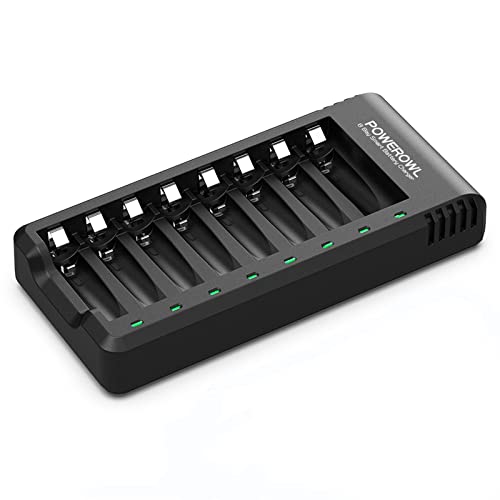
Two chargers in the box is the pitch, and it solves a real problem: one unit lives at the kitchen outlet, the other at the desk. Each eight-bay unit handles AA and AAA NiMH and NiCD cells (two related rechargeable chemistries, with NiMH being the modern standard and NiCD being the older, less common variant), with independent slots and USB power input. That’s a small detail until you realize the same charger travels with a laptop or a power bank.
Versus the single POWEROWL charger reviewed sixth in this list, the dual-pack trades portability for redundancy, which is the right call for a household that can’t tolerate a dead remote.
What Works In Its Favor
- Sixteen total bays across two units, far beyond what a single-charger household typically needs
- USB input means any modern wall adapter, laptop port, or power bank can run them
- Independent slot design lets you top up a single cell without wasting the other seven bays
- Smart chip control stops current at full charge, protecting cell longevity across hundreds of cycles
Small Caveats
- USB cable is included but the wall adapter is not, so factor in your own USB brick
- Two units on the counter takes up more space than a single charger, an issue in tight kitchens
Feature Snapshot
Perfect Match For
Multi-room households and small studios where one charger can never be in the right place.
A Better Fit Elsewhere
Solo travelers who want one compact USB charger should look at the POWEROWL single eight-bay reviewed below.
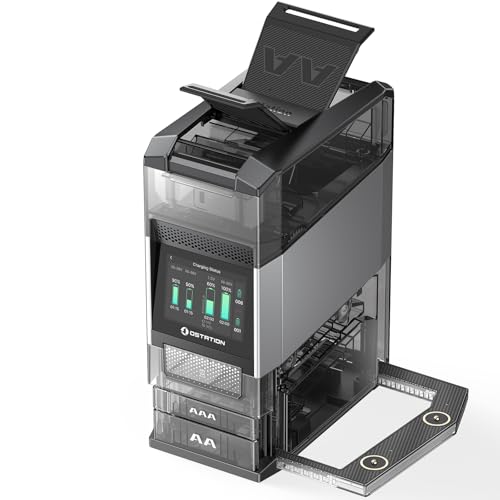
This is the closest entry on the list to a “set it and forget it” station. Twenty-four cells ship in the box, the station itself functions as a charger, tester, and organizer, and thermal-adaptive charging adjusts current based on cell temperature. Real-time monitoring means a glance at the unit tells you which slots are full without unplugging anything.
Compared to every Eneloop and POWEROWL pick above, this is a different category of gear. It’s the right answer for a household that goes through a pack of AAs every few weeks and wants the entire workflow collapsed into one countertop box.
The Value In It
- Three roles in one unit: charging, testing, and organizing, so the device replaces several accessories
- Smart sorting places charged and depleted cells in separate zones, removing guesswork during a power outage
- Dual MCC magnetic charging ports support specific Olight flashlights, a niche but real perk for that brand’s users
Practical Considerations
- Bulkier footprint than any other entry on this list, so it needs a dedicated counter spot
- Premium positioning means the upfront spend is higher than a basic charger and cells separately
Who Should Grab It
Heavy-use households, content creators, or preppers running dozens of AA or AAA gadgets on rotation.
Reach For A Different Pick When
You only run a handful of devices and don’t need a countertop station, where the POWEROWL or Eneloop kits are more proportionate.
The single-unit sibling to the two-pack reviewed earlier, this is the bare charger without bundled cells. For shoppers who already own a stockpile of AA or AAA NiMH cells and need a smarter dock, that’s the appeal. USB power input, eight independent bays, smart chip control with auto shut-off, and an LED indicator strip per slot handle the daily routine.
For most homes, this is enough. The trade-off versus the POWEROWL two-pack is redundancy: one unit fails and the whole household loses its charging hub.
A Strong Showing
- Independent bay design beats older paired-slot chargers that demand even numbers
- USB power input keeps the unit flexible for travel, the office, or a power bank setup
- Auto shut-off prevents the overcharge damage that wears down cells over time
Where It May Fall Short
- No cells included, so this only makes sense if you already own compatible NiMH rechargeables
- Wall adapter is not included, so a spare USB brick is required out of the box
Built With In Mind
Existing rechargeable owners looking to upgrade an old paired-slot charger without rebuying cells.
Where Another Pick Suits Better
First-time shoppers who need cells and charger together should start with the POWEROWL mix bundle reviewed first.
The CC55 charger is the upgrade over the K-KJ55 series reviewed earlier, and the difference shows up in the LED indicators. Instead of a generic red/green light, four separate LEDs report progress per cell: green for 80% or higher, orange for the middle range, and red when a cell is below 20%. That feedback loop is genuinely useful when you’re deciding whether to swap a cell or wait.
The included AA cells hold up to 2000mAh typical and the AAA cells around 800mAh typical, with the brand’s 2,100-cycle rating. Versus the Pro bundle reviewed last, this is the standard (non-Pro) Eneloop line, trading some capacity for cycle longevity.
Where It Excels
- Per-cell LED progress gauge beats single-color indicators for users who want visibility
- Individual charging per slot avoids the old “charge in pairs” annoyance
- Standard Eneloop line offers better cycle life than the Pro bundle for lower-drain household gear
Trade-Offs
- Capacity is lower than POWEROWL and Pro Eneloop cells, though longevity makes up ground
- Four-bay design means top-up sessions take longer than eight-bay competitors
Key Attributes
Best Suited To
Detail-oriented owners who like watching charge progress and value per-cell feedback over raw speed.
Not Your Match When
You run eight cells at once and want the dual-charger setup that the POWEROWL two-pack delivers.
The headline feature here is chemistry flexibility. Where the POWEROWL and Eneloop chargers handle NiMH and NiCD cells, this Ostation also accepts 1.5V lithium rechargeable AA and AAA cells, the type showing up in higher-end electronics and camera gear. For a household that has shifted toward lithium rechargeables, that compatibility prevents buying a second dock.
Versus the Ostation 2 Pro reviewed earlier, this is the station without bundled cells, so the price reflects the dock alone. Smart sorting, thermal-adaptive charging, and dual MCC magnetic ports for Olight flashlights all carry over.
Advantages To Know
- Handles NiMH, NiCD, and 1.5V lithium rechargeables in one dock, useful for mixed-chemistry households
- Thermal-adaptive charging adjusts to cell temperature, a real longevity benefit across hundreds of cycles
- Smart sorting separates charged and depleted cells automatically, removing the “is this one full?” mental load
Possible Compromises
- No cells included, so the dock is only useful if you already own compatible rechargeables
- Larger footprint than a basic charger, requiring a permanent counter or shelf spot
Who Will Love This
Owners running a mix of NiMH and lithium AA or AAA cells who want one dock for both chemistries.
Skip It When
You only use NiMH cells and don’t need the lithium path, where the POWEROWL bundles cover the job for less.
Polarity-free drop-in slots sound trivial until you’ve tried inserting a cell the wrong way at midnight. This station accepts AA and AAA cells in either orientation, auto-detects the chemistry, and adapts charging current to match. For smart households with kids who swap batteries into flashlights, that polarity-free design removes a small but recurring frustration.
Against the Ostation 2 Pro station reviewed just before, this is the original “Smart” tier with the same three-in-one charger-tester-organizer role. The Pro models added bundled batteries, so the trade-off here is unit-only purchase versus cell-inclusive kits.
Standout Benefits
- Polarity-free slots accept cells in either direction, a real win for low-light or grab-and-go use
- Auto detection reads chemistry per cell, so NiMH and 1.5V lithium cells mix without manual switching
- Built-in storage organizer keeps up to 24 cells sorted and accounted for in one footprint
- Fast charging adjusts to cell condition, balancing speed against long-term cell wear
What To Weigh
- No cells ship with the unit, so the dock is only useful with a pre-existing rechargeable collection
- Larger price tag than a basic charger, though justified by the organizer and tester functions
Feature Card
The Right Fit
Gadget-heavy smart households and gamers running flashlights, controllers, and remotes that cycle batteries fast.
Where A Sibling Pick Shines
You want cells included out of the box, where the Ostation 2 Pro 24-battery bundle is the more complete answer.
The Pro line trades cycle count for capacity, and that swap pays off in high-drain devices. AA cells hit 2500mAh typical (2450mAh minimum) and recharge up to 500 times, a real upgrade for camera flashes, game controllers, and handheld consoles that burn through standard cells fast. The same CC55 charger with color-coded per-cell LED indicators ships in the box.
Versus the standard Eneloop BQ-CC55 bundle reviewed just before, the Pro cells deliver more runtime per charge but fewer total cycles. For users who drain cells weekly and don’t mind replacing them sooner, that trade is worth it.
Everyday Advantages
- 2500mAh typical AA capacity handles high-drain gear longer per charge than standard Eneloop cells
- Same CC55 charger with color LED indicators carries over from the standard bundle
- Pre-charged at the factory, ready to drop into a device on day one
Things That May Matter
- Cycle count drops to 500 versus 2,100 on standard Eneloop, so heavy users replace cells more often
- Higher per-cell cost than the standard line, justified only if you actually use the extra capacity
Core Details
Who It Suits Best
Photographers, console gamers, and anyone running camera flashes or handheld devices that drain cells in hours.
Look Elsewhere When
You only need low-drain devices covered, where the standard Eneloop BQ-CC55 bundle reviewed above is the better cycle-life value.
Picking The Right Match For Your Household
Cell capacity tells only half the story. A 2800mAh AA cell sounds impressive until you realize it won’t survive 500 cycles, which matters once you’ve been recharging the same cell every week for three years. Capacity (mAh) and cycle life work as a trade-off: high-capacity cells run longer per session but wear out faster, while standard cells deliver less runtime per charge but last through thousands of sessions.
Independent charging bays are worth prioritizing. Paired-slot chargers, common in older designs, force you to charge cells in matched pairs and waste slots when only one cell needs topping up. Every entry on this list uses independent bays, but it’s a feature worth confirming on any charger you consider beyond these picks.
Chemistry compatibility matters less until it suddenly matters a lot. NiMH is the modern standard and works with every entry above. NiCD is older and less common. 1.5V lithium rechargeables are showing up in higher-end electronics, and only the Ostation stations handle them alongside NiMH. If your household is starting to mix cell types, a dual-chemistry dock saves buying a second unit later.
Indicator style changes daily usability more than people expect. Single-color LEDs answer “is it done?” but not “how close is it done?” The CC55 charger’s color-coded indicators and the Ostation’s smart sorting both add visibility that becomes habit-forming within a week.
Key Considerations Across These Picks
Where Shoppers Go Wrong
The most common slip-up is buying high-capacity cells and expecting long cycle life. The two are usually a trade-off, so shoppers chasing 2800mAh or 2500mAh headlines often end up replacing cells sooner than expected. Match the chemistry and cycle rating to your actual usage rather than the largest spec on the box.
Another trap is grabbing a charger without checking bay independence. Older paired-slot designs look identical to modern independent-bay chargers from the outside, and the difference only shows up when you try to charge a single cell. Worth confirming before any purchase.
What The Higher Tier Buys
The premium tier in this category delivers three things that budget chargers don’t: longer cycle life (2,100 cycles versus 500 on some high-capacity packs), better indicator feedback (per-cell color LEDs versus generic on/off lights), and smarter safety features (thermal-adaptive charging, polarity-free slots, and chemistry auto-detection).
The upgrade is worth it for anyone running more than a handful of devices on rotation. For a household with two remotes and a clock, a budget kit gets the job done. For a dozen gadgets cycling through weekly, the premium tier pays for itself within a couple of years through fewer cell replacements.
Frequently Asked Questions
How long do rechargeable AA batteries typically last before needing replacement? Standard NiMH cells in this list are rated for up to 2,100 recharge cycles, which translates to roughly five to seven years of weekly use. High-capacity cells trade cycle count for runtime, often landing closer to 500 cycles.
Can I mix different battery brands in the same charger? Most modern chargers handle any NiMH or NiCD AA or AAA regardless of brand, so mixing brands within a charger is fine. Mixing chemistries, such as NiMH and lithium, is a different question, and only certain chargers like the Ostation stations are designed for that.
Do rechargeable batteries lose charge when sitting unused? Standard NiMH cells lose roughly one to two percent of charge per day when stored, so a cell left on the shelf for a month is noticeably depleted. Low self-discharge cells like the Eneloop line are designed to retain most of their charge for months or even years in storage.
Is it safe to leave batteries in the charger after they’re full? Modern chargers with auto shut-off, which every entry on this list uses, stop current once cells reach full charge, making overnight top-ups safe. Older chargers without this feature can overcharge cells and shorten their lifespan.
What’s the difference between NiMH and NiCD batteries? NiMH (nickel-metal hydride) is the modern standard with higher capacity and no memory effect. NiCD (nickel-cadmium) is older, lower capacity, and suffers from memory effect, where partial discharge cycles reduce usable capacity over time.
Closing Remarks
The right pick depends less on specs and more on how many devices you actually run, how often you swap cells, and whether you value raw capacity or cycle longevity. For most households, a balanced NiMH kit with independent bays covers the daily reality without overpaying. Heavy-use households running flashlights, cameras, or game controllers will feel the upgrade from the premium tier within a month. Whichever direction you go, the jump from disposables to rechargeables pays back the initial spend quickly and keeps batteries out of the landfill, one recharge at a time.