A 6V rechargeable battery quietly runs the gear you forget about until it dies: emergency exit lights, kids’ ride-on toys, deer feeders, lanterns, backup alarms, and a handful of specialty electronics. Choosing the right one matters because capacity, terminal type, and chemistry change how the battery behaves under load and over time. This roundup breaks down eight solid options so you can match the spec to the situation without sorting through dozens of listings.
The Choices Worth Comparing

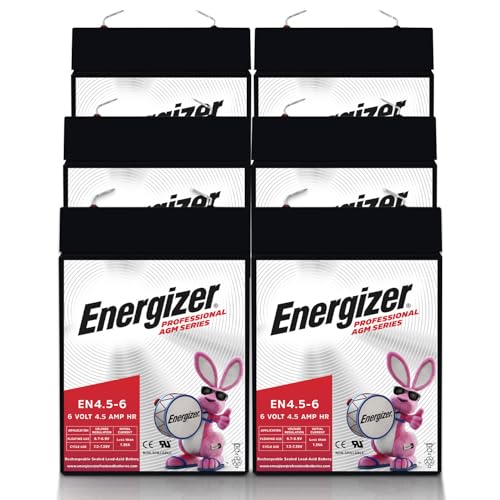
Energizer EN4.5-6 6-Pack 6V AGM Battery

ELB-0604 4-Pack 6V SLA Exit Light Battery

Mighty Max 6V 4.5Ah SLA Battery for Coleman 5348

Mighty Max 6V 4.5Ah SLA Battery for Deer Feeder (4-Pack)

Mighty Max ML4-6 6V 4.5Ah Replacement Battery (3-Pack)
Mighty Max ML4-6 6V 4.5Ah SLA AGM Battery

HQRP Ni-Cd 6V 2500mAh Replacement Battery (1/2D)
Inside Each Recommended Option
The Amstron UB645 is a classic 6V 4.5Ah sealed lead-acid (SLA) unit in the smallest footprint of this lineup. At roughly 2.78 x 1.88 x 4.18 inches and about 1.59 lbs, it slides into tight battery compartments where longer cells just won’t fit. That makes it a sensible pick for emergency exit signs, alarm panels, and small UPS-style backups tucked behind furniture.
The AGM construction (absorbent glass mat, a design where the electrolyte is held in fiberglass separators rather than free-flowing liquid) means the case stays sealed and spill-proof, so you can mount it in awkward orientations without worrying about leaks. For most home and office backup scenarios, that kind of mounting flexibility is the feature you’ll appreciate most, well before you ever think about the spec sheet.
Practical Pluses
- Compact 6V 4.5Ah SLA form factor fits crowded battery bays where longer cells won’t go.
- AGM sealed design resists spills and supports mounting in any position, handy for alarm panels mounted sideways or overhead.
- Vibration resistance helps the unit survive in equipment that sees daily handling or transport.
- Direct replacement compatibility with the common UB645 footprint makes swaps quick for routine maintenance.
Points To Keep In Mind
- Single-pack format means higher per-unit cost than the multi-packs lower in this list if you service multiple fixtures.
- No wire harness or mounting accessories ship with the battery, so you may need to reuse hardware from the old cell.
Whose Shelf It Belongs On
Facilities teams and homeowners replacing a single emergency light or alarm backup who need a no-fuss direct swap.
Swap It Out When
The Energizer EN4.5-6 6-Pack makes more sense when you’re refreshing several devices at once and want a lower per-cell cost.
Where the UB645 ships solo, Energizer leans into the multi-pack idea with a six-count box of 6V 4.5Ah AGM cells. The energy density matters less than the convenience: six batteries at once covers a household full of exit signs, kids’ ride-on toys, and emergency lanterns without back-to-back orders.
Internal construction uses calcium tin alloy grids for higher power density, and the valve-regulated, spill-proof housing handles gas recombination internally. That’s a quiet safety upgrade in any indoor setup, especially in closets and crawlspaces where gas venting matters.
A Few Strong Suits
- Six batteries in one box lowers per-cell cost and covers an entire property’s worth of fixtures in a single order.
- Low self-discharge rate keeps stored cells ready for months without babysitting a maintenance charger.
- Spill-proof valve-regulated design with overpressure venting protects indoor installations from gas and acid concerns.
- Calcium tin alloy grids support both float (continuous trickle charge) and cyclic (repeated charge-discharge) use across mixed equipment.
Where It Is Less Suited
- Six cells is overkill if you only need one replacement, so the bulk format doesn’t suit every shopper.
- AGM chemistry still prefers a proper smart charger; using a mismatched charger can shorten cycle life over time.
Key Product Details
Right Fit For
Homeowners and small business owners stocking replacements for multiple devices in one go.
Look Elsewhere When
The UB645 6V/4.5Ah is a smarter pick if you only need a single cell and want to skip the surplus.
The Battery Hawk ELB-0604 4-pack is purpose-built for exit signs and emergency lighting, and it shows in the small details. F1 terminals (the narrow 0.187-inch spade connectors common on small SLA batteries) line up with the wiring on most exit sign fixtures, so swapping is a slide-and-click job rather than a wiring project.
At about 2.75 x 1.86 x 3.09 inches and 25 oz, the case is shorter than the UB645, which matters when fixtures have a tight internal cavity. In buildings with lots of ceiling-mounted exit signs, that extra clearance saves real headaches during installation.
Where It Helps
- Four-pack format is sized for refreshing an entire hallway or small office’s exit signs in one trip up the ladder.
- F1 spade terminals match the connectors on most common emergency light fixtures for tool-light swaps.
- Shorter case profile compared to the UB645 fits fixtures with restricted internal space.
- Direct replacement compatibility with the UB645 footprint simplifies cross-referencing when ordering.
Softer Spots
- Smaller case leaves less room for thermal dissipation, so installations in hot ceilings may shorten service life.
- Capacity rating of 4.0Ah in some references is slightly lower than other 4.5Ah cells, which can affect runtime on heavy-load fixtures.
Who It Suits Best
Maintenance crews handling quarterly exit sign refreshes across small commercial spaces.
Not Your Match When
The Mighty Max ML4-6 single battery is a better call if you only need one cell and don’t want to manage leftovers.
Mighty Max targets the Coleman 5348 lantern specifically, which is the kind of niche fit that saves a camping trip. At 2.76 x 1.89 x 4.21 inches with F1 terminals, the cell drops straight into the lantern’s battery compartment without adapters or shims. For campers, that translates to a faster pack-up the night before a trip.
UL certification on the ML4-6 platform adds a layer of confidence for anyone using the same lantern in a cabin, tent, or emergency kit. Wide operating temperature tolerance also matters for stashed gear in a hot garage or a freezing trunk.
What Helps Most
- Form factor matches the Coleman 5348 lantern directly, so there’s no terminal fussing during installation.
- UL certification signals the cell has been evaluated against established safety standards for stationary and portable use.
- Wide operating temperature range handles stashed gear in attics, garages, and unheated sheds.
- SLA/AGM construction with high discharge rate suits lantern loads that draw bursts of current.
A Few Limitations
- Single-pack format means you’ll pay more per cell than the multi-pack options lower on this list.
- No wire harness or mounting hardware ships with the battery, so plan to reuse parts from the original cell.
Quick Facts
Built With In Mind
Campers, cabin owners, and emergency kit builders who specifically run a Coleman 5348 lantern.
Consider Something Else When
The Mighty Max 4-pack for deer feeders fits better if you need multiple batteries for scattered gear rather than one lantern.
The same ML4-6 platform, repackaged for hunters running multiple Mojo Duck and game feeder setups. Four cells at once means you can rotate through the season without scrambling for replacements before a hunt weekend. For landowners running two or three feeders, that kind of redundancy removes a real source of stress.
Like the Coleman-targeted single pack, these cells are UL Certified and built for wide temperature swings. That matters at remote lease sites where feeders bake in summer sun and freeze in winter cold.
Where It Delivers
- Four-pack lowers per-cell cost compared to buying single batteries across multiple trips to the feed store.
- Wide operating temperature range handles summer heat and winter cold at exposed feeder sites.
- Shock and vibration resistance suits feeder motors that rattle on every spin cycle.
- SLA/AGM spill-proof design lets you mount cells in any orientation inside a feeder housing.
Trade-Offs
- No wire harness or mounting accessories ship with the pack, so each feeder needs its own pigtail adapter.
- Four cells sitting on a shelf will slowly self-discharge, so unused spares should be topped up seasonally.
Who Should Grab It
Hunters and lease managers running multiple game feeders across rural properties where access is limited.
A Better Fit Elsewhere
The HQRP Ni-Cd 6V 2500mAh is the better match for specialty emergency lighting rigs that need nickel-cadmium chemistry.
Three cells is an unusual pack size, and that ends up being the point. The ML4-6 3-pack slots between the single lantern battery and the bigger four- and six-packs, hitting the sweet spot for households running two or three exit signs or a mix of gear that doesn’t quite need a full six-pack.
F1 terminals and the standard ML4-6 dimensions carry over from the rest of the Mighty Max line, so each cell is a drop-in replacement for any fixture expecting this footprint.
Useful Touches
- Three-pack offers a middle-ground quantity that suits small homes without forcing a surplus of cells.
- Standard ML4-6 dimensions make each cell interchangeable with other fixtures in the same product family.
- F1 spade terminals match the wiring on most common 6V 4.5Ah applications.
- AGM construction supports both float and cyclic use across mixed home equipment.
Less-Strong Areas
- Limited source data makes it harder to verify detailed specs beyond the core voltage and capacity.
- No included accessories mean you’ll need to reuse existing wire harnesses for each installation.
Best Suited To
Homeowners refreshing a handful of emergency lights or alarm backups without buying more than they need.
Another Choice May Suit
The Mighty Max ML4-6 single battery is the better pick if you only need one replacement and want to avoid storing extras.
The single ML4-6 is the unit that anchors the rest of the Mighty Max lineup. A calcium-alloy grid gives the cell decent cycle life for both float and cyclic use, which matters in alarm panels that sit on trickle charge for months and lanterns that discharge hard and recharge often.
Valve-regulated AGM construction means you can install it in enclosed cabinets and indoor fixtures without worrying about leaks or off-gassing under normal conditions. For most general replacement duty, it’s the dependable baseline.
Useful Strengths
- Calcium-alloy grid supports both float standby and cyclic discharge patterns across mixed equipment.
- Valve-regulated AGM design is safe for enclosed indoor environments without active ventilation.
- Single-cell format suits one-off replacements without surplus sitting on a shelf for years.
- UL certification backs the safety claims for stationary and portable installations.
Things To Weigh Up
- Per-cell cost is higher than multi-pack options if you service several devices.
- Documentation is light on advanced specs, so buyers should cross-check dimensions against their fixture before ordering.
Feature Snapshot
Made For
Anyone needing a single general-purpose replacement for an alarm panel, small UPS, or emergency fixture.
Reach For A Different Pick When
The Battery Hawk ELB-0604 4-Pack is a smarter choice when you’re rotating through several exit signs at once.
The HQRP is the odd one out, and that’s also why it earns its place. Built around five Ni-Cd (nickel-cadmium) 1/2D cells, this stick-style battery is shaped for specialty emergency lighting units from Moltech, Intec, and similar industrial brands. SLA replacements won’t physically fit these housings, so the chemistry really does matter here.
Ni-Cd tolerates deep discharge cycles and long storage better than most AGM cells, which is why it shows up in legacy commercial fixtures that have been in service for decades. Rated for 500+ recharge cycles, it suits installations where the battery gets exercised regularly.
What Earns Its Place
- Ni-Cd chemistry tolerates deep discharge cycles better than many AGM alternatives in legacy fixtures.
- 500+ recharge cycle rating supports frequent exercise in emergency lighting duty cycles.
- Stick form factor matches specialty emergency units that won’t accept rectangular SLA cells.
- Compatible with multiple industrial part numbers across Moltech, Intec, and similar brands.
Honest Caveats
- Lower 2.5Ah capacity means heavier loads will see shorter runtime than a 4.5Ah SLA alternative.
- Ni-Cd cells require specific chargers designed for nickel-based chemistry to avoid damage.
- Not a drop-in replacement for standard 6V SLA fixtures, so verify dimensions and terminal layout before ordering.
Core Details
Perfect Match For
Maintenance techs servicing legacy commercial emergency lighting that requires Ni-Cd sticks rather than rectangular SLA cells.
Where Another Pick Suits Better
The Mighty Max ML4-6 single battery is the right call for anyone running standard rectangular 6V SLA fixtures.
What To Weigh Before Choosing A 6V Rechargeable Battery
Most 6V rechargeables in this category share the same headline numbers (4.5Ah, F1 terminals, AGM construction) but the right pick depends on the job. Capacity drives runtime, so a flashlight pulling a steady 0.5A from a 4.5Ah cell gets roughly 9 hours of use before the voltage drops below useful levels. Emergency exit signs drawing lower standby current last far longer, often years of float operation before replacement.
Terminal style matters more than shoppers expect. F1 spade terminals are nearly universal in this segment, but F2 (wider 0.25-inch blades) show up occasionally and won’t seat in F1 wiring. Always match the terminal before assuming compatibility, even when dimensions look identical on paper.
Chemistry sets the long-term behavior. SLA/AGM is the everyday standard, affordable and widely supported. Ni-Cd costs more per cell but tolerates deep discharge and irregular charging, which is why it survives in older commercial fixtures. Lithium variants exist but rarely show up at this voltage in common household gear.
Mounting position is the unsung feature. AGM cells can be installed sideways or upside down because the electrolyte is held in fiberglass mats, while flooded cells (rare in this category) must stay upright. For ceiling-mounted exit signs or compact alarm panels, that flexibility alone can justify the AGM choice.
Smart Considerations Across These Picks
Common Buying Traps
One frequent mistake is assuming all 6V 4.5Ah batteries are interchangeable. Small differences in case length or terminal position can keep a battery from seating properly, especially in fixtures with tight covers. Measure the old battery before ordering and cross-check dimensions in the spec listing.
Another trap is mixing chargers across chemistries. A charger set for SLA cells can overheat Ni-Cd packs, and the reverse is just as risky. Match the charger to the chemistry on the label, not to the voltage alone.
When The Higher Tier Helps
Higher-tier 6V batteries typically add cycle durability, lower self-discharge rates, and tighter quality control on internal grids. For installations where the battery sits unattended for years, like a security alarm or a remote feeder, that extra margin translates to fewer service calls and less guesswork about when to swap cells. For casual lanterns that get exercised monthly, the value math looks different, and a budget-friendly multi-pack is usually the better spend.