You cycle a flashlight through your work shift, run a vape mod on weekends, and keep a stash of high-drain cells for photography gear. The charger that came bundled with your first 18650s is slow, vague about state of charge, and probably won’t recognize the larger 21700s you bought later. A solid 18650 rechargeable battery charger fixes all of that in one box, and the difference between a frustrating routine and a reliable one comes down to slot count, chemistry support, and how clearly the device reports what it’s doing.
This list rounds up ten chargers that handle the realities of mixed battery households. Some excel at single-cell speed for travel, others chew through four packs overnight for hobbyists, and a few stretch to handle NiMH AAs alongside lithium ions. Every pick was reviewed on its spec sheet and stated capabilities, so the recommendations reflect what the product is actually built to do.
The Picks In Brief
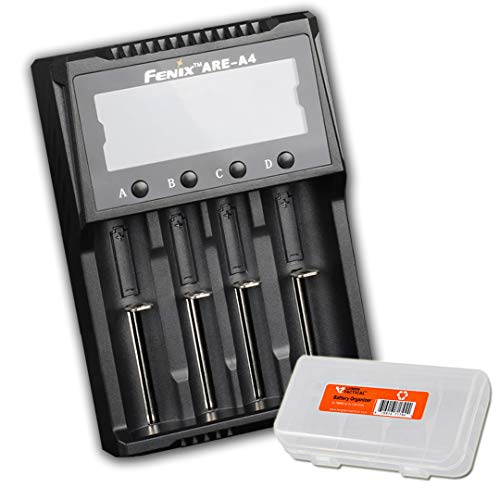
FENIX ARE-A4 Multifunctional Smart Battery Charger with LumenTac Organizer

IMREN Single-Slot 18650 Battery Charger USB-C 2A Fast

MC-ELIN Smart Universal 2-Slot 18650 Battery Charger

IMREN 2 Bay 26650 Battery Charger USB-C Wide Slot

Nitecore UMS4 Four Slot Quick Battery Charger with QC3.0

IMREN 4 Bay 18650 USB-C Charger Wide Chemistry Support

MiBOXER Smart Universal 4-Bay Battery Charger with LCD

HiLetgo TP4056 18650 Charging Board 10-Pack with Protection

Nitecore UI1 Single-Slot USB Battery Charger with Organizer

Swanlake LCD Display 2 Bay 18650 Charger Adjustable Current
The Strengths Of Each Pick
The FENIX ARE-A4 is the charger you buy when your household has wandered past a single battery format and into something messier. Four independent bays (independent meaning each slot charges and reports on its own) handle 18650s alongside 21700s, 16340s, and a long list of NiMH and NiCd sizes. The LCD readout is crisp enough to glance at from across a desk, and the included LumenTac organizer keeps loose cells from rolling around in a drawer.
You notice the smarts when you slot in a partially drained battery; the ARE-A4 reads the cell type and adjusts current to match, which protects cell health over months of rotation. Compared to the single-slot picks later in this list, this is the obvious upgrade when more than one or two devices share your charging station. For most people juggling flashlights, headlamps, and remotes on the same night, this is the sweet spot.
The Value In It
- Four independent bays let you charge mismatched cells without pairing, useful when one flashlight and one radio finish at different times.
- Supports a genuinely wide chemistry list, including Li-ion, NiMH, and NiCd, so the same box handles AAs and 21700s.
- High-definition LCD shows charging status, voltage, and current at a glance rather than guessing from a single LED.
- Auto current adjustment means you can leave a partially used cell in without babysitting the charge cycle.
Honest Caveats
- Charges four cells at lower per-bay current than dedicated single-slot units, so a full set takes longer than the IMREN single-slot below.
- Bulkier than travel-oriented chargers; not the pick if the bag space is already spoken for.
- No USB-C input, relying on the included AC cable rather than the cables you already own.
Key Specs
Whose Shelf It Belongs On
Best for the household charging station where multiple chemistries and formats converge, from flashlights to game controllers.
Reach For A Different Pick When
Pick the Nitecore UI1 below if you travel often and want a pocket-sized single slot that runs off any USB port.
The IMREN single-slot trades bay count for raw charging speed in a footprint that fits in a coat pocket. It accepts a long list of cylindrical Li-ion sizes plus 1.2V NiMH and NiCd cells, and the front button lets you cycle between 0.5A, 1A, and 2A modes depending on how much time you have. The LCD power indicator gives you enough information to know whether the cell is finished or still climbing.
This is the charger that makes sense when one or two batteries define your day. Set it to 2A for a quick morning top-up, drop to 0.5A overnight for a gentler cycle that long-time owners prefer for older cells. Where the FENIX ARE-A4 above covers the whole charging station, this IMREN unit travels with you to the campsite or the job site.
Everyday Perks
- Three current modes (0.5A, 1A, 2A) let you prioritize speed or battery longevity on a per-session basis.
- USB-C input means it works with laptop chargers, power banks, and car adapters without a proprietary cable.
- Long slot geometry accepts 26650 cells alongside shorter 18350s without adapter sleeves.
Trade-Offs
- One cell at a time means longer total runtime when charging a full rotation of batteries.
- No display for cell voltage or internal resistance, only basic charging status.
Best Suited To
Frequent travelers and minimal kit owners who need one fast, reliable slot on the road.
Skip It When
Step up to the IMREN 4 Bay below if most of your charging happens at home with multiple cells waiting.
The MC-ELIN lands in the awkward middle ground between single-slot travel units and full four-bay stations, and it makes that middle ground work. Two bays cover most personal rotation needs, while the supported size list is genuinely long: 10440 through 26650 Li-ion, plus NiMH and NiCd in AA and AAA. The onboard circuit handles short-circuit, overheating, and overvoltage protection, and it stops automatically when cells reach full.
For most people starting out with a few 18650s and a stack of AA rechargeables, this covers the realistic daily routine without overspending. Where the Swanlake pick at the bottom of this list offers adjustable current, the MC-ELIN keeps things simpler and focuses on broad compatibility instead.
Where It Helps
- Chemistry list covers Li-ion IMR/INR/ICR cells alongside NiMH AA and AAA in one unit.
- Built-in protection circuit stops charging automatically when cells reach full, reducing the risk of overcharging overnight.
- USB-C input simplifies cable management if the rest of your bench already runs on USB-C.
Soft Spots
- Fixed charging current rather than adjustable, so slower top-ups require waiting rather than switching modes.
- Two-bay limit becomes tight when a flashlight, headlamp, and remote all empty in the same week.
Feature Card
Right Fit For
Casual users running a mixed stash of Li-ion flashlight cells and NiMH household rechargeables.
Swap It Out When
The Nitecore UMS4 below suits hobbyists who want faster per-slot charging and a detailed status display.
Some 26650 cells barely fit in standard chargers because the slots were designed for thinner 18650s. The IMREN 2 Bay solves that by widening the central channel to 25mm, so two oversized 26650s sit side by side without forcing or adapter sleeves. It still accepts the common sizes you’d expect, from 10440 to 26650, and runs off the same USB-C cables you already own.
Where the IMREN single-slot earlier focuses on speed, this model leans into capacity. You can run it at 1A for standard cells or bump to 2A when time is short. It suits anyone whose rotation includes high-capacity 26650s for powerful flashlights or mod batteries.
Strengths Worth Knowing
- 25mm wide slot geometry accepts two 26650 cells simultaneously, a fit most two-bay chargers can’t match.
- Switchable 1A and 2A current modes give flexibility without crowding the front panel.
- USB-C input keeps cable compatibility simple across phone chargers and laptops.
A Few Limitations
- Two bays means slower throughput than four-bay competitors when you need to charge an entire rotation.
- No advanced readouts like internal resistance or health metrics on the display.
Who Should Grab It
Owners of high-capacity 26650 flashlights or vaping mods who need slots wide enough for the larger cells.
Look Elsewhere When
The MiBOXER pick below covers similar chemistry with a richer LCD read-out if data matters more than slot width.
The Nitecore UMS4 is the charger hobbyists reach for when charging speed becomes a bottleneck. With a QC 3.0 adapter, a single slot can hit 3000mA, and the four slots share up to 2000mA total under a standard 2A source. The LCD reports battery health, charging status, and current mode in real time, so you can see exactly what each bay is doing without unplugging anything.
Compared to the FENIX ARE-A4 at the top of this list, the UMS4 prioritizes speed and data over battery organizer accessories. Pair it with a high-output USB source and the difference shows up in the morning: cells that took all night in other chargers finish before bedtime here.
Everyday Wins
- Up to 3000mA per slot with a Quick Charge adapter cuts total charging time substantially on compatible cells.
- LCD reports health, voltage, current, and mode per bay, which helps diagnose aging cells in a rotation.
- Wide chemistry list covers Li-ion, NiMH, NiCd, and IMR cells across AA through 21700 sizes.
Worth Bearing In Mind
- Maximum per-slot output requires a QC-compatible power source; standard 2A adapters limit throughput.
- More expensive than basic two-bay models, so the speed premium only pays off under heavy rotation.
Who Will Love This
Active hobbyists running a daily rotation of high-drain flashlight or photography cells who want data and speed.
Consider Something Else When
The IMREN 4 Bay below is friendlier on cost if four slots matter more than the QC speed ceiling.
The IMREN 4 Bay covers the common ground between the FENIX ARE-A4 and the Nitecore UMS4 above, with four slots, USB-C input, and a chemistry list that stretches from tiny 10440s up to 26650s. Single-bay charging means you can leave one slot empty without forcing pairs, which extends cell life when batteries run out at different rates. Smart input detection reads the connected source and dials in appropriate current automatically.
You trade off the per-slot speed ceiling of the UMS4 for a friendlier price, and in return you get enough bays to clear a rotation overnight. For most households, that’s a fair swap.
Strong Points
- Single-cell charging across all four bays avoids forced pairing when batteries finish at different times.
- Smart input detection adjusts current based on the connected USB source.
- Chemistry support stretches from 10440 Li-ion through AAAA NiMH in one unit.
Honest Caveats
- Per-bay charging speed is lower than the Nitecore UMS4, so heavy rotations take longer.
- Display provides basic status rather than full health diagnostics.
Feature Snapshot
Built With In Mind
Households that want four-bay throughput without paying for the top-tier speed ceiling.
Where Another Pick Suits Better
The Nitecore UMS4 fits users who measure success in minutes per charge and want richer per-bay data.
The MiBOXER C4 leans into detailed feedback. The LCD reports charging current, voltage, capacity, and elapsed time per bay, and the fire-retardant PC housing keeps things cool even when all four slots push current simultaneously. The chemistry list stretches from LiFePO4 through NiMH, so if you have a few LiFePO4 cells for solar storage or backup devices, this unit covers them alongside your 18650s.
The error symbol feature is small but useful: a reversed or shorted cell shows up immediately rather than charging silently. Compared to the FENIX ARE-A4 at the top of this list, you give up the bundled organizer but gain per-bay capacity readouts.
Positive Points
- Per-bay capacity and elapsed time readouts help track battery health over months of use.
- LiFePO4 support broadens the chemistry list beyond the standard Li-ion and NiMH coverage.
- Error detection for reversed or shorted cells reduces risk when juggling partially taped cells.
Small Caveats
- Display density takes a moment to learn; first-time users may need the manual to decode all fields.
- Charging speed per bay is moderate, not the fastest option in this list.
Who It Suits Best
Data-focused hobbyists and off-grid users with mixed LiFePO4 and 18650 banks who want per-cell readouts.
Not Your Match When
Step down to the MC-ELIN 2-Slot if two bays and a simpler display match your actual rotation.
The HiLetgo 10-pack isn’t a charger in the consumer sense, and that’s the point. Each TP4056 board charges a single 18650 from a 5V Micro USB source at up to 1A, with built-in protection that cuts off at 4.2V. Solder pads let you integrate them into custom battery packs, portable power stations, or wall-mounted charging arrays where off-the-shelf chargers won’t fit.
For the hobbyist building a USB-charged power bank or a fleet of cordless tool batteries, ten of these at once means building several packs in parallel. Compared to every other pick on this list, this skips the LCD and the plastic housing entirely and hands you raw modules instead.
Real-World Strengths
- 10-pack pricing lowers the per-board cost for multi-pack projects and DIY fleet builds.
- Built-in protection circuit stops at the standard 4.2V lithium charge ceiling, which is the safe full-charge voltage for most Li-ion cells.
- Micro USB input lets you run each board from any standard 5V phone charger.
Practical Considerations
- Requires soldering and basic electronics skill; not a plug-and-play consumer charger.
- One cell per board means a full rotation needs multiple USB sources to charge in parallel.
- No display or status indicator beyond the onboard LED, so monitoring requires visual checks.
Right Fit For
Makers, tinkerers, and DIY builders assembling custom battery packs or fixed charging stations.
Where Another Pick Suits Better
The Nitecore UI1 below works out of the box if you just want a finished charger without any soldering.
The Nitecore UI1 is the smallest serious charger in this roundup. One slot, 800mA maximum charging current, and a USB input that accepts anything from a laptop port to a solar panel to a power bank. The included organizer keeps a couple of spare cells from rattling around loose in your bag. Charging safeguards cover reverse polarity, overcharging, and short circuits.
Where the IMREN single-slot earlier pushes 2A on the same kind of USB-C input, the UI1 trades raw speed for a smaller body and the Nitecore safeguard reputation. For a daily-carry charger that lives in a backpack or laptop sleeve, that balance makes sense.
Standout Benefits
- Compact body slips into laptop sleeves and small organizer pouches without dominating the space.
- USB input works with solar panels and power banks, useful for off-grid and travel scenarios.
- Multi-layer safeguards cover reverse polarity, overcharging, and short circuits in one circuit.
Where It May Fall Short
- 800mA maximum current is slower than the IMREN single-slot earlier on this list.
- Single slot limits how many cells you can rotate in a single session.
Quick Technical Notes
The Right Fit
Daily commuters and travelers who want a finished single-slot charger that disappears into a small bag.
A Better Fit Elsewhere
The IMREN Single-Slot earlier suits users who want faster 2A charging on the same travel-friendly form factor.
The Swanlake 2 Bay closes the list with adjustable current control at a price that doesn’t punish first-time buyers. You can step between 0.5A, 1A, and 2A modes for lithium cells, with NiMH and NiCd topping out at 0.5A. The LCD shows charging status for both bays, and the supported size list covers 10440 through 26650 plus AA and AAA NiMH.
For users just starting out who want the option to charge slowly overnight or quickly before a trip, this delivers without the cost of the QC-enabled four-bay units above. Two bays and adjustable current cover the realistic routines of most households running one or two devices.
Advantages To Know
- Adjustable 0.5A, 1A, and 2A modes for lithium cells give flexibility without buying a second charger.
- Size support stretches from 10440 Li-ion through 26650, plus 1.2V NiMH in A and AA sizes.
- LCD status display keeps both bays readable at a glance.
Some Limits To Know
- Two-bay limit means heavier rotations need overnight planning rather than full clear-outs in one session.
- Display is basic; no capacity, internal resistance, or health readouts.
Made For
First-time owners and casual users who want adjustable current at a price that doesn’t overcommit.
Where A Sibling Pick Shines
The IMREN 2 Bay earlier handles 26650 cells more confidently if oversized batteries dominate your rotation.
Picking The Right Charger For Your Rotation
Chemistry support sets the foundation of any 18650 charger decision. Lithium-ion (Li-ion) is the standard chemistry for 18650 cells, but NiMH and NiCd matter if you also run rechargeable AA and AAA batteries. Chargers that handle both chemistries in one unit eliminate the need for a second charger on the bench, and most of the picks above cover both.
Slot count shapes how you actually live with the charger. Single-slot units travel well and finish a depleted cell fast, but they bottleneck when three or four devices run out at once. Two-bay chargers cover small households. Four-bay units clear a rotation overnight but take up more desk space, and they share total current across all slots when charging simultaneously, which slows individual cells compared to single-slot units at the same input rating.
Display quality matters more than most shoppers expect. A basic LED tells you charged or not charged. An LCD shows voltage, current, and capacity, which helps identify aging cells that hold less charge than they used to. For most users, an LCD readout pays for itself by flagging a dying cell before it leaves you stranded.
Input type affects daily convenience. USB-C input works with the cables you already own for phones and laptops, which simplifies travel kits. AC adapters draw power directly from a wall outlet but require the dedicated cable to come along. Pick the input that matches the rest of your gear to keep the cable drawer manageable.
Key Considerations Across These Picks
Mistakes Worth Dodging
Skipping the chemistry check is the most common slip. A charger rated for Li-ion will not safely charge NiMH, and the reverse is also true. Confirm the supported list before plugging in a cell.
Forgetting about slot width costs you a charger the day a 26650 arrives. Standard slots sized for 18650s physically won’t accept the wider cell, no matter how the charger is rated. Match slot dimensions to your largest battery.
Buying on speed alone leads to underwhelming results. A 2A slot draws 2A only when the input source can supply it; a weak wall adapter caps the actual charging current regardless of what the label claims. Pair high-current chargers with appropriately rated power sources.
When Paying More Pays Off
Premium tiers buy meaningful improvements: faster per-slot charging with QC adapters, per-bay diagnostics that track battery health over time, and housings that dissipate heat during four-slot simultaneous charging. For users running a daily rotation of three or more batteries, those improvements show up in saved time and longer cell lifespan.
Budget tiers work fine for occasional charging, smaller rotations, and beginner kits. The trade-off shows up when you ask the charger to do more at once: more cells, faster turnaround, or detailed monitoring. Spend up when your routine demands it, save when it doesn’t.
Frequently Asked Questions
How do I know if a charger supports my specific battery?
Check the manufacturer’s supported size list, typically printed on the charger body or in the listing details. Match your battery’s exact code (18650, 21700, 26650) rather than guessing from a size description.
Can one charger handle both Li-ion and NiMH batteries?
Yes, most of the picks in this list support both chemistries in one unit. NiMH cells charge at different voltages than Li-ion, so a charger with dual-chemistry support selects the right mode automatically.
What does adjustable charging current actually do?
It lets you pick a slower, gentler charge for older cells or overnight sessions, or a faster 2A mode when you need a quick top-up. Slower charging tends to extend overall battery lifespan.
Is USB-C input important on a charger?
It depends on the rest of your gear. USB-C input means fewer cables to pack when traveling and compatibility with modern laptops and power banks. AC input works fine for a dedicated charging station at home.
Are charging boards like the HiLetgo safe for beginners?
They require soldering and basic electronics knowledge, so they suit makers and hobbyists rather than casual users. Finished chargers are safer for anyone who just wants to plug in and charge.
Final Verdict
The right 18650 rechargeable battery charger comes down to matching slot count, chemistry support, and display depth to your actual routine. Heavy rotation households benefit from four-bay units like the FENIX ARE-A4 or Nitecore UMS4, while travelers and minimal-kit users get more from the IMREN single-slot or Nitecore UI1. Whatever your day looks like, a charger that reports what it’s doing and protects your cells from overcharging will outlast the batteries it carries.