A loose lug on a battery cable is the kind of problem that ruins weekends. Whether you’re wiring a trailer, replacing a corroded terminal on a marine battery, or upgrading audio in a project car, a solid ring terminal decides whether the system starts every time or strands you at the worst moment. This roundup covers ten battery cable and lug kits built for real electrical work, from compact repair jobs to heavy 1/0 and 4/0 gauge runs. Each pick reflects the materials, gauge range, stud sizing, and finishing details that separate a quick fix from a connection you’ll trust for years.
The Picks In Brief

SELTERM 25pcs 4 AWG 5/16″ Stud Heavy Duty Battery Cable Lugs

SELTERM 25pcs 6 AWG Tinned Copper Lugs with Heat Shrink Kit

RED WOLF 1/0 Gauge Copper Wire Ring Terminals with Heat Shrink
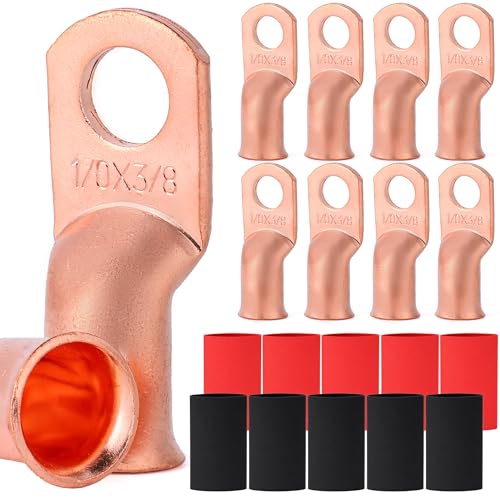
TKDMR 10 PCS 1/0 AWG Battery Cable Lugs Copper Ring Terminals

SELTERM 25pcs 2 AWG 3/8″ Stud Heavy Duty Battery Cable Lugs

Sanuke 10pcs 4 Gauge-3/8 (M10) Ring Terminals Lugs

SVAAR 20pcs Battery Cable Ends Kit 1/0 2/0 AWG Copper Lugs

SVAAR 4 6 8 AWG Battery Lug Heavy Duty Cable Ends Kit

Bare Copper Lugs 2 4 6 Gauge Battery Lugs 72pcs Kit
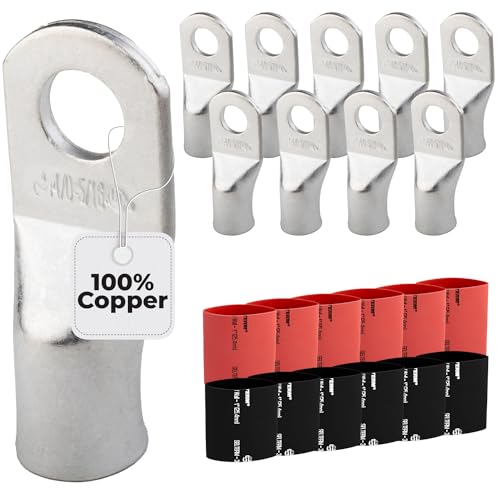
SELTERM 10pcs 4/0 AWG Marine Grade Tinned Copper Battery Lugs
The Details Behind The Selections
A 25-pack of bare copper lugs reads like the kind of kit that lives at the back of a workbench for years. SELTERM’s 4 AWG ring terminals (gauge refers to the American Wire Gauge wire thickness standard) fit a 5/16″ stud, the common size found on many automotive batteries and starter terminals, so you spend less time hunting the right adapter. Annealing (a heat treatment that softens copper) keeps the metal workable under a crimper, which matters when you’re feeding thick 4 gauge cable into a tight palm tool.
Each lug is built from annealed copper, which balances electrical flow with the flexibility needed for a clean crimp. For most home garage repairs and small trailer rewires, the 25-piece count feels generous rather than wasteful. The bare copper finish takes solder cleanly, which is handy if you prefer a soldered joint over a mechanical crimp.
Useful Highlights
- 25-piece bulk pack covers most small-shop repair runs.
- 5/16″ stud hole matches common automotive and marine posts.
- Annealed copper accepts both crimping and soldering workflows.
- Heavy-duty build rated for high-temperature under-hood conditions.
Points To Note
- Bare copper will patina over time if used outdoors without shrink tubing or sealant.
- 4 AWG limits you to mid-current applications, not big inverter or amplifier feeds.
Feature Snapshot
Built With In Mind
Shed bench tinkerers replacing a single terminal or running a small trailer harness.
Reach For A Different Pick When
The SVAAR 4 6 8 AWG kit is a better match if you need multiple gauges on hand for varied projects.
Tinned copper earns its keep anywhere salt spray or humid air would eat bare copper in a season. SELTERM bundles 25 six AWG lugs with a 108-piece adhesive-lined heat shrink tubing assortment, so you finish the connection properly with sealed insulation rather than taping it off. The included tubing covers 1/2″, 5/8″, 3/4″, and 1″ diameters to fit a range of cable jackets.
The 1/4″ stud sizing leans lighter than the common 5/16″, making these better suited to accessory circuits, fuse blocks, and smaller marine grounds than main battery posts. Owners commonly pair these with trolling motor leads and lighting runs. The closed-barrel design crimps cleanly with a standard hex or ratcheting tool.
Practical Advantages
- Tin plating resists corrosion in marine and outdoor environments.
- Bundled 3:1 adhesive shrink tubing seals against moisture ingress.
- 108 tubing pieces span multiple cable diameters.
- Closed-end barrel supports both crimping and soldering.
Trade-Offs To Consider
- 1/4″ stud hole is too small for many standard battery posts.
- 6 AWG limits current capacity, so it won’t replace a main feed lug.
Right Fit For
Boat owners and outdoor installers who want tinned hardware plus matched sealing tubing in one box.
A Better Fit Elsewhere
Drivers running main battery feeds should look at the RED WOLF 1/0 Gauge kit for heavier gauge options.
When the project calls for serious current flow, 1/0 gauge cable steps in for the big jobs. RED WOLF’s twelve-pack splits evenly between 3/8″ and 5/16″ stud lugs, both sized for the chunky terminals you’ll find on car audio amplifiers, inverters, and winch motors. The bare copper has a special surface treatment aimed at slowing corrosion, and the package includes 3:1 adhesive heat shrink in red and black for polarity marking.
These lugs feel purpose-built for stereo installs where a bass-heavy system pulls hundreds of amps at peak. The color-coded shrink tubing helps avoid reversed polarity mistakes during late-night wiring sessions. Compared to the SELTERM 4 AWG pack above, you’re trading quantity for current capacity, which is the right call when the wire itself is also 1/0.
A Strong Showing
- 1/0 gauge handles high-current amplifier and inverter draws.
- Mix of 3/8″ and 5/16″ studs covers most large terminal posts.
- Surface treatment helps resist corrosion at the crimp joint.
- Red and black shrink tubing aids polarity identification.
Small Caveats
- Twelve pieces is enough for one or two vehicles, not bulk shop restocking.
- You’ll want a heavy-duty hammer or hydraulic crimper, not a basic hand tool.
Quick Facts
Whose Shelf It Belongs On
Car audio installers and off-road winch users wiring high-amperage accessories from a 12V source.
Look Elsewhere When
You need an even heavier gauge for industrial power, in which case the SELTERM 4/0 AWG marine kit is the next step up.
TKDMR’s ten-pack of 1/0 gauge lugs is built for the focused repair. You get five red and five black 4:1 adhesive heat shrink tubes alongside the lugs themselves, so polarity stays visible after the joint is sealed. The closed-barrel design and 100% annealed copper construction match what you’d expect from a higher-priced kit, just trimmed down to a smaller project size.
Each lug fits a 3/8″ stud, the size found on most heavy-duty starter and ground posts. This kit suits the typical truck or SUV battery cable replacement where one or two ends need rebuilding. The 4:1 shrink ratio is more forgiving than a 3:1 tube when sealing thicker 1/0 insulation jackets.
The Helpful Details
- 4:1 shrink ratio seals thicker insulation more completely.
- Matched red and black tubing for clean polarity marking.
- Annealed copper balances conductivity and crimp workability.
- 3/8″ stud size fits common heavy battery terminals.
Worth Bearing In Mind
- Single stud size limits you if your setup needs a different post size.
- Ten-piece count runs short on multi-vehicle fleet jobs.
Who Should Grab It
Truck and SUV owners replacing a single corroded battery end without buying a 25-pack surplus.
Consider Something Else When
The RED WOLF kit is a better choice if you need both 3/8″ and 5/16″ studs in the same purchase.
Two gauge wire (2 AWG) sits in the middle of the cable sizing chart, heavy enough for solar battery banks and trailer house feeds, light enough to crimp without a hydraulic press. SELTERM offers 25 of these bare copper lugs at 3/8″ stud sizing, matching the typical post on deep-cycle batteries and many inverter inputs.
The 25-piece count makes this a stocking item rather than a one-off purchase, useful if you wire cabins, RVs, or off-grid sheds where the same gauge comes up project after project. The bare copper finish will tarnish over time, so applying heat shrink or anti-corrosion grease at the joint pays off in long-term reliability.
Features That Help
- 2 AWG handles battery bank and inverter feeds comfortably.
- 3/8″ stud matches most deep-cycle and inverter terminals.
- 25-pack suits repeat or multi-location installations.
- OEM-approved design carries over from SELTERM’s proven line.
Where It May Fall Short
- Bare copper needs sealing for outdoor or marine use.
- Not heavy enough for the largest amplifier or winch installations.
Perfect Match For
Cabin and RV owners building out solar battery banks where 2 AWG cable is the standard feed size.
Swap It Out When
The SVAAR 72-piece kit is a smarter shop pick if you need flexibility across multiple gauges at once.
Sanuke’s kit lands in the sweet spot for first-timers tackling a single vehicle repair. Ten annealed copper 4 AWG lugs pair with ten 3:1 adhesive heat shrink tubes, half red and half black, so polarity mistakes are harder to make. The lugs are sized for a 3/8″ (M10 metric equivalent) stud, common on many automotive ground points and battery posts.
For someone wiring a trailer plug, replacing a worn alternator cable, or upgrading a ground strap, this kit strips out the guesswork. The matched color tubing removes the need to buy shrink separately, which is where most DIYers stall out. Compared to the bulkier SELTERM 25-pack, you save the leftover clutter for one focused project.
Good Reasons To Consider
- All-in-one kit removes the need for separate tubing purchase.
- Color-coded red and black shrink speeds correct polarity.
- Annealed electrolytic copper supports reliable crimping.
- 3/8″ stud size covers typical automotive ground and battery posts.
Honest Caveats
- Ten-piece count means no spares if you mis-crimp a lug.
- Single stud size doesn’t fit smaller accessory posts.
Best Suited To
First-time installers fixing one car or trailer who want a complete kit without sourcing parts separately.
Another Choice May Suit
The SELTERM 4 AWG 25-pack fits better for stocking a workbench with longer-term supply.
Two-zero gauge cable (2/0 AWG) is the territory of large inverter banks, high-output alternators, and competition audio systems. SVAAR’s kit carries four sizes in one box, 1/0 with 3/8″ and 5/16″ studs plus 2/0 with 3/8″ and 5/16″ studs, covering both the medium-heavy and heavy ends of the spectrum. The T2 copper construction aims for low resistance at the joint where voltage drop matters most.
Each lug has a closed-end design meant to keep moisture from wicking up the cable strands. Twenty pieces split across two gauges give you flexibility for projects where the wire gauge might change mid-build. Owners working on competition-style audio or large solar arrays will find this combination harder to match in a single kit.
Notable Gains
- Both 1/0 and 2/0 gauges in one purchase.
- Four stud combinations cover most heavy terminal posts.
- T2 copper construction targets high-conductivity demands.
- Closed-end barrel design helps block moisture intrusion.
Points To Keep In Mind
- You need a hydraulic or hammer crimper for clean 2/0 results.
- Overkill for standard automotive repairs that don’t need 2/0.
Feature Rundown
Who It Suits Best
Big-amp audio competitors and off-grid installers running high-capacity battery banks and inverter feeds.
Skip It When
Your project stays under 1/0 gauge, where the SVAAR 4 6 8 AWG kit is a more cost-effective fit.
Most small-project wiring uses 4, 6, or 8 gauge cable depending on the circuit length and load. SVAAR bundles all three in one kit, plus matching 5/16″ and 3/8″ ring terminals and adhesive heat shrink. That mix turns this into a flexible shop kit, the kind you reach for when a repair comes in with unknown wire sizes.
The T2 copper construction aims for high conductivity, and the closed-end barrel seals out cable-strand corrosion. For someone running accessory wiring, fog lights, amplifiers on a smaller scale, or trailer harnesses, this kit covers most scenarios without buying three separate packs. The lugs conform to UL486 standards, a common safety benchmark for wire connectors.
Bright Spots
- Three gauge sizes in a single box reduce shop clutter.
- Two stud sizes cover most small-load terminal posts.
- UL486 conformance supports safety-conscious installations.
- Heat shrink tubing included for sealed, finished joints.
Less Ideal Details
- Maximum 4 AWG means heavier 1/0 or 2/0 jobs still need a separate kit.
- Stud sizing won’t match all specialty marine or industrial posts.
Made For
Mixed-fleet shop owners and home installers who regularly encounter varied small-to-mid gauge wiring.
Where Another Pick Suits Better
Marine environments with salt exposure call for the SELTERM tinned copper kit rather than bare copper.
Seventy-two lugs across three gauge sizes is the kind of count a shop orders once and forgets about for a year. SVAAR’s bulk kit splits between 2, 4, and 6 AWG with both 5/16″ and 3/8″ stud options, making it a versatile backup for nearly any small-to-mid repair that walks through the door.
The T2 copper and UL486-aligned closed-barrel design aim for clean crimps and long service life. Owners commonly report this kit handles years of varied projects without running dry. The included heat shrink tubing lets you finish each joint immediately. For hobbyists who never want to make a second trip to the retailer, the 72-piece count is hard to beat.
The Practical Payoff
- 72-piece multi-gauge kit covers years of varied small jobs.
- Both 5/16″ and 3/8″ studs in one purchase.
- T2 copper targets stable conductivity and mechanical strength.
- Closed-end barrel resists moisture wicking into cable strands.
A Few Limitations
- Bare copper needs sealing for any outdoor or marine installation.
- Bulk count is wasteful for a one-off single-cable repair.
Who Will Love This
Long-term hobbyists and small-shop owners who want a stocked drawer of lugs in three common gauges.
Not Your Match When
You’re running a single high-current job, where the RED WOLF 1/0 kit fits the cable gauge better.
Four-zero gauge cable (4/0 AWG) is the top end of the practical battery cable chart, used in commercial marine, large solar storage banks, and electric vehicle conversions. SELTERM’s ten-pack of tinned copper lugs is built for those environments, with matte tin plating that survives salt spray tests to the ASTMB117 standard, a common benchmark for marine corrosion resistance.
Each lug fits a 5/16″ stud and is designed to be easy to solder or crimp depending on your tooling. The tinned finish is what separates this from a bare copper equivalent, since uncoated copper would pit within months in saltwater use. For a one-off big project, the ten-piece count is right-sized. For fleet service, the same lug is available in higher-count kits.
Everyday Perks
- 4/0 gauge handles the largest practical battery and inverter feeds.
- Salt spray tested to ASTMB117 for marine confidence.
- Matte tin plating accepts both crimp and solder workflows.
- Heat-resistant build rated for high-temperature compartments.
Trade-Offs To Consider
- Premium pricing reflects the heavier copper and tinning process.
- 5/16″ stud may not match the largest industrial posts, which often run 3/8″ or larger.
Who Should Grab It
Boat builders, EV converters, and large solar installers who need tinned lugs rated for salt air exposure.
Consider Something Else When
The SVAAR 1/0 and 2/0 kit is the right call if 4/0 gauge exceeds what your cable run actually requires.
What To Weigh Before Choosing Battery Cable And Lugs
Match The Lug To The Cable Gauge
Wire gauge is the single biggest decision point. A lug sized for 4 AWG won’t accept 2 AWG cable, and forcing the wrong pairing creates a loose crimp that builds resistance and heat. Measure the cable cross-section or read the jacket printing before ordering. Most pickups from the list above cover the common 4 to 6 AWG range, while the heavier kits handle 1/0, 2/0, and 4/0.
Stud Size And Post Threading Matter
Stud sizing on the lug has to match the terminal post. 5/16″ and 3/8″ dominate automotive and marine battery posts, while smaller 1/4″ studs appear on accessory fuse blocks and ground points. Buying a kit with a mixed stud range, like the SVAAR 1/0 2/0 set, helps if you aren’t sure what your project requires.
Choose Bare Or Tinned Copper For The Environment
Bare copper offers the highest conductivity and lowest cost. Tinned copper adds a thin tin coating that resists corrosion in salt air, humid engine bays, and outdoor solar installations. For indoor trailers or short automotive runs, bare copper sealed with heat shrink works well. Boats, coastal vehicles, and battery banks exposed to weather benefit from tinned plating.
Don’t Skip Heat Shrink And Crimping Quality
A good crimp without sealed insulation invites corrosion at the joint. Adhesive-lined heat shrink tubing (3:1 or 4:1 shrink ratio) wraps the connection and seals it as it shrinks. Use a proper ratcheting crimper sized to the lug, not pliers. A weak mechanical joint is the leading cause of voltage drop and starting problems in older vehicles.
Key Considerations Across These Picks
Common Shopping Slip Ups
The most frequent mistake is choosing a lug based on stud size alone and ignoring the cable gauge, which leads to a crimp that won’t hold. Another trap is buying bare copper for a marine or outdoor installation without sealing the joint, after which the copper pits within months. Confirming the wire gauge, stud size, and finish before ordering saves rework later.
What The Higher Tier Buys
Premium tinned copper kits like the SELTERM 4/0 marine set cost more because of the tin plating process and the heavier copper mass. That extra material pays off in saltwater durability, larger current capacity, and longer service life in harsh environments. For occasional indoor use, a value-tier bare copper kit performs the same job without the added expense.
Frequently Asked Questions
What gauge battery cable do I need?
Cable gauge depends on the current draw and the total cable length from battery to load. Most automotive accessory wiring uses 4 to 6 AWG, while high-output amplifiers and inverters typically require 1/0 or 2/0.
Can I solder battery cable lugs instead of crimping?
Soldering works on tinned copper lugs with a matte plating, but it requires a torch and clean joint prep. For most home repairs, a proper ratcheting crimp is faster, repeatable, and mechanically strong.
What is the difference between bare and tinned copper lugs?
Bare copper has the highest conductivity but corrodes when exposed to moisture and salt. Tinned copper adds a thin tin layer that resists corrosion, making it the right pick for marine and outdoor installations.
How many lugs come in a typical kit?
Most battery lug kits range from 10 to 72 pieces, depending on the gauge and stud combination. Bulk kits favor shop stocking, while smaller packs fit single-vehicle repairs.
Do I need heat shrink tubing with my lugs?
Heat shrink tubing seals the crimp joint against moisture and reduces strain on the cable strands. Adhesive-lined tubing bonds to the insulation as it shrinks, creating a watertight seal that extends joint life.
Closing Thoughts
Reliable battery cable and lug connections depend less on brand loyalty and more on matching gauge, stud size, and finish to the job at hand. Tinned copper earns its place in marine and outdoor environments, while bare copper remains a solid value choice for enclosed garage projects. Pick the kit that fits your cable, your studs, and the conditions your wiring will face, and the connection will outlast the components around it.