A 36V system shows up in more places than most people expect, from golf carts and floor scrubbers to kid scooters and solar storage banks. Picking the right charger matters because a generic lead-acid unit can undercharge LiFePO4 packs or, worse, push them into protection mode. The list below sorts through ten solid options, covering onboard installs, garage wall mounts, portable replacements, and small-format scooter chargers, so you can match connector, chemistry, and amperage to the pack you actually own.
An Overview Of The Picks

RALBIL 36V Lithium Charger 900W 20A

FORM 36V 18A Onboard Charger (Ring Terminals)

Cloudenergy 36V 105Ah Battery + 20A Charger
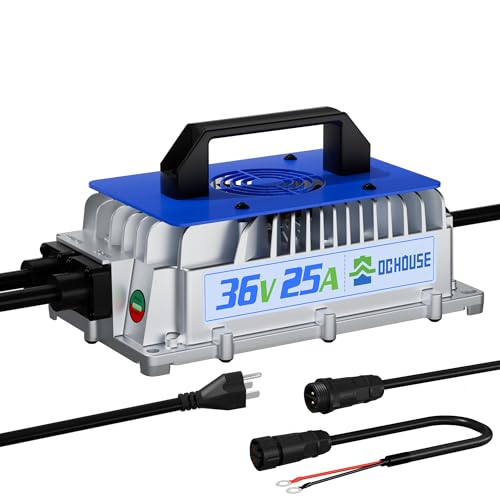
DC HOUSE 36V 25A Waterproof Charger

EPOWREY 25A LiFePO4 Charger

YUANRI 21A Charger for EZGO Marathon SB-50

YUANRI 21A Charger for EZGO TXT D-Style

YUANRI 20A IP67 Charger for Lead-Acid TXT

Razor MX500/MX650/Metro Charger

YUANRI 21A Crowfoot Charger (Tri-Brand)
What Each Pick Brings To The Table
The RALBIL 36V Lithium Charger pushes a serious 20A output at 900W, the kind of current that genuinely cuts overnight charge sessions in half on a large LiFePO4 pack. A LiFePO4 battery uses lithium iron phosphate chemistry, which charges at a higher resting voltage than a typical 36V lead-acid string and needs a charger that tops out at exactly 43.8V, not the looser range a lead-acid profile allows.
For a golf cart commuter who runs the course every weekend or a homeowner cycling a 100Ah storage bank through solar, that speed matters. The 0V wake-up function revives deeply discharged cells that many chargers refuse to engage with, which can save a pack that sat through a long winter. Owners commonly report that the eight-stage protection suite, covering overvoltage, reverse polarity, and thermal events, runs quietly in the background without nuisance shutdowns.
Where It Excels
- 20A output fills a 100Ah LiFePO4 pack in roughly five hours, a real time savings over stock 10A units
- 43.8V ceiling matches LiFePO4’s chemistry, so cells reach a full state of charge without overstress
- 0V wake-up recovers packs that tripped BMS protection during storage
- Eight protection layers reduce the chance of accidental damage during unattended charging sessions
- Wide input range works with common 100-240V wall outlets without a step-down transformer
Worth Bearing In Mind
- Connector style varies by batch, so confirm the ring terminal or Anderson plug matches your cart before ordering
- The 20A draw means a standard 15A household circuit may not suffice for parallel loads; you may need a dedicated outlet
- Bulkier than 5A trickle units, which makes it less suited to toss in a travel bag
Feature Snapshot
Right Fit For
Owners running a 100Ah LiFePO4 cart pack or solar bank who want overnight turnaround without babysitting the cycle.
Reach For A Different Pick When
You only need to service an older EZGO Marathon with stock lead-acid batteries, where the EPOWREY 25A LiFePO4 Charger brings broader brand coverage at similar amperage.
The FORM 36V Lithium LiFePO4 onboard charger is the kind of unit you bolt to the frame once and forget about. At 80% lighter than typical OEM onboard hardware, it cuts noticeable weight from a Club Car, EZGO, or Yamaha build, which matters when you are chasing range or just want easier access to the battery bay.
An onboard setup means no dragging a portable brick out of the garage between rounds; you park, plug into a standard outlet, and walk away. The ring terminals make the install a clean two-bolt job for anyone comfortable with a wrench. Solar and off-grid pairing makes sense here because the maintenance mode tops off cells without cooking them, and the chemistry-specific profile suits a 38.4V or 43.8V LiFePO4 string without needing a separate lead-acid setting.
Notable Upsides
- Onboard design eliminates the daily carry of a portable charger
- Ring terminals simplify hard-mounting to cart frames
- Maintenance mode prevents overcharge during long storage periods
- Lightweight housing makes the unit easier to position in tight battery compartments
Honest Caveats
- Once bolted in, swapping carts becomes more involved than a portable unit
- 18A output is slower than the RALBIL 900W 20A option on the largest packs
- Ring terminal install needs basic electrical comfort and a wrench set
Perfect Match For
Cart owners upgrading to LiFePO4 who want a permanent, plug-and-forget install rather than a portable brick.
Look Elsewhere When
You run mixed chemistry or need a charger that moves between carts, where the YUANRI 21A Crowfoot Charger offers a more flexible carry-along profile.
The Cloudenergy 36V 105Ah LiFePO4 kit pairs a 105 amp-hour lithium battery with a matched 20A charger, which solves the chemistry guessing game in one box. Amp-hours measure how much current a battery can deliver over time, so a 105Ah pack stores roughly five times the usable energy of a typical 20Ah scooter pack. For someone replacing a tired set of six lead-acid cart batteries, this bundle removes the spreadsheet work of matching a charger to a new pack.
The pairing is tuned out of the box, so the charger’s voltage ceiling lines up with the battery’s resting chemistry without manual tweaks. Cloudenergy also publishes a 24-hour technical support window, which matters when a brand-new lithium install throws an unfamiliar error code. Compared with buying a charger like the RALBIL 900W 20A separately, this route guarantees the battery and charger speak the same language from day one.
Where It Delivers
- Pre-matched battery and charger pair removes voltage and profile guesswork
- 105Ah capacity covers long cart routes between charges
- Single-shipment purchase simplifies a full cart conversion project
- 24-hour technical support shortens the troubleshooting loop after install
Factors To Consider
- Bundle pricing is higher than buying a charger alone, which doesn’t help owners who already own a healthy pack
- Large battery dimensions demand a check of the existing battery tray before ordering
- LiFePO4 cells need a compatible BMS accessory if you retrofit older carts without one
Built With In Mind
Cart owners planning a full lithium conversion who would rather skip the parts-matching research and start fresh with a single purchase.
Swap It Out When
You only need a charger for an existing healthy battery, where the DC HOUSE 36V 25A Waterproof Charger covers a similar amperage without bundling a new pack.
The DC HOUSE 36V 25A Lithium Battery Charger earns its spot through sealing rather than speed alone. An IP65 rating means the housing resists low-pressure water jets and dust ingress, which sounds technical but translates into “you can leave it mounted near an open shed wall.” For carts parked outside or workshop setups where splash and dust are daily realities, that protection extends the unit’s working life.
The 25A current tops out higher than the RALBIL 900W 20A and the FORM 18A options, so a 100Ah pack finishes in roughly four hours from a low state of charge. Operating range from -20°C to 45°C lets the unit perform in unheated garages during shoulder seasons, though very cold packs should warm before high-current charging. Owners commonly mount these on solar trailers and boat housebanks where moisture is unavoidable.
A Few Strong Suits
- IP65 sealing holds up to splashes and dusty installs
- 25A output refills large packs faster than most 18-20A competitors
- Wide operating temperature range suits seasonal outdoor use
- 0V charging function reactivates deeply discharged lithium cells
Points To Keep In Mind
- 25A draw requires a circuit rated for sustained high current; older garage outlets may not cooperate
- Bulkier chassis than indoor-only chargers, which limits mount positions
- IP65 is splash-resistant, not submersible, so direct rain exposure still warrants a cover
Quick Facts
Whose Shelf It Belongs On
Fleet operators and homeowners with carts or solar banks parked in damp, dusty, or open-air environments.
A Better Fit Elsewhere
Shop owners running a single indoor cart, where the FORM 36V 18A Onboard Charger trades splash rating for a lighter, easier-to-mount profile.
The EPOWREY 25AMP Lithium Battery Charger sells itself on versatility. The product listing lists compatibility with golf carts, RVs, cars, trucks, forklifts, boats, electric outboards, and solar systems, so it works as a shared shop charger rather than a single-purpose tool. Ring terminals make the hardware side straightforward, while the 43.8V/38.4V output covers the LiFePO4 voltage window without manual switching.
For a small repair shop or a homestead with a cart, a troller motor, and a forklift all running 36V lithium packs, one unit that handles them all beats three specialty chargers. The 25A current matches the DC HOUSE option, and efficiency is described as high and stable. Owners commonly report the housing running cooler than older transformer-based chargers, which extends the lifespan of internal components during long summer workdays.
Useful Touches
- Multi-vehicle compatibility reduces the need for separate chargers per platform
- 25A current handles 100Ah packs in roughly four hours
- Ring terminals suit permanent or semi-permanent mounts
- LiFePO4-specific profile avoids the undercharge that generic lead-acid programs cause
Trade-Offs
- Bulkier than dedicated single-use chargers, so it takes more shelf space
- No IP rating advertised, so outdoor mounting warrants a protective enclosure
- Higher amperage demands a dedicated outlet on a non-shared circuit
Best Suited To
Hobbyists and small shop owners juggling multiple 36V lithium vehicles or marine setups under one roof.
Consider Something Else When
You only need a cart-specific charger with a brand-correct plug, where the YUANRI 21A Crowfoot Charger delivers a more tailored fit.
The YUANRI 21 Amp 36 Volt Golf Cart Charger targets a specific audience: owners of EZGO Marathon carts with the Anderson SB-50 plug. That connector is the dead giveaway, since SB-50 refers to a high-current Anderson-style plug rated for 50 amps continuous, which is the shape OEM carts used before the crowfoot standard took over. If you have one of those older carts, generic modern chargers simply will not seat without an adapter, which makes this unit a clean drop-in.
The smart charging profile adjusts output based on real-time battery condition, so it backs off as the pack fills rather than hammering a full voltage into a topped-up string. For a weekend course operator or a rental fleet running older EZGO hardware, that auto-tuning matters because it reduces the manual babysitting older chargers required.
Practical Advantages
- Native Anderson SB-50 plug eliminates adapter hassle on legacy EZGO carts
- Smart auto-adjust extends battery life by tapering current near full charge
- Wide 100-240V input handles field outlets without a transformer
- 21A current refills 100Ah packs in roughly five hours
Less Ideal Details
- Connector compatibility is locked to the SB-50 standard, so it is not useful across newer EZGO models
- Lead-acid tuned profiles may not match a lithium conversion without verification
- No advertised IP rating, so outdoor storage needs a covered mount point
Who Should Grab It
EZGO Marathon owners with the SB-50 plug who want a no-adapter replacement for an aging OEM unit.
Where Another Pick Suits Better
TXT owners should skip past this for the YUANRI 21A Charger for EZGO TXT D-Style, which uses the plug their carts actually have.
The YUANRI 21 Amp 36 Volt Golf Cart Charger fills the same role as the previous pick, only for EZGO TXT carts using the D-style plug. That three-prong plug is the standard on TXT models and looks visually distinct from the SB-50 Anderson plug found on older Marathons. Picking the wrong one means a trip back to the shop, so this model earns its keep by being obvious about its target.
The aluminum alloy housing helps dissipate heat during long summer charging sessions, which matters in garages that climb past 35°C. The smart profile, also seen on the Marathon version, tapers current as the pack fills. Compared with the EPOWREY 25A option, this charger trades raw speed for a more cart-specific plug fit, which is the right call when adapter stacks become a frustration point.
Practical Pluses
- D-style plug fits EZGO TXT carts without an adapter
- Aluminum housing handles heat during hot-weather charging
- Smart current tapering reduces manual monitoring
- Wide input voltage works on 100-240V outlets worldwide
Potential Compromises
- Plug style locks the unit to EZGO TXT carts only
- Lead-acid stock profile may undercharge lithium swaps without adjustment
- 21A is slower than the DC HOUSE 25A on equivalent packs
Made For
EZGO TXT owners with stock battery setups who want a plug-matched replacement that just works.
Not Your Match When
Your cart is a Marathon with the older SB-50 plug, where the YUANRI 21A Marathon Charger matches that hardware directly.
The YUANRI 20 AMP 36 Volt EZGO TXT Charger is the lead-acid specialist in this group. It targets flooded lead-acid packs on TXT carts from 1996 onward, and the 16-foot cable gives room to reach a wall outlet without dragging the cart closer. The IP67 rating is a step above the typical splash-proof claims, meaning the housing can handle temporary immersion, which is more than most garage or shed environments ever throw at it.
The smart profile tapers voltage as the pack fills, which is important for flooded lead-acid because overcharging cooks off water and shortens plate life. Compared with the YUANRI 21A D-Style unit reviewed earlier, this model drops one amp in exchange for higher ingress protection and a longer cable. For an owner who keeps the cart parked under a leaky carport, the IP67 spec is the deciding factor.
Strong Points
- IP67 sealing protects against heavy water exposure beyond simple splashes
- 16-foot cable adds reach for carts parked away from outlets
- Lead-acid-tuned profile protects flooded cells from overcharge damage
- Smart auto-adjust matches output to battery condition in real time
Soft Spots
- Lead-acid focus means it undercharges LiFePO4 swaps without manual checks
- 20A current is slower than the EPOWREY 25A option on equivalent capacity
- Larger cable is convenient but adds weight to the storage bag
Spec Overview
Who Will Love This
Lead-acid EZGO TXT owners who store carts outdoors and want a tougher-than-average housing.
Skip It When
You have already converted to lithium, since the FORM 36V 18A Onboard Charger speaks the right chemistry profile from the start.
The Razor Dirt Rocket replacement charger serves the smallest 36V category on this list: kid scooters. The MX500, MX650, and EcoSmart Metro all use a 36V sealed lead-acid pack, and this charger is built as the factory-style replacement, so it matches the OEM voltage and current profile without surprises. Aftermarket scooter chargers that look similar often deliver the wrong float voltage, which shortens pack life in a few months.
For a parent whose original brick finally died after years of garage storage, the practical win here is fit certainty rather than raw speed. Charging a small scooter pack takes a fraction of the time a cart battery demands, so speed is rarely the bottleneck. Owners commonly report the OEM-style plug seating cleanly without wiggle or intermittent connection.
What Pays Off
- OEM-equivalent replacement avoids the voltage mismatch that kills scooter packs
- Factory-style plug fits without modification
- Compact form factor stores in a drawer or small shelf
- Affordable entry point compared to cart chargers in this list
Room For Improvement
- Limited to Razor MX500, MX650, and EcoSmart Metro compatibility
- Not suited to high-amperage cart or solar storage applications
- Lead-acid profile does not help lithium scooter swaps
Right Fit For
Parents replacing a dead charger on a Razor Dirt Rocket or EcoSmart Metro scooter.
A Better Fit Elsewhere
Anyone needing real cart-grade power should look back at the RALBIL 900W 20A for LiFePO4 or the YUANRI 20A IP67 for stock TXT carts.
The YUANRI 21 Amp 36 Volt Golf Cart Battery Charger rounds out the list with the broadest brand coverage in the YUANRI lineup. The crowfoot plug works across newer EZGO, Yamaha, and Club Car carts, which is the trio that dominates most North American courses. For a small fleet operator running a mix of these brands, one shared charger is simpler than tracking three.
The IP67 sealing matches the lead-acid YUANRI model, so wet storage and pressure-wash cleanups are non-issues. The smart charging profile adjusts in real time to battery state, which keeps cells healthier across the long cycle. Compared with the FORM 36V onboard unit, this charger is portable rather than permanent, which trades convenience for flexibility depending on how the cart is stored.
What Earns Its Place
- Crowfoot plug fits newer EZGO, Yamaha, and Club Car carts
- IP67 sealing handles harsh storage and cleaning environments
- Smart profile tapers output to extend battery life
- Wide 100-240V input suits field use in different regions
Small Caveats
- Lead-acid default profile may not suit lithium swaps without verification
- 21A current is slower than the DC HOUSE 25A on large packs
- Crowfoot plug does not fit older Marathon SB-50 carts without an adapter
Best Suited To
Fleet operators and households running newer EZGO, Yamaha, or Club Car carts who want one charger across multiple vehicles.
Where A Sibling Pick Shines
Older Marathon owners should reach for the YUANRI 21A SB-50 Charger, since crowfoot and SB-50 are not interchangeable.
Choosing The Right 36V Charger For Your Setup
Picking a 36V charger starts with the battery you actually own, not the cart or scooter you sit on. Lithium iron phosphate, or LiFePO4, packs charge at a different voltage ceiling than flooded lead-acid strings, and using the wrong profile either undercharges the pack or stresses the cells. Smart shoppers confirm the connector next, since Anderson SB-50, D-style, crowfoot, and ring terminal plugs are not interchangeable, and an adapter stack adds resistance and failure points.
Match Chemistry Before Anything Else
A lithium pack needs a charger that tops out at exactly 43.8V for a 12S configuration (twelve cells wired in series to reach the 36V class), while a flooded lead-acid string typically tops out lower and benefits from an equalization phase that lithium should never see. Owners commonly find that “36V charger” labels are loose, and the chemistry matters more than the headline voltage. Confirming the spec sheet before ordering saves both cells and money.
Connector And Mount Style Drive Daily Use
A portable brick with a long cable suits a scooter or a single cart kept near an outlet, while an onboard charger bolts to the frame and removes the daily carry. Connector style affects both fit and water resistance, so garage setups may accept any plug while outdoor carts benefit from IP65 or IP67 sealing. Amp-hour capacity and amperage determine how fast a pack tops off, and a 25A unit cuts hours off the cycle compared to a 15A trickle.
Key Considerations Across These Picks
Common Shopping Slip Ups
The most frequent mistake is grabbing a “36V” charger without checking whether it targets lead-acid or LiFePO4, since the voltage windows overlap but the profiles differ. Another trap is assuming all cart plugs match; an SB-50 Anderson plug will not seat in a D-style or crowfoot receptacle without an adapter. Buyers also overlook amperage relative to pack size, ending up with a 5A trickle on a 100Ah cart pack that takes far too long overnight.
Where The Extra Money Goes
Higher-tier models in this list cost more because of sealing, smart profiles, and onboard mounting hardware rather than raw charging speed. A premium IP67 housing protects against water damage that would destroy an indoor-rated unit in a single season. Built-in wake-up functions and multi-stage protection circuitry also add cost, but they extend pack life and prevent the kind of mistakes that ruin expensive lithium batteries. Paying up makes sense when the charger lives outdoors, runs unattended, or serves a battery that costs several times the charger’s price to replace.
Frequently Asked Questions
Can a 36V charger be used on both lithium and lead-acid batteries?
No. Lithium and lead-acid batteries require different voltage ceilings and charging profiles, so a charger built for one chemistry can undercharge or damage the other. Confirm the charger’s chemistry label before connecting it to any pack.
How long does it take to charge a 100Ah 36V battery?
Charge time depends on the charger’s amperage output and the pack’s depth of discharge. A 20A charger refills a 100Ah pack in roughly five hours from empty, while a 25A unit finishes the same job closer to four hours.
Do all 36V golf cart chargers use the same plug?
No. EZGO Marathon carts use the Anderson SB-50, EZGO TXT carts use the D-style plug, and newer EZGO, Yamaha, and Club Car carts typically use the crowfoot connector. Matching the plug to the cart avoids adapters that add resistance.
Is an IP65 or IP67 rating important for an indoor garage?
The rating matters most when the unit lives near splashes, dust, or uncovered outdoor storage. A clean, dry indoor garage rarely stresses either rating, so a sealed unit becomes valuable once the charger steps outside or sits in a damp shed.
Can a scooter charger replace a cart charger?
Scooter chargers deliver lower amperage and use smaller connectors, so they are not a substitute for cart chargers. A scooter pack charges quickly at low current, while a 100Ah cart pack would take many extra hours on the same hardware.
Wrap Up
The right 36V charger comes down to three matching details: battery chemistry, connector style, and amperage relative to pack size. Cart owners running LiFePO4 benefit from the RALBIL or DC HOUSE picks, while lead-acid fleets should stay with the YUANRI plug-specific models. Scooter owners have a simpler path with the Razor replacement unit. Match those three details, and the rest is just whether the housing can handle your storage environment.