A dead 36V battery on a Tuesday commute is the kind of small disaster that lingers. You pedal home sweating, fish out the brick charger, and watch a tiny indicator light crawl back to full. Picking the right replacement charger means matching your connector, your battery chemistry, and your daily routine to the right output, not the cheapest brick on the shelf. This list walks through nine options worth a closer look, from universal multi-plug kits to brand-specific Gotrax replacements.
The Leading Options At A Glance
Smarthu 42V 2A Scooter Charger for Gotrax
Suptopone 48V Ebike Charger 54.6V 2A DC2.1
SANS 42V 2A Charger 36V DC2.1 (5.5×2.1mm)
VHBW 42V 2A Charger for Gotrax GXL V2
Pinkind ETL 42V 2A Charger 7-Plug Set
Suptopone 52V Ebike Charger 58.8V 5-Plug
Qoovi UL 42V 2A Charger 7-in-1 Plug Set
HAHEWEA 42V 2A Charger for Gotrax GXL

TREE.NB 42V 2A 3-Pin XLR Inline Cable
The Picks, Examined More Closely
Smarthu’s 42V 2A brick is the kind of no-frills replacement that fits neatly into a Gotrax owner’s life. Output sits at the standard 42V (a 36V lithium pack charges at 42V, the higher voltage pushes current into the cells), with 2A flowing in for a reasonable overnight refill.
You give up universal connectors and brand-list certifications, but the price reflects that. For someone whose scooter already takes a barrel-jack plug and just needs a working brick, it covers the basics.
Real Benefits
- 2A output refills a typical 36V pack in a few hours, which is fine for overnight routines.
- Compact brick shape slides into a desk drawer or backpack pouch.
- Designed specifically for Gotrax scooters, so connector fit should match the original charger.
Trade Offs
- No listed safety certifications beyond basic function.
- Compatibility scope appears narrow; double-check your Gotrax model’s charging port before ordering.
Right Fit For
Gotrax riders who lost their original charger and want an affordable, direct-fit replacement.
Swap It Out When
Households with multiple scooter brands should look at the Pinkind 7-plug kit, which handles more connector types in one box.
The Suptopone 48V charger delivers 54.6V at 2A, which is the correct target voltage for a 48V lithium pack (the higher number represents the fully charged state of the 13-cell series). Its DC2.1 barrel connector, a common 5.5×2.1mm tip, suits Lectric and similar ebikes that use this standard.
It accepts 100-240V input, so international travel won’t trip it up. For Lectric XP riders whose original brick frayed or vanished, this is a close match to the OEM output profile.
Practical Pluses
- 54.6V output matches the full-charge profile of 48V lithium packs.
- Universal input voltage covers travel use.
- DC2.1 connector fits the standard Lectric-style charging port.
Points To Note
- Wrong connector size (5.5×2.5mm instead of 2.1mm) will simply not seat.
- Lead-acid battery owners should look elsewhere; this is for lithium packs only.
Best Suited To
Lectric XP and other 48V ebike riders who need a direct replacement charger.
A Better Fit Elsewhere
Riders with mixed-brand garages and 36V packs get more value from the Qoovi 7-plug charger.
SANS has built a charger around the protection side of the equation. OVP (over-voltage protection), OCP (over-current protection), and SCP (short-circuit protection) all sit inside the housing, so a power surge or wiring hiccup won’t cook your pack.
The 100-240VAC input range handles wall outlets in most countries, and the 5.5×2.1mm barrel matches many common scooter ports. For commuters who plug in daily, those layered protections translate to longer pack life.
Positive Takeaways
- Built-in over-voltage, over-current, and short-circuit protections.
- 100-240VAC input handles international outlets.
- CC-CV charging profile (constant current, then constant voltage) helps preserve battery health.
Honest Caveats
- Output is 2A, which means longer charge times than 3A or 4A bricks.
- Connector is a single DC2.1, so brand versatility is limited.
Made For
Riders who charge their 36V bike or scooter daily and want extra circuit protection built in.
Skip It When
Households juggling Razor, Gotrax, and Jetson ports will find the Pinkind multi-plug charger more flexible.
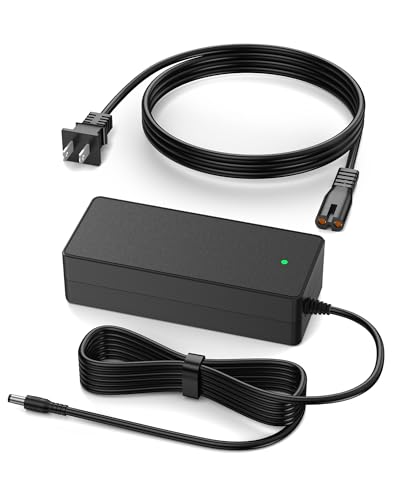
VHBW targets the Gotrax crowd with a charger that lists an unusually wide scooter compatibility roster. Apex, GXL V2, G4, Rival, XR Elite, and several others appear in the supported lineup, which helps families running more than one scooter.
Standard 42V 2A output and 100-240V input cover the usual bases. A known caveat to flag: the G2 Plus is excluded, so confirm your exact model before checking out.
Useful Touches
- Broad Gotrax model coverage simplifies multi-scooter ownership.
- 100-240V input for travel and varied outlets.
- 2A output rate balances charge time and battery stress.
Worth Noting
- The Gotrax G2 Plus is not supported, which catches out a popular model.
- Connector is brand-specific; not a multi-plug solution.
Who Will Love This
Gotrax owners with several models in the supported list who want one charger to keep nearby.
Consider Something Else When
Multi-brand households with Razor and Jetson in the mix should pick up the Qoovi 7-in-1 instead.
Pinkind packs seven connector tips into one brick, covering the usual suspects: 5.5×2.1mm, 5.5×2.5mm, Mini 3-Prong, Standard 3-Prong, RCA, XLR, and IEC. The “10S” in the description means it targets 36V packs built from 10 lithium cells in series, which is the standard 36V configuration.
ETL certification (a North American safety standard similar to UL) adds credibility for daily use. Compatibility spans Razor, Gotrax, Jetson, Ninebot, and Voyage hoverboards, so mixed-brand homes can run one charger instead of three.
Standout Benefits
- ETL safety certification covers North American electrical standards.
- Seven connector tips handle most common scooter and hoverboard ports.
- Wide brand compatibility cuts down on charger clutter.
Things To Consider
- 2A output means a slower refill than 3A or 4A chargers.
- Not for lead-acid packs or 48V/52V battery systems.
Perfect Match For
Households with multiple 36V scooters or hoverboards from different brands who want one shared charger.
Another Choice May Suit
Riders running 52V ebike packs need the Suptopone 58.8V charger, which is built for the higher-voltage chemistry.
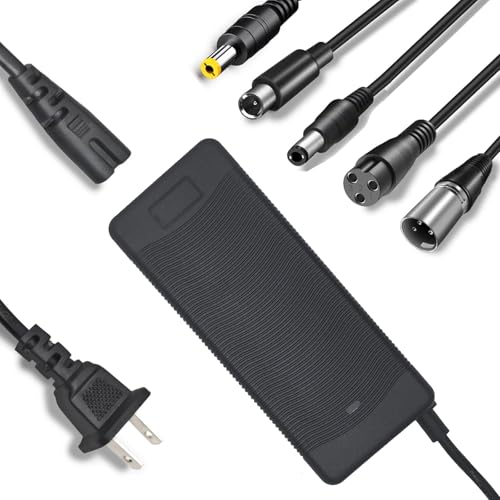
Suptopone’s second entry on this list serves the 52V crowd, which is a step above the standard 36V setup. Output lands at 58.8V (the fully charged state of 14 cells in series), with five connector tips covering 5.5×2.5mm, 5.5×2.1mm, Standard 3-Prong, RCA, and XLR ports.
The versatile plug selection and 100-240V input range target riders who travel with their ebikes or swap packs between builds. For 52V packs, a 36V charger simply won’t fill them up.
Notable Upsides
- 58.8V output correctly matches 52V lithium pack requirements.
- Five connector tips cover most 52V ebike ports.
- Universal input voltage for global travel.
Worth Bearing In Mind
- Not for 36V or 48V packs, which is a mismatch.
- 2A output is moderate; 3A or 4A bricks refill faster.
Who Should Grab It
52V ebike owners with dead or missing chargers who need a multi-plug, travel-friendly brick.
Reach For A Different Pick When
36V riders get a perfect voltage match from the SANS 42V 2A charger instead.
The Qoovi charger brings UL listing (Underwriters Laboratories, a widely recognized North American safety certification) and a seven-plug adapter set to the 36V lithium category. ABS plastic housing keeps weight at a manageable 325g, and the 6-foot power cable adds reach for awkward outlet placements.
Compatibility spans Razor, Gotrax, Jetson, Voyage, Ninebot, Segway, and Swagtron, so most popular 36V scooters and hoverboards sit on the supported list. For a multi-rider household, this single brick clears most charging needs.
What Helps Most
- UL safety certification for verified electrical protection.
- Seven plug tips cover the most common scooter and hoverboard ports.
- 84W max output handles 42V 2A charging efficiently.
Some Limits To Know
- 2A charging current means longer refill times than higher-amperage bricks.
- Only for 36V lithium packs; not a 48V or 52V solution.
The Right Fit
Families running Razor, Gotrax, Jetson, and Segway devices who want one UL-listed brick instead of a drawer of chargers.
Look Elsewhere When
Riders with 52V ebike packs need the Suptopone 58.8V 5-plug charger for correct voltage matching.
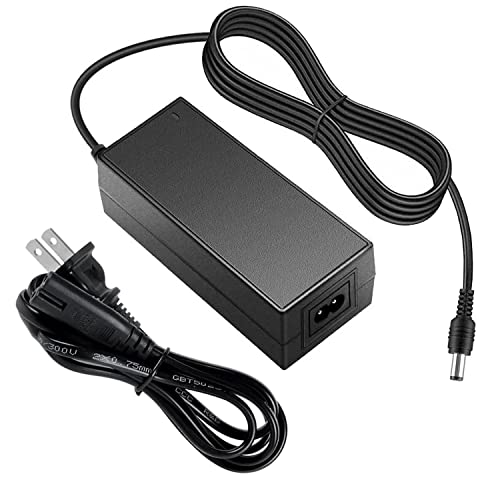
HAHEWEA leans into convenience with an 8-foot power cord, which is longer than most stock replacements. For Gotrax owners whose outlet sits across the room or behind furniture, that extra reach removes the daily annoyance of dragging the scooter closer to the wall.
Compatibility covers the popular GXL V2, G4, G3, G2, XR Elite, XR Ultra, Apex, and Glider models running 36V lithium packs. Just confirm your port style, since 3-Prong connector versions are not supported.
The Good Stuff
- 8-foot cord reaches outlets other chargers can’t.
- Covers most common Gotrax 36V models in one listing.
- Standard 42V 2A output matches OEM specs.
Trade-Offs To Consider
- Not for Gotrax models with 3-Prong charging ports.
- Not compatible with 24V or 25.2V Gotrax versions.
Whose Shelf It Belongs On
Gotrax riders with barrel-jack ports who need extra cord length for awkward outlet placements.
Where Another Pick Suits Better
Riders with multiple scooter brands benefit more from the Qoovi 7-in-1 plug set.
TREE.NB addresses a specific niche: packs that use a 3-pin XLR connector, the same locking round connector common in audio gear. Standard 42V 2A output and CC-CV charging profile make it a straightforward replacement for those who know their battery uses this port style.
A red-to-green LED indicator confirms charging status at a glance. Verify your pack’s port before ordering, since XLR is far less common than barrel-jack plugs in the scooter world.
What Works In Its Favor
- 3-pin XLR connector fits specialty battery packs that use this port.
- LED indicator shows charging state without guesswork.
- CC-CV profile is gentler on lithium cells than constant-current-only designs.
Practical Considerations
- Connector is XLR-specific; will not fit barrel-jack or RCA ports.
- 2A charging rate is moderate; specialty fast chargers are rare in this format.
Built With In Mind
Riders with 36V lithium packs that use a 3-pin XLR charging port and need a direct-fit replacement.
Not Your Match When
Gotrax and Razor owners should pick the HAHEWEA or Smarthu barrel-jack chargers instead.
Picking the Right Charger for Your Battery Setup
Match the Voltage Before Anything Else
A 36V lithium pack requires a 42V charger; the extra 6V represents the fully charged state of the cells. Plugging a 24V or 48V charger into a 36V pack either undercharges or pushes unsafe voltage into the cells. Cross-check your battery’s nominal voltage (the printed rating on the pack label) against the charger’s output before anything else.
Connector Type Matters More Than Specs
Even a perfectly rated charger is useless with the wrong tip. Barrel jacks in 5.5×2.1mm and 5.5×2.5mm sizes cover most consumer scooters. Premium ebikes often use 3-pin XLR, while hoverboards lean toward 3-Prong RCA-style plugs. Universal kits like the Pinkind or Qoovi ship with multiple tips, but single-connector bricks require an exact match.
Charging Speed vs. Battery Longevity
A 2A charger fills a 36V 10Ah pack in roughly five hours, while a 4A brick cuts that closer to two and a half. Faster charging generates more heat, which over time stresses lithium cells. For daily commuters who drain and refill quickly, 2A remains the gentler choice for long-term battery health.
Safety Certifications and Protection Circuits
ETL or UL certification (independent North American safety standards) means the charger passed third-party electrical testing. Built-in OVP, OCP, and SCP protections guard against voltage spikes, current overloads, and short circuits. Daily chargers benefit most from these features, since they handle hundreds of plug cycles per year.
Key Considerations Across These Picks
Where Shoppers Go Wrong
The most common mistake is grabbing the cheapest brick without checking the connector. A 5.5×2.1mm plug will not seat in a 5.5×2.5mm jack, and forcing it damages both the cable and the port. Another trap is matching voltage only: a 36V pack and a 42V charger are correct together, but a 48V charger on a 36V pack pushes dangerous overvoltage.
What Separates Premium From Basic
Higher-tier chargers add safety certifications, multi-plug adapter sets, and longer power cords. For most riders, the upgrade pays off when the household owns multiple scooter brands, since one certified brick replaces three cheap replacements. Single-rider households with one brand and a known port type can stick with a direct-fit OEM-style charger without losing meaningful value.
Frequently Asked Questions
Can a 42V charger safely charge a 36V battery?
Yes. The 42V rating reflects the fully charged state of the 36V lithium pack’s 10-cell series, and a quality charger drops to a lower voltage as the battery fills.
What is the difference between 2A and 4A chargers?
The amp rating controls charging speed. A 4A charger refills a battery roughly twice as fast as a 2A brick but generates more heat, which can shorten long-term cell life.
Are universal multi-plug chargers safe for all scooter brands?
They are safe when the output voltage and connector match the battery. Verify both before plugging in, since a wrong connector will not seat properly.
How long does a 36V battery take to charge fully?
A 2A charger typically refills a 36V 10Ah pack in four to five hours, while a 4A charger finishes in about two and a half hours.
Do I need a charger with safety certification?
Certification adds verified electrical protection, which matters for daily commuters. Occasional users can manage with uncertified bricks, though certified options are the safer long-term choice.
Final Verdict
The right 36V charger comes down to matching three things: your battery’s voltage, your scooter’s port style, and how often you plug in. Multi-rider households get the most mileage from a certified multi-plug kit, while single-rider commuters with a known brand can save with a direct-fit replacement. Whichever route you take, double-check the connector before clicking through.