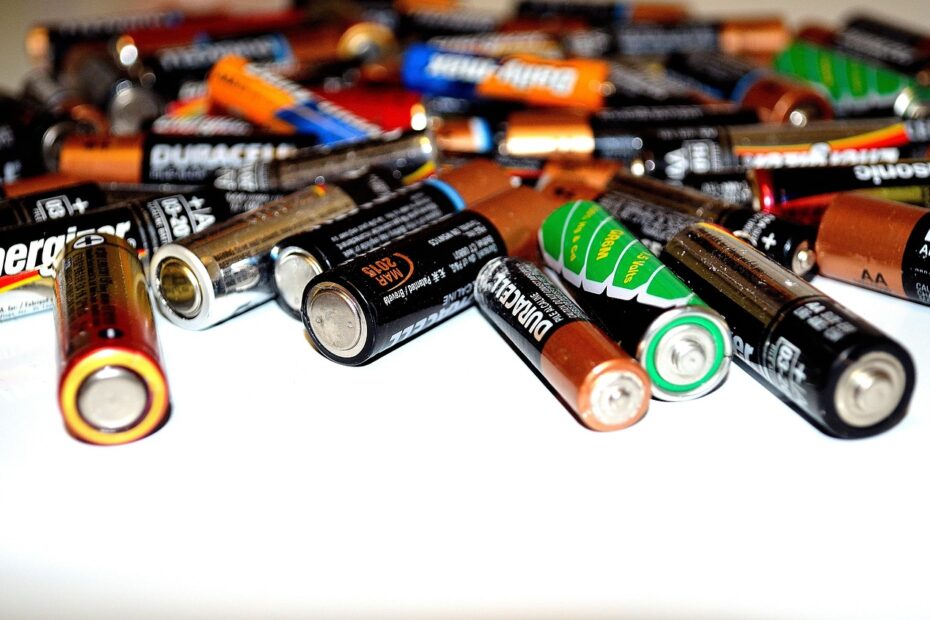
A standard AA measures 50.5 mm long, while size also affects stored energy, current delivery, and device fit.5V label alone. An AA battery (IEC LR6/R6) is wider and longer than an AAA battery (IEC LR03/R03), so it holds more active material while fitting a different compartment.
Your remote, flashlight, toy, clock, key fob, and emergency drawer each need a battery format that matches their compartment, voltage needs, and expected electrical load.
Battery Letters Identify Physical Formats
A battery compartment has fixed walls, springs, terminals, and contact spacing. AA, AAA, C, and D labels identify cylindrical battery dimensions, while chemistry labels identify the materials inside the shell.
Your replacement choice rests on three details: physical fit, stated voltage, and chemistry. An AA shell may contain alkaline batteries, rechargeable NiMH batteries, zinc-carbon material, or lithium batteries, even though every version has the same basic exterior dimensions.
Format and chemistry labels serve separate roles
An AA battery refers to a size, while alkaline refers to chemistry. A package marked AA alkaline identifies both the 14.5 mm by 50.5 mm shell and the electrochemical system inside it.
Duracell AA alkaline cells illustrate the distinction. AA identifies the format, while alkaline describes the cell chemistry. Your device needs the stated format, but your expected runtime and electrical load shape the chemistry choice.
Three checks avoid wrong replacements
- Physical fit: Match the compartment label, cell diameter, cell length, terminal shape, and spring arrangement before inserting a battery.
- Voltage match: Follow the voltage printed inside the battery bay or in device instructions, because close dimensions do not prove electrical compatibility.
- Chemistry choice: Select alkaline, NiMH, disposable lithium, or zinc-carbon based on device demand, storage conditions, and stated instructions.
- Polarity alignment: Place the raised positive end and flat negative end against the matching plus and minus marks.
That physical check leads into the labels printed on battery packages. IEC battery codes look technical, yet they identify familiar household formats with more detail than a letter alone.
Those codes become more useful when their names are matched to the dimensions that determine physical fit.
The Battery Sizes Chart Shows Physical Differences
Millimeter measurements reveal differences that look minor in a storage drawer. An AA battery is only 4 mm wider than an AAA battery, yet that extra space holds more electrode material and electrolyte.
| Format | Dimensions in millimeters | Dimensions in inches | Common IEC code or alias |
|---|---|---|---|
| AAAA | 8.3 mm diameter x 42.5 mm long | 0.33 x 1.67 in | LR61, R61 |
| AAA | 10.5 mm diameter x 44.5 mm long | 0.41 x 1.75 in | LR03, R03 |
| AA | 14.5 mm diameter x 50.5 mm long | 0.57 x 1.99 in | LR6, R6 |
| C | 26.2 mm diameter x 50.0 mm long | 1.03 x 1.97 in | LR14, R14 |
| D | 34.2 mm diameter x 61.5 mm long | 1.35 x 2.42 in | LR20, R20 |
| N | 12.0 mm diameter x 30.2 mm long | 0.47 x 1.19 in | LR1, R1 |
| 9-volt battery | 26.5 x 17.5 x 48.5 mm | 1.04 x 0.69 x 1.91 in | PP3, 6LR61 |
| Coin cell | Varies, such as 20.0 x 3.2 mm | Varies, such as 0.79 x 0.13 in | CR2032 |
IEC labels add chemistry detail to the size name. LR6 identifies an alkaline AA battery, while R6 identifies the same AA format in a non-alkaline system such as zinc-carbon. LR03 marks alkaline AAA, and R03 identifies AAA in another chemistry family.
A 9-volt battery (PP3) belongs in a separate category. Its rectangular body has two snap terminals at one end and a nominal 9V output, unlike the single-cell 1.5V output of AA, AAA, C, and D formats.
Do not identify button-cell batteries by diameter alone. A CR2032 and CR2025 both measure 20 mm across, but their thickness differs by 0.7 mm and their device fit differs.
The AA and AAA battery size comparison explains why the two formats look related but do not substitute for each other. Their cylindrical shape and nominal voltage overlap, while their internal volume and compartment dimensions do not.
AA and AAA Differ in Stored Energy Space
An AA battery measures about 14.5 mm across and 50.5 mm long. An AAA battery measures about 10.5 mm across and 44.5 mm long. The AA shell leaves more room for electrodes and electrolyte.
| Feature | AA battery | AAA battery |
|---|---|---|
| Physical size | 14.5 mm x 50.5 mm | 10.5 mm x 44.5 mm |
| Common alkaline voltage | 1.5V nominal | 1.5V nominal |
| Internal volume | More room for active material | Less room for active material |
| Current demand | Better suited to sustained loads | Better suited to compact, lighter loads |
| Common devices | Toys, controllers, flashlights | Remotes, compact lights, sensors |
Equal voltage does not mean equal runtime
Alkaline AA and AAA cells both carry a nominal battery voltage of 1.5V. Voltage describes electrical pressure, not a fuel gauge. Your device draws current from that pressure, and the smaller AAA shell has less chemical material available across a long discharge period.
AA vs AAA battery capacity becomes clear in a bright flashlight. A fresh AAA pair may light the lamp, but brightness may drop sooner on a long walk because the cells face steady current demand. An AA-powered flashlight carries a larger energy reserve in the same chemistry class.
Device dimensions choose the format
Your slim TV remote may accept only AAA cells because its narrow channel was built around a 10.5 mm diameter. A game controller may use AA cells because wireless communication, vibration motors, and extended play place a larger demand on the cells.
A wall clock can run a long time on either format in a compartment designed for that size. Your correct choice is not the physically larger cell. It is the marked format, followed by a chemistry that suits the device load.
Stored energy explains part of runtime. Battery voltage, battery capacity (mAh), current capability, and cutoff voltage describe separate properties, so a battery label needs more than one number.
Voltage, Capacity, Current, and Runtime Describe Different Things
A 1.5V label states nominal electrical potential, not runtime. The number resembles water pressure in a hose: pressure matters, but available water and flow rate shape how long the system works.
Voltage and capacity measure separate properties
Voltage describes electrical potential. Alkaline AA, AAA, C, and D cells carry a 1.5V nominal rating, while rechargeable NiMH batteries in AA and AAA formats carry a 1.2V nominal rating.
Capacity describes stored charge and appears in milliamp-hours, written mAh. A 2,000 mAh cell can supply 2,000 milliamps for one hour or 200 milliamps for ten hours under stated discharge conditions.
Energy joins voltage and capacity. Watt-hours show a fuller energy picture because they account for both values. Your runtime depends on energy, device draw, temperature, and the voltage at which the device shuts down.
Current delivery changes behavior under load
Current capability describes how well a cell supplies requested amps without a sharp voltage drop. A digital camera flash, motorized toy, or high-output flashlight places a harder demand on a battery than a quartz clock movement.
Capacity figures are not fixed runtime promises. Brand design, chemistry, discharge rate, cold conditions, and device cutoff voltage all change the usable result. Your 2,000 mAh NiMH cell and a 2,000 mAh alkaline cell will not deliver identical runtime in every device.
A capacity label from one chemistry does not settle a head-to-head runtime claim. Check the device load, temperature, and stated discharge conditions before treating mAh as a universal score.
The 14500 cell is not a standard AA replacement
A 14500 lithium-ion cell has dimensions close to an AA battery, which causes confusion. Its nominal voltage is about 3.6V or 3.7V, far above a 1.5V alkaline AA or 1.2V NiMH AA. Your equipment may suffer electrical damage from that mismatch.
The 14500 name refers to dimensions in another naming system: roughly 14 mm wide and 50 mm long. Close physical dimensions do not establish electrical compatibility. Reserve a 14500 cell for equipment marked for that lithium-ion format.
Once you separate voltage from energy and current, the battery letters become easier to interpret. Smaller cells fit compact electronics, while larger shells carry larger reserves for prolonged or harder work.
Battery Formats Match Device Space and Demand
A battery format reflects the room available inside a device and the electrical work expected from it. Thin electronics favor smaller cells, while lanterns and portable radios can hold heavier formats with more active material.
AAA and AA fit household electronics
AAA cells appear in TV remotes, slim wireless keyboards, compact flashlights, bathroom scales, and small sensors. Their narrow shape keeps handheld equipment light while providing enough energy for low or intermittent loads.
AA cells appear in toys, portable radios, game controllers, LED lanterns, and larger flashlights. Your compartment label remains the deciding detail, even where a nearby format appears close in size.
C and D serve larger energy demands
C battery (IEC LR14/R14) cells measure about 26.2 mm across, while D battery (IEC LR20/R20) cells measure about 34.2 mm across. Their larger volume holds more electrochemical material than AA cells, which suits long runtimes and sustained current demand.
C, D, and 9V battery sizes serve distinct device designs. A large flashlight, portable radio, automatic soap dispenser, or bulky toy may use C or D cells. Some D-cell equipment draws modest current but needs months of service between cell changes.
Smaller formats fill specialty spaces
AAAA batteries fit select styluses, laser pointers, small medical accessories, and compact electronics. An AAAA battery looks like a slimmer, shorter AAA, but its 8.3 mm diameter and shorter contact reach keep it from replacing an AAA cell.
N cells fit specialty alarms, garage-door accessories, and compact transmitters. Button-cell batteries and coin cells fit watches, calculators, key fobs, glucose meters, and small electronic equipment where even AAAA is too large.
A CR2032 is a 3V lithium manganese dioxide coin cell measuring about 20 mm across and 3.2 mm thick. Your device needs the exact code printed in its battery bay, not a coin cell with a similar appearance.
Size explains the shell shape, while chemistry changes how that same shell behaves in cold weather, storage, or a motor-driven device.
Chemistry Changes Battery Performance
Two AA cells can share identical dimensions and behave differently in a flashlight. Internal chemistry affects voltage behavior, cold-weather response, storage life, recharge ability, and response to heavy current draw.
| Chemistry | Nominal voltage | Practical traits | Suitable situations |
|---|---|---|---|
| Alkaline | 1.5V | Disposable household chemistry with broad device compatibility | Remotes, clocks, toys, household gear |
| Zinc-carbon | 1.5V | Lower reserve under demanding loads | Low-drain items with modest demand |
| Lithium primary | 1.5V in AA or AAA formats | Light weight, strong cold response, long storage life | Emergency kits, outdoor gear, cold conditions |
| NiMH rechargeable | 1.2V | Rechargeable chemistry for repeated device use | Controllers, toys, cameras, frequent-use devices |
Alkaline and zinc-carbon fit different loads
Alkaline batteries suit a wide range of household devices in AA, AAA, C, and D formats. Their voltage declines during discharge, with a sharper drop under harder loads such as bright lights and motorized toys.
Zinc-carbon cells may appear under labels such as heavy duty or super heavy duty. Those labels do not identify actual electrical performance. Check the stated chemistry because bright lights and high-drain toys exhaust zinc-carbon cells quickly.
Lithium and NiMH suit separate needs
Disposable lithium batteries retain energy well during storage and perform strongly in cold conditions. Your emergency flashlight or outdoor sensor may suit lithium primary cells where device instructions list that chemistry.
Rechargeable AA and AAA batteries made with NiMH chemistry run at 1.2V nominal. Many household devices work well with them, particularly controllers, toys, and cameras. Your voltage-sensitive equipment may need the chemistry named by its maker.
Do not charge alkaline, zinc-carbon, or disposable lithium cells unless the package states that the cell is rechargeable. Charging a non-rechargeable cell can lead to leakage, heat, rupture, or fire.
Chemistry does not correct a wrong physical size. The next choice is stricter: whether a different format fits the compartment, reaches its contacts, and supplies suitable voltage.
Substitution Fails With Wrong Fit or Voltage
An AA battery does not directly replace an AAA battery, and an AAA battery does not directly replace an AA battery. Fixed compartment walls, springs, and terminals match one precise format. The larger AA will not enter an AAA bay, while the smaller AAA cannot reliably bridge an AA bay.
Three substitution outcomes show the risks
- Cells do not fit: A D cell does not enter a C compartment, and an AA cell does not enter an AAA compartment without forcing the housing.
- Adapters compromise runtime: An adapter positions a smaller cell inside a larger bay, yet it does not add stored energy or stronger current delivery.
- Voltage mismatch harms equipment: A 3.7V 14500 lithium-ion cell may fit an AA-shaped space but can harm equipment built for 1.5V cells.
- Loose contacts overheat: Foil, coins, loose spacers, or bent springs can create intermittent contact, heat, leakage, and internal damage.
Your temptation to improvise usually starts with a drained device and a nearby wrong-sized battery. Avoid foil spacers. A foil strip can shift, short terminals, and remove the stable spring pressure that keeps a cell seated.
Adapters change space, not battery output
An adapter shell can position an AAA cell inside an AA compartment, but the AAA retains its smaller capacity and current capability. A motorized toy that drains AA cells quickly will drain adapted AAA cells faster.
Only as a physical compromise in limited low-drain equipment. Your safer choice remains the marked format, matching voltage, and stated chemistry.
The same care matters during replacement. Mixed cells begin at different charge levels and discharge differently under load, which raises the chance of leakage and weak performance.
A Careful Replacement Routine Reduces Mistakes
The marks molded into a battery door offer more useful detail than a loose cell in a drawer. Check the compartment before opening a package, especially where AA, AAA, C, D, N, and coin cells sit together.
- Read the compartment: Find the exact format marking, such as AA, AAA, C, D, N, PP3, or CR2032, inside the battery bay.
- Match polarity: Align every raised positive nub and flat negative end with the molded plus and minus symbols.
- Match voltage: Follow the printed voltage and avoid close-sized lithium-ion cells with much higher voltage than household cells.
- Choose by load: Match chemistry to low-drain storage, repeated motor use, cold weather, or a bright flashlight.
- Install matched cells: Place a full set of the same brand, chemistry, age, and charge state into multi-cell equipment.
- Remove idle cells: Take depleted or long-idle cells from seasonal decorations and stored devices that may leak.
Mixed sets create weak links
A fresh cell paired with an exhausted cell can force the weaker cell into reverse charging under load. That condition raises leakage risk and can leave corrosive material inside your device. Replace the full set together.
Your set should not mix alkaline with NiMH, disposable lithium with alkaline, or different charge levels. Brand designs differ in discharge behavior, so matched cells reduce uneven drain across a multi-cell circuit.
Storage, charging, and disposal need care
Store loose cells in original packaging or a plastic organizer, with terminals separated from metal objects. A loose 9-volt battery can short against keys or steel wool because both terminals sit close together on the same end.
Keep button-cell batteries secured away from children. A swallowed coin cell can cause severe internal injury within a short period, even where the battery appears spent. Tape used coin-cell terminals before taking them to a collection location.
Your county waste program, municipal drop-off location, or store collection bin can state which battery types it accepts. Rechargeable cells and lithium batteries deserve particular care during disposal because exposed terminals can short against metal.
Final Takeaways
Battery letters are fit codes, not power rankings. Your dependable choice starts with the marked format, then moves to battery voltage and chemistry. AA cells hold more energy than AAA cells of the same chemistry, yet neither belongs in the other compartment.
Match the complete specification: format, voltage, chemistry, polarity, and charge state. A matched set protects your device from weak runtime, poor contact, leakage, and high-voltage substitution errors.
FAQ
What is the difference between AA and AAA batteries?
AA batteries measure about 14.5 mm by 50.5 mm, while AAA batteries measure about 10.5 mm by 44.5 mm. Both alkaline formats have a 1.5V nominal rating, but AA cells hold more active material and suit longer or heavier electrical loads.
Are AA and AAA batteries the same voltage?
Alkaline AA and AAA cells both have a 1.5V nominal rating. Rechargeable NiMH AA and AAA cells both have a 1.2V nominal rating. Equal voltage does not mean equal runtime because the larger AA shell holds more active material.
Can I use AA batteries instead of AAA batteries?
No. An AA battery is wider and longer than an AAA battery, so it does not fit an AAA compartment. An AAA cell also does not reliably replace an AA because it is too narrow and short, even where a spacer seems to bridge the gap.
What battery looks like AAA but smaller?
Measuring just 42.5 mm long, an AAAA cell is a slim cylindrical battery smaller than an AAA. It measures about 8.3 mm in diameter and 42.5 mm long, compared with 10.5 mm by 44.5 mm for AAA. N cells are also small, but their shape is shorter and stouter.
Are all AA and AAA batteries the same?
No. AA and AAA identify physical formats, while alkaline, zinc-carbon, lithium primary, and NiMH identify chemistry. Your cells can share a size yet differ in voltage, capacity, cold-weather response, storage life, recharge ability, and current delivery.
Are there two sizes of AA batteries?
Standard AA cells share a shell size of about 14.5 mm by 50.5 mm, but 14500 lithium-ion cells have close dimensions and can be mistaken for AA. A 14500 runs around 3.6V or 3.7V, so it is not a direct AA replacement.