Group 31 batteries show up everywhere a serious amount of stored power is needed, from offshore trolling motors to overland camper setups and off-grid solar banks. A loose battery in a bouncing boat compartment is a real safety problem, so the right hold-down or enclosed box matters more than most people realize. The picks below mix heavy-duty steel enclosures, molded polypropylene trays, and two lithium battery packages that pair naturally with Group 31 mounts.
The Picks In Brief

Sidasu Stainless Steel Battery Box for Group 27

NOCO Snap-Top BG24 Battery Box

Litime 12V 100Ah Group 31 LiFePO4 Battery

Attwood 9094-5 Heavy-Duty Battery Tray 29/31
Camco Heavy Duty Group 24 Battery Box
LiTime 12V 165Ah Group 31 LiFePO4 Battery

Attwood 9099-5 Battery Tray With Strap 29/31

T-H Marine Battery Holder Tray for 31 Series

NOCO BT31S Group 31 Heavy-Duty Battery Tray

Allstar Performance ALL76100 Steel Battery Box
The Picks, Examined More Closely
Most plastic trays handle splash and dust fine, but in a saltwater bay you eventually see corrosion set in. The Sidasu Stainless Steel Battery Box sidesteps that whole conversation by going full stainless from the start, with a fitted lid that drops over a Group 24 or 27 footprint and accepts many Group 31 cells up to a recommended 13.0″ L x 7.5″ W x 10.0″ H interior.
That rating matters because it means the box tolerates slightly oversized cells, which is a real headache on older boats where terminals, lugs, and bus bars eat into the room you thought you had. For owners rebuilding a damp bilge or upgrading a saltwater trolling setup, this is one of the more reassuring enclosures you can drop in. Compared with the snap-top NOCO BG24 reviewed next, the trade-off here is weight: stainless adds pounds you’ll feel when you hoist it into a tight compartment.
What Pays Off
- Stainless construction resists the rust creep that ruins mild steel boxes after a season in brine.
- Lid design closes over terminals, so accidental shorts from tossed tools become much less likely.
- Generous tolerance for cells up to about 13 inches long covers most Group 24, 27, and many Group 31 batteries.
- Enclosed box style contains minor acid leaks, which protects plywood decks and bilge pumps.
Trade-Offs To Consider
- Stainless adds noticeable weight over polypropylene trays, so mounting brackets need to be robust.
- Always measure your battery, since the manufacturer calls out that some oversized cells still won’t clear the lid.
Built With In Mind
Owners running saltwater boats or coastal RVs who want a long-service-life enclosure and don’t mind the extra heft.
Skip It When
Weight-sensitive campers should look at the NOCO BT31S Group 31 Heavy-Duty Battery Tray instead, which uses a strap-style mount that weighs far less.
If you’ve ever fumbled with battery straps and tiny bolts while kneeling in a damp bilge, the NOCO Snap-Top BG24 is going to feel like a small gift. NOCO rebuilt this box around a snap-lock lid and simplified the mounting footprint so you can drop a Group 24 battery in and snap it shut without tools.
It’s marketed for Group 24 cells, but the same overall shape gives enough clearance for several Group 31 sizes as long as you measure first. The reinforced top adds structural rigidity that earlier snap-top designs lacked, which matters when the box lives under a slamming hatch. The trade-off is real: the snap lock is convenient, but it isn’t a fully sealed marine enclosure like the Sidasu reviewed above, so you wouldn’t want it sitting in standing water.
A Strong Showing
- Snap-lock lid removes the strap-and-bolt routine for quick seasonal swaps.
- Reinforced top geometry resists flexing under foot traffic in a busy compartment.
- Pre-drilled base lets you mount without buying a separate hold-down strap.
- Works with automotive, marine, RV, and camper battery types, so it’s a flexible spare to keep around.
Points To Keep In Mind
- Snap-top isn’t a sealed lid, so spray and dust intrusion are still possible in open bilges.
- Group 31 fit depends on the specific cell height and terminal layout, so measuring before ordering is essential.
Right Fit For
Weekend DIYers who want a tidy, tool-free install in a covered battery compartment.
Reach For A Different Pick When
Saltwater boaters needing a fully enclosed lid should pair the Camco Heavy Duty Group 24 Battery Box with a marine strap setup instead.
The first two picks were boxes. This one is the battery that goes inside one, and it’s worth a serious look for anyone planning a Group 31 lithium swap. Litime builds this 12V 100Ah LiFePO4 cell (LiFePO4 is shorthand for lithium iron phosphate, a chemistry prized for thermal stability and long cycle life) using automotive-grade cells and packages it in a Group 31 footprint.
The integrated BMS, or battery management system, is the part you’ll appreciate most: it handles overcharge, over-discharge, and the other common failure modes so you don’t have to babysit the bank. IP65 ingress protection means it shrugs off jets of water, and you can stack up to four in series and four in parallel for larger house banks. Compared with the lead-acid batteries these boxes were originally designed around, you trade upfront cost for a fraction of the weight and a much longer service life.
Useful Strengths
- Group 31 case fits the trays and boxes reviewed throughout this list, so mounting is straightforward.
- Automotive-grade cell construction tends to deliver steadier voltage under heavy trolling loads.
- Multi-protection BMS covers overcharge, short, and temperature events internally.
- IP65 rating tolerates bilge spray and outdoor solar cabinet moisture.
Honest Caveats
- Lithium cells need a compatible charger profile, so older lead-acid chargers may undercharge them.
- Cold-weather charging requires the BMS to allow it, and not every Litime variant handles deep sub-freezing inputs the same way.
Feature Snapshot
Best Suited To
Off-grid solar households and RV owners building long-life lithium banks who already plan to upgrade charging gear.
Not Your Match When
Shoppers only after a holding tray should look at the Attwood 9094-5 Heavy-Duty Battery Tray, which is purely a mounting solution.
Attwood has been building marine hardware for decades, and the 9094-5 shows that heritage in a tray that doesn’t try to be anything other than a rock-solid mounting base. The non-corrosive black plastic construction shrugs off electrolyte spills, and the stainless retaining bolts keep the hold-down hardware from seizing up after a year in the damp.
It’s rated for 29 and 31 series batteries with an interior around 13-1/16″ L x 6-7/8″ W, and the adjustable height crossbar lets you dial in tension for taller cells. Crucially, it meets ABYC Standard E-10, a marine safety benchmark set by the American Boat & Yacht Council for battery installations, and aligns with U.S. Coast Guard expectations, so surveyors tend to look kindly on it. Compared with the T-H Marine tray reviewed later, this one ships without a strap, so you’ll need to source one separately.
Features That Help
- ABYC E-10 alignment helps pass marine surveys and insurance inspections.
- Stainless hardware resists seizing in salt air, so seasonal swaps don’t turn into a grinding job.
- Adjustable crossbar fits different Group 31 cell heights without custom shimming.
Less Ideal Details
- Tray-only design means buying a strap separately, which adds a step for first-time installers.
- No lid, so terminals remain exposed and benefit from a cover or boot.
Who It Suits Best
Boat owners and technicians who need an ABYC-compliant platform and don’t mind sourcing a strap to complete the install.
Swap It Out When
DIYers who want the strap included out of the box should reach for the Attwood 9099-5 Battery Tray With Strap, which ships as a complete kit.
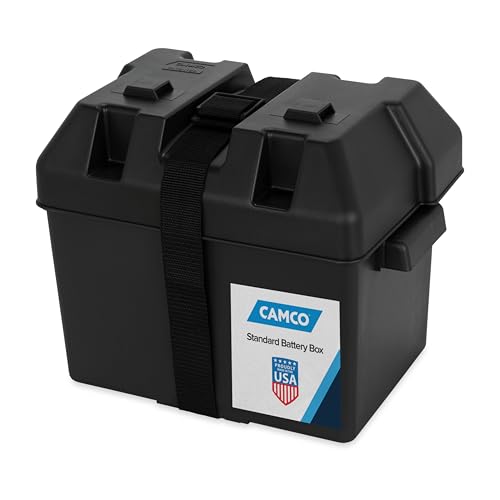
Camco has earned its reputation among RV owners by selling complete kits rather than bare trays, and the 55363 fits that pattern. You get the polypropylene box, a lift-off lid, a woven hold-down strap, foot clamps, and stainless screws in one package, which is genuinely useful for a camper who wants to do the install in an afternoon.
The box is officially Group 24 sized, so it tends to fit smaller Group 31 cells on a case-by-case basis depending on terminal height. It’s lightweight, corrosion-resistant, and meets USCG CFR 183.420 plus ABYC E-010.7 for marine use, so it covers the regulatory basics for most installations. Compared with the Attwood 9094-5 reviewed earlier, the Camco is lighter and friendlier to handle, though it trades some rigidity for that weight savings.
Everyday Perks
- Complete kit eliminates the “I forgot the strap” trip back to the hardware store.
- Lightweight polypropylene is easy to lift into a high-mounted RV compartment.
- USCG and ABYC compliance simplifies installation in inspected vessels.
Some Limits To Know
- Group 24 native sizing means larger Group 31 batteries may not clear the lid.
- Lift-off lid has no latches, so a rough road can shift it if the strap loosens.
Made For
RV and trailer owners who want a regulation-friendly, all-in-one box without measuring for separate parts.
Look Elsewhere When
Owners committed to a true Group 31 footprint should choose the NOCO BT31S Group 31 Heavy-Duty Battery Tray instead, which is sized specifically for that format.
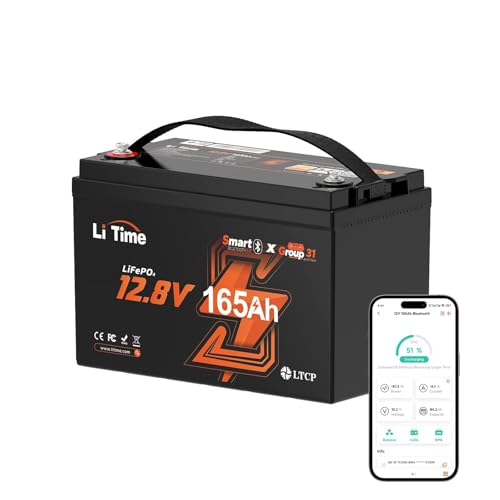
Where the 100Ah Litime reviewed earlier is a sensible house bank starter, the 165Ah sibling is the bigger, smarter version for the same family of installs. Capacity jumps to 165 amp hours in the same Group 31 envelope, and the integrated Bluetooth 5.0 radio reports voltage, current, and state of charge to a phone app without extra shunts.
The BMS carries 20-plus protection routines, IP65 sealing, and salt-fog resistance, and the low-temperature cutoff stops charging below about 32°F, which protects the cells in shoulder-season camping. Compared with the 100Ah version, this is the one to choose when you want fewer cells doing more work in the same compartment. The main caveat is that lithium banks of this size demand a charger and alternator profile designed for LiFePO4, which adds real cost.
Benefits That Matter
- Bluetooth telemetry removes the guesswork from checking state of charge at the campsite.
- Low-temperature cutoff protects cells from damage when camping in cold shoulder seasons.
- Salt-fog resistance suits offshore mounts where standard lithium batteries would degrade.
Practical Considerations
- You may find the larger capacity overkill for a single-battery weekend rig.
- Alternator and shore chargers often need a lithium profile to fully recharge this bank safely.
Perfect Match For
Full-time RV owners and liveaboard boaters who want phone-app monitoring and a single cell that handles serious house loads.
A Better Fit Elsewhere
Shoppers building a smaller bank should stay with the Litime 12V 100Ah Group 31 LiFePO4 Battery, which fits lighter duty at lower cost.
The 9099-5 is what Attwood sells when a tray has to fit where a tray doesn’t really want to fit. The footprint runs about 12-7/8″ L x 7″ W and accepts batteries up to 10-1/2″ tall, so it squeezes into the kind of cramped engine bay where full-size boxes simply won’t go.
The polypropylene hold-down strap uses a positive-locking, quick-disconnect buckle, which makes removing the cell for off-season storage a one-hand job rather than a tool hunt. Owners commonly report that the molded base mounts cleanly with four standard #10 panhead fasteners, so no specialty hardware is needed. Compared with the Attwood 9094-5 reviewed earlier, this one ships as a complete kit and fits tighter spaces, though it’s slightly less adjustable in height.
Practical Pluses
- Compact footprint fits small bilge areas where standard Group 31 boxes won’t fit.
- Quick-disconnect buckle speeds up seasonal battery removal.
- Standard fastener mounting means no specialty hardware to source.
Worth Bearing In Mind
- Height limit of about 10-1/2″ rules out taller Group 31 cells with high terminal posts.
- Open tray design offers no lid to contain minor leaks or short hazards.
Who Should Grab It
Backyard mechanics and weekend boat owners with tight engine bays who need a clean, complete tray setup.
Where A Sibling Pick Shines
Owners running taller Group 31 cells should pick the Attwood 9094-5 Heavy-Duty Battery Tray, which has more height adjustment range.
T-H Marine earned its stripes in offshore hardware, and the Group 31 holder tray reflects that pedigree. The stainless steel buckle is the headline: in a pounding seaway, plastic buckles crack and snap, so a metal buckle tends to outlast the boat it’s mounted on.
The construction is built for permanent mounting, and the NMMA certification (a National Marine Manufacturers Association mark that signals the part passed industry-recognized testing) gives confidence that the holder has been independently evaluated. For a center-console fishing rig or a trailerable cruiser, that’s a meaningful distinction. Compared with the Allstar Performance steel box reviewed at the end, this tray is lighter and simpler, since the Allstar is geared toward custom fabrication rather than drop-in marine service.
A Favorable Mix
- Stainless buckle resists the cracking and UV brittleness that plague plastic fasteners.
- NMMA certification supports resale value on documented marine installations.
- Corrosion-resistant materials suit long-term saltwater exposure.
Where It May Fall Short
- Open-tray design leaves terminals exposed, so you may want to add terminal covers.
- Stainless buckle adds cost compared to plain plastic hold-downs.
Whose Shelf It Belongs On
Offshore boaters and saltwater anglers who want a documented, hold-everything mount for a Group 31 trolling battery.
Consider Something Else When
Fabricators building a custom race or buggy setup should reach for the Allstar Performance ALL76100 Steel Battery Box, which is designed for welding and custom fitment.
The BT31S is NOCO’s answer for shop owners and overlanders who treat their trailers like rental fleets. The 42-inch hold-down strap is water-resistant nylon rated for tensile loads above 120 kilograms, so a bouncing road or a hard wake is unlikely to loosen it.
Impact resistance is rated to a useful low temperature, which is a polite way of saying the tray tolerates the kind of rocks, stumps, and dropped tools that come with off-grid travel. It’s built around a single Group 31 footprint, and the strap’s length gives room for taller cell housings. Compared with the Attwood 9099-5 reviewed earlier, the BT31S uses a longer strap and a more ruggedized frame, though it ships without a lid.
Where It Helps
- 42-inch strap clears taller Group 31 housings without modifications.
- Impact-rated construction survives the kind of abuse trailers see on rough roads.
- Wide compatibility across marine, RV, camper, and trailer installs.
Potential Sticking Points
- No lid means terminals stay exposed and benefit from a separate boot or cover.
- Long strap can look loose on shorter battery heights without adjustment.
Right Fit For
Overlanders, rental fleet owners, and trailering anglers who punish their gear and want a forgiving tray.
Skip It When
Shoppers needing a sealed enclosure should pair the Sidasu Stainless Steel Battery Box with their battery instead, which adds a closing lid.
The Allstar ALL76100 isn’t a marine box in disguise, and that honesty is part of its appeal. It’s a lightweight steel battery mounting box that comes with frame hooks and hold-down hardware, so a fabricator can weld it into a tubular chassis or bolt it into a buggy without fighting a plastic housing.
At roughly 11-3/4″ wide x 7-1/4″ deep, the box fits compact Group 31 footprints, though cell height depends on the lid or cover you build around it. It’s sold as a kit with hardware included, and the natural steel finish is ready for paint or powder coating. Compared with the NOCO BT31S reviewed earlier, this is the pick for someone who wants to modify the mount rather than drop it into a finished compartment.
Good Reasons To Consider
- Weldable steel construction suits custom race and off-road chassis.
- Frame hooks simplify tying the box into an existing roll cage or tube structure.
- Hardware included removes the second-trip-to-the-store problem.
Things To Weigh Up
- Steel construction will rust without paint, coating, or sealing.
- No marine lid, so it’s not a drop-in replacement for saltwater boat compartments.
Made For
Race teams and buggy builders who want a fabrication-friendly Group 31 mounting point they can weld or bracket into place.
A Better Fit Elsewhere
Saltwater boaters should pick the T-H Marine Battery Holder Tray, which is engineered for marine service rather than custom chassis work.
Picking A Group 31 Mount That Actually Fits Your Build
Battery boxes and trays for Group 31 cells vary more than the category suggests, and the differences show up at install time. Start with the actual cell dimensions: most Group 31 batteries sit around 13″ L x 6-7/8″ W, but terminal height varies, and oversized terminals can ruin an otherwise tight fit.
Material choice matters more than brand. Polypropylene trays are light and corrosion-proof, so they handle RV compartments and camper builds gracefully. Stainless or coated steel boxes add weight and need maintenance, but they shrug off impact better and resist the cracking that eventually shows up in plastic under UV exposure. In a saltwater bay, stainless is the safer long-term bet; in a covered engine bay, polypropylene saves your back.
Regulatory compliance is worth checking for marine installations. ABYC E-10 and USCG CFR 183.420 are the two standards most surveyors look for, and the Attwood and Camco entries above meet both. If your boat is documented or financed, a compliant tray protects resale value.
Finally, think about lithium upgrades. Group 31 LiFePO4 batteries drop into many Group 24 and 31 trays, but they bring their own charger and cold-weather requirements. Pick a tray or box with enough clearance around the terminals to land heavier-gauge cables without strain.
Key Considerations Across These Picks
Pitfalls Shoppers Hit
The most common mistake is buying a Group 24 box for a Group 31 battery. The lid closes fine in the store, then the taller cell arrives and nothing fits. Measure the actual battery, terminals included, and add at least a quarter inch on every side.
Another trap is assuming any strap kit works in a marine environment. Plastic buckles harden under UV and snap in cold weather, so for saltwater or year-round use, a stainless or reinforced buckle like the one on the T-H Marine tray pays back the small premium. Forgetting terminal covers is the third classic miss: an open tray leaves live posts exposed, and a dropped wrench becomes an expensive lesson.
Where The Extra Money Goes
Higher-tier Group 31 boxes and trays spend the premium on three things: material grade, regulatory compliance, and hardware quality. Stainless steel costs more than polypropylene, but it also resists the cracking, corrosion, and UV damage that shorten the service life of cheaper plastics. Boxes and trays that meet ABYC standards cost a bit more because they’ve been engineered against a published specification rather than a rough visual check.
The hardware matters too. Stainless or zinc-plated fasteners resist seizing in damp compartments, so seasonal swaps don’t turn into a cutting torch exercise. For most weekend users, a mid-tier polypropylene tray with a quality strap is plenty; for full-time marine or commercial service, the upgrade to stainless hardware and certified construction is usually worth it.
Frequently Asked Questions
Will a Group 31 battery fit in a Group 24 box?
Some shorter Group 31 cells will fit in a Group 24 box, but taller cells won’t clear the lid. Measure your battery, including terminals, and compare against the box’s interior dimensions before ordering.
Do I need a tray or a fully enclosed box?
A tray holds the battery and exposes the terminals for easy service, while a box adds a lid for spill containment and short protection. For a covered RV or camper compartment, a tray is usually enough; for marine bilges and rough service, an enclosed box is safer.
Are Group 31 lithium batteries safe in marine compartments?
LiFePO4 batteries are thermally stable and ship with integrated BMS protection, so they’re generally safe. They still need a compatible charger and should be mounted with terminal protection, and they require venting consideration in sealed compartments.
What hardware do I need to mount a Group 31 tray?
Most trays ship with mounting fasteners and either an integrated strap or hardware for a separate one. You typically need four #10 panhead screws or matching bolts, and a hold-down strap rated for the cell’s weight.
Can I stack two Group 31 batteries in one box?
Most boxes are sized for a single cell. For dual-battery banks, use matched individual trays or boxes mounted side by side, and follow ABYC guidance for battery separation and ventilation.
Bottom Line
Group 31 boxes and trays come in three flavors: lightweight polypropylene for everyday RV and trailer service, heavy-duty stainless or coated steel for marine and impact-prone installs, and fully integrated lithium batteries that pair with either style. Match the material to your environment, confirm the regulatory fit, and double-check dimensions before you commit. The right mount keeps the battery safe, the surveyor happy, and the rest of your gear protected for years.