A dead battery rarely picks a convenient moment. It shows up in a parking lot before a meeting, at a campsite in the rain, or on a Monday morning when you’re already running late. Modern battery boosters sidestep the wait for a tow truck or a kind stranger by cranking enough cold-start current from a small box to bring most passenger vehicles back to life in seconds. The best of them also double as tire inflators, power banks, and emergency lights, which is why they belong in trunks, work vans, and weekend road-trip bags.
The ten picks below cover the spread you actually care about: heavy-duty rolling units for shops, slim lithium packs that vanish in a glove box, and hybrid jump-and-inflate combos for the driver who likes one tool that handles several emergencies. Each one earns its spot on a specific real-world use case, not on a spec sheet.
The Choices Worth Comparing

BRPOM 8000A Jump Starter with 160 PSI Inflator

Clore Automotive Jump-N-Carry JNC660 1700A

Clore Automotive Jump-N-Carry JNC770R

WOLFBOX 4000A Rose Gold Jump Starter

HPBS 5000A Jump Starter with Air Compressor

Battery Tender 2000A Lithium Jump Starter

HPBS H50 5000A Jump Starter with LCD

Westinghouse 2000A Waterproof Jump Starter
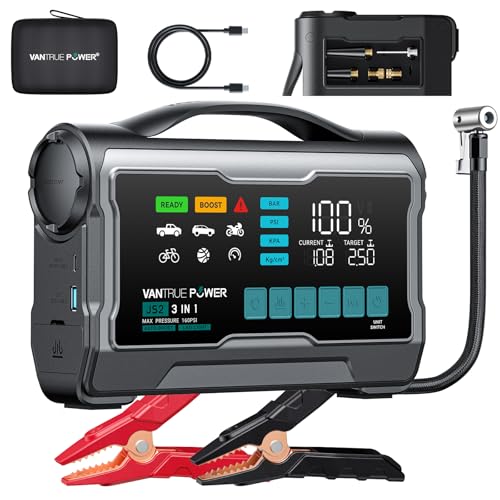
VANTRUE POWER JS2 2500A with Inflator

HPBS 5500A Jump Starter with LCD (Red)
Inside Each Recommended Option
The BRPOM G10 jump starter is the kind of unit you stash in a tow rig or family SUV because it handles two emergencies in one box: a flat battery and a soft tire. Peak current sits at 8000A, which is genuinely oversized for most passenger cars but earns its keep on larger-displacement gasoline and diesel engines up to 12L. Compared to the Clore JNC660 in spot two, this one trades shop-grade simplicity for versatility, including a built-in 160 PSI inflator.
Owners commonly appreciate the Force Start mode for batteries too depleted to register normally. That little detail matters in cold snaps, when a battery might be alive but undetectable. The trade-off is heft: this is a tote-along, not a glove-box unit.
Key Advantages
- 8000A peak current handles trucks, SUVs, and large diesels comfortably
- Built-in air compressor rated up to 160 PSI replaces a separate inflator
- Force Start helps recover batteries too low for standard detection
- All-gas plus up to 12L diesel coverage broadens the use case
Things To Consider
- Size and weight make it more of a trunk tool than a daily-carry
- Inflator runtime on a single tank of air is shorter than dedicated compressors
Built With In Mind
Long-haul drivers, overlanders, and rural households running larger engines who want one box instead of three separate tools.
A Better Fit Elsewhere
Daily commuters in small cars should reach for the Battery Tender 2000A instead, since their needs rarely call for 8000A of headroom.
The JNC660 has been a shop-staple for so long that “Jump-N-Carry” is almost generic for portable jump packs. This bundle adds a JNC350 charging cord, which keeps the onboard 22Ah PROFORMER battery topped up between uses, an honest convenience for anyone who only remembers to charge gear after it’s needed. The included 46-inch #2 AWG cables (a thick, high-conductivity gauge) give solid reach across larger engine bays.
The onboard voltmeter is a quiet strength: a glance tells you charge status before the next vehicle rolls in. It’s not a lithium unit, so it carries real weight, but that weight is also why it keeps cranking in freezing weather better than many compact packs.
Notable Gains
- 1700 peak amps with 425 cranking amps for dependable cold starts
- Heavy-duty 46-inch #2 AWG cables handle bigger engine bays
- Voltmeter on the front shows battery state at a glance
- Lead-acid PROFORMER battery tolerates cold storage well
Trade Offs
- Heavier than lithium packs, so it’s not a glove-box item
- No tire inflator, flashlight, or USB power bank built in
- Needs the included charger or a 120V outlet to recharge
Made For
Garage owners, mobile mechanics, and small-fleet operators who want proven shop-grade cranking and don’t need extra features.
Consider Something Else When
Drivers who want jump-and-inflate in one tool should look at the BRPOM 8000A in spot one.
The JNC770R sits one rung above the JNC660 reviewed earlier, and the upgrades show in three places that matter on a busy morning: a 68-inch cable reach, dual USB outputs for topping off a phone or scan tool, and a 3-amp internal charger that refills the pack noticeably faster than older Jump-N-Carry models. Same 1700 peak amp output, but the longer leads mean fewer awkward cable swaps around diesel trucks.
Like its sibling, this is a workshop-style lead-acid unit, not a featherweight lithium brick. The master ON/OFF switch helps avoid parasitic drain when the unit sits on a shelf between service calls, a small detail that adds up over months of ownership.
Well-Handled Touches
- 68-inch cables reach across full-size engine bays without repositioning
- Dual USB ports turn it into a backup power bank for tools and phones
- 3-amp onboard charger fills the unit quicker than older models
- Master switch prevents slow drain during long storage
Room For Improvement
- Bigger and heavier than lithium competitors
- Premium price step over the JNC660 if you don’t need extra reach
Whose Shelf It Belongs On
Prosumers and serious DIYers driving trucks or SUVs who want extra cable length and USB output in a proven platform.
Not Your Match When
Lightweight daily-carry shoppers are better served by the Battery Tender 2000A in spot six.
The MegaVolt24 in rose gold is the rare booster that doesn’t look out of place sitting on a passenger seat. WOLFBOX pairs a 4000A peak current with an 88.8Wh internal battery, which is enough to bring back cars, SUVs, light trucks, and boats powered by engines up to 10L gas or 10L diesel. The 65W quick-charge input matters more than the spec suggests: in real life, it means a 30-minute wall top-up gets you meaningful capacity back.
An integrated LED light handles the dark-garage scenario without needing a second tool. Versus the workmanlike HPBS H50 in spot seven, this WOLFBOX leans into lifestyle design without sacrificing serious starting power.
What Works In Its Favor
- 4000A peak current covers most personal vehicles and small boats
- 65W quick-charge input fills the pack noticeably faster
- Rose gold finish stands out from the usual black-and-orange crowd
- Built-in LED light for nighttime emergencies
Soft Spots
- Color-matched finish shows scuffs faster than textured black cases
- No tire inflator, unlike the hybrid options in spots one and five
Best Suited To
Style-conscious daily drivers who want a real booster that complements the car rather than disappears in a trunk bin.
Swap It Out When
Overlanders who want jump-and-inflate in one tool should pick the BRPOM 8000A in spot one instead.
Where most lithium boosters skip the inflator, this HPBS unit leans into it: a 5000A peak jump starter paired with a 150 PSI compressor that handles up to 10.0L gas and 8.0L diesel engines. The operating range, from -4°F to 140°F, is a useful detail for anyone living through real winters or desert summers. The RST button helps recover batteries that read as fully dead.
A full charge is rated for up to 50 jump starts on paper, which means most households will top it up once a season rather than weekly. The trade-off is bulk: this is a hybrid box, not a pocket unit.
Everyday Perks
- 5000A peak pairs with a 150 PSI built-in compressor
- Wide operating temperature range handles cold winters and hot summers
- Up to 50 jumps per charge for light household use
- RST mode revives batteries too low to register normally
Honest Caveats
- Bigger than single-purpose lithium packs
- Inflator is slower than a dedicated 12V tire compressor
Right Fit For
Road-trippers, weekend haulers, and small-fleet owners who want one tool that handles both dead batteries and soft tires.
Reach For A Different Pick When
Shop mechanics prioritizing raw cranking power should still pick the Clore JNC660 in spot two.
The Battery Tender 2000A lives in the glove-box lane of the market. The 16000mAh lithium pack slips under a seat or in a center console while still delivering 2000A of peak current, enough for any 12V battery on gas engines and diesels up to a V8. The 100W inverter is a quiet bonus that turns the unit into a real power station for laptops or small appliances during a tailgate.
Three fast USB ports and a multi-mode LED flashlight (including an emergency strobe) round it out for road use. Against the larger Clore JNC770R reviewed earlier, this one trades cranking headroom for genuine portability.
A Strong Showing
- Compact lithium design fits in glove boxes and under seats
- Three USB ports plus a 100W inverter for real power-bank use
- LED flashlight with emergency strobe for roadside visibility
- Handles gas engines and diesels up to a V8
Worth Bearing In Mind
- 2000A peak trails heavier-duty units on large diesel trucks
- Lithium cells prefer being topped up every few months during storage
Who Will Love This
Commuters, rideshare drivers, and apartment dwellers who need a glove-box-friendly booster that doubles as a phone charger.
Look Elsewhere When
Drivers of heavy trucks or large equipment should look at the HPBS 5500A in spot ten.
The H50’s defining feature is its 3.0-inch LCD, which surfaces the kind of detail most boosters bury under blinking LEDs. You see voltage state, remaining capacity, and operating status in plain text, which lowers the learning curve for first-time owners. Under the hood it’s a 5000A peak unit rated for gas engines up to 10.0L and diesels up to 8.0L.
Up to 40 jumps per full charge is the published rating, which lines up with weekend-garage use rather than daily fleet duty. Compared with the WOLFBOX rose gold unit in spot four, the H50 is more toolbox than fashion statement, but the screen is genuinely useful in a panic.
A Few Strong Suits
- 3.0-inch LCD displays voltage and capacity in plain terms
- 5000A peak current covers most family vehicles
- Up to 40 jump starts per charge for periodic use
- 10.0L gas and 8.0L diesel coverage broadens the use case
Points To Keep In Mind
- LCD adds cost you may not need if you’re used to indicator lights
- No built-in tire inflator, unlike spot five’s HPBS hybrid
Perfect Match For
New booster owners who appreciate clear readouts over tiny blinking LEDs in stressful moments.
Another Choice May Suit
Style-leaning shoppers may prefer the WOLFBOX Rose Gold in spot four.
The Westinghouse 2000A leans into outdoor and off-grid use. The IP65-rated housing shrugs off rain and dust, which matters when your booster lives in a truck bed, ATV box, or backpack rather than a clean trunk. Up to 30 starts per charge handle gas engines up to 7.0L and diesel engines up to 5.0L. Spark-proof technology and reverse-polarity protection ease the nerves of anyone new to jumper cables.
It also works as a USB power bank, so you can top off a phone or headlamp while sitting at a trailhead. The bright LED flashlight rounds out the outdoor kit. Compared to the sleeker WOLFBOX in spot four, this one is plainer but tougher.
Positive Points
- IP65 housing handles rain, mud, and trail dust
- Up to 30 jump starts per charge for weekend trips
- Spark-proof and reverse-polarity protected for safer connections
- Doubles as a USB power bank and bright LED flashlight
Practical Considerations
- Engine cap of 7.0L gas and 5.0L diesel rules out big trucks
- 2000A peak trails heavier units like the HPBS H50 in spot seven
Who Should Grab It
Campers, overlanders, and trail drivers who need weatherproof gear that pulls double duty on a campsite.
Skip It When
Truck and SUV owners with larger engines should grab the HPBS 5500A in spot ten instead.
VANTRUE POWER’s JS2 packs three jobs into one box: a 2500A peak jump starter for engines up to 8.0L gas and 7.0L diesel, a 160 PSI air compressor for tires and inflatables, and a 65W PD power bank for fast laptop and phone charging. The 16000mAh internal cell feeds all three without complaint, and the dedicated nozzle compartment keeps the inflator accessories from rattling loose in a trunk.
For tech-heavy drivers, the bidirectional 65W PD port is the standout feature: it charges the unit fast and reverses to power USB-C laptops in a pinch. The display keeps you oriented on voltage and inflator pressure without leaning on guesswork.
Real Benefits
- 2500A peak current plus 160 PSI compressor in one case
- 65W bidirectional PD port for fast top-ups of laptops and phones
- Built-in display for voltage and pressure readouts
- Nozzle storage compartment keeps accessories organized
Points To Note
- Higher feature density raises the price over single-purpose units
- Cap of 8.0L gas and 7.0L diesel rules out heavy-duty trucks
Right Fit For
Tech-heavy commuters and road warriors who want one device to charge laptops, inflate tires, and start a dead battery.
Where A Sibling Pick Shines
Overlanders who want maximum cranking headroom will do better with the BRPOM 8000A in spot one.
The HPBS 5500A rounds out the list as the muscle option for truck and SUV owners. The 5500A peak output handles all gasoline engines and diesels up to 10L, while the 3.0-inch LCD keeps voltage and status legible at a glance. Up to 60 jumps per charge is a generous budget, enough for a season of helping stranded neighbors before a recharge.
Ten layers of safety protection are part of the spec, which reduces the risk of crossed clips on a dark driveway. Versus the BRPOM 8000A at the top, this one skips the inflator in exchange for a smaller footprint.
Benefits That Matter
- 5500A peak handles all gas engines and diesels up to 10L
- 3.0-inch LCD for clear voltage and capacity readouts
- Up to 60 jump starts per charge for frequent helpers
- Ten layers of safety protection reduce crossed-clip mishaps
A Few Limitations
- No built-in air compressor for tire emergencies
- Red finish shows dust and grime faster than textured black housings
The Right Fit
Truck, SUV, and large-engine owners who want headroom and clear readouts without paying for an integrated inflator.
Not Your Match When
Road-trippers who also want tire inflation should consider the VANTRUE POWER JS2 in spot nine instead.
What To Weigh Before Choosing Battery Boosters
Peak current is the headline number, but it isn’t the only one that decides a real-world jump. Engine displacement is the practical ceiling: a 2.0L commuter and a 6.7L diesel pickup live in different universes of cranking demand, and a booster rated “for 12L diesel” is genuinely safer for the truck than a unit capped at 5.0L.
Battery chemistry matters too. Lithium packs are lighter, fit in glove boxes, and hold a charge for months, but they lose capacity in deep cold if left uncharged. Lead-acid units like the Clore Jump-N-Carry line are heavier but tolerate freezing garages and repeated shop use. Lithium iron phosphate (LiFePO4) cells split the difference with better cold tolerance than standard lithium-ion.
Cable length and gauge (the thickness of the wire, where lower AWG numbers mean thicker cable) are easy to overlook until you’re trying to reach a battery buried under a fender. A 68-inch #2 AWG cable, like the one on the JNC770R, turns a stressful swap into a one-person job. Shorter 30-inch leads force awkward positioning, especially on larger trucks.
Decide whether you want a single-purpose cranker or a hybrid that adds a tire inflator and USB power bank. Hybrids cost more and weigh more, but they consolidate gear in one trunk. Single-purpose units stay lighter and often cheaper, ideal for vehicles that rarely face a flat tire.
Finally, consider recharge behavior. A booster that sits in a trunk for six months between emergencies is useless if its self-discharge rate drained the cells. Units with master switches and clear battery indicators help avoid that quiet failure mode.
Key Considerations Across These Picks
Common Shopping Slip Ups
The most frequent mistake is buying on peak-current headlines alone. A 8000A peak number only helps if the booster also has the cable reach and connection quality to deliver that current safely. Check that the clamps are copper or copper-coated, that the cable gauge is appropriate for the rated amps, and that safety features like reverse-polarity protection are present.
Another trap is ignoring storage behavior. Lithium units stored in a freezing garage overnight can lose effective capacity until warmed up. Buyers in cold climates should look at operating-temperature ranges or choose a lead-acid unit that handles low temperatures without ceremony.
What The Higher Tier Buys
Stepping up from a budget lithium booster to a premium unit typically buys three things: thicker cables with longer reach, a more robust battery cell with higher cycle life, and integrated accessories like compressors or PD charging. For casual users who jump once or twice a year, a mid-tier unit is plenty. For frequent helpers, roadside professionals, or anyone running larger engines, the upgrade pays off in fewer mid-jobs surprises.
Frequently Asked Questions
How many amps do you really need in a battery booster?
Match the booster to your engine size rather than chasing the largest number. A 4-cylinder commuter usually starts comfortably with 1000-2000A of peak current. V6 and V8 gasoline engines benefit from 2000-4000A. Diesel trucks over 6 liters typically need 4000A and up, with 8000A giving headroom for very large displacement or older, stubborn engines.
Can you leave a battery booster in a hot or freezing car?
Heat is the bigger enemy. Sustained cabin temperatures above 140°F can degrade lithium cells permanently. Cold is less destructive but reduces available capacity until the pack warms up. If your booster lives in a vehicle, garage it in the cabin rather than the trunk, and top it off every two to three months.
How often should you recharge a stored jump starter?
Every two to three months for most lithium units, and at least once per season for lead-acid boosters. Many modern units include a voltmeter or LCD that signals when recharge is due, which is easier than remembering a calendar.
Are built-in air compressors worth the extra cost?
For drivers who travel through rural areas or carry passengers on long trips, yes. A flat tire at the wrong moment is more common than a dead battery, and an integrated 150-160 PSI compressor handles most cars and SUVs. For urban drivers with roadside service coverage, a slimmer single-purpose booster is usually enough.
Can a jump starter damage a vehicle’s electronics?
Modern boosters with reverse-polarity protection and spark-proof clamps are designed to prevent that. The bigger risk comes from cheap units without those protections, or from crossed clips during the connection. Following the included sequence (positive first, negative last, reverse on removal) keeps the risk low.
Wrap Up
The right battery booster is the one that matches your engine, your vehicle, and the way you actually drive. For a glove-box daily carry, the Battery Tender 2000A or Westinghouse 2000A covers most needs. For truck owners and overlanders, the BRPOM 8000A or HPBS 5500A bring the muscle. For shops and pros, the Clore JNC660 and JNC770R remain the dependable anchors. Pick the tool that fits the scenario you actually face, and you’ll never again have to flag down a stranger with jumper cables.