A loose battery in a rocking hull is a real safety problem, not just a cosmetic one. Acid leaks, terminal damage, and short circuits all start with a battery that shifts under load. The right battery boat box keeps Group 24 through 31 cells locked down, vented properly, and shielded from spray, which matters on any vessel from a jon boat to a 28-foot center console.
Whether you’re running a trolling motor all weekend or storing a starting battery over the off-season, the picks below cover plain vented boxes, accessory-rich power stations, vibration mats, and rugged steel trays. Each one solves a slightly different problem, so match the box to your battery group, your space, and how much power you actually need to distribute on board.
A Fast Comparison Of The Options

SeaSense Battery Box Series 27, Black

Attwood 9067-1 Vented Battery Box, Group 27

Megaware Keelguard BatteryGuard Protector, Group 31

Sunapex Trolling Motor Smart Battery Box

Sunapex Marine Battery Box Replacement Strap
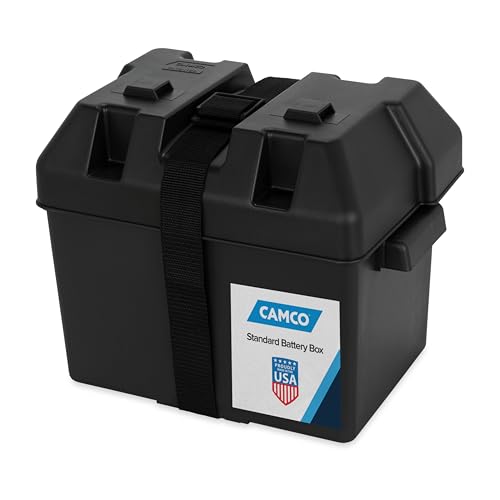
Camco Group 24 Marine RV Battery Box

Attwood 9093-5 Battery Tray With Strap, 27 Series

Attwood 9099-5 Battery Tray, 29/31 Series

Sunapex Smart Battery Box Pro 12V/24V Power Center

Allstar Performance ALL76100 Steel Battery Box
Inside Each Recommended Option
The SeaSense Series 27 box is the kind of plain, no-frills housing most weekend anglers reach for first. The molded black polyethylene shell shrugs off spray, and the vented lid lets charging gases escape instead of building pressure under the cover.
Stainless steel mounting hardware comes in the box, which means no last-minute hardware store run on launch day. Compared to the Attwood 9067-1 below, this one trades a Coast Guard specification stamp for a lower price tag, so it’s the better pick for skiffs and jon boats where compliance isn’t required.
Reasons It Performs
- Vented top with cover keeps the battery dry while still allowing gases to escape during charging.
- Stainless steel hardware resists rust in saltwater environments.
- Battery strap included, so you don’t need to source a hold-down separately.
- Lightweight polyethylene is easy to lift in and out for off-season storage.
Things To Consider
- Available in four sizes, so confirm your battery group matches before ordering to avoid a snug fit that becomes a fight.
- Plastic construction can show scuffs over time in rocky bilge conditions.
Key Product Details
Right Fit For
Recreational boat owners running a single Group 27 starting or deep-cycle battery on a small-to-mid-size hull.
Consider Something Else When
The Attwood 9067-1 suits you better if Coast Guard and ABYC compliance is required for your vessel’s battery installation.
The Attwood 9067-1 is built for boat owners who care about the spec sheet, not just the price. It’s engineered to meet ABYC Standard E-10 and U.S. Coast Guard Specification 183.420, so it passes inspection on regulated vessels where a plain vented box would not.
The acid-resistant construction handles the occasional spill or condensation drip without degrading. Where the SeaSense box above leans simple and light, this one adds compliance-grade durability for permanent installs in larger boats.
The Practical Payoff
- Meets ABYC and Coast Guard battery hold-down rules for federally regulated craft.
- Acid-resistant material extends service life in damp bilge environments.
- Mounting strap included for immediate install.
- Tuned specifically for Group 27 footprints, so the fit stays snug.
Trade Offs
- Heavier than a basic polyethylene box, which matters when you’re hauling the unit in and out for charging.
Whose Shelf It Belongs On
Inspected commercial operators and serious recreational skippers who want a spec-compliant Group 27 housing.
Skip It When
The Camco Heavy Duty Group 24 Marine RV Battery Box makes more sense if your battery is Group 24 rather than 27.
Megaware’s BatteryGuard is a different animal from the molded boxes above. It’s a thin vibration-absorbing mat sized 12.75 x 6.88 x 0.375 inches, designed to sit under a battery that already lives in its own tray.
Use it on boats that pound through chop, on RVs heading down washboard forest roads, or on semi trucks and off-road builds where constant shaking shortens battery life. The material damps vibration before it reaches the plates, which is what kills deep-cycle batteries prematurely.
Positive Points
- Sized to drop into a Group 31 box or tray without trimming.
- Cuts vibration transferred from hull, frame, or chassis into the battery.
- Helps extend service life on deep-cycle banks that see heavy discharge cycles.
- Cross-vehicle compatibility means one mat covers boat, RV, or truck use.
Points To Keep In Mind
- Not a full enclosure, so you still need a tray or box around the battery for compliance.
- Trim or sand the edges in tight trays where 0.375 inches eats into clearance.
Best Suited To
Owners running Group 31 deep-cycle batteries on rough-water boats or vehicles that hammer the batteries with constant vibration.
Reach For A Different Pick When
The Attwood 9099-5 Tray With Strap is the better call if you need a complete Group 31 tray rather than a vibration mat alone.
The Sunapex Smart Battery Box is less a storage box and more a portable power station wrapped around Group 24, 27, or 31 batteries. It carries a 16A overload switch (a resettable breaker that trips before wiring overheats), dual USB 5V 2.1A ports, a 12V cigarette socket, and a digital voltmeter on the outside panel.
The built-in side light is the small touch that wins people over on early-morning launches or night dockside work. Side handles keep the loaded box portable between vehicles. Compared to the plain SeaSense box earlier, this one turns your battery into a campsite or dock-side hub.
Why It Works Well
- Integrated 16A overload switch protects downstream electronics from current spikes.
- USB ports and 12V socket eliminate the need for separate adapters at the dock.
- Digital voltmeter shows state of charge at a glance without a multimeter.
- Side handles make transport easier once the battery is loaded inside.
Honest Caveats
- Heavier than a plain vented box once the battery is inside, so plan your carry path.
- External ports require some care to keep spray out during rough weather.
Feature Snapshot
Built With In Mind
Anglers and kayak-trolling-motor users who want USB charging, 12V accessory power, and a built-in light from one portable rig.
A Better Fit Elsewhere
The Sunapex Smart Battery Box Pro suits you better if you need 30A Anderson outputs for high-current accessories.
This isn’t a box at all. It’s the factory replacement strap designed specifically for Sunapex battery boxes, sold for owners whose original webbing has frayed or stretched.
Worn straps are a real safety issue, since a strap that doesn’t cinch tight lets the battery slide under hard turns. Replacing the strap is faster and cheaper than buying a whole new box, especially when the box itself is still in good shape.
Real-World Strengths
- Factory fit on Sunapex boxes means no trimming or drilling.
- Restores full hold-down force on an otherwise undamaged box.
- Cheaper than replacing the entire box for one stretched part.
A Few Limitations
- Only fits Sunapex boxes, so it’s useless as a universal strap.
- Battery and box are not included, so confirm what you actually need before ordering.
Perfect Match For
Sunapex Smart Battery Box owners who need to restore a stretched or sun-damaged hold-down strap.
Another Choice May Suit
The Camco Group 24 Marine RV Battery Box is a smarter replacement if your strap is worn because the box itself is aging out.
The Camco 55363 is the dependable Group 24 box that shows up on RV bays and small boats in equal numbers. Heavy-duty polypropylene resists corrosion, and the lift-off lid makes top-post access quick for routine water checks.
Inside lid dimensions run roughly 7-1/4 inches wide, so confirm your Group 24 battery sits below that clearance ceiling. The box carries USCG CFR 183.420 and ABYC E-010.7 compliance for installations where those specs apply.
Useful Touches
- Lift-off lid simplifies top-post maintenance and watering.
- Woven strap and stainless screws included for full install.
- Lightweight polypropylene keeps total weight manageable.
- Spec-compliant for federally regulated vessels.
Some Limits To Know
- Group 24 footprint won’t accept larger Group 27 or 31 batteries without swapping boxes.
The Right Fit
Boat and RV owners running standard Group 24 batteries who want a spec-compliant, lightweight housing.
Look Elsewhere When
The Attwood 9067-1 is the stronger pick if you need a Group 27 box with the same compliance pedigree.
The Attwood 9093-5 is a low-profile molded tray, not a sealed enclosure. It slides a Group 27 or 27M battery into a 12 3/8 x 7 1/8-inch footprint and holds it with a quick-disconnect polypropylene strap.
This shape is the right call in tight bilge compartments where a full vented box adds too much height. Four #10 panhead fasteners secure the base, and the open top means charging and watering stay easy.
The Upside
- Low-profile design fits where taller vented boxes won’t.
- Quick-disconnect buckle saves time on swaps and inspections.
- Easy top access for terminal work without removing the lid.
- Molded base installs with standard fasteners.
Worth Bearing In Mind
- Open-top design means splashing water reaches the battery, so seal terminals if you run in heavy spray.
- Group 27 only, so 31-series batteries won’t sit properly on this tray.
Made For
Boat owners with shallow battery compartments running Group 27 or 27M cells where vertical space is the constraint.
Where A Sibling Pick Shines
The Attwood 9099-5 is the right move if you need a tray sized for the larger Group 29 or 31 footprint.
The Attwood 9099-5 takes everything the 9093-5 does and stretches it for the bigger Group 29 and 31 batteries used in deep-cycle trolling and house banks. Tray dimensions run 12 7/8 x 7 inches, sized for batteries up to 10 1/2 inches tall.
Same quick-disconnect buckle and four-fastener install as its smaller sibling. The taller battery capacity also opens the door to lithium drop-ins in the same group, which matters as more anglers move away from lead-acid.
The Case For It
- Handles Group 29 and 31 batteries up to 10 1/2 inches tall.
- Quick-disconnect strap speeds up seasonal swaps.
- Open design keeps terminals and caps reachable for service.
- Same proven mounting footprint as the smaller 9093-5 tray.
Where It Is Less Suited
- Open tray offers no spray protection, so battery terminal covers matter in saltwater use.
- Larger footprint needs more bilge clearance than Group 27 trays.
Spec Overview
Who Should Grab It
Skippers running Group 29 or 31 deep-cycle banks on boats with enough bilge room to clear a 12 7/8-inch tray.
Swap It Out When
The Attwood 9093-5 makes more sense if your boat is wired around smaller Group 27 batteries.
The Sunapex Pro is the upgraded version of the Smart Battery Box covered earlier, and the differences show up in the current handling. It carries dual 30A Anderson ports (high-current plug connectors used for trolling motors and solar arrays) with a combined max draw of 50A, plus QC3.0 and USB-C PD fast-charge ports for modern phones and tablets.
The 16A overload switch, digital voltmeter, and built-in side light all carry over from the basic model. Where this one pulls ahead is feeding high-current trolling motors and inverter loads without voltage drop at the connector.
Benefits That Matter
- Dual 30A Anderson ports handle trolling motors and solar charging cables directly.
- QC3.0 and USB-C PD ports charge phones and laptops at full speed.
- 50A combined max supports serious house-bank accessories.
- Retains the built-in light and voltmeter from the basic Sunapex.
What To Weigh
- More expensive than the basic Sunapex Smart Battery Box, which may be overkill for casual users.
- Battery not included, so budget for a separate Group 24, 27, or 31 cell.
Who Will Love This
Offshore anglers and solar-RV owners who need high-current Anderson outputs and modern USB-C charging in one portable box.
Not Your Match When
The basic Sunapex Smart Battery Box suits you better if you don’t need Anderson ports and want to keep the cost down.
The Allstar Performance ALL76100 steps away from plastic entirely. It’s a lightweight steel mounting box measuring 11 3/4 inches wide by 7 1/4 inches deep, designed for race cars, hot rods, and custom trailers where a plastic box would feel out of place.
Frame hooks and hold-down hardware come included, and the natural steel finish takes paint or powder-coat cleanly. Unlike the marine-focused boxes above, this one prioritizes chassis rigidity over corrosion resistance, so it works best in dry or coated environments.
Strong Points
- Steel frame adds chassis rigidity over plastic alternatives.
- Frame hooks accept standard hold-down rods.
- Lightweight steel keeps total mass manageable for race-weight builds.
- Natural finish accepts paint or powder-coat for a custom look.
Potential Drawbacks
- Bare steel will rust in saltwater use without a coating or paint layer.
- Not Coast Guard or ABYC rated for marine compliance installs.
Perfect Match For
Race car, hot rod, and trailer builders who want a steel box that bolts cleanly to a chassis or frame rail.
Where Another Pick Suits Better
The Attwood 9067-1 is the right call if the box will live in a wet marine bilge rather than a dry chassis.
Choosing The Right Battery Boat Box For Your Setup
Battery group size is the first filter. Measure your battery or check the label, then match it to a box rated for that group, since a loose fit lets the cell shift under hard turns.
Next, decide whether you need a sealed vented enclosure or an open tray. Vented boxes contain acid splashes and meet Coast Guard and ABYC rules, while trays save vertical space and keep terminals accessible. If you run a trolling motor or charge devices off the battery, a smart box with USB ports and a voltmeter simplifies the rig.
Finally, think about corrosion. Polypropylene handles saltwater well, steel demands a coating, and aluminum sits in between. Match the box material to the environment, not the price.
Things Worth Knowing Before You Buy
Common Shopping Slip Ups
The biggest mistake is grabbing a box by guess rather than by group number. Group 24, 27, and 31 batteries all look similar at a glance, but the dimensions differ enough that a wrong box ends up holding the battery too loosely.
Another common slip is ignoring venting. Flooded lead-acid batteries off-gas hydrogen while charging, and a sealed non-vented box can trap that gas in a closed hull compartment. Always confirm the lid vents or the install location allows gas to escape.
What The Higher Tier Buys
Paying more for a smart battery box buys integrated ports, meters, and overload protection that a plain vented housing doesn’t carry. If you already own separate USB chargers, inverters, and a multimeter, the basic box is plenty.
The upgrade pays off when you want one portable rig that charges phones, runs a trolling motor, and shows state of charge at a glance. For anglers who launch and load the boat daily, that consolidation saves setup time and cable clutter.
Frequently Asked Questions
Do battery boat boxes need to be vented?
Vented lids are important for flooded lead-acid batteries, which release hydrogen gas during charging. AGM (Absorbent Glass Mat) and lithium batteries off-gas far less, so venting matters less for those chemistries.
Will a Group 27 box fit a Group 31 battery?
No. Group 31 batteries are larger in every dimension, and forcing them into a 27-rated box leaves the hold-down strap too loose. Always match the box group rating to your actual battery group.
Are marine battery boxes Coast Guard approved?
Boxes built to ABYC E-10 and USCG 183.420 specs meet the federal rules for permanently installed batteries. Plain plastic boxes without those ratings are fine for portable or non-regulated use.
Can I use a battery tray instead of a box indoors?
Trays work fine in dry compartments where splashing isn’t a concern. In bilge spaces or any area where water can reach the terminals, a sealed vented box is the safer choice.
How do I secure a battery box inside the boat?
Most boxes include stainless screws or mounting tabs. Bolt through the box base into a solid fiberglass floor or wooden stringer, and add a strap over the lid to keep it from popping off in rough water.
The Takeaway
The right battery boat box comes down to matching group size, environment, and accessory needs. Plain vented boxes like the SeaSense and Attwood 9067-1 cover most installs. Smart boxes from Sunapex add ports and meters for anglers who run a lot of accessories. Trays from Attwood solve tight-bilge problems, and the Allstar steel box covers dry chassis builds. Pick the box that fits your battery and your boat, and the rest takes care of itself.