A reliable battery bank changes how you move through the day. Whether your phone dies on a long flight, you shoot video off-grid, or you need to keep a laptop alive between coffee shops, the right portable cell takes the anxiety out of low-battery warnings. We put together this list to match real use cases, from ultra-thin magnetic packs you barely feel, to laptop-class bricks that can run a MacBook through a full work session.
The Picks In Brief
Ntaanoo Slim Magnetic Wireless Power Bank 5000mAh
RORRY Flow Portable Charger 10000mAh 40W
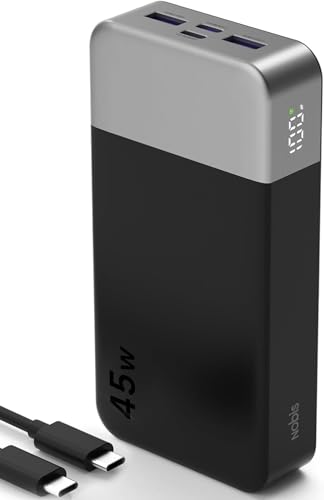
NOBIS 45W 20000mAh Portable Charger Power Bank

NOBIS Portable Charger 20000mAh 45W

RORRY CharmGo Portable Charger 5000mAh

RORRY CharmGo Portable Charger 10000mAh 20W

JUOVI Power Bank 90W 20000mAh with Detachable Cable
More Details On Our Top Picks

At roughly 0.38 inches thin and only about 119 grams, this magnetic power bank disappears into a back pocket or jacket lining. It snaps directly to the back of a recent iPhone using an upgraded ring magnet array, so there is no cable to fumble with on a crowded train platform or a long airport line.
Compared with the larger 10,000 and 20,000 mAh picks further down the list, this one trades capacity for true grab-and-go convenience. It is the kind of battery bank you forget you are carrying until your phone hits 20% and you keep scrolling.
Good Reasons To Consider
- Slim profile slips into small pockets and slim bags without a bulge
- Magnetic alignment means one-handed use while charging, useful on commutes
- USB-C port adds a wired option for non-magnetic devices or quick top-ups
- Light enough to ignore on long days, around 119 grams in hand
Trade-Offs Worth Noting
- 5,000 mAh only covers about a single phone charge, so heavy users may drain it by mid-afternoon
- Magnetic feature is tuned for iPhone models with built-in magnets, so Android owners miss the snap-on benefit
Right Fit For
iPhone users who want a barely-there top-up for commutes, flights, and nights out rather than full multi-day power.
Skip It When
The RORRY Flow Portable Charger 10000mAh 40W is a better match if you need built-in cables and faster 40W output for heavier phones or a tablet.
The RORRY Flow leans hard into simplification: a foldable AC wall plug and a built-in USB-C cable live on the unit itself, so you can leave your wall charger and cables at home for short trips. USB-C PD at 40W (Power Delivery, the fast-charging standard used by most modern phones and tablets) means it can refill an iPhone or even an iPad at meaningful speed.
Against the slim Ntaanoo magnetic bank above, this is the roomier, more travel-rugged choice. It trades the featherweight shell for double the capacity and a wall plug that turns any outlet into a refill station.
Real Benefits
- Foldable AC plug removes the need for a separate wall adapter on hotel stays
- Built-in USB-C cable cuts cable clutter in your daily bag
- 40W output supports fast charging for iPhone, iPad, and many laptops in a pinch
- 10,000 mAh comfortably covers a full phone cycle plus a tablet top-up
Honest Caveats
- Bulky compared with the 5,000 mAh magnetic option, so it is less comfortable in a trouser pocket
- 40W is shared across ports during multi-device charging, which can slow individual top-ups
Built With In Mind
Frequent flyers and commuters who want one device that charges a phone, refills at a wall outlet, and skips the cable drawer.
Reach For A Different Pick When
The JUOVI Power Bank 90W 20000mAh makes more sense if your carry includes a USB-C laptop that needs full-power charging on the move.
The NOBIS 45W model is built for speed: 45W output through its USB-C ports means a phone can jump from empty to roughly 60% in about 30 minutes, which is the difference between a useful coffee break and a missed call. The bank itself refills in around two hours thanks to bidirectional USB-C PD.
Where the RORRY Flow above focuses on cable convenience, this NOBIS doubles down on raw wattage. You trade the foldable plug for higher output and a 20,000 mAh reservoir that can run a phone through three or four full cycles.
Features That Help
- 45W output handles fast-charging iPhones, many Android flagships, and some tablets
- 20,000 mAh supports multi-day trips or shared charging with travel companions
- Two-way USB-C PD cuts the wall-refill wait to about two hours
- High-capacity cell recharges most smartphones around three and a half times
Things To Consider
- Heavier than 10,000 mAh packs, so plan for backpack carry rather than a pocket
- 45W requires a USB-C to USB-C cable of adequate rating, which is not always included in the box
At A Glance
Best Suited To
Road-trippers and remote workers who need serious capacity plus fast top-ups for phones and tablets.
Look Elsewhere When
The JUOVI Power Bank 90W 20000mAh suits you better if your bag carries a MacBook or other USB-C laptop that needs genuine laptop-class wattage.
This second NOBIS entry shares the same 45W USB-C PD profile and 20,000 mAh reservoir as Item 3, but it positions itself as a straightforward capacity play rather than a speed showcase. For shoppers who want the same large reservoir in a slightly more conventional form, it offers a familiar fast-charge spec sheet.
Compared with the slimmer Ntaanoo and the cable-rich RORRY Flow, this NOBIS is the workhorse option. You get full-power top-ups for a phone or tablet without the magnetic gimmick or the built-in cables, just a classic brick with serious endurance.
Real-World Strengths
- 20,000 mAh handles multi-day phone and tablet use away from outlets
- 45W USB-C PD speeds up refills for compatible iPhones and Android flagships
- Two-way charging means the bank itself refills fast when paired with a 45W adapter
Room For Improvement
- Same heavy carry as other 20,000 mAh packs, so backpack carry is the realistic default
- 45W output falls short of true laptop charging, unlike the 90W JUOVI option below
- Charges most smartphones about three and a half times, which is generous but not category-leading at this capacity
Feature Snapshot
Whose Shelf It Belongs On
Travelers and commuters who want a large, dependable reservoir and do not need built-in cables or a wall plug.
Consider Something Else When
The RORRY CharmGo Portable Charger 10000mAh 20W is a better fit if you would rather have built-in cables and a smaller pack for everyday carry.
The CharmGo 5,000 mAh model is built around the Apple Watch crowd, with a magnetic charging puck tuned for the watch plus iPhone-friendly outputs on the same body. Owners commonly report it tops up an Apple Watch roughly seven to ten times on a single bank charge, which covers long weekends or trail days when an outlet is miles away.
This sits in a different lane from the magnetic Ntaanoo at the top: the Ntaanoo is a phone-first magnetic pad, while the CharmGo splits time between watch and phone. It is the pick for someone whose watch dies before their phone does.
Points In Its Favor
- Dedicated Apple Watch charging pad keeps the watch topped up on overnight trips
- Compact 5,000 mAh cell suits keychain or jacket-pocket carry
- Charges AirPods several times over, useful for long-haul flights and road trips
Small Caveats
- Only enough capacity for about a single iPhone top-up, so heavy phone users may drain it by evening
- Watch-first design means Android phone owners get limited value from the magnetic pad
Made For
Apple Watch wearers and AirPods users who want one tiny brick that handles their smallest devices on the road.
Where Another Pick Suits Better
The RORRY CharmGo Portable Charger 10000mAh 20W is a stronger match if you also need fast iPhone top-ups and built-in cables in the same package.
This CharmGo bumps capacity to 10,000 mAh and adds 20W PD output along with built-in USB-C and Lightning cables plus a magnetic watch charger. In practical terms, that means you can leave a small nest of cables at home and still power an iPhone, an Apple Watch, and AirPods from one brick.
It is the more capable cousin of the 5,000 mAh CharmGo above, and the cable trio sets it apart from the magnetic-only Ntaanoo at the top of the list. You pay for it in size, but you save space in your bag.
The Value In It
- Three charging options built in: USB-C cable, Lightning cable, and Apple Watch pad
- 20W PD fast-charges a recent iPhone to roughly 56% in about half an hour
- 10,000 mAh covers a full phone cycle and still has reserve for earbuds or a watch
Practical Considerations
- Built-in cables can wear at the hinge over time with daily fold-and-unfold use
- 20W is solid for phones but slower than the 45W NOBIS and 90W JUOVI options for tablets and laptops
Who Should Grab It
Apple-first households and travelers who want one charger to cover iPhone, Apple Watch, and AirPods without packing extra cables.
Not Your Match When
The NOBIS 45W 20000mAh Portable Charger Power Bank is the better pick if your priority is maximum wattage and capacity over integrated cables.
The JUOVI 90W sits at the top of this list for raw wattage. With dual USB-C ports each rated up to 90W when used solo, it can push a 13-inch MacBook Air to about half charge in half an hour, and an iPhone to roughly 60% in the same window. That is laptop territory, not just phone territory.
The detachable cable is a small but meaningful touch: it tucks away cleanly when you travel and swaps out if it ever wears. Against the 45W NOBIS picks above, the JUOVI is the answer when a USB-C laptop is part of your everyday loadout.
Where It Excels
- 90W single-port output genuinely powers MacBook Air and many Windows ultrabooks
- 20,000 mAh supports a full workday away from outlets for both laptop and phone
- Supports both PD and QC (Qualcomm Quick Charge, the Android fast-charging standard) for broad device compatibility
- Detachable cable keeps the unit tidy in a laptop sleeve or backpack
Things To Weigh
- Heaviest pick on this list at 20,000 mAh, so it earns backpack space, not pocket space
- 90W per port drops when both USB-C ports are in use, which can slow dual-device sessions
Perfect Match For
Mobile professionals, students, and content creators who carry a USB-C laptop and want genuine laptop-class charging away from outlets.
A Better Fit Elsewhere
The RORRY CharmGo Portable Charger 10000mAh 20W is a friendlier daily carry if your bag carries only a phone, watch, and earbuds.
Picking The Right Battery Bank For Your Routine
Match Capacity To Your Use Pattern
Capacity, measured in milliamp-hours (mAh), describes how much charge the bank can hold. A 5,000 mAh pack covers a single iPhone top-up and nothing more, which suits short days and quick errands. A 10,000 mAh model gets most people through a full phone cycle plus a tablet or watch refresh, making it a strong everyday default. The 20,000 mAh picks on this list cover multi-day trips, shared charging, and laptops, but they earn their size in your bag.
Pay Attention To Wattage And Ports
Wattage tells you how fast the bank can deliver power. Phones are usually happy at 20W, which is why the RORRY CharmGo 20W feels quick. Tablets and most modern laptops want 45W or higher, which is where the NOBIS 45W models and the JUOVI 90W step in. USB-C PD is the modern fast-charging standard; QC is the equivalent standard for many Android phones. Banks with at least one USB-C PD port cover the widest range of devices in 2026.
Think About How You Carry It
Form factor matters more than raw specs for daily carry. Magnetic pads like the Ntaanoo vanish into a pocket but lack capacity. Built-in-cable bricks like the RORRY CharmGo 10000mAh cut clutter but add bulk. Laptop-class bricks like the JUOVI 90W are heavier still, so they live in backpacks. Choosing the shape that fits your bag is the difference between a battery bank you actually use and one that stays at home.
Plan For Recharging The Bank Itself
A larger bank is only useful if you can refill it. Look at the input wattage: a 45W-input bank refills in about two hours, while a slower-input pack may need five or six. If you travel with a fast laptop charger, a high-input bank becomes a quiet workhorse rather than a brick that takes overnight to recover.
Key Considerations Across These Picks
Pitfalls Shoppers Hit
The most common mistake is buying capacity you will never carry. A 20,000 mAh brick is impressive on paper, but if it lives in a drawer because it is too heavy, it has failed at its job. The second trap is ignoring wattage: a 10,000 mAh bank at 10W feels sluggish next to a 10,000 mAh bank at 20W. Last, shoppers often overlook port layout. A single USB-C port is fine for one device, but two phones and a watch need either multiple ports or built-in cables.
Why Top Tier Costs More
Higher-tier banks cost more for three reasons. First, larger or higher-quality battery cells add real material cost. Second, faster USB-C PD controllers and QC chips raise the bill of components. Third, thermal engineering matters: pushing 90W through a small body requires better heat dissipation, which is why the JUOVI carries a premium over a basic 20W pack. If you only need phone top-ups, a 5,000 or 10,000 mAh bank at 20W is plenty. If your laptop joins the trip, the upgrade to a 45W or 90W model earns its keep.
Frequently Asked Questions
How Many mAh Do I Really Need?
A 10,000 mAh bank covers most phone users for a full day away from outlets, while 20,000 mAh makes sense for trips, shared charging, or laptops. A 5,000 mAh pack works as a slim backup rather than a daily driver.
Is Higher Wattage Always Better?
Higher wattage charges faster, but only devices that support PD or QC at that level actually draw it. A 90W bank is wasted on a phone that only accepts 20W, though it has headroom for tablets and laptops.
Can I Bring A Battery Bank On A Plane?
Most airlines allow battery banks in carry-on bags under 100Wh (watt-hours), which covers all the picks on this list. Larger banks may need airline approval, so check your carrier’s rules before flying.
Do Magnetic Battery Banks Work With Any Phone?
Magnetic pads like the Ntaanoo only snap on to phones with built-in magnets, which covers recent iPhones. Most Android phones need a magnetic case or sticker to take advantage of the alignment.
How Should I Store A Battery Bank When Not Using It?
Store it around half charge in a cool, dry place if you will not use it for weeks. Avoid leaving any battery bank in a hot car, since heat shortens long-term cell health.
The Takeaway
The right battery bank is the one you actually carry, charged, in the bag you already use. Match capacity to your day, wattage to your devices, and form factor to your routine, and the rest of the picks become clear. Anything from this list will hold up well; the best one is the one that fits your habits.