One flicker of a power line can vaporize hours of unsaved work, corrupt a critical database, or brick a NAS array mid-write. A solid battery backup sits between your gear and the grid, giving you the seconds (or minutes) you need to save, close, and shut down properly. These ten picks cover everything from compact desktop towers to rackmount workhorses and a NAS-specific unit, so you can match capacity to the workload you actually run.
The Lineup, Simplified

CyberPower CP1500AVRLCD3 Intelligent LCD UPS
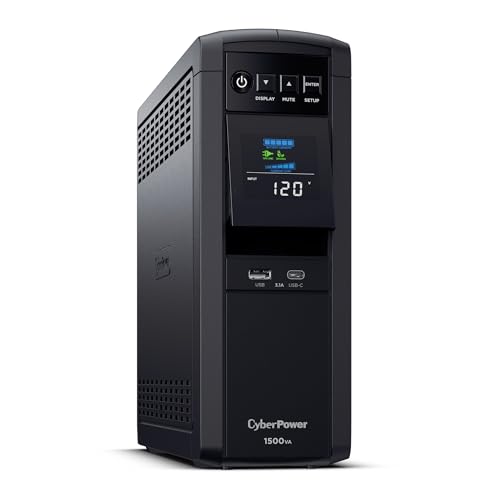
CyberPower CP1500PFCLCD PFC Sinewave UPS

CyberPower EC850LCD Ecologic UPS

CyberPower ST425 Standby UPS

CyberPower ST625U Standby UPS

APC Replacement Battery APCRBC123

CyberPower CP2000PFCRM2U PFC Sinewave UPS

CyberPower OR500LCDRM1U 1U Rackmount UPS


CyberPower CP1500PFCRM2U PFC Sinewave UPS
A Closer Look At Each Pick
The CyberPower CP1500AVRLCD3 sits in that sweet spot most home offices need: enough capacity for a full tower, monitor, router, and NAS, without the bulk or weight of a rack unit. Mini-tower form factor fits beside or under a desk, and the front LCD gives real-time readouts of load, estimated runtime, and input voltage, which matters when your neighborhood grid flickers more than you’d like.
Automatic Voltage Regulation (AVR) corrects minor brownouts and over-voltages without dipping into the battery, so you save runtime for actual outages rather than wasting it on sag events. Compared to the standby ST425 further down the list, this unit actively conditions power on the fly, which protects sensitive electronics from those nagging micro-surges a cheap power strip ignores.
Strong Points
- AVR trims small voltage swings without consuming battery reserves
- LCD panel surfaces load percentage and runtime at a glance
- Mini-tower chassis fits under a monitor stand or beside a desk tower
- Simulated sine wave handles most desktop PC power supplies cleanly
- Multiple outlets support a tower, displays, and networking gear at once
Things To Weigh Up
- Simulated (stepped) sine wave may not pair well with active PFC power supplies in newer workstations
- Battery is sealed lead-acid, which means a replacement cycle in roughly 3 to 5 years depending on discharge frequency
Feature Snapshot
Right Fit For
Home users running a single tower, monitor, and network gear who want AVR conditioning plus enough runtime to save work and shut down cleanly.
Reach For A Different Pick When
Modern builds with active PFC power supplies should consider the CyberPower CP1500PFCLCD for true sine wave output.
The CP1500PFCLCD exists for one specific reason: compatibility with active PFC power supplies found in most modern desktop builds and workstations. Where the CP1500AVRLCD3 above uses a stepped simulated sine wave, this unit outputs true sine wave power, which prevents the shutdown loops and chirping some PFC PSUs produce on cheaper UPS topologies.
The color LCD adds a polish touch the older monochrome displays lack, and the same AVR trick keeps minor grid noise from chewing through battery cycles. For a workstation running a high-end GPU and an 80 Plus Platinum PSU, this is the safer pairing, even if it costs more up front than the AVR-only sibling.
Advantages To Know
- True sine wave output plays nicely with active PFC power supplies
- Multifunction color LCD displays vitals without launching software
- AVR extends battery life by handling small fluctuations on its own
- Enough outlets to cover a tower, dual monitors, and a NAS
Room For Improvement
- Pricing runs above simulated-wave models for comparable VA ratings
- Fan noise picks up under heavier loads, which some users notice in quiet rooms
Who Should Grab It
Anyone running a modern PC with an active PFC PSU who has been burned by cheaper UPS units shutting the system down unexpectedly.
A Better Fit Elsewhere
The CyberPower CP1500AVRLCD3 is the smarter spend for older systems that don’t need pure sine wave output.
The Ecologic line earns its name through a power-saving mode that shuts down peripherals when your PC goes to sleep, which trims phantom draw from a desk that spends hours idle. The EC850LCD keeps the footprint small enough to hide behind a monitor stand while still offering a front LCD for at-a-glance status checks.
Standby topology (the most basic UPS category) means the unit only kicks in when power actually drops, so you’re not paying for AVR you don’t need. That keeps the price sensible for users protecting a compact desktop, a monitor, and a modem rather than a full gaming tower plus peripherals.
Positive Points
- Compact chassis disappears behind most monitors
- Ecologic mode cuts phantom load when your PC sleeps
- LCD panel reports battery status without software installation
- Lower price tier than line-interactive siblings
Points To Note
- Standby topology offers no voltage regulation, so brownouts pass straight through
- Simulated sine wave limits compatibility with active PFC PSUs in newer builds
- Smaller battery capacity means shorter runtime under heavier loads
The Right Fit
Compact home offices with a single monitor, mini PC, or all-in-one where battery backup matters more than voltage conditioning.
Swap It Out When
Anyone running a full tower with active PFC should step up to the CyberPower CP1500PFCLCD instead.
The ST425 covers the most common residential blackout scenario: your cable modem and router lose power, your work-from-home Zoom call dies, and your smart home hub forgets its schedule. At a lower VA rating, it’s not meant to keep a gaming rig humming for a full session; it’s meant to bridge short outages and give clean shutdowns to networking gear.
Standby topology keeps the unit affordable and quiet, with surge protection for lightning-induced spikes that often ride in on utility lines. Compared to the ST625U below, the ST425 sacrifices capacity and the USB monitoring port for a tighter entry-level price.
Positive Takeaways
- Lowest entry cost for genuine battery backup on this list
- Surge protection guards against lightning-induced line spikes
- Enough runtime for a graceful router and modem shutdown
- Compact wall-side footprint fits in tight home setups
Softer Spots
- Capacity supports only low-draw networking equipment comfortably
- Standby topology lacks AVR for brownout conditions
- No USB monitoring port for automated PC shutdown
Best Suited To
Users who mainly want to protect a modem, router, and maybe a small PC during brief outages without overspending.
Consider Something Else When
Full desktop systems and home entertainment centers should look at the CyberPower CP1500AVRLCD3 for proper runtime.
The ST625U takes the ST425 formula and gives you a slightly larger battery plus a USB communication port, which matters if you want your PC to auto-shutdown gracefully when the UPS reaches low battery. That single port is what separates a “blind” backup from one that can actually coordinate with your operating system.
Still a standby topology unit, so you won’t get AVR smoothing, but for a basic home workstation with a tower and a single monitor, it covers the essentials. It’s a quieter alternative to the line-interactive CP1500AVRLCD3 for setups where brownouts aren’t a daily reality.
A Few Highlights
- USB monitoring enables automated PC shutdown on low battery
- Higher capacity than the ST425 for modestly larger desktop loads
- Surge protection handles lightning-induced line events
- Compact housing tucks next to a desk tower without crowding the workspace
Honest Caveats
- No AVR means brownouts still reach connected equipment
- Simulated sine wave limits use with active PFC power supplies
- Fan-free design can feel warm under sustained load
Whose Shelf It Belongs On
Home users who want auto-shutdown coordination with their PC without jumping to a higher-capacity unit.
Where Another Pick Suits Better
Anyone needing AVR and longer runtime for a fuller desktop setup should consider the CyberPower CP1500AVRLCD3.
The APCRBC123 isn’t a UPS; it’s the factory-spec replacement battery for select APC models, and that distinction matters. Third-party cells can save money, but a genuine APC replacement is tested and approved to restore your unit to its original runtime, which matters when your three-year-old UPS starts chirping the low-battery alarm.
If you already own a compatible APC unit, this is the part that keeps it useful rather than landfill-bound. It’s a sealed lead-acid VRLA cartridge, which means hot-swap replacement in most supported models without powering down your connected load, though you should always verify that against your specific model’s manual.
Strengths Worth Knowing
- Genuine OEM replacement preserves original runtime specs
- VRLA sealed construction requires no maintenance
- Hot-swap friendly in supported APC chassis
- Extends the service life of an existing UPS investment
Some Limits To Know
- Only fits specific APC models (verify compatibility before ordering)
- Not a standalone UPS; requires an existing APC unit to function
- Sealed lead-acid cells still degrade over years regardless of use
Made For
APC owners whose SMT750RM2UC or BX1350M is hitting the end of its battery cycle and want a factory-grade replacement.
Look Elsewhere When
Anyone needing an actual backup unit should pick the CyberPower CP1500AVRLCD3 or CP1500PFCLCD instead.
The CP2000PFCRM2U steps up capacity meaningfully, giving you headroom for a small rack of network gear, a server, or a beefy A/V stack that includes amplifiers. Rackmount form factor (2U) means it slides into a standard equipment rack alongside switches and patch panels, with EMI/RFI noise filtering to keep that rack humming cleanly.
True sine wave output pairs correctly with active PFC power supplies commonly found in rackmount servers and pro audio gear. Automatic Voltage Regulation handles minor grid drift without dipping into battery reserves, which is genuinely useful in older buildings where line voltage sags are routine.
The Good Stuff
- Higher VA capacity supports multi-device rack loads
- True sine wave matches active PFC server and A/V power supplies
- EMI/RFI noise filtering cleans dirty utility power
- AVR prevents unnecessary battery drain on minor fluctuations
Practical Considerations
- Rackmount 2U form factor requires rack rails or shelf space
- Heavier than tower units, so plan your rack depth accordingly
- Higher capacity commands a higher price tier than desktop picks
Feature Snapshot
Who It Suits Best
Small server rooms, home labs, and pro A/V racks that need genuine sine wave output and rack-friendly mounting.
Not Your Match When
Single-tower home setups will overpay for features they won’t use; the CyberPower CP1500PFCLCD covers those.
The OR500LCDRM1U earns its space-saver badge by collapsing into a single rack unit, which matters when your server closet is already stuffed with switches, patch panels, and a firewall. You still get AVR and a multifunction LCD despite the shallow chassis, which is a quiet engineering win for small rack deployments.
At 500VA/300W it’s sized for department servers and telecom gear rather than full tower workstations, so this is a focused tool, not a generalist. Pair it with the CP2000PFCRM2U above if you need heavier capacity, or pick this when rack real estate costs more than raw wattage.
A Few Strong Suits
- 1U form factor preserves precious rack space
- AVR handles minor voltage drift without battery use
- Six outlets cover small rack loads without daisy-chaining
- LCD panel surfaces status without a connected management console
Worth Bearing In Mind
- 500VA/300W limits which devices you can back up simultaneously
- Simulated sine wave limits active PFC compatibility
- Smart App LCD monitoring requires network setup to access remote features
Perfect Match For
Small server closets, telecom rooms, and home labs that need AVR in a tight 1U footprint.
Skip It When
Heavier loads with active PFC power supplies should look at the CyberPower CP2000PFCRM2U instead.
The UGREEN US3000 sits in a different category than the rest of this list: it’s a DC-output battery backup designed specifically for select UGREEN NAS units, not a general AC UPS. A 12,000mAh lithium-ion pack quietly keeps your NAS alive long enough to write caches to disk and shut down, which prevents the file-system corruption that haunts unprotected storage boxes.
It plugs directly into the NAS’s DC input port, so there’s no bulky inverter, no fan noise, and a much smaller footprint than even the compact EC850LCD. The trade-off is severe: it only works with certain UGREEN models, and you must verify compatibility before ordering, since the DXP6800 and DXP8800 series are explicitly excluded.
Where It Helps
- Direct DC connection avoids inverter inefficiency
- Lithium-ion battery offers a longer service life than lead-acid units
- Silent operation suits noise-sensitive home offices
- Compact size matches the form factor of supported NAS units
- Built-in protections cover surge, over-charge, and short-circuit scenarios
Possible Compromises
- Only compatible with listed UGREEN NAS models; excludes DXP6800 and DXP8800 series
- 120W DC output limits which other devices you can power from it
- Niche use case means no resale value outside the UGREEN ecosystem
Built With In Mind
UGREEN NAS owners running a DXP2800, DXP4800, DXP4800 Pro, DXP4800 Plus, DXP480T, DH4300 Plus, or DH2300 who want silent, NAS-specific backup.
Wrong Turns To Avoid
Anyone running a non-UGREEN NAS or needing general AC outlets should skip this and pick the CyberPower EC850LCD for a similar small-form-factor experience.
The CP1500PFCRM2U takes the pure sine wave output of the tower-style CP1500PFCLCD and slides it into a 2U rackmount chassis, which gives you a middle ground between the OR500LCDRM1U’s small 1U capacity and the heavier CP2000PFCRM2U above. For a network rack powering a mid-sized switch stack and a server or two, this is often the sweet spot.
EMI/RFI filtration and AVR both come standard, matching the larger sibling, while the lower VA rating trims cost for setups that don’t need the CP2000’s full headroom. You give up some runtime versus the 2000VA unit, but for many home labs and small offices, this capacity covers everything that matters.
Points In Its Favor
- Pure sine wave output pairs with active PFC rackmount power supplies
- EMI/RFI noise filtering cleans dirty utility power
- 2U rackmount chassis fits common equipment racks
- AVR prevents unnecessary battery drain on minor fluctuations
Trade-Offs To Consider
- Capacity sits between smaller 1U units and heavier 2000VA racks, leaving less headroom than the CP2000PFCRM2U
- Rackmount rails or shelf may need separate purchase
- Heavier than tower units, so plan rack mounting accordingly
Who Will Love This
Mid-sized home labs and small office racks that need true sine wave power without the full capacity of the CP2000PFCRM2U.
A Better Fit Elsewhere
Single-tower home users will find the CyberPower CP1500PFCLCD a more practical and less expensive match.
What To Weigh Before Picking A Battery Backup
Choosing the right battery backup for a computer system comes down to matching capacity, waveform, and topology to your gear rather than chasing the biggest VA number. Start with the load you actually run: a single desktop and monitor is a very different ask than a rack of switches and servers.
For most home users, line-interactive topology with AVR offers the best balance of protection and price. Active PFC power supplies in modern desktops demand true sine wave output, since simulated sine waves can confuse the PSU’s power factor correction circuit and trigger nuisance trips during switchover. Always confirm your PSU’s PFC type before choosing a waveform.
Runtime depends heavily on how much load you attach. A 1500VA unit on a single small PC and monitor can run far longer than the same unit powering a gaming tower plus peripherals, so overestimating your needs is rarely a mistake. For NAS devices, DC-direct units like the UGREEN US3000 avoid inverter losses and keep noise down, but they lock you into a specific ecosystem.
Where Shoppers Go Wrong
The most common slip is buying a UPS rated for the entire house rather than the actual connected load, then wondering why runtime is so short. Another is ignoring PFC compatibility: simulated sine wave units paired with active PFC power supplies sometimes reboot the PC every time the UPS switches over, which defeats the purpose. Always match the waveform to your PSU.
When Paying More Pays Off
Higher-tier units earn their premium through true sine wave output, longer battery life, and rack-friendly form factors. Spending up makes sense when you run active PFC gear, rackmount servers, or equipment that simply cannot tolerate a brownout. For a single basic PC, the cost difference rarely justifies the upgrade over a solid mid-tier line-interactive unit.
Frequently Asked Questions
How long will a battery backup keep my computer running?
Runtime depends on how much wattage you connect versus the unit’s VA rating. A 1500VA UPS powering a single desktop and monitor typically delivers several minutes, enough to save and shut down. Heavier loads drain the battery faster, sometimes in under a minute.
What is the difference between simulated sine wave and pure sine wave?
Simulated sine wave approximates AC power in stepped blocks; pure sine wave replicates the smooth grid waveform your utility provides. Pure sine wave is required for active PFC power supplies in modern desktops, while simulated wave is fine for older or simpler PSUs.
Do I need AVR if my power is already stable?
AVR (Automatic Voltage Regulation) corrects minor brownouts and over-voltages without draining the battery. In areas with frequent small voltage swings, AVR saves the battery for real outages and extends its lifespan.
Can a UPS protect my NAS from data loss?
Yes, when properly matched. A UPS gives your NAS the seconds it needs to flush write caches and shut down cleanly, preventing the file-system corruption that can follow a sudden power cut. NAS-specific DC units like the UGREEN US3000 work especially well within supported ecosystems.
How often do UPS batteries need replacement?
Sealed lead-acid cells typically last 3 to 5 years depending on discharge cycles and ambient temperature. Lithium-ion units like the UGREEN US3000 generally last longer. Frequent discharge, high heat, and continuous near-full load all shorten battery service life.
Closing Remarks
The right battery backup depends on what you’re protecting and how long you need it to ride out an outage. For most home users, a mid-capacity line-interactive unit with AVR covers daily realities, while active PFC builds benefit from true sine wave output. NAS owners get the cleanest experience with a matched DC unit, and rack setups need rackmount form factors. Match the unit to the gear, and you’ll rarely think about it again, until the lights flicker.