Replacing a battery is rarely fun. The morning your car won’t crank, the headlights dim, and you’re stuck with a tow bill, that’s the moment a Group 24F battery suddenly matters. Group 24F is one of the most common BCI group sizes in Japanese sedans, crossovers, and light trucks from Honda, Toyota, Nissan, Acura, Subaru, and Lexus, so picking the right unit now pays off in fewer roadside headaches later. AGM chemistry (Absorbent Glass Mat, where the electrolyte is held in fiberglass mats rather than pooled liquid) handles modern start-stop systems and accessory loads far better than old flooded cells. The picks below cover daily drivers, premium replacements, dual-purpose marine/RV crossovers, and a lithium alternative worth knowing about.
How The Shortlist Stacks Up

Weize Platinum AGM Battery BCI Group 24F Automotive Battery (710CCA)

MARXON Group 24F Car Battery 12V 70AH AGM Maintenance Free

Autocessking Group Size 24F Start and Stop AGM Battery
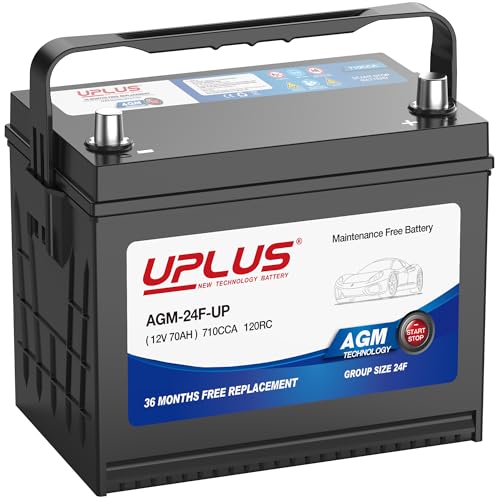
UPLUS BCI Group 24F AGM Start-Stop Car Battery

Interstate Batteries MTX AGM Group 24F 12V Battery

Goodyear 24F-AGM Platinum Series Automotive Battery

Daakmax Platinum AGM Group 24F Start-Stop Battery

Weize Dual Purpose AGM Group 24M Marine & RV Battery

Lipower Group 24/24F Solid State Start-Stop Battery

OTTARO 24V 7AH Battery for Ride-On Car UTV
A Deeper Look At The Lineup
The Weize Platinum AGM Group 24F sits at the front of the lineup for a reason: it nails the spec sheet most daily drivers actually need without overreaching. Its 710 cold cranking amps (CCA), the rating that tells you how much cranking power the battery delivers at 0°F, hits the same threshold used by Honda Accord, Toyota Camry, and Subaru Outback factory fitments. The 70Ah capacity and 120-minute reserve (the minutes a battery can run accessories if the alternator fails) suggest enough headroom for accessory-laden commutes.
Compared with the flooded batteries this unit replaces, the absorbed glass-mat construction resists vibration and handles stop-start traffic far better. For a commuter car seeing 15–25 starts per day, that’s a meaningful upgrade. Owners commonly report straightforward drop-in fitment when the prior battery was already a 24F, though measuring the tray first is wise since some Toyota models use a Group 35 in the same generation.
Noteworthy Benefits
- AGM construction tolerates repeated engine restarts better than flooded cells, useful in city traffic.
- 710 CCA matches the OE (original equipment) spec for most Japanese sedans and crossovers.
- 120-minute reserve capacity keeps accessories running through short alternator hiccups.
- Sealed, maintenance-free design means no watering or terminal corrosion checks.
- Tapered terminal layout (left negative, right positive) matches the standard 24F footprint.
Honest Caveats
- Terminal style should be verified before ordering, since some 24F applications require a different post type.
- AGM pricing runs higher than basic flooded units, a fair trade for the lifespan but worth budgeting for.
Key Product Details
Who Will Love This
Daily commuters driving Honda, Toyota, Nissan, or Subaru sedans and crossovers who want a sealed AGM that matches OE cold-cranking expectations.
Look Elsewhere When
If your engine bay space is unusually tight or you want a battery with multi-position mounting flexibility, the Goodyear 24F-AGM Platinum Series is a closer match.
MARXON lands the same 710 CCA and 70Ah numbers that show up across this category, but positions itself as a budget-conscious entry point. The absorbed glass-mat design is genuinely sealed, so once installed you can skip the periodic water-topping routine that older flooded batteries demanded. For an older Camry or Accord that sees mostly highway miles, that simplicity is a real perk.
The trade-off shows up in longevity expectations: AGM chemistry typically lasts longer than flooded, but a budget-tier AGM won’t usually match the deep-cycle resilience of premium MTX or pure-lead designs. For most commuters logging 10,000–15,000 miles a year, that’s not a problem. Owners swapping a tired factory battery after year four or five will likely see several solid years from this unit before the next replacement.
The Case For It
- Maintenance-free construction removes watering and corrosion cleanup from the ownership routine.
- Standard 24F dimensions allow direct swap from a factory battery in most Japanese sedans.
- Reserve capacity of 120 minutes keeps accessories running through brief alternator drops.
Worth Bearing In Mind
- AGM cycle life under heavy accessory loads may trail premium pure-lead designs, particularly in start-stop vehicles with frequent engine restarts.
- Terminal orientation should be confirmed against your existing battery before installing, since some vehicles require the posts reversed.
- Cold cranking is solid but not exceptional in extreme sub-zero climates where premium units hold voltage longer.
Best Suited To
Owners of older Honda, Toyota, or Nissan sedans looking to replace a worn factory battery with a sealed AGM that handles predictable commuter use without overpaying.
Consider Something Else When
If you drive a start-stop-equipped vehicle that restarts dozens of times per trip, the UPLUS BCI Group 24F AGM Start-Stop Battery is built for that workload.
The Autocessking Group 24F is engineered specifically around start-stop duty cycles, where the engine shuts off at traffic lights and the battery has to repeatedly crank it back to life. Its absorbed glass-mat construction suspends the acid in fiberglass mats, which means the unit can handle the dozens of micro-cycles a stop-and-go commute produces without drying out internal plates. That’s a different stress profile from a long-highway commuter.
The same leak-resistant design also makes installation less of a worry: spilled acid and corroded hold-downs become non-issues when the battery is fully sealed. Compared with the budget MARXON, this unit is positioned for vehicles whose alternators push them harder. For a recent Subaru Crosstrek or Toyota Highlander with auto start-stop, this is closer to the right tool for the job.
What Helps Most
- Sealed AGM architecture tolerates repeated engine restarts typical in urban commuting.
- Standard 24F dimensions and tapered terminal layout match OE trays in most Japanese vehicles.
- 710 CCA delivers consistent cranking even on cold mornings before the engine reaches operating temperature.
- Reduced leak risk simplifies installation and long-term under-hood cleanliness.
Trade-Offs To Consider
- AGM pricing outpaces flooded options, so this is a step up in initial cost.
- Charge voltage compatibility should be verified for vehicles with intelligent charging systems, since some start-stop cars demand specific charge profiles.
Feature Snapshot
Made For
Drivers of modern start-stop-equipped crossovers and sedans who rack up frequent engine restarts in urban traffic.
Reach For A Different Pick When
If you live in a region with harsh winters and want extra cranking headroom, the Interstate Batteries MTX AGM Group 24F uses a denser lead design that holds voltage better in extreme cold.
The UPLUS Group 24F AGM earns its premium label by stacking start-stop optimization with a 12V 70Ah 710 CCA spec sheet that mirrors OE targets for many late-model Hondas and Acuras. The absorbed glass-mat construction is built for vehicles whose alternators and BMS (battery management system) modules expect AGM-grade charge acceptance. Cold-weather drivers in the upper Midwest or New England will appreciate the voltage hold under heavy cranking.
Compared with the Autocessking, this one positions itself as a tier above, with a slightly more refined internal plate structure. The honest read is that for most commuters the difference is marginal, but anyone with a recent start-stop SUV running winter tires will feel the gap on a 5°F morning. Owners commonly note that the maintenance-free sealed format removes the periodic terminal cleanup that older flooded units required.
The Upside
- 710 CCA holds voltage well through cold-start cranking before the alternator takes over.
- Start-stop rated AGM construction handles repeated micro-cycles without early capacity loss.
- 120-minute reserve keeps cabin electronics, infotainment, and lighting alive during alternator dips.
- Sealed, maintenance-free design eliminates watering and reduces under-hood corrosion.
Practical Considerations
- Higher initial cost than budget AGM units, though offset for vehicles with intelligent charging systems that benefit from the chemistry.
- Terminal polarity should be cross-checked against the existing battery, since some 24F vehicles wire opposite to the tapered standard.
Right Fit For
Cold-climate commuters driving late-model start-stop Hondas, Acuras, Subarus, or similar vehicles where AGM-grade charge acceptance is expected.
Swap It Out When
If you want a battery with proven dealer-channel pedigree and a denser plate design, the Interstate Batteries MTX AGM Group 24F is a sensible step up.
Interstate’s MTX AGM is the heavy hitter of the conventional lineup. Its pure lead AGM (where the plates use high-purity lead rather than lead alloys) design packs more lead into each cell, which directly translates to longer service life under the punishing start-stop cycle. For drivers running heated seats, infotainment, dash cams, and remote starters all at once, that extra plate density keeps voltage from sagging when the alternator is already loaded.
Where the Weize and MARXON cover basic commuter duty, this unit targets vehicles whose electrical demand is meaningfully higher. The trade-off is weight and price: pure lead units cost more and tip the scales heavier than standard AGM, so casual commuters don’t need the extra headroom. Interstate has long-standing dealer relationships, which means parts availability tends to be strong if you ever need a swap during travel.
Notable Upsides
- Pure lead plate design extends cycle life under heavy accessory loads and frequent restarts.
- 710 CCA delivers confident cold-weather cranking in northern climates.
- AGM chemistry accepts charge faster than flooded cells, useful for short-trip commuters.
- Wide dealer and parts network simplifies warranty exchanges if a unit fails early.
Points To Keep In Mind
- Higher upfront cost than standard AGM, which may not pencil out for lightly loaded commuters.
- Heavier than basic AGM units, a small consideration if the factory hold-down is already tight.
Whose Shelf It Belongs On
Drivers of accessorized vehicles, start-stop crossovers, or anyone whose commute involves heavy electrical loads and wants a long-service premium AGM.
A Better Fit Elsewhere
If your driving profile is mostly short suburban hops with modest electrical demand, the Weize Platinum AGM Battery Group 24F delivers the same cranking at a friendlier price.
The Goodyear 24F-AGM Platinum Series brings something the rest of this list mostly skips: multi-position mounting. In tight engine bays where a flooded battery had to sit upright, an AGM that can be tilted (without going fully upside down) opens up installation options that matter when the factory tray orientation is awkward. For custom builds, lifted trucks with relocated battery boxes, or motorcycles converted to automotive format, that single feature can outweigh a spec-sheet difference.
The core spec sheet stays competitive: 12V 70Ah, 710 CCA, 120 reserve minutes. Where it shines is flexibility, not raw cranking headroom. If you’re restoring a classic and routing the battery to the trunk, or running a dual-battery setup where space is at a premium, the mounting tolerance is a quiet but real advantage. Owners running non-standard setups commonly cite this kind of flexibility as the deciding factor.
The Value In It
- Mountable in multiple positions (except fully inverted), great for custom installs and relocated trays.
- 710 CCA and 70Ah match the OE target for most Japanese sedans and crossovers.
- AGM sealed design tolerates vibration better than flooded units on rough roads.
Less Ideal Details
- Pricing trends above standard AGM units, reflecting the brand premium rather than raw capacity.
- Not the right choice for pure deep-cycle duty, since it’s still optimized as a cranking battery.
Best Suited To
Owners with non-standard battery placement, custom engine bays, or lifted vehicles where the factory tray orientation is awkward.
Skip It When
If your goal is straightforward drop-in replacement and you don’t need mounting flexibility, the MARXON Group 24F AGM keeps things simpler.
The Daakmax Platinum AGM keeps the spec line familiar (Group 24F, 12V 70Ah, 710 CCA, 120 reserve) but pairs it with a 36-month coverage window that gives warranty-conscious owners some breathing room. It’s the kind of unit a shade-tree mechanic can install on a Saturday and not worry about through the next three winters. The tapered terminal layout mirrors the standard 24F convention, so it drops into most factory trays without rewiring.
Where it sits in the lineup is interesting. It doesn’t pretend to out-spec the Interstate MTX or undercut the MARXON, but it occupies a steady middle: AGM-grade construction with a usable warranty term. For someone replacing a battery that’s already failed once and wants predictable coverage, that positioning matters. In most climates and most daily-driver scenarios, the difference between this and other 710 CCA AGMs is modest.
Advantages To Know
- 36-month warranty window offers longer protection than many competitors in this class.
- Standard 24F dimensions and tapered terminal layout match OE trays.
- AGM construction handles start-stop cycling better than flooded alternatives.
Factors To Consider
- Cycle life under heavy deep-discharge scenarios (cabin accessories left running for hours) won’t match pure-lead designs.
- Polar layout should be verified against your existing battery since some 24F vehicles reverse the post positions.
Perfect Match For
Owners who value warranty length and want a no-surprise replacement for a worn factory battery in a commuter car or crossover.
Another Choice May Suit
If your vehicle has a start-stop system that cycles aggressively in heavy traffic, the UPLUS BCI Group 24F AGM is tuned more specifically for that workload.
This is the curveball in the lineup. The Weize Dual Purpose AGM is a Group 24M, which is a different BCI size class than the 24F automotive batteries above. It’s built for boats and RVs where the battery has to both crank an engine and run accessories (lights, pumps, trolling motors) for hours at a time. The 90Ah capacity and 150 reserve capacity point to deep-cycle tolerance, while the 550 CCA handles starter duty adequately for marine inboards and outboards.
For the right shopper, this is exactly the right tool. A bass boat that needs reliable trolling-motor power between charges, or an RV running a residential refrigerator on a battery bank, will appreciate the dual-purpose design. Where it doesn’t fit: standard automotive 24F trays in Japanese sedans and crossovers. The 24M dimensions and post layout are physically different, so it’s not a drop-in for car use. Owners using a Group 24M box in a custom automotive setup will find it works well.
Strong Points
- Dual-purpose design combines cranking and deep-cycle capability in one sealed AGM unit.
- 90Ah capacity supports extended accessory loads like trolling motors or RV inverters.
- Sealed construction tolerates marine environments with less corrosion risk than flooded cells.
Some Limits To Know
- Group 24M dimensions differ from 24F, so this is not a direct replacement for automotive 24F trays.
- 550 CCA is meaningfully lower than the 710 CCA automotive units above, limiting its use as a cranking battery in cold climates or large-displacement engines.
Built With In Mind
Boat owners, RV enthusiasts, and marine applications that need a sealed AGM capable of both cranking and running accessories for extended periods.
Where A Sibling Pick Shines
If you need an automotive 24F for a Japanese sedan or crossover, any of the Weize, MARXON, Autocessking, UPLUS, Interstate, Goodyear, or Daakmax units above will physically fit and deliver stronger cranking.
The Lipower Group 24/24F breaks the mold by swapping AGM chemistry for solid-state lithium. In plain terms, that means a fraction of the weight, a longer cycle life, and a different voltage profile than the lead-based units above. For an enthusiast who wants to shave pounds from a project car or simply wants a battery that should outlast two or three AGM replacements, the lithium angle is compelling.
The trade-off is real, though. Lithium automotive batteries typically cost more up front, and some vehicles with traditional lead-acid charging profiles may need a compatible BMS or alternator setup to play nicely. The unit markets itself as compatible with Group 24 and 24F fitments, but checking the tray dimensions and post layout before ordering remains important. In our view, this is the pick for hobbyists and tinkerers who already understand their electrical system rather than casual commuters.
Features That Help
- Solid-state lithium chemistry delivers longer cycle life than lead-acid AGM equivalents.
- Lower weight than AGM units of similar capacity, useful in performance or weight-sensitive builds.
- Compatible with both Group 24 and 24F trays, widening installation options.
Where It May Fall Short
- Higher upfront cost than comparable AGM units, which may not pencil out for everyday commuter use.
- Vehicles with traditional alternators and lead-acid voltage profiles may need charging-system verification before installation.
- Cold-weather cranking performance can be lower than equivalent lead-acid units in extreme sub-freezing conditions.
Who Should Grab It
Enthusiasts building project cars, restomod owners, or anyone willing to verify charging-system compatibility for a longer-life lithium upgrade.
Not Your Match When
If you just want a reliable drop-in replacement for a daily driver, the Weize Platinum AGM Battery Group 24F Automotive Battery keeps the install simple.
The OTTARO 24V 7AH battery closes the list with something completely different: a 24-volt unit designed for kids’ ride-on vehicles, UTV-style toys, and similar small electric platforms. It is not a 12V automotive battery, and it does not slot into a Group 24F automotive tray. What it does is provide a compact, sealed power source for low-amperage electric toys that have worn out their original pack.
For parents whose kid’s ride-on Jeep finally gave up after two years of driveway abuse, this is the kind of straightforward replacement that gets the toy back in service without sending it to the landfill. Owners commonly note that swapping the OEM (original equipment manufacturer) battery for a fresh sealed unit restores the run time the toy originally had. It earns its place in this roundup as a useful utility pick, even though it sits outside the main automotive category.
Benefits That Matter
- 24V output matches the wiring on most 24V ride-on cars and small UTV toys.
- Compact dimensions fit the standard battery compartment of common ride-on platforms.
- Sealed AGM-style construction tolerates occasional tipping better than flooded cells.
Practical Considerations
- Not a 12V automotive battery, so it does not fit Group 24F automotive trays in cars and trucks.
- Capacity is sized for low-draw electric toys, not engine cranking.
Right Fit For
Parents and hobbyists replacing worn batteries in 24V ride-on vehicles, small electric UTV toys, or similar low-amperage electric platforms.
Look Elsewhere When
If you’re replacing a battery in an actual car, truck, or crossover, any of the Weize, MARXON, Autocessking, UPLUS, Interstate, Goodyear, or Daakmax Group 24F units above will physically fit and deliver automotive cranking performance.
Matching The Right Battery To Your Vehicle
Group 24F is one of the most common BCI sizes in Japanese sedans and crossovers, but “common” doesn’t mean universal. The first step is confirming the physical dimensions, terminal polarity (left negative, right positive is standard for 24F but not universal), and CCA requirements before any purchase. If the spec sheet from your owner’s manual calls for 650 CCA, a 710 CCA AGM will meet the spec with some headroom. If it calls for 850 CCA, you’ll need to step up to a larger BCI group entirely.
Next, match the chemistry to the electrical demand. Standard flooded batteries are fine for older commuter cars with alternators that put out a steady 13.8–14.4V and modest accessory loads. Modern start-stop vehicles, cars with intelligent BMS modules, or vehicles running multiple accessories (heated seats, premium audio, dash cams) want AGM chemistry for faster recharge acceptance and better vibration tolerance. Pure lead AGM designs like the Interstate MTX add extra cycle life for heavy-accessory daily drivers.
Reserve capacity is the third leg of the stool. A 120-minute reserve rating means the battery can run your cabin accessories for two hours if the alternator suddenly fails. For most commuters that’s a non-issue, but for someone running a refrigerator in a camper or a comms setup in an overland rig, reserve capacity matters more than peak CCA. Match the unit to the actual use case, not just the spec sheet.
Finally, think about climate. Cold climates (consistently below freezing) benefit from higher CCA and reserve capacity because cold oil and slow chemical reactions drain cranking power. Hot climates stress batteries through under-hood heat, which accelerates electrolyte loss in flooded units and shortens lifespan. AGM chemistry handles heat better than flooded, but even AGM has a service-life ceiling in desert climates.
Key Considerations Across These Picks
Wrong Turns To Avoid
The most common slip-up is assuming any 24F battery will drop into any 24F tray. Some vehicles in the same model year use a Group 35, a Group 24, or a Group 27 depending on the engine and trim. Measure the tray, count the hold-down bolt pattern, and verify terminal polarity before ordering. The second mistake is ignoring the charging system: a vehicle with a smart alternator and a BMS designed for AGM behaves very differently than a 1990s commuter with a fixed-voltage regulator. If you swap in an AGM where the system expects flooded, the battery may never reach full charge and will sulfate early.
What Separates Premium From Basic
The price gap between a budget AGM and a premium MTX-style unit often comes down to plate purity and density. Pure lead plates resist corrosion longer than lead-alloy plates, which is why premium units typically last two to three cycles longer in start-stop service. Reserve capacity improvements, vibration tolerance, and faster recharge acceptance also come from the same engineering refinements. Whether the upgrade pays off depends on how hard you drive the electrical system. A 15-minute-each-way commuter with a basic stereo won’t notice much difference. A delivery driver running HVAC, navigation, and a phone charger for eight-hour shifts will feel it every week.
Frequently Asked Questions
What does Group 24F mean on a car battery?
Group 24F is a BCI (Battery Council International) size designation that defines the battery’s physical dimensions, terminal layout, and post type. Vehicles designed for Group 24F have factory hold-downs, cable lengths, and tray sizes that match this standard. Always confirm the group size in your owner’s manual before ordering.
How long does a Group 24F AGM battery typically last?
Under normal commuter use, an AGM Group 24F battery commonly lasts four to six years before capacity drops below reliable cranking levels. In hot climates or vehicles with heavy accessory loads, lifespan may shorten to three to four years. In mild climates with light loads, the same battery can run six to eight years.
Can I replace a flooded battery with AGM without changing the alternator?
In most modern vehicles, yes. AGM batteries accept the same charging voltage range as flooded batteries (around 13.8–14.4V) and recharge through a stock alternator without modification. Vehicles with intelligent BMS modules may need a system reset or a registration step, which is sometimes done with a scan tool.
What’s the difference between Group 24 and Group 24F?
Group 24 and Group 24F share similar dimensions but differ in terminal post type and polarity layout. Group 24F typically uses a tapered post with the negative terminal on the left, while Group 24 may have different terminal configurations. Confirming the exact group size and terminal layout before purchase avoids fitment problems.
Is a higher CCA rating always better?
Higher CCA means more cranking power available at 0°F, which matters in cold climates but isn’t strictly necessary in warm regions. A battery rated well above your engine’s actual cranking requirement won’t deliver a noticeable performance gain, and you’ll pay extra for capacity you don’t use.
The Takeaway
The right Group 24F battery comes down to matching the spec sheet to the actual vehicle, climate, and electrical demand. For most Japanese sedans and crossovers, a 710 CCA AGM that meets OE expectations will outlast the prior battery by years. If your driving profile is heavier than average, step up to a premium MTX-grade design. If you want something completely different, the lithium alternative is worth knowing about. Either way, measure the tray first and confirm terminal polarity before ordering.