You turn the key on a January morning, the engine coughs once, and that little flash of dread lights up. A 24F AGM battery solves that moment, but only if the dimensions line up with your tray and the terminals land in the right spots. Most vehicles that call for a Group 24F case want a sealed absorbed glass-mat unit because the cabin runs hotter and the electrical load is heavier than it used to be. The picks below cover everything from daily-driver replacements to upgraded lithium solid-state options, with notes on fit, cold cranking amps, and reserve capacity so you can match a battery to your specific vehicle without guesswork.
A Closer Look At The Lineup

Weize Platinum AGM Battery BCI Group 24F

Mighty Max MM-G24 Group 24 AGM Battery

Mighty Max MM-G26 Group 26 AGM Battery

MARXON Group 24F AGM Battery

Autocessking Group 24F Start-Stop AGM Battery
UPLUS BCI Group 24F AGM Car Battery

Interstate Batteries MTX Group 24F AGM

Goodyear 24F-AGM Platinum Series Battery

Lipower Group 24/24F Solid State Battery
Mighty Max MM-G31 Group 31 AGM Battery
The Picks, Examined More Closely
The Weize Platinum lands at the top of this list because it threads the needle most shoppers actually need: standard Group 24F dimensions, a familiar terminal layout, and enough cranking power for cold mornings without forcing you into premium-tier pricing. The 10.75-inch length and 6.81-inch width match the BCI Group 24F footprint that most domestics and several Japanese sedans require.
Reserve capacity (how long the battery can run accessories if the alternator quits) lands at 120 minutes, which gives a comfortable margin during short trips and accessory-heavy idling. The 36-month warranty is also longer than a lot of entry-level units. In real terms, that means a suburban commuter who lets the car sit for a few days between drives still gets confident starts.
Real Benefits
- 710 CCA handles sub-freezing morning starts in most climates
- 120-minute reserve capacity covers short commutes and idle-heavy driving
- Standard Group 24F dimensions fit common domestic trays without modification
- 36-month warranty outlasts many entry-tier competitors
- Tapered terminal layout (left negative, right positive) matches common factory orientation
Things To Consider
- Verify your old battery’s case dimensions before ordering, since small tray differences can complicate fit
- AGM units like this one don’t always like sitting at a partial charge, so a maintenance charger helps in seasonal vehicles
Who It Suits Best
Daily drivers of mainstream sedans, crossovers, and light trucks who want a long warranty without paying premium-tier pricing for a battery they may never stress.
Where Another Pick Suits Better
Drivers running diesel accessories or aftermarket audio should look at the Mighty Max MM-G31 instead, since its higher CCA handles heavier loads more comfortably.
The Mighty Max MM-G24 reads like a near-twin to the Weize on paper, but the brand’s reputation for sealed AGM construction (absorbed glass-mat: a design where electrolyte is held in fiberglass mats instead of pooling as liquid) gives it a small edge in start-stop applications. The 70Ah capacity and 710 CCA spec sheet suggests similar performance to pick one, with the difference showing up in how the battery handles repeated engine restarts.
For commuters stuck in stop-and-go traffic or anyone driving a vehicle whose engine shuts off at lights, that cycling tolerance matters more than raw CCA. The sealed, spill-proof design also makes installation cleaner in cabin-adjacent battery locations. Compared to the Weize Platinum, you trade a longer warranty for more cycling-friendly internals.
What Earns Its Place
- Sealed AGM design tolerates start-stop cycling better than flooded units
- 120-minute reserve capacity supports extended accessory use
- Spill-proof construction simplifies installation in tight or angled trays
- Strong deep-discharge recovery if you accidentally drain it
Worth Noting
- Warranty terms vary by seller, so check the listing details before checkout
- Performance in extreme cold lags behind higher-CCA units in this category
Made For
Start-stop vehicle owners and short-trip commuters who cycle the battery more often than long-haul drivers.
Consider Something Else When
Truck and SUV owners with bigger electrical demands get more headroom from the Goodyear 24F-AGM, which offers flexible mounting positions alongside similar capacity.
The MM-G26 is the odd one out in this roundup, and that is intentional. It uses the smaller Group 26 case instead of Group 24F, which means it does not drop into a 24F tray. The trade-off is a more compact footprint, lighter weight, and a friendlier fit in older Japanese vehicles, classic cars, and secondary applications like a generator or motorcycle-trailering setup.
With 540 CCA and 45Ah, the output is lower than every 24F unit here, so owners expecting a direct 24F replacement should keep looking. Where it shines is in tight spaces where the larger batteries simply will not seat. It is also worth noting that AGM construction keeps it sealed and tilt-safe, a real plus for non-automotive uses.
Everyday Perks
- Compact Group 26 case fits trays that reject larger 24F batteries
- Lighter weight simplifies solo installation in awkward positions
- Sealed AGM design prevents leaks during off-angle mounting
Trade Offs
- Not a true Group 24F replacement; case dimensions differ
- Lower CCA limits cold-weather performance compared to 24F units
- 80-minute reserve capacity is shorter than other picks here
Key Specs
Best Suited To
Owners of older compact vehicles, classics, or secondary equipment who need a sealed AGM unit that fits where larger batteries will not.
Look Elsewhere When
Daily drivers who specifically need a Group 24F case should choose the MARXON Group 24F instead, since it matches the standard footprint at a similar capacity.
The MARXON entry keeps the spec sheet honest: 70Ah, 710 CCA, 120-minute reserve capacity, and the same BCI Group 24F dimensions that fit most trays built around this case size. It is a “no surprises” option, the kind of battery that does not promise anything beyond what the source data confirms.
Maintenance-free AGM construction means no topping off cells, which removes one of the small hassles of older flooded designs. For most drivers, the experience is drop-in and forget-about-it. Versus the Weize Platinum up top, the trade-off is a shorter warranty window, so budget-minded shoppers who plan to replace the battery in three to four years anyway will not miss the extra coverage.
Good Reasons To Consider
- Standard Group 24F dimensions match most factory trays without modification
- Maintenance-free sealed design simplifies ownership
- 120-minute reserve capacity is on par with higher-priced competitors
- Tapered terminal layout fits common factory cable orientation
Room For Improvement
- Warranty length is shorter than premium competitors in this category
- Brand recognition lags behind more established names, which can matter for resale
Perfect Match For
Shrewd shoppers who want honest Group 24F specs without paying for a badge and who replace their battery on a regular cycle.
Skip It When
Drivers who keep vehicles past the seven-year mark benefit more from the Interstate Batteries MTX, which uses pure lead construction for longer service life.
Autocessking leans into the safety story of AGM construction, and that framing suits owners who worry about acid spills or under-hood corrosion. The glass-mat suspension holds the electrolyte in place, which means the battery can be mounted in less conventional positions without leaking. That makes installation less of a nervous moment for first-timers.
The 70Ah, 710 CCA, 120 RC spec sheet mirrors the Weize and MARXON units, so the real choice comes down to brand comfort and warranty specifics rather than raw performance. In real terms, owners of vehicles with sensitive electronics sometimes prefer batteries marketed with extra care around leak prevention, and that is where this option earns its place in the lineup.
Useful Highlights
- AGM suspension design resists leaks during angled mounting
- 120-minute reserve capacity matches higher-priced alternatives
- Compatible with start-stop vehicle cycling demands
- Standard Group 24F footprint fits common factory trays
Points To Note
- Spec sheet mirrors several competitors, so differentiation is mostly about branding
- AGM chemistry prefers a full charge; trickle charging helps in seasonal storage
Who Should Grab It
Owners of vehicles with start-stop systems or tight engine bays who want a sealed, low-spill option with conventional 24F specs.
Another Choice May Suit
Drivers chasing longer overall service life should look at the Interstate Batteries MTX instead, since its pure lead AGM design is engineered for higher cycle counts.
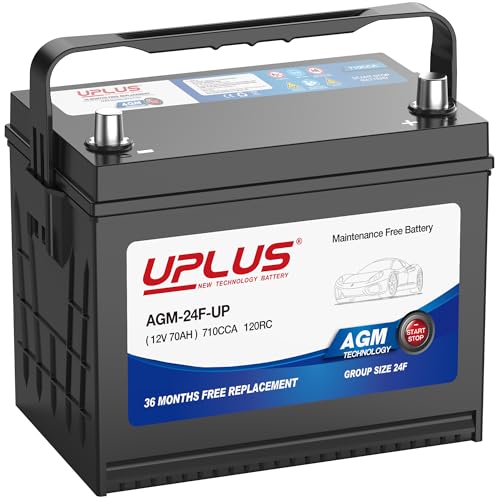
UPLUS pitches its 24F directly at the modern start-stop segment, where the engine cycles dozens of times per commute. The 70Ah capacity, 710 CCA, and 120 RC ratings match the broader 24F AGM pack here, but the brand emphasizes compatibility with vehicles whose charging systems demand stronger cycling tolerance than older designs require.
Compared to the MARXON at the budget end, the UPLUS targets a different shopper: someone whose vehicle came from the factory with start-stop and needs a battery engineered for that workload. In practice, you may find the real difference shows up after the second winter, when cheaper units begin to lose cranking punch. That said, the dimensions and terminal layout still match the Group 24F standard, so installation is not the differentiator.
Real-World Strengths
- Tuned for start-stop cycling, a real plus for newer commuter sedans
- Maintenance-free sealed construction simplifies ownership
- Standard Group 24F case fits common factory trays
- 120-minute reserve capacity supports longer accessory runtime
Soft Spots
- Spec sheet is similar to less expensive options, so the upgrade costs more for marginal gains
- Brand recognition is still building in the North American market
Feature Snapshot
Whose Shelf It Belongs On
Owners of newer start-stop vehicles who want a battery tuned for the workload, even if the spec sheet looks similar to cheaper picks.
A Better Fit Elsewhere
Owners of older vehicles without start-stop systems can save money with the MARXON Group 24F, since the cycling tuning adds little benefit there.
Interstate’s MTX line uses a pure lead AGM design, which packs more lead into each cell than conventional AGM batteries. The result is a battery engineered for the longest possible service life in start-stop applications, especially in vehicles whose factory systems expect premium-tier replacements.
The 70Ah capacity and 710 CCA mirror the broader 24F field, so day-one performance is comparable. The longevity story is what justifies the higher price tier: drivers who keep vehicles past the seven-year mark, or who simply want to install a battery and forget about it, get the most value here. You may find the additional cost hard to justify on a car you plan to sell next year, but for long-haul ownership, the pure-lead design pays back over time.
What Stands Out
- Pure lead AGM construction supports longer cycle life than standard AGM
- Engineered specifically for start-stop vehicle demands
- 70Ah capacity with 710 CCA covers mainstream driving needs
- Interstate’s distribution network simplifies warranty claims
Factors To Consider
- Costs more than value-tier 24F AGM options with similar day-one specs
- Premium pricing only pays off for long-term owners
Right Fit For
Long-term vehicle owners who keep cars past the typical battery lifespan and want premium internal construction to match that timeline.
Reach For A Different Pick When
Short-term owners or those replacing a battery in a vehicle they’re selling soon should consider the MARXON Group 24F for better value in a shorter ownership window.
The Goodyear 24F-AGM rides on a familiar brand name and a flexible installation story. The maker explicitly notes multiple mounting positions, which matters for trucks, SUVs, and modified engine bays where the tray sits at an unusual angle. Owners who have wrestled with a battery that only fits one way will appreciate that flexibility.
The 70Ah capacity, 710 CCA, and 120 RC specs match the field, so it does not break new ground on raw output. Where it differentiates is the platinum-series positioning and the Goodyear badge, which carry weight with drivers who trust legacy tire and automotive brands over newer entrants. Versus the UPLUS premium pick, the focus here is on installation versatility rather than start-stop tuning.
Useful Strengths
- Multiple mounting positions simplify installation in non-standard trays
- Goodyear branding brings familiarity to the AGM category
- 120-minute reserve capacity covers typical accessory loads
- 710 CCA handles cold starts in most climates
A Few Limitations
- Inverted mounting is still not supported, which limits the most extreme angle installations
- Spec sheet aligns with less expensive options, so the brand premium has to matter to you
Quick Facts
The Right Fit
Truck and SUV owners with non-traditional battery trays who value flexible mounting and a recognizable brand name.
Swap It Out When
Start-stop sedan owners get more targeted engineering from the UPLUS BCI Group 24F, which is tuned for that specific workload.
The Lipower entry breaks from the AGM pack by stepping into solid-state lithium chemistry. That means a fundamentally different cell architecture inside the same Group 24/24F case footprint, aimed at shoppers who want lighter weight, longer cycle life, and modern performance characteristics over traditional lead-acid designs.
The trade-off shows up in two areas: cost, which is meaningfully higher than every AGM option here, and compatibility, since lithium chemistries interact differently with conventional charging systems. In real terms, this battery suits tech-forward upgraders building a modern electrical system or replacing a battery that has failed twice already and want to break the cycle. For a daily driver where the original equipment was lead-acid, the upgrade math does not always pencil out.
Strengths Worth Knowing
- Solid-state lithium chemistry offers longer cycle life than lead-acid designs
- Lighter weight than comparable AGM units, which helps in weight-sensitive builds
- Modern cell architecture suits custom electrical setups
Honest Caveats
- Costs noticeably more than every AGM option in this roundup
- Charging system compatibility should be confirmed before installation
- Cold-weather performance differs from conventional AGM chemistry
Who Will Love This
Tech-forward drivers and custom-build enthusiasts who want modern battery chemistry and are willing to verify charging system compatibility for the upgrade.
Where A Sibling Pick Shines
Conventional daily drivers get more predictable, lower-cost value from the Weize Platinum AGM Battery, which fits standard factory charging systems without modification.
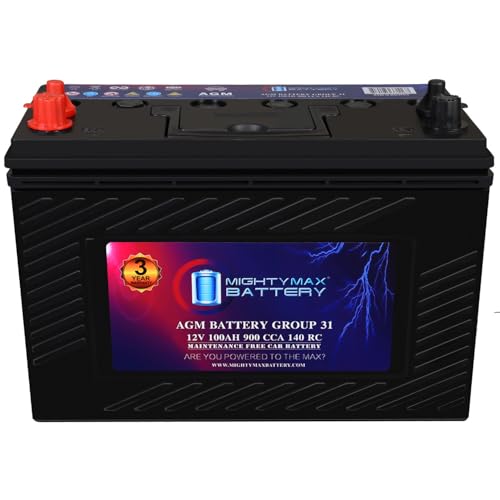
The MM-G31 is the second non-24F unit in this roundup, and it sits at the opposite end of the spectrum from the MM-G26. This is a Group 31 case, which is physically larger than Group 24F, so it does not fit a 24F tray. The upside is serious output: 100Ah capacity, 900 CCA, and 140-minute reserve capacity for trucks, diesel accessories, and electrical systems running winches or aftermarket amplifiers.
For diesel owners, overlanders, and anyone running serious accessory loads, the extra capacity is what keeps the engine turning on cold mornings and the lights burning at the campsite. The honest read is that this is a specialized choice, not a 24F replacement. Confirm your tray dimensions before ordering, since the larger case demands more under-hood room.
What Works In Its Favor
- 900 CCA handles cold mornings in diesel and high-compression engines
- 100Ah capacity supports long accessory runtime
- 140-minute reserve capacity exceeds every 24F unit in this roundup
- Sealed AGM design tolerates off-angle mounting
Less-Strong Areas
- Group 31 case does not fit a Group 24F tray; verify dimensions first
- Heavier than 24F units, which complicates solo installation
Built With In Mind
Diesel truck owners, overlanders, and accessory-heavy builds that need higher CCA and reserve capacity than any 24F battery offers.
Not Your Match When
Standard sedan and crossover owners should choose the Weize Platinum or MARXON Group 24F instead, since both fit factory 24F trays with appropriate output.
Matching the Right Battery to Your Vehicle
A 24F AGM battery is defined by three things working together: the BCI Group 24F case size (about 10.75 x 6.81 x 8.98 inches), the terminal layout (left negative, right positive when viewed from the front), and the absorbed glass-mat construction. Before ordering anything, measure the old battery and confirm the terminal positions match your factory orientation, since reversed terminals will not connect to the existing cables without modification.
Cold cranking amps (CCA) measure how much current the battery can deliver at 0°F for 30 seconds while maintaining voltage above a set threshold. For most temperate climates, 700+ CCA is sufficient, but drivers in northern states or Canada benefit from higher headroom. Reserve capacity (RC) tells you how long the battery can run accessories if the alternator fails, and 120 minutes is a comfortable benchmark for daily driving.
AGM construction matters because it suspends the electrolyte in glass mats rather than letting it pool as liquid. That makes the battery spill-proof, more vibration-resistant, and better at handling repeated deep discharges. The trade-off is cost, since AGM units run higher than flooded equivalents, but the longer service life and start-stop compatibility often justify the difference.
Group Size Versus Output
Group 24F is not the only case size in this category. Group 26 is smaller and suits compact or older vehicles, while Group 31 is larger and serves diesel and high-accessory applications. Choosing the wrong case size means the battery simply will not fit, regardless of how strong the spec sheet looks. When in doubt, match the existing battery’s case dimensions first and consider CCA and reserve capacity second.
AGM Versus Flooded and Lithium
AGM sits between conventional flooded lead-acid and lithium solid-state designs. Flooded batteries cost less but require periodic maintenance and tolerate deep cycling poorly. Lithium solid-state units like the Lipower option bring longer cycle life and lighter weight, but cost more and demand charging system compatibility. AGM is the middle ground that fits most modern vehicles without modification.
Key Considerations Across These Picks
Where Shoppers Go Wrong
The most common slip is assuming any “24F” battery fits any 24F tray. Small dimension differences exist between brands, and reversed terminal layouts force cable swaps that most owners do not want to make. Always measure your old battery (length, width, height) and verify the terminal orientation before ordering.
Another trap is chasing the highest CCA without considering reserve capacity. CCA handles cold starts, but RC matters during alternator failure or extended accessory use. A balanced battery with 700+ CCA and 120-minute RC covers most realistic scenarios.
When Paying More Pays Off
The premium tier in this category buys two things: longer cycle life and better internal components. Pure lead AGM designs like the Interstate MTX pack more lead into each cell, which extends service life in vehicles kept past the seven-year mark. Lithium solid-state designs like the Lipower add modern chemistry but require charging system verification.
For a daily driver you plan to keep for a few years, the value tier (MARXON, Weize) covers the workload. For long-term ownership or heavy accessory loads, the premium tier pays back through longer service and stronger performance.
Frequently Asked Questions
What vehicles use a Group 24F battery?
Many domestic sedans, crossovers, and light trucks from the late 1990s onward call for a Group 24F case. Common fits include certain Toyota, Honda, Nissan, Acura, Chrysler, and Ford models, though you should always verify against your owner’s manual before ordering.
Can I replace a flooded battery with an AGM unit?
Yes, in most cases an AGM battery drops into a tray originally designed for flooded chemistry. The charging system in modern vehicles handles AGM without modification, and the spill-proof construction simplifies installation.
How long does a 24F AGM battery typically last?
Service life varies by climate and workload, but most AGM units last three to five years under normal driving conditions. Premium pure-lead designs can stretch that further, especially in vehicles with heavy electrical loads.
Does higher CCA always mean a better battery?
Not necessarily. CCA above what your climate demands adds cost without practical benefit. For temperate regions, 700 CCA is usually sufficient, while northern climates benefit from higher headroom for the coldest mornings.
Is a lithium solid-state battery worth the upgrade?
For most daily drivers, the cost premium is hard to justify. Tech-forward upgraders building custom electrical systems, or anyone replacing failed batteries repeatedly, get more value from the longer cycle life and lighter weight.
Wrap Up
The right 24F AGM battery comes down to matching the case size and terminal layout first, then weighing CCA, reserve capacity, and warranty against your climate and driving habits. For most drivers, the Weize Platinum or MARXON covers the workload without overspending. Long-term owners and start-stop sedan drivers get more from the Interstate MTX or UPLUS, while specialized builds should look at the Lipower or Mighty Max MM-G31 for their specific use cases.