Boondocking off-grid, running a rooftop AC through the night, or just wanting quiet power without a generator thumping away, the right lithium battery makes the difference between a comfortable rig and a frustrating one. Lead-acid batteries weigh a ton, lose capacity fast, and demand constant babysitting. Lithium iron phosphate (LiFePO4) chemistry changed the game: lighter, deeper-discharge capable, and far longer-lived. The ten options below cover a range of capacities, BMS ratings (the battery management system that protects against overcharge, over-discharge, and short circuits), and form factors that slot into RV bays without modification.
A Quick View Of The Lineup

Redodo 12V 100Ah LiFePO4 Battery with 14.6V 20A Charger

ECO-WORTHY 12V 314Ah LiFePO4 Lithium Battery with SOC LEDs

ECO-WORTHY EnergyRock 12V 280Ah 2-Pack LiFePO4 Metal Case

ECO-WORTHY 12V 280Ah Metal Case LiFePO4 with Bluetooth

power queen 12V 100Ah LiFePO4 Group 31 Battery

GRENERPOWER 2-Pack 12V 100Ah LiFePO4 Group 24 Battery

Redodo 12.8V 100Ah LiFePO4 Battery with 14.6V 10A Charger

Redodo 12V 165Ah LiFePO4 Battery with 14.6V 20A Charger
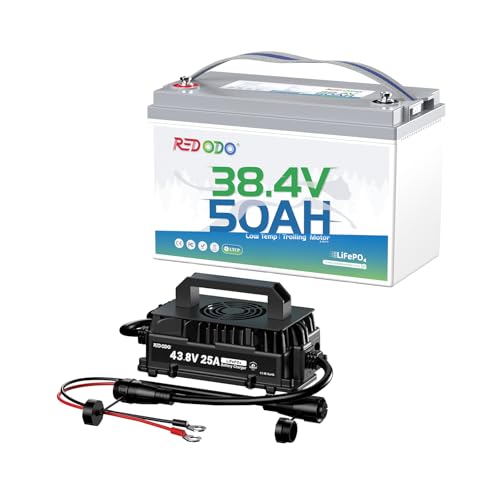
Redodo 36V 50Ah Trolling Motor LiFePO4 Battery with Charger

Redodo 16V 30Ah LiFePO4 Battery with 18.25V Charger
More On The Choices That Made The List
The Redodo 12V 100Ah LiFePO4 arrives with a matched 20A charger in the box, which removes one of the biggest headaches for first-time upgraders: figuring out which charger matches the battery. For weekend warriors running a fridge, lights, and a fan, 100Ah covers the basics without overcomplicating the install. Compared to the larger ECO-WORTHY options later in this list, this one keeps things simple and budget-friendly.
Bluetooth 5.0 monitoring means you can check voltage and state of charge from your phone rather than climbing into the battery bay. The low-temp cutoff stops charging below 32°F and blocks discharge below -4°F, protecting the cells from damage in shoulder-season camping. Depending on your climate, this auto-protection could be the difference between a battery that lasts a decade and one that doesn’t.
What Pays Off
- 20A charger fills the pack from empty in roughly 5 hours, faster than most bundled options
- Built-in BMS with Bluetooth lets you monitor and control discharge remotely
- Cold-weather protection activates automatically, no manual intervention needed
- 100Ah capacity handles typical weekend RV loads without strain
Trade-Offs To Consider
- 100A-class BMS limits you to lighter inverter loads, larger inverters may need a different battery
- Battery and charger may arrive in separate shipments
- No metal enclosure, owners commonly report the plastic case feels light in hand
Made For
New lithium adopters running smaller rigs with modest power demands who want a turnkey bundle.
Consider Something Else When
Full-time RVers needing serious reserve should look at the ECO-WORTHY EnergyRock 12V 280Ah 2-Pack for double the capacity.
The ECO-WORTHY 12V 314Ah packs more stored energy into a single unit than anything else here, roughly 4,019Wh per battery. For someone living full-time off-grid, that single-bank approach simplifies wiring compared to paralleling multiple smaller packs. Where Redodo’s 100Ah starter option handles weekend duty, this one stretches to multi-day off-grid stays.
The integrated SOC (state of charge) LEDs give you a glanceable readout right on the battery, useful when you’re not near your phone. A 200A BMS supports heavier inverter loads, so running a microwave or small AC becomes realistic. You may find, however, that the larger capacity demands more careful charge planning, especially with smaller solar arrays.
Positive Points
- 314Ah capacity in one unit reduces parallel wiring complexity
- SOC LED display provides at-a-glance status without opening an app
- 200A continuous BMS handles medium inverter loads comfortably
- Low-temperature protection keeps cells safe in cold storage
Points To Keep In Mind
- Single-battery weight increases handling difficulty during install
- Larger capacity means longer full-charge times with smaller chargers
- Higher upfront cost than 100Ah starter options
Feature Snapshot
Who Will Love This
Full-time RVers and off-grid cabin owners who want one battery instead of a paralleled array.
Look Elsewhere When
Shoppers wanting the fire-resistant metal enclosure should consider the ECO-WORTHY 12V 280Ah Metal Case battery instead.
Buying two matched batteries in one box solves a problem many DIYers run into: balancing parallel banks over time. The ECO-WORTHY EnergyRock 12V 280Ah 2-Pack delivers factory-matched cells in metal enclosures, taking the guesswork out of parallel wiring. Compared to the single 314Ah ECO-WORTHY above, this pair offers redundant capacity, one battery can stay online while the other is serviced.
The metal housing adds thermal resistance, valuable during summer heat when battery bays can reach uncomfortable temperatures. Bluetooth monitoring lets you check each bank individually from your phone. Two 280Ah units deliver 7,168Wh of total energy, enough to run rooftop AC intermittently and still keep the lights on for days.
A Strong Showing
- Factory-matched pair eliminates cell-imbalance issues common in mixed banks
- Metal cases improve heat dissipation and structural durability
- 200A BMS per battery supports heavy inverter loads
- Bluetooth monitoring tracks each bank separately
Worth Noting
- Pair configuration means double the install space requirement
- Exterior labels ship in two random styles, cosmetic inconsistency
- Metal cases add weight compared to plastic alternatives
Built With In Mind
Large motorhomes and fifth-wheels with dedicated battery compartments needing serious capacity.
Swap It Out When
Tight battery bays with limited space may fit the single ECO-WORTHY 12V 280Ah Metal Case unit better than a 2-pack.
Heat and lithium batteries have a complicated relationship, which is why the ECO-WORTHY 12V 280Ah Metal Case stands out for desert campers and southern travelers. The metal enclosure adds a layer of fire resistance and helps shed heat better than standard ABS plastic. Where the EnergyRock 2-Pack prioritizes capacity, this single 280Ah unit prioritizes durability in harsh conditions.
The included low-voltage cutoff switch gives you one-touch power isolation, handy for storage or troubleshooting. Bluetooth monitoring pairs with the ECO-WORTHY app, and the 200A BMS handles up to 2,560W of inverter draw. For most full-time RV setups, 280Ah hits a sweet spot between capacity and physical footprint.
Practical Pluses
- Metal case offers improved thermal management and fire resistance
- One-touch low-voltage cutoff simplifies storage and service
- 200A BMS supports up to 2,560W inverter loads
- 3,584Wh capacity covers multi-day moderate loads
Trade-Offs To Consider
- Metal enclosure adds roughly 10 pounds over plastic alternatives
- Exterior labels ship in two random styles
- Single battery limits true redundancy compared to a 2-pack
Quick Facts
Right Fit For
Hot-climate full-timers and off-grid households prioritizing safety and thermal performance.
Reach For A Different Pick When
Redundancy matters more than fire resistance, the ECO-WORTHY EnergyRock 12V 280Ah 2-Pack provides matched backup.
The power queen 12V 100Ah LiFePO4 drops into a standard Group 31 battery tray, which matters if you’re replacing lead-acid without modifying the existing hold-downs or cable routing. Many RV manufacturers built their bays around Group 31 dimensions, so this format eliminates fabrication. The Group 31 footprint also fits most marine applications, expanding use cases beyond camping.
Where Redodo’s 100Ah option bundles a charger and Bluetooth, the power queen keeps things simpler and often lighter on the wallet. The 100A BMS supports typical RV inverter loads up to about 1,280W. For most weekend campers replacing a single Group 31 lead-acid, this is a clean swap.
Features That Help
- Standard Group 31 dimensions drop into existing trays without modification
- Up to 15,000 cycle rating extends service life well beyond lead-acid
- 100A BMS handles typical RV inverter loads
- 1,280Wh capacity matches a single Group 31 lead-acid replacement
Less Ideal Details
- No built-in Bluetooth, requires external shunt for monitoring
- Lower BMS rating limits larger inverter pairings
- No bundled charger included
Best Suited To
RVers replacing a single Group 31 lead-acid who want a clean physical swap without bay modifications.
A Better Fit Elsewhere
Shoppers wanting phone monitoring included should consider the Redodo 12V 100Ah LiFePO4 Battery with Bluetooth.
The GRENERPOWER 2-Pack delivers something rare in this category: true configuration flexibility. You can run both packs in parallel for 200Ah at 12V, or wire them in series for 24V at 100Ah. For anglers running 24V trolling motors, this dual-configuration approach skips the need for a separate 24V battery bank. The Group 24 footprint also fits smaller battery compartments where Group 31 won’t go.
Compared to the ECO-WORTHY EnergyRock 2-Pack, this set uses smaller individual batteries but offers the series option. Cylindrical Grade A+ cells tend to handle vibration better than prismatic cells, useful for rougher roads and boat hulls. Depending on your boat or trailer wiring, you may find the dual-format flexibility more valuable than raw capacity.
Everyday Advantages
- Series or parallel configuration supports 12V or 24V systems
- Group 24 footprint fits smaller battery compartments
- Cylindrical cells resist vibration damage on rough terrain
- Up to 15,000 cycle rating for long service life
A Few Limitations
- 100A BMS per battery caps inverter loads lower than 200A alternatives
- Series configuration requires matched wiring and balanced components
- No built-in monitoring or bundled charger
Whose Shelf It Belongs On
Boat owners and anglers running 24V trolling motors who want one battery SKU for multiple setups.
Not Your Match When
Heavy inverter loads above 1,280W are better served by the ECO-WORTHY 12V 280Ah Metal Case battery.
The Redodo 12.8V 100Ah is the budget-conscious sibling of the Bluetooth-equipped Redodo at the top of this list. You give up Bluetooth monitoring and a faster charger, but you keep the matched-charger convenience. For someone whose first lithium conversion feels already expensive, dropping the extras makes the jump less painful.
The 10A charger fills the pack in roughly 10 hours, slower than the 20A version above. Owners commonly report using a 10A charge overnight as part of their routine anyway, so the slower rate rarely matters in practice. The chemistry and BMS protections remain consistent with Redodo’s higher-tier offerings.
Standout Benefits
- Lower entry price for first-time lithium converters
- Matched 10A charger eliminates compatibility guesswork
- Same LiFePO4 cycle rating as premium Redodo options
- Standard 100Ah capacity fits typical weekend RV loads
Potential Compromises
- No Bluetooth means external monitoring required
- Slower 10A charging extends refill time after heavy use
- Plastic case lacks the heat resistance of metal alternatives
Feature Card
Perfect Match For
First-time converters on a tighter budget who prioritize capacity over smart features.
Skip It When
Phone monitoring matters to you, the Redodo 12V 100Ah LiFePO4 with Bluetooth is the smarter pick.
The Redodo 12V 165Ah squeezes 65% more capacity than a standard 100Ah unit while keeping the Group 31 footprint. That extra headroom means longer runtime between charges without growing the battery bay. Where the 100Ah options handle weekend loads, the 165Ah stretches into 3-4 day trips with moderate consumption.
The bundled 20A charger refills the larger pack in roughly 8 hours, reasonable for overnight shore-power sessions. Bluetooth monitoring and the same low-temp protection as Redodo’s smaller batteries carry over. For most mid-sized trailers and camper vans, the capacity-to-size ratio hits a sweet spot.
Benefits That Matter
- 165Ah delivers 2,112Wh in a Group 31 footprint
- 20A charger fills the pack in about 8 hours
- Bluetooth monitoring included for phone-based status checks
- Low-temp protection for cold-weather camping
Softer Spots
- Not a true 200Ah, may fall short for full-time RV demands
- Battery and charger ship separately
- Higher cost than 100Ah starter options
The Right Fit
Mid-sized trailer and van owners wanting more runtime without stepping up to a 280Ah footprint.
Where A Sibling Pick Shines
Full-timers needing true 200Ah-plus should jump to the ECO-WORTHY 12V 314Ah for serious capacity.
The Redodo 36V 50Ah targets a specific audience: anglers running 36V trolling motors in the 100-120lb thrust range. Most RV-focused lithium batteries on this list won’t power that system directly, you’d need three 12V batteries wired in series. This single 36V unit simplifies trolling motor setups considerably.
The 25A charger fills the pack in roughly 2 hours, fast enough for a lunch break on the water. For boaters transitioning from lead-acid, the weight savings alone make the swap worthwhile. Depending on your fishing style, you may find this battery frees up hull space for additional gear or tackle storage.
What It Does Well
- Single 36V pack replaces three series-wired 12V batteries
- 25A charger refills the pack in about 2 hours
- Targets 100-120lb thrust trolling motors specifically
- Significant weight savings over lead-acid trolling setups
A Few Limitations
- Specialty voltage limits use to trolling motor applications
- 50Ah capacity is modest for full-day fishing at high thrust
- Not interchangeable with the 12V RV batteries on this list
At A Glance
Who Should Grab It
Anglers running 36V trolling motors who want to ditch heavy series-wired lead-acid banks.
Where Another Pick Suits Better
Standard RV house battery needs are better served by the Redodo 12V 165Ah or a 12V ECO-WORTHY option.
The Redodo 16V 30Ah fills a niche that 12V batteries can’t: powering fish finders and 360 sonar systems that require 16V input. Kayak anglers and small-boat fishermen have struggled for years with voltage-conversion hacks or unreliable battery packs. This dedicated unit solves the problem cleanly.
The compact form factor fits in a kayak hatch or under a small-boat seat without eating valuable space. The 10A charger refills the pack in about 3 hours. For most kayak anglers fishing dawn-to-dusk, 30Ah covers multi-day trips without recharge.
The Value In It
- 16V output matches fish finder and 360 sonar voltage requirements
- Compact size fits kayak hatches and small-boat seats
- 10A charger refills in about 3 hours
- LiFePO4 chemistry handles deep discharge without damage
Honest Caveats
- 30Ah capacity is limited compared to RV house batteries
- 16V output won’t run standard 12V RV appliances
- Narrow use case outside sonar and electronics
Built With In Mind
Kayak and small-boat anglers running modern fish finders who need clean, dedicated 16V power.
Another Choice May Suit
Standard RV house battery applications call for a 12V option like the power queen 12V 100Ah Group 31 instead.
What To Weigh Before Picking A 200ah Lithium Battery For Rv
Capacity vs. Physical Size
200Ah sounds like a single number, but the batteries here run from 30Ah to 314Ah per unit. The 200Ah sweet spot most people search for typically means a single 12V battery around 200Ah, a 280Ah pack, or paralleled smaller units. Check your battery bay dimensions before chasing capacity, a 280Ah battery that doesn’t physically fit solves nothing.
For most weekenders, a single 200-280Ah battery covers lights, fridge, and device charging for 2-3 days. Full-time RVers running inverters for AC appliances often want 400Ah or more, which usually means paralleled banks or 314Ah-plus units like the ECO-WORTHY 12V 314Ah.
BMS Current Rating Matters
The BMS rating determines how much current the battery can deliver continuously without tripping protection. A 100A BMS supports inverters up to roughly 1,200W, fine for laptops, TVs, and small microwaves. Running a 2,000W inverter for a rooftop AC demands a 200A BMS, which the ECO-WORTHY 280Ah and 314Ah options provide.
Underestimating BMS needs leads to nuisance tripping at the worst moments. Match your BMS to your largest expected load, not your average draw.
Temperature Protection And Real-World Camping
Lithium batteries and cold weather don’t mix well during charging. Below 32°F, charging lithium cells can cause permanent damage. The low-temp cutoff protections on Redodo and ECO-WORTHY batteries handle this automatically, blocking charge below the threshold and resuming when temperatures climb.
For four-season campers or shoulder-season travelers, this protection isn’t optional, it’s essential. Battery heaters exist but add complexity and draw. Auto-cutoff simplifies the setup considerably.
Physical Form Factor And Drop-In Replacement
Group 24, Group 27, and Group 31 are standard battery sizes defined by the Battery Council International. Group 31 is the most common RV house battery format, roughly 13 x 6.8 x 9.4 inches. If your rig came with lead-acid, swapping to a Group 31 lithium like the power queen 12V 100Ah requires no fabrication. Group 24 fits smaller compartments where Group 31 won’t.
Metal cases, like those on the ECO-WORTHY 280Ah options, add thermal management at the cost of weight. For hot-climate travelers, that tradeoff is usually worth it.
Key Considerations Across These Picks
Pitfalls Shoppers Hit
The most common mistake is underestimating how much capacity you actually need. Lithium batteries advertise full capacity, but you typically only use 80% to preserve cycle life. A 100Ah battery gives you 80Ah of usable power, not 100Ah. For a fridge pulling 3 amps, that’s roughly 26 hours of runtime, not 33.
Another trap is mixing battery ages or brands in parallel banks. New and old batteries have different internal resistances, which causes uneven current sharing and accelerated degradation. Factory-matched pairs like the ECO-WORTHY EnergyRock 12V 280Ah 2-Pack sidestep this problem entirely.
Where The Extra Money Goes
Higher-tier lithium batteries cost more for several reasons, and understanding the differences helps you decide if they’re worth it. Metal enclosures add thermal protection and structural durability, valuable in hot climates or rough terrain. Larger BMS ratings support bigger inverters without tripping protection. Bluetooth and SOC displays add convenience but aren’t essential.
The jump from a 100Ah starter battery to a 280Ah or 314Ah unit typically costs 2-3x more but delivers 3x the capacity and better thermal performance. For weekend campers, the starter tier makes sense. For full-timers, the premium tier pays for itself in fewer replacements and better reliability.
Frequently Asked Questions
How long will a 200Ah lithium battery run my RV fridge?
A typical RV fridge draws 3-5 amps when running, averaging around 40Ah per 24-hour day. A 200Ah battery with 80% usable capacity gives you roughly 160Ah, enough for about 4 days of fridge-only operation without recharging. Add lights, fans, and device charging and runtime drops to 1-2 days.
Can I replace my lead-acid batteries with lithium without changing my charger?
Most RV converters and chargers built for lead-acid don’t include a lithium-specific charging profile. Lithium batteries want 14.4-14.6V absorption, while many lead-acid chargers top out at 13.8-14.0V. Undercharging occasionally works but leaves capacity on the table. The Redodo bundles with matched chargers solve this completely.
Do lithium batteries work in cold weather?
LiFePO4 cells discharge fine in cold temperatures, but charging below 32°F risks permanent damage. Batteries with low-temp cutoff protection, like the Redodo and ECO-WORTHY options here, block charging automatically when cold and resume when warm. Without this protection, you’ll need a battery heater or strict charge management.
How many cycles will a LiFePO4 RV battery actually last?
The 4,000 to 15,000 cycle ratings from manufacturers assume proper depth-of-discharge limits. Cycling to 100% depth repeatedly shortens lifespan; staying at 80% depth extends it. Real-world lifespan typically lands between 2,000 and 5,000 cycles, still vastly longer than the 300-500 cycles lead-acid delivers.
Can I mount lithium batteries on their side?
Most LiFePO4 batteries can be mounted in any orientation except inverted, since they don’t have liquid electrolyte. Sideways and upright mounting both work. Check your specific battery’s manual for confirmation, especially with metal-case models where venting paths may differ.
Final Verdict
The right battery depends on how you actually use your rig. Weekend campers replacing a single Group 31 lead-acid will find the power queen 12V 100Ah the cleanest swap. Full-timers wanting capacity without complexity should look at the ECO-WORTHY 12V 314Ah. Anglers with trolling motors or fish finders need specialty options like the Redodo 36V or 16V units. Match the battery to your bay dimensions, your inverter size, and your climate before chasing the biggest capacity number. The best lithium battery is the one that fits your space, your loads, and your travel style.