A reliable 18650 power source can mean the difference between a flashlight that fires on the first click during a power outage and one that dies when you need it. Most flashlights built around this cell format demand steady, chemistry-matched charging to keep the battery healthy through hundreds of cycles. The lineup below mixes multi-bay smart chargers, simple two-slot workhorses, and a flashlight itself, so you can match the rig to how often you recharge, how many cells you keep on rotation, and whether you want to charge from a wall outlet, a car adapter, or a USB-C cable.
A Closer Look At The Lineup

EdisonBright Fenix ARE-A2 Charger Bundle

MC-ELIN 18650 Smart Universal Charger (2-Slot)

Fenix PD35 V2.0 Flashlight

FARSAIL LCD Universal 18650 Battery Charger

Nitecore UMS4 Intelligent USB Four-Slot Charger

Nitecore D2 Two-Bay LCD Battery Charger
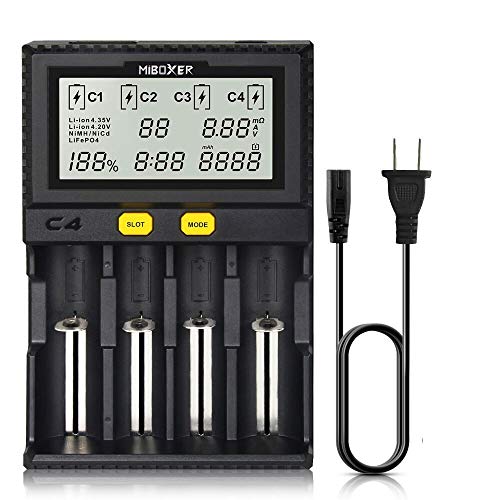
MiBOXER C4 4-Bay Smart Charger

XTAR VC4H 4-Bay USB-C Charger

Swanlake 2-Bay Adjustable LCD Charger

Tenergy TN270 Li-ion Two-Bay Charger
The Picks, Examined More Closely
This bundle centers on the Fenix ARE-A2, a two-bay charger that draws power from either a household AC cord or the included 12V in-car cable. For someone whose flashlight rides in a backpack or a glove box, having a charging option that works off a vehicle socket turns a long drive into a useful top-up window.
Compatibility covers 21700, 18650, and 16340 lithium cells, plus Ni-MH and Ni-Cd AA, AAA, and C sizes, so you can charge one or two cells at a time without juggling adapters. The EdisonBright BBX5 carry case rounds out the kit with a structured way to keep spares sorted on the road.
A Few Strong Suits
- Dual power input (AC wall plus 12V car) for charging wherever you park or plug in.
- Wide cell coverage spans modern 21700 cells down to legacy 16340 formats.
- Included BBX5 case protects cell contacts from keys and loose change.
- Independent bays let you charge two different chemistries at once.
Worth Noting
- Two bays cap your throughput on heavy rotation days.
- Car cable adds bulk to the storage pouch compared to single-cord kits.
Who It Suits Best
Road-trippers, overlanders, and emergency kit builders who want a charger that follows them from the kitchen counter to the driver’s seat.
Where Another Pick Suits Better
Stationary home users charging many cells at once will find the XTAR VC4H 4-Bay USB-C Charger more efficient for batch top-ups.
Where the EdisonBright bundle focuses on versatility between wall and car, the MC-ELIN leans into portability through a USB-C input. The 2-slot body keeps the desk footprint small, which helps in apartments, dorm rooms, or any workbench where space is contested.
It supports a long list of 3.7V lithium chemistries (10440, 14500, 16340, 18350, 18490, 18650, 20700, 21700, 22650, 26650, 26700) and AA/AAA Ni-MH or Ni-Cd cells. Built-in safeguards cover short-circuit, overheat, and overvoltage conditions, with the unit halting output once a cell is full.
Positive Points
- USB-C input means a laptop, power bank, or car adapter can feed it.
- Auto-stop charging protects cells from trickle overcharge when left overnight.
- Wide lithium compatibility including 20700 and 21700 next-gen formats.
Trade Offs
- Two slots only, which can bottleneck users running multiple flashlights.
- No display, so you only know the cell is full when the indicator stops blinking.
At A Glance
Made For
Travelers and minimalists who already carry USB-C bricks and want one compact charger that tucks into a go-bag.
Skip It When
You rotate more than two cells at a time, in which case the Nitecore UMS4 Intelligent USB Four-Slot Charger is a smoother workflow.
The Fenix PD35 V2.0 is the only flashlight in this lineup, and for good reason: it is the cell-consuming device that every other charger on this list is designed to support. Built around the Cree XP-L HI V3 LED, it pushes up to 1000 lumens with a beam throw reaching roughly 250 meters.
Six lighting modes are cycled through a metal side switch that also surfaces a built-in battery level indicator, removing the guesswork when you grab the light before a hike. Tail-cap switching handles on/off, so the grip pattern stays familiar for anyone migrating from older PD-series lights.
Where It Delivers
- Six-mode UI covers everything from a low-glow map reading beam to full output.
- Battery level indicator inside the side switch prevents surprise dead cells.
- Pocket-friendly tube design fits standard belt holsters for everyday carry.
- Pairs naturally with chargers on this list that handle 18650 and CR123A backup cells.
Points To Note
- The light ships without a cell, so you’ll need to pair it with one of the chargers above and a separate 18650 purchase.
- Maximum output on Turbo drains high-capacity cells faster than mid modes.
Best Suited To
Everyday-carry flashlight owners who want a durable, weather-sealed host and already plan to keep cells on a smart charger.
Consider Something Else When
You want a turnkey kit; the EdisonBright Fenix ARE-A2 Charger Bundle pairs a smart charger with a carry case in one box.
Where the MC-ELIN strips back to two slots and a status LED, the FARSAIL puts a voltage readout on every bay. That screen becomes useful when you juggle older cells mixed in with new ones, since a healthy 18650 should hover near 3.7V at rest and a tired cell sags below that.
Charging current runs up to 1000mA per slot for 3.7V lithium cells (twice the speed of typical 500mA wall chargers), while Ni-MH and Ni-Cd cells top out at 400mA. Coverage spans 18650, 18490, 18500, 18350, 17670, 17500, 16340, RCR123A, 14500, 10440, and the usual AA/AAA household cells.
Real Benefits
- Per-slot LCD voltage readouts help you spot a tired cell before it strands you.
- 1000mA lithium output halves charge time compared to 500mA chargers.
- Independent bay control prevents one cell from slowing down the other.
- LiFePO4 compatibility opens the door to safer chemistry cells.
Small Caveats
- Higher current generates more heat on long sessions, so airflow around the bays matters.
Right Fit For
Households running mixed cells across cameras, flashlights, and remote controls who appreciate a numerical readout.
Look Elsewhere When
You only charge one or two cells at a time and care more about USB-C portability than the LCD, which is where the MC-ELIN 18650 Smart Universal Charger fits.
The UMS4 sits at the high-amperage end of the USB charger category. Plug it into a Quick Charge 3.0 wall brick and a single slot can draw up to 3000mA, while the unit totals 4000mA split across four bays when fed from a 2A source.
Each bay has its own LCD readout showing charging current, voltage, and battery health in real time. For households that cycle through several cells a week, those numbers help identify which 18650 is starting to lose capacity. Coverage spans Li-ion, Ni-MH, Ni-Cd, and IMR cells in sizes from 16340 up to 21700 and 20700, plus AA and AAA.
Why It Works Well
- 3000mA single-slot QC mode refills a depleted 18650 faster than 1A competitors.
- Independent bay monitoring displays real-time current and voltage data.
- USB input means any QC-compatible power bank can drive it in the field.
- Health readings help you retire aging cells before they fail under load.
A Few Limitations
- To hit the top 3000mA slot output you must supply a Quick Charge 3.0 source, which often ships separately.
- Heat climbs during long QC sessions, so leaving it on soft surfaces can shorten component life.
Feature Snapshot
Who Will Love This
Heavy-rotation users running multiple flashlights, headlamps, and devices that all draw from 18650 banks.
Reach For A Different Pick When
You only need to charge two cells at a time and want a more travel-friendly footprint, in which case the XTAR VC4H 4-Bay USB-C Charger offers a similar bay count with a different charging profile.
The D2 has been around long enough to develop a reputation as a workshop workhorse. Its ABS fire-retardant shell and metal battery sliders are designed to take the kind of repeated insertion and removal that a busy hobby bench generates.
Two bays each monitor and charge independently, which means a half-used cell next to a fresh one does not slow the other down. Owners frequently cite the unit’s ability to recover deeply discharged IMR cells that cheaper chargers refuse to acknowledge.
Benefits That Matter
- ABS shell is fire-retardant, lowering risk if a cell is inserted in poor condition.
- Metal sliders reduce wear at the contact points over years of daily swaps.
- Independent charging circuits protect each cell from cross-load issues.
Honest Caveats
- Wall-plug only, no USB input, so off-grid use requires an inverter.
- Charging speed lags behind newer QC-capable chargers on this list.
Perfect Match For
Workshop and garage users who keep the charger plugged in year-round and value rugged construction over fast top-ups.
A Better Fit Elsewhere
Anyone wanting faster fill times should compare against the Nitecore UMS4 Intelligent USB Four-Slot Charger in the same brand family.
MiBOXER’s C4 is a four-bay charger built around a PC fire-retardant body, with attention paid to heat dissipation and circuit design. The automatic LCD readout shows charging status, voltage, and current across all four bays, which makes it easy to glance at a charging station and see how full the cells are.
The smart logic stops charging once a cell is full, and it flags reversed or short-circuited cells with an error symbol on the screen. Over-discharged cells can be revived by the charger, which is helpful for anyone who has left a flashlight switched on in a drawer and come back to a deeply drained 18650.
Bright Spots
- Four independent bays in a compact tabletop footprint.
- Auto-stop and reverse-polarity detection protect both cells and charger.
- Revives over-discharged cells that some competitors reject outright.
- Broad chemistry coverage spans Li-ion, LiFePO4, Ni-MH, and Ni-Cd cells.
Points To Keep In Mind
- Total current is shared across bays, so charging four cells simultaneously takes longer than charging two.
- LCD readability dips under bright direct sunlight on a workbench.
Built With In Mind
Family charging stations where multiple devices and chemistries get topped up across the week.
Swap It Out When
You mainly charge two cells and want faster per-cell speeds, which is where the Nitecore UMS4 Intelligent USB Four-Slot Charger pulls ahead.
XTAR built the VC4H around a transparent LCD that surfaces charging current, voltage, charged capacity, cell type, and channel number for every bay. That level of detail appeals to flashlight hobbyists who track the actual milliamp-hours going into a cell rather than guessing from a blinking LED.
USB-C input modernizes the cable situation, and the unit auto-detects battery status to pick the right charging mode without manual switching. Compatibility covers 3.6V/3.7V Li-ion/IMR/INR/ICR cells from 10440 up to 32650, plus Ni-MH and Ni-Cd in AAAA, AAA, AA, A, SC, C, and D sizes, and protected 20700 and 21700 cells.
What Works In Its Favor
- USB-C input accepts the same cable you use for a laptop or phone.
- Per-cell capacity readouts let you compare cells and retire weak ones.
- Auto-detect logic avoids manual mode switching for unfamiliar chemistries.
- Handles protected 20700 and 21700 cells that some chargers physically reject.
Factors To Consider
- No display backlight timer, so the screen stays lit through the entire charging session.
- Higher capacity readings assume accurate cell calibration, which can drift on older cells.
Feature Card
Whose Shelf It Belongs On
Flashlight enthusiasts who keep spares on rotation and want to monitor actual cell health rather than just charge state.
Where A Sibling Pick Shines
Owners wanting the absolute fastest QC-driven top-ups will prefer the Nitecore UMS4 Intelligent USB Four-Slot Charger in the same four-bay category.
The Swanlake gives you manual control over charging speed, which is unusual in this price tier. You can dial lithium cells down to 0.5A for older or heat-sensitive batteries, push them to 1A for routine top-ups, or hit 2A when a freshly drained 18650 needs to be back in rotation quickly.
Two bays with an LCD screen report charging status, and chemistry support spans 3.7V lithium (10440 through 26650) and 1.2V Ni-MH/Ni-Cd in AA, AAA, AAAA, SC, C, and F6 sizes. Ni-MH cells charge at a fixed 0.5A regardless of the adjustable setting.
Useful Highlights
- Manual current selection at 0.5A, 1A, or 2A gives flexibility per cell.
- Wide lithium coverage up to 26650 for high-capacity cells.
- LCD readout keeps you informed without a phone app or external meter.
Trade-Offs To Consider
- Ni-MH charging is locked at 0.5A, so AA/AAA top-ups take longer than on dedicated NiMH chargers.
- Two slots cap the throughput for users with bigger rotation banks.
The Right Fit
Owners with mixed-age cells who want to slow-charge tired batteries and fast-charge fresh ones without buying two chargers.
Not Your Match When
You want four bays and broader chemistries; the MiBOXER C4 4-Bay Smart Charger fits that scenario.
The Tenergy TN270 keeps things simple, which is exactly the point. A red LED means the cell is charging, and a green LED means it is full. There is no LCD screen to interpret and no buttons to press, which lowers the entry barrier for anyone buying their first 18650 setup.
Charging covers 18650, 18500, and 14500 lithium-ion cells, the three formats most commonly used in flashlights, digital cameras, and solar yard lights. The 100V to 240V AC input means the unit works from any standard wall outlet regardless of region, and CE certification is on file.
A Favorable Mix
- LED-only interface leaves zero room for setup confusion.
- World-voltage AC input is useful for anyone traveling internationally.
- Focus on common flashlight cell sizes avoids paying for unused formats.
Practical Considerations
- Lacks chemistry support beyond 3.7V Li-ion, so Ni-MH AA cells need a separate charger.
- No display means you cannot verify charge current or detect a worn cell before it sits too long.
Who Should Grab It
First-time 18650 owners who want a charger that does one job simply and predictably without extra features to navigate.
Another Choice May Suit
Users who want USB-C power input and broader chemistry support will be better served by the MC-ELIN 18650 Smart Universal Charger.
Picking The Right Charger For Your Flashlight Routine
Match The Charger To Your Cell Rotation
A single-flashlight owner who tops off one cell a week has different needs than someone running a rotation of six 18650s across headlamps, lanterns, and handheld lights. Two-bay chargers handle the first case cleanly; four-bay models like the MiBOXER C4 or XTAR VC4H earn their slots once you start juggling multiple spares. Cell chemistry matters too, since lithium-ion, Ni-MH, and LiFePO4 all demand different voltage curves and termination logic. A charger that auto-detects chemistry removes one more thing to think about.
Decide Between Wall, USB-C, And Car Power
Wall-plug-only chargers like the Nitecore D2 and Tenergy TN270 are stable and predictable, but they tie you to an outlet. USB-C chargers (MC-ELIN, Nitecore UMS4, XTAR VC4H, Swanlake) draw from any laptop, power bank, or wall adapter, which is a major advantage for travelers. The EdisonBright Fenix ARE-A2 Charger Bundle covers both wall and 12V car outlets, which makes it the pick for anyone whose flashlights spend as much time in a vehicle as at home.
Look At Speed Vs. Cell Longevity
High-amperage charging (1A or above) refills cells fast, but it also raises cell temperature and can shorten cycle life over years of daily use. Adjustable models like the Swanlake 2-Bay Adjustable LCD Charger let you slow-charge older or heat-sensitive cells and fast-charge fresh ones, which is a useful middle path. For most users, a 0.5A to 1A rate on lithium cells is a sensible default.
Smart Choices That Hold Up Over Time
Pitfalls Shoppers Hit
A common mistake is grabbing the cheapest two-bay charger without checking the supported chemistry list, then discovering it will not touch a 21700 cell or a LiFePO4 variant. Another is assuming any USB port delivers full charging speed; the Nitecore UMS4 only hits its 3000mA slot output with a Quick Charge 3.0 source. It is also worth confirming that the charger matches your cell length; protected 20700 and 21700 cells are longer than unprotected ones, and some bay designs physically reject them.
What The Higher Tier Buys
Stepping up to a multi-bay smart charger typically buys you a per-cell LCD readout, independent charging circuits, and safer termination logic. Those features show up as longer cell life, fewer mystery failures, and the ability to retire a worn cell before it strands you on a night hike. For users charging two or more cells every week, the upgrade pays back quickly in convenience alone, even before counting the durability gain.
Frequently Asked Questions
Can any 18650 charger safely charge protected and unprotected cells?
Most smart chargers on this list handle both, since the protection circuit lives inside the cell, not the charger. What matters is the bay length, because protected 21700 and 20700 cells extend further than their unprotected siblings. Confirm that the charger’s slot physically accepts the longer format before inserting.
Is USB-C input as reliable as a dedicated wall adapter?
A USB-C input paired with a quality wall brick is stable enough for routine charging and far more convenient. Chargers that support Quick Charge 3.0 need a QC-compatible source to hit peak rates, while a standard 5V USB-C source will simply charge at a slower, still-safe current.
How fast should a 18650 be charged to maximize lifespan?
Charging at 0.5A keeps cells cool and is the gentlest path to long cycle life. Most mid-tier chargers default to 0.5A or 1A, which balances speed and longevity. Reserve 2A or higher rates for occasional fast top-ups rather than every session.
Do I need a special charger for LiFePO4 cells?
Yes, LiFePO4 cells charge at a different voltage (3.6V nominal) than standard Li-ion (3.7V), so a charger without LiFePO4 support can undercharge or mis-terminate the cell. Chargers like the FARSAIL LCD Universal 18650 Battery Charger, XTAR VC4H, and MiBOXER C4 explicitly list LiFePO4 compatibility.
Should I buy a flashlight and charger separately or in a bundle?
Bundles like the EdisonBright Fenix ARE-A2 Charger Bundle simplify the first purchase and pair a known charger with a carry case. Buying separately lets you match the flashlight to your exact carry preference and pair it with a more advanced four-bay charger if you already run several cells.
The Takeaway
The right 18650 setup depends less on chasing specs and more on how you actually use your flashlights. Two-bay chargers cover the basics, four-bay models earn their place once rotation expands, and the Fenix PD35 V2.0 anchors the conversation about what kind of host those cells are feeding. Pick the charger that fits your real routine, treat the cells gently, and your flashlight will be ready the next time the lights go out.