Living out of an RV means every amp-hour matters. The right lithium battery keeps your lights on through a rainy weekend, handles cold-morning starts without complaint, and weighs a fraction of the lead-acid brick it replaces. The ten options below cover a wide range of capacities, chemistries, and budgets, so you can match storage to your travel style without overspec’ing your rig or underspec’ing your weekend plans.
A Snapshot Of The Selections

Redodo 12V 100Ah LiFePO4 Battery with Charger

VATRER POWER 12V 300Ah Self-Heating LiFePO4 Battery

VATRER POWER 12.8V 300Ah Self-Heating LiFePO4 Battery

ECO-WORTHY 12V 314Ah LiFePO4 Battery with Bluetooth

ECO-WORTHY EnergyRock 12V 280Ah 2-Pack Metal Case

ECO-WORTHY 12V 280Ah Metal Case LiFePO4 Battery

power queen 12V 100Ah Group 31 LiFePO4 Battery

Redodo 12.8V 100Ah LiFePO4 Battery with Charger

Redodo 12V 165Ah LiFePO4 Battery with Charger
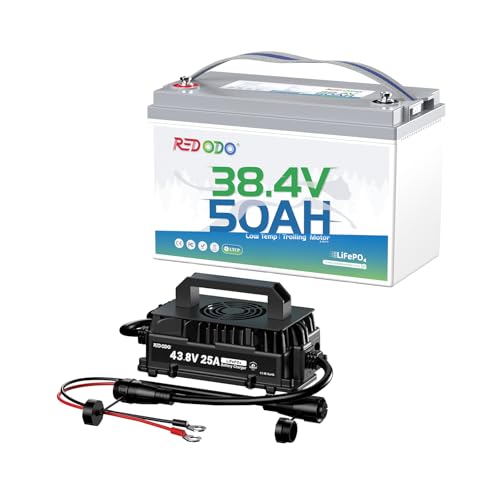
Redodo 36V 50Ah Trolling Motor Lithium Battery
If you’re trading out a tired group 24 lead-acid for something modern, this Redodo pair arrives with everything in one box: a 100Ah LiFePO4 (lithium iron phosphate, a safer, longer-lasting lithium chemistry) cell and a matched 14.6V 20A charger. The BMS, short for Battery Management System, protects against overcharge, deep discharge, and short circuits, and here it adds Bluetooth 5.0 so you can watch state of charge from the cab.
For most weekend warriors running a fridge, lights, and a fan, 100Ah is the practical sweet spot. Owners commonly report the bundle simplifying a first lithium install because the included charger is already tuned for LiFePO4 charging profiles.
Standout Benefits
- Bluetooth monitoring shows voltage, current, and remaining capacity on your phone
- Charger included, so there’s no guessing about compatible charging profiles
- Low-temperature cutoff prevents charging damage below 32°F
- 100Ah in a familiar Group 31-ish footprint for easier swaps
Worth Noting
- Bundle ships in two packages, so you may receive the battery and charger on different days
- Bluetooth range is modest, so the cab is the realistic monitoring spot
Key Specs
Right Fit For
First-time lithium converters who want a matched battery-and-charger bundle without research rabbit holes.
Consider Something Else When
The VATRER POWER 12V 300Ah Self-Heating battery suits travelers who run larger inverter loads or camp in sub-freezing temperatures more often.
Winter warriors pay attention: this 300Ah VATRER POWER pack brings an internal heating film that wakes up once temperatures drop near freezing. The heating draws from incoming charge current, so you only need the BMS to push at least 10A for warmth to engage. That single feature eliminates the manual warming rituals many lead-acid owners dread at sunrise.
Triple the capacity of the Redodo 100Ah above, and you’re suddenly running induction cooking, a microwave, and a residential fridge without flinching. Owners commonly mount a single 300Ah in the bay where two 100Ah batteries used to live.
Reasons It Performs
- 300Ah offers roughly 3.84kWh of usable energy for larger rigs
- Auto-heating activates below 32°F, so cold-morning charging is safer
- App monitoring mirrors the Redodo approach but adds capacity telemetry
- Single-pack design simplifies wiring compared to paralleled banks
Trade Offs
- Self-heating draws from charging current, so you need a robust charger to take advantage
- The 300Ah footprint is large, so measure your battery bay first
Built With In Mind
Full-time RVers and winter campers who push high-draw appliances and need reliable cold-weather charging.
Look Elsewhere When
Smaller camper vans on tight budgets may find the Redodo 12.8V 100Ah a more proportional fit.
Where the previous VATRER packs raw storage, this 12.8V 300Ah sibling leans into longevity. The LiFePO4 cells are specced for over 5000 cycles at full depth of discharge, so even daily deep cycling should leave years of service ahead. That’s roughly an order of magnitude beyond a typical lead-acid’s 300 to 500 cycle window.
Compared to the ECO-WORTHY 314Ah below, this unit trades a bit of total capacity for the self-heating feature, which matters more in shoulder-season travel. The app interface also shows cell-level voltage drift, useful if you’re troubleshooting an unusual voltage drop.
The Helpful Details
- 5000+ cycle rating keeps total ownership cost low over a decade
- Internal heating engages before charging resumes in cold weather
- App shows individual cell voltages for early problem detection
- Higher energy density means less weight than equivalent lead-acid banks
Honest Caveats
- 300Ah in a single case is heavy, around 60 pounds, so plan mounting
- Self-heating only kicks in during active charging sessions
Whose Shelf It Belongs On
Long-haul full-timers who plan to keep the same rig running for many seasons and want maximum cycle durability.
A Better Fit Elsewhere
Weekenders running a single Group 31 slot will find the power queen 12V 100Ah simpler and easier to handle.
When raw kilowatt-hours matter more than clever packaging, the 314Ah ECO-WORTHY delivers roughly 4kWh of usable storage in a single 12V unit. The 200A BMS (the BMS handles peak current safely, so a 200A rating means up to 200 amps of continuous draw without tripping protection) supports serious inverter loads, think 2000W coffee makers and induction cooktops, without the BMS crying uncle.
The integrated SOC (state of charge) LEDs and Bluetooth app give you two ways to check remaining capacity. A wall-side glance tells you the rough percentage; the app shows precise voltage and current draw.
The Value In It
- 314Ah is among the largest single-pack capacities in this roundup
- 200A BMS supports large inverters for induction and microwave use
- LED display gives instant state-of-charge reading without a phone
- Up to 15000 deep cycles reduces long-term replacement cost
Things To Weigh
- Single 314Ah pack adds noticeable weight to the battery bay
- Low-temp charging cutoff still requires a heater or warm storage below freezing
Feature Snapshot
Best Suited To
Off-grid enthusiasts running solar arrays who want one battery instead of a paralleled bank.
Swap It Out When
The ECO-WORTHY EnergyRock 2-Pack suits shoppers who prefer redundant, lighter individual units over one heavy box.
The EnergyRock ships as two 280Ah batteries, a configuration that splits risk across two packs. If one ever fails, the other keeps the fridge cold while you troubleshoot. The metal case upgrade (recently swapped from plastic) handles vibration and heat better than the older enclosure.
Together you get roughly 7.1kWh of usable storage. Owners commonly mount these in separate bays to balance weight side-to-side, which also helps with tongue-weight calculations on towables.
The Upside
- Two-pack layout distributes weight across the chassis
- Metal case adds heat dissipation and crash protection
- Bluetooth monitoring on each unit simplifies diagnostics
- Total 7.1kWh covers most large-rig residential fridge needs
Points To Note
- Wiring two packs in parallel adds small resistance losses
- Two enclosures take up more bay length than a single large battery
Technical Highlights
Perfect Match For
Riggers building expandable banks who value redundancy and the option to add capacity later.
Not Your Match When
Tight single-bay installs are better served by the VATRER POWER 12V 300Ah single-pack design.
Where the EnergyRock 2-Pack spreads capacity across two enclosures, this single 280Ah version consolidates the same core capacity into one rugged metal box. The weak-current power switch lets you cut output with a single press, useful for storage or working on the system.
The metal housing adds fire resistance and stands up to the constant vibration of long-haul towing. Compared to the ECO-WORTHY 314Ah above, this trades a bit of capacity for that low-voltage cutoff switch, a small but practical convenience for owners who don’t want to disconnect cables by hand.
Points In Its Favor
- Metal enclosure improves heat dissipation and structural safety
- One-touch power cutoff switch simplifies storage and service
- 280Ah fits many standard battery trays without modification
- 200A BMS supports most RV-sized inverters cleanly
Room For Improvement
- Single 280Ah falls short of 300Ah competitors for heavy inverter loads
- Exterior label style varies between production runs, though internals match
Who Should Grab It
Travelers who want a single, tough, fire-resistant pack and don’t need the extra 14Ah the 314Ah sibling offers.
Another Choice May Suit
Those needing the absolute largest single-pack capacity should weigh the ECO-WORTHY 12V 314Ah instead.
The power queen 100Ah is the cleanest lead-acid replacement on this list because it follows the Group 31 footprint, a standard battery box dimension used across many RVs and boats. Drop it in, secure the hold-downs, and reconnect the existing cables without bracket modifications.
The 100A BMS handles moderate inverter loads, well-suited to a 1000W inverter running a small coffee maker or laptop charger. You can also expand the system later because the battery supports up to 4P4S configurations, meaning four packs in parallel and four in series for 24V or 48V systems.
Strong Points
- Group 31 size matches most existing RV trays for true drop-in installation
- Up to 15000 cycles extends usable life well past a decade of weekly trips
- 4P4S support lets you grow capacity or voltage as needs change
- 100A BMS protects common RV loads without tripping
Practical Considerations
- No Bluetooth, so you’ll want an external shunt monitor for precise state of charge
- 100Ah may feel small for rigs running residential fridges full time
Quick Facts
Made For
Shoppers upgrading from lead-acid who want a battery that fits existing hardware without custom brackets.
Reach For A Different Pick When
The Redodo 12V 165Ah is a better match for those wanting more capacity in the same Group 31 size envelope.
The earlier Redodo entry ships with a 20A charger, while this version pairs a 10A charger with the same 100Ah cell. The slower charging rate means longer refill times, often 10 to 12 hours from empty, but the smaller, lighter charger is easier to stow in a tight galley cabinet.
Specs around cycle life match the 4000 to 15000 cycle range typical of LiFePO4 cells, which means years of weekly camping before you think about replacement. Owners commonly report this kit working well for modest setups with a single fridge and LED lighting.
Real Benefits
- Compact 10A charger fits smaller storage cubbies than bulkier 20A units
- LiFePO4 chemistry offers the same long cycle life as larger Redodo packs
- Drop-in replacement for many Group 24 or Group 31 trays
- Lower entry cost than bundled 20A charger versions
Where It May Fall Short
- Slower charging rate means overnight shore-power sessions to refill
- No Bluetooth, so remote monitoring requires an add-on shunt
Who Will Love This
Casual weekend travelers running modest loads who prefer a slower charger they can tuck in a small space.
Where A Sibling Pick Shines
The Redodo 12V 100Ah with 20A charger is a better fit when you want faster turnaround between trips.
The 165Ah Redodo splits the difference between a basic 100Ah and a full 300Ah, packing roughly 2.1kWh of storage into a Group 31 footprint. That’s enough for a couple traveling with a small inverter, a fridge, and lights, without paying for the third battery you don’t need.
The included 20A charger fully refills the pack in around eight hours, faster than the 10A version above. Owners commonly cite the size as a sweet spot for mid-size camper vans where space and budget both matter.
A Favorable Mix
- 165Ah offers more runtime than 100Ah without jumping to 300Ah pricing
- 20A charger refills in roughly eight hours from empty
- Group 31 size fits standard RV battery trays cleanly
- LiFePO4 chemistry supports thousands of deep cycles
A Few Limitations
- Bundle arrives in multiple packages, so plan for staggered deliveries
- 165Ah is right on the edge for larger inverters running induction cooking
Best Suited To
Couples and small families running moderate inverter loads who want extra headroom without doubling capacity.
Skip It When
The ECO-WORTHY 12V 314Ah fits shoppers who regularly power microwaves or residential fridges.
Strictly speaking, this 36V 50Ah pack is built for trolling motors in the 100 to 120 pound thrust range, but RVers who tow a boat or run a separate high-voltage accessory bank will recognize the value. The 43.8V 25A charger fully refills the pack in about two hours, faster than most 12V chargers manage.
For RV use, this Redodo works best in hybrid rigs where the boat and camper share a charging setup. Owners commonly install it as an auxiliary power source for higher-voltage gear that wouldn’t run cleanly on standard 12V house banks.
Everyday Perks
- 43.8V 25A charger refills the pack in roughly two hours from empty
- Built specifically for 100 to 120 pound thrust trolling motors
- LiFePO4 chemistry extends cycle life far beyond lead-acid marine batteries
- Stable voltage delivery keeps trolling motors running at consistent RPM
Things To Consider
- 36V output requires a dedicated inverter or trolling motor, not standard RV 12V loads
- Capacity is modest compared to 12V house banks, so runtime is shorter
The Right Fit
RVers with a paired boat rig who want a single lithium solution for trolling motor power.
Not Your Match When
Pure RV house-bank shoppers should consider the Redodo 12V 100Ah or ECO-WORTHY 12V 314Ah instead.
## What To Weigh Before Choosing a 12v Lithium Battery### Capacity Vs FootprintCapacity (measured in amp-hours at 12V) tells you how long the battery can run your loads. A 100Ah pack holds roughly 1.28kWh of usable energy, enough for LED lights and a fridge for a weekend. A 300Ah pack triples that to 3.84kWh, enough for induction cooking or residential fridges. The trade-off is weight and size: bigger packs need bigger battery bays and add meaningful pounds to your rig’s tongue or axle load.### BMS Rating And Inverter LoadsThe BMS rating (the BMS handles peak current safely, so a 200A rating means up to 200 amps of continuous draw without tripping protection) dictates what you can run through an inverter. A 100A BMS handles small electronics and modest microwaves. A 200A BMS supports induction cooktops and larger coffee makers without protection faults. Match the BMS to your biggest planned load, not your average draw.### Cold-Weather Charging BehaviorLithium cells can be permanently damaged if you charge them below freezing without protection. Low-temperature cutoff BMS systems block charging when temperatures drop near 32°F, while self-heating packs (like the VATRER POWER options above) warm cells before accepting charge. Campers in mild climates can skip the heating premium, but anyone winter camping in northern states will appreciate the safety margin.### Battery Chemistry And Cycle LifeLiFePO4 (lithium iron phosphate) is the chemistry used across this list. Compared to older lithium-ion variants, LiFePO4 runs cooler, tolerates more cycles, and is far less prone to thermal runaway. Most packs in this roundup are rated for 4000 to 15000 cycles, so a weekend warrior might see a decade of use before any noticeable capacity loss.## Key Considerations Across These Picks### Common Shopping Slip UpsThe biggest mistake is matching capacity to wishful thinking instead of measured loads. Add up the watts your fridge, lights, fans, and inverter draw on a typical day, then divide by 12V to estimate amp-hours. Buying a 100Ah battery for a residential fridge running 24/7 means running out by morning. Another common slip is ignoring the charger’s amperage, since a 10A unit refills much slower than a 20A version, a meaningful gap for solar-dependent setups.### When Paying More Pays OffHigher-tier models in this category buy three things: more amp-hours, stronger BMS ratings, and cold-weather features like self-heating. For occasional weekend use, a 100Ah battery is plenty. For full-time RV living or winter camping, the upgrade to a 300Ah self-heating pack pays back quickly in usable runtime and charging flexibility, especially if you ever run an induction cooktop or microwave.## Frequently Asked Questions### How long does a 12v lithium battery last in an RV? A typical LiFePO4 pack rated for 4000 to 15000 cycles can run for 10+ years of regular RV use before capacity drops noticeably. Actual lifespan depends on depth of discharge, charge rate, and operating temperature.### Can I replace my lead-acid battery with lithium directly? Most modern LiFePO4 batteries fit standard Group 24 or Group 31 trays, so the swap is usually a clean drop-in. You may need to upgrade your converter or charger to a lithium-compatible profile for full refill.### Do lithium RV batteries work in cold weather? They discharge fine in cold conditions, but charging below freezing can damage cells unless the pack has a low-temperature cutoff or self-heating feature. The VATRER POWER options above include self-heating for exactly this reason.### What size inverter can a 100A BMS handle? A 100A continuous BMS supports roughly 1200W from a 12V source before protection circuits engage. Larger inverters need a higher-rated BMS, such as the 200A units on the ECO-WORTHY 314Ah and 280Ah packs.### Is Bluetooth monitoring worth the extra cost? For travelers who park for weeks at a time, Bluetooth gives precise state-of-charge readings from the cab without opening battery bays. For short weekend trips, an external shunt monitor or simple LED indicator is often enough.## The TakeawayThe right 12v lithium battery matches your typical daily draw, fits your battery bay, and survives your coldest camping conditions. Weekend travelers will be happy with a 100Ah Group 31 unit, while full-timers running residential fridges and induction cooking will appreciate the headroom of a 300Ah or larger pack. Whichever path you take, the chemistry upgrade pays off in weight savings, deeper usable capacity, and far longer service life than any lead-acid it replaces.