A 12 volt lead acid battery quietly keeps a lot of life running: garage door openers during an outage, security panels that need to stay armed all night, small marine electronics, mobility scooters, and the trickle of standby power behind emergency lighting. The catch is that the category looks simple until you actually shop it, because sizes, terminal layouts, and chemistries overlap in confusing ways. This roundup breaks nine solid options into the use cases they actually fit, including chargers and replacement packs, so you can match the right model to your situation without overpaying for capacity you will never use.
A Quick View Of The Lineup

ECO-Worthy 12V/24V 20A Smart Battery Charger
Miady 12V 9Ah Sealed Lead Acid Battery

SigmasTek Chamberlain 41A6357-1 Compatible 12V 5Ah
Mighty Max 12V 5AH SLA Garage Door Opener Battery

ECO-WORTHY 12V 5A Smart Battery Maintainer
ECO-Worthy 2 Bank Marine Battery Charger 5×2
Mighty Max 12V 7Ah ADT Security Alarm Battery

Miady 12V 5Ah Sealed Lead Acid Battery (2-Pack)

Mighty Max 12V 22AH SLA Replacement Battery
More On The Choices That Made The List
Workshop owners juggling both a 12V lawn tractor battery and a 24V trolling setup will appreciate how the ECO-Worthy 12V/24V 20A Smart Battery Charger sidesteps the usual two-charger problem. It reads the system voltage automatically and then lets you dial in current by hand, which matters when a small battery simply cannot accept the full 20A flood without overheating.
Unlike the simpler 5A maintainer later in this list, this one is genuinely a charger first, with current options of 5A, 10A, 15A, and 20A in 12V mode. That flexibility comes from supporting LiFePO4, AGM, gel, and flooded lead acid chemistries on a single platform.
Features That Help
- Automatic detection of 12V versus 24V battery banks reduces setup errors in a busy shop.
- Four selectable current levels in 12V mode let you match a small alarm panel or a larger mobility pack without swapping units.
- Broad chemistry support covers LiFePO4 (lithium iron phosphate, a long-life lithium chemistry), AGM (absorbent glass mat, a sealed lead-acid design), gel, and standard flooded lead acid.
- Manual current selection helps protect smaller batteries that cannot safely accept the maximum 20A output.
Things To Consider
- At full 20A output the unit generates noticeable fan noise, which is a fair trade-off for faster charging but worth knowing in a quiet garage.
- Owners of a single small battery may find the menu of current options more than they actually need day to day.
Feature Card
Built With In Mind
Shed owners, small-shop hobbyists, and anyone running a mix of 12V and 24V lead acid or LiFePO4 batteries will get the most from this charger’s flexibility.
Where Another Pick Suits Better
Storage-only setups that just need to keep one battery topped off will be happier with the simpler ECO-WORTHY 12V 5A Smart Battery Maintainer later in this list.
The Miady 12V 9Ah Sealed Lead Acid Battery is the middle child of the SLA family, sitting between compact 5Ah alarm batteries and the larger 22Ah deep-cycle units. That 9Ah rating translates to roughly twice the runtime of the 5Ah options in this list, which is meaningful for a kid’s ride-on toy or a small UPS that has to bridge a few hours of utility blips.
AGM construction means the acid is held in fiberglass mats rather than free-flowing liquid, so the case is sealed and can be mounted in less-than-perfect orientations without venting. ABS plastic housing adds a layer of shock and heat resistance, which is useful in a garage that swings from cold winters to hot summers.
A Few Highlights
- Higher 9Ah capacity than typical alarm batteries gives noticeably longer runtime per charge.
- AGM sealed design means no acid spills and no topping off, even in tilted mounting positions.
- Wide operating temperature range suits unheated sheds, basements, and outdoor enclosures.
- Rechargeable and maintenance-free over the typical SLA service life.
Trade Offs
- Heavier than the 5Ah alternatives, so it is not ideal for portable rigs where every ounce matters.
- Like most SLA batteries, deep discharges shorten cycle life, so pairing it with a smart charger like the ECO-WORTHY 12V 5A Smart Battery Maintainer is worth considering.
Whose Shelf It Belongs On
Households running small UPS units, mobility scooter backup packs, or kids’ ride-on vehicles will get a comfortable balance of capacity and footprint from this 9Ah unit.
Skip It When
Buyers who need two matched batteries for a parallel project should look at the Miady 12V 5Ah Sealed Lead Acid Battery (2-Pack) instead, which delivers a pair of smaller units at a similar combined capacity.
Replacing a garage door opener battery usually starts with a confusing model number, and the SigmasTek Chamberlain 41A6357-1 Compatible 12V 5Ah F1 makes that first step easier. The listing cross-references a long list of equivalent part numbers, so a quick check against the dead battery in your opener is usually enough to confirm fit.
The 5Ah capacity and F1 spade terminals match the form factor that most residential openers expect. AGM construction keeps the unit sealed and maintenance-free, which is the right combination for a part that lives in a ceiling-mounted unit and rarely gets touched between outages.
Useful Strengths
- Cross-compatibility across numerous part numbers simplifies the search for an obscure opener model.
- UL recognition and CE certification suggest baseline safety and quality standards have been checked.
- Sealed, spill-proof AGM case is a good match for the enclosed, hard-to-reach location of an opener battery.
- Good cycle life relative to the standby role it plays.
Points To Keep In Mind
- Designed for light standby duty, so it is not the right pick for high-current cycling or mobility applications.
- Confirm the terminal type and physical dimensions before ordering, since the F1 connector is small and a slightly different layout will not seat properly.
Made For
Homeowners replacing the backup battery in a Chamberlain or compatible garage door opener who want a drop-in fit and do not need higher capacity.
Not Your Match When
Those seeking a similar standby battery without a specific part-number reference may find the Mighty Max 12V 5AH SLA Garage Door Opener Battery a simpler choice.
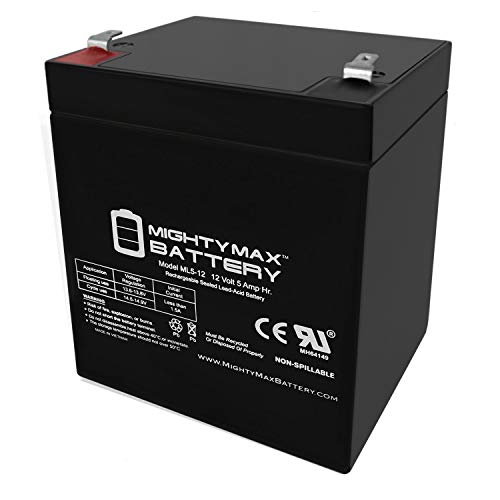
The Mighty Max 12V 5AH SLA Garage Door Opener Battery is the kind of low-key standby part that just does its job. The ML5-12 designation is one of the most common SLA footprints in the category, which means a lot of opener brackets, alarm panels, and small UPS units have a slot built around its dimensions.
UL certification is the main story here, since standby batteries live unattended for years and quietly fail if quality control is sloppy. A high discharge rate and wide operating temperature range also help in a garage that sees real seasonal swings.
Everyday Wins
- Common 12V 5Ah form factor fits a wide range of openers, alarm panels, and small UPS units.
- UL certification offers reassurance for an unattended, long-life installation.
- High discharge rate supports the brief surge a garage door opener motor draws at startup.
- Rechargeable and maintenance-free across its service life.
Worth Noting
- Like most small SLAs, deep discharge cycles will shorten overall life, so a periodic top-up charge on a smart maintainer is worth the effort.
- The 5Ah capacity is intentionally modest, so do not expect multi-day runtime for heavy loads.
Who It Suits Best
Homeowners who need a straightforward standby replacement for a 41B822-style garage door opener slot and want UL-listed peace of mind.
Look Elsewhere When
Anyone juggling multiple opener brands and part numbers will appreciate the broader cross-compatibility list on the SigmasTek Chamberlain 41A6357-1 Compatible 12V 5Ah F1.
Classic cars, weekend motorcycles, and seldom-used lawn tractors all share the same problem: a battery that goes flat between uses. The ECO-WORTHY 12V 5A Smart Battery Maintainer targets exactly that situation with a fully automated profile that watches voltage and steps in only when needed.
Unlike the bigger ECO-Worthy 12V/24V 20A Smart Battery Charger earlier in this list, this one is sized for lighter, single-battery maintenance. The 100-240V AC input means it travels well, and the LCD display gives a quick visual read on charging state without needing to check with a multimeter.
Practical Advantages
- Set-and-forget operation is well suited to seasonal vehicles that sit for weeks at a time.
- Compatibility with both lead acid and LiFePO4 chemistries broadens its usefulness as a household tool.
- Intelligent detection of low voltage and sulfation (crystal buildup on plates that reduces capacity) helps revive neglected batteries.
- LCD display removes guesswork about what stage the charger is in.
Honest Caveats
- 5A output is too gentle to recover a deeply discharged large battery in a reasonable timeframe, so it works best on smaller packs.
- Lacks the dual-bank setup that boat owners get with the ECO-Worthy 2 Bank Marine Battery Charger 5×2 reviewed below.
Right Fit For
Garage owners with a single 12V battery in a car, motorcycle, or small tractor that sits between uses and needs a quiet, automatic top-up.
Consider Something Else When
Boat owners running two batteries at once will want the dual-bank ECO-Worthy 2 Bank Marine Battery Charger 5×2 instead.
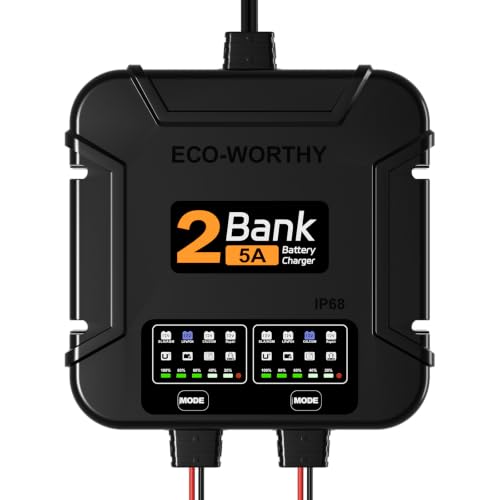
Boats and RVs almost always end up with two battery banks: one for starting, one for house loads. The ECO-Worthy 2 Bank Marine Battery Charger 5×2 is built around that reality, delivering 5A to each of two batteries simultaneously for a combined 10A output. The IP68 rating means it is fully sealed against dust and continuous water immersion, so an engine-room or transom installation is fair game.
Three chemistry modes (SLA/AGM, lithium, calcium) let each bank be configured independently, which is helpful when a starter battery and a house lithium pack are wired side by side. Compared to the smaller ECO-WORTHY 12V 5A Smart Battery Maintainer, this unit trades single-battery simplicity for true dual-bank handling.
A Favorable Mix
- Independent outputs of 5A per bank prevent one weak battery from dragging down the other during charging.
- IP68 sealing protects the electronics in damp bilge, RV, or exterior mounting locations.
- Multi-chemistry support (SLA/AGM, lithium, calcium) covers most batteries a small boat or RV might run.
Some Limits To Know
- 5A per bank is on the slow side for larger house banks, so charging a deeply discharged 100Ah lithium pack will take a long while.
- Wiring and mounting add complexity versus a single-bank maintainer, and you may want help if you have not installed onboard marine chargers before.
Best Suited To
Boat owners, RV enthusiasts, and ATV or motorcycle users with paired 12V batteries who need a sealed, weatherproof charging solution.
Reach For A Different Pick When
Single-battery garage setups will do better with the simpler ECO-WORTHY 12V 5A Smart Battery Maintainer covered earlier in this list.
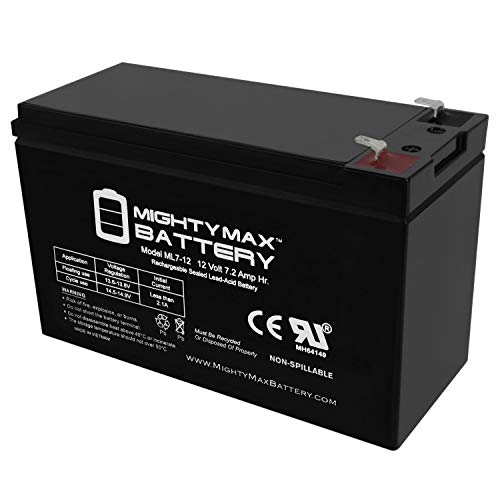
Home alarm panels typically need 7Ah batteries to ride out multi-hour outages, and the Mighty Max 12V 7Ah ADT Security Alarm Battery is built to that exact spec. The ML7-12 footprint, F1 terminal layout, and UL certification match what most residential panels expect, which keeps the swap-in straightforward.
The 5.90 x 2.50 x 3.90 inch case slides into the typical battery compartment without modification, and the AGM construction means you can mount it in the orientation your panel requires. Compared to the 5Ah opener batteries earlier in this list, the extra 2Ah is meaningful when the alarm has to stay armed through the night.
Advantages To Know
- 7Ah capacity extends alarm runtime during outages compared to standard 5Ah replacements.
- UL certification is a meaningful signal for an unattended, long-life safety installation.
- Sealed AGM design supports a range of mounting orientations inside the panel enclosure.
A Few Limitations
- Listing is battery-only, so no wire harness or mounting hardware is included, which can mean a short trip to the hardware store for the right spade adapters.
- Like other small SLAs, performance drops noticeably in very cold installations, so unheated garages in northern climates may see shorter backup windows.
Who Should Grab It
Homeowners with an ADT or compatible alarm panel who want a right-sized, UL-listed 7Ah replacement and are comfortable connecting the existing leads.
Swap It Out When
Anyone running a smaller 5Ah-compatible panel will find the Mighty Max 12V 5AH SLA Garage Door Opener Battery a better fit for that enclosure.
Most standby battery projects come in pairs: a garage door opener and a backup unit, or two alarm panels at different ends of the house. The Miady 12V 5Ah Sealed Lead Acid Battery (2-Pack) delivers two matched units so the spares drawer stays stocked and the replacements arrive on the same shipment.
Beyond the convenience, the AGM construction and ABS plastic case match what single-pack Miady 9Ah buyers get, just at a lower capacity. The shock, vibration, and heat resistance of the housing is a real benefit if one of the batteries ends up in a workshop or a utility closet that gets warm in summer.
Positive Points
- Two matched units simplify paired projects and ensure both batteries age at the same rate.
- Sealed AGM design with a sturdy ABS case handles temperature swings and minor impacts well.
- Rechargeable and maintenance-free across the typical SLA lifespan.
Worth Bearing In Mind
- 5Ah per unit is modest, so these will not suit higher-draw applications like a wheelchair or large UPS.
- Like all SLA batteries, they self-discharge when stored, so plan to top them up with a maintainer like the ECO-WORTHY 12V 5A Smart Battery Maintainer if they sit for months.
Perfect Match For
DIYers stocking up for multiple garage openers, alarm panels, or small electronics projects who appreciate the convenience of matched batteries from a single order.
A Better Fit Elsewhere
Anyone running a single 7Ah alarm panel should step up to the Mighty Max 12V 7Ah ADT Security Alarm Battery for a better runtime match.
Mobility scooters, floor scrubbers, and larger UPS rigs all want more capacity than a 5Ah or 7Ah unit can deliver, and the Mighty Max 12V 22AH SLA Replacement Battery is the heavy hauler in this roundup. Its 7.17 x 3.03 x 6.57 inch case and nut-and-bolt terminals are very different from the small spade-style SLAs earlier in the list, reflecting its role in higher-current equipment.
High discharge rate, wide operating temperature range, and AGM sealing all support the deep-cycle demands these batteries typically see. The SEL CB19-12 reference helps anyone with an existing deep-cycle slot confirm fit before ordering, and UL certification adds a layer of quality assurance for a part that gets used hard.
Positive Takeaways
- 22Ah capacity supports deep-cycle use cases that smaller SLAs simply cannot sustain.
- Nut-and-bolt terminals handle higher current loads more reliably than spade-style connectors.
- UL certification and SLA/AGM construction suit unattended and demanding installations.
Trade-Offs To Consider
- Substantial weight and size mean you will want a secure mounting location, since this battery is not a casual carry item.
Whose Workshop It Belongs In
Owners of mobility scooters, floor cleaning machines, and larger UPS systems that need reliable, high-capacity standby power.
Not Your Match When
Households with a small alarm panel or garage door opener will get more practical use from the Mighty Max 12V 7Ah ADT Security Alarm Battery earlier in this roundup.
What To Weigh Before Choosing A 12 Volt Lead Acid Battery
Match Capacity To The Load, Not The Spec Sheet
A battery’s amp-hour rating tells you how much current it can deliver over time, but the practical question is how long your equipment actually needs to run. A 5Ah battery is plenty for an alarm panel that just has to bridge short blips, while a 7Ah unit handles overnight outages, and 22Ah packs exist for mobility scooters that draw power continuously. Oversizing costs you money and space, while undersizing means the battery dies before the job is done.
Terminals And Footprint Matter More Than People Expect
Many returns in this category happen not because a battery was bad, but because the terminals or dimensions did not match the bracket. F1 spade terminals are common on small 5Ah units, while larger deep-cycle batteries move to nut-and-bolt connectors that handle higher current. Always check the case size, terminal type, and orientation before ordering, since SLA batteries are not as forgiving as a soft lithium pack in this regard.
Pair The Battery With The Right Charger
Even the best SLA battery suffers if it is left in a discharged state or charged with a mismatched supply. Smart chargers that taper current as the battery fills up, and maintainers that float at a safe voltage once full, do most of the heavy lifting in extending service life. A trickle charger that never steps down can overheat a battery over weeks, while a charger with no float mode may undercharge one.
Plan For Replacement In Three To Five Years
Sealed lead acid batteries are not lifetime purchases, and honest expectations help. Light standby use in a temperature-stable environment can stretch life toward the longer end, while a battery in a hot garage or one that gets deeply cycled regularly will need replacement sooner. Buying a smart maintainer at the same time as the battery is a reasonable hedge.
Key Considerations Across These Picks
Mistakes Worth Dodging
The most common error in this category is grabbing a 5Ah battery for a device that really needs 7Ah or 9Ah, then blaming the brand when the runtime falls short. The opposite mistake is overpaying for a 22Ah unit to back up a tiny alarm panel that only draws a few milliamps. The honest middle path is to read the equipment’s manual for its recommended capacity, double-check the terminal layout, and only then pick from the right tier of this list.
Where The Extra Money Goes
Stepping up from a basic 5Ah to a UL-listed 7Ah or 22Ah model often means tighter manufacturing tolerances, better plate composition, and the certification paperwork to back it up. That matters most in unattended safety roles like alarm backup, where a flaky battery can mean a silent panel. The premium is harder to justify for a casual project that gets checked on regularly.
Frequently Asked Questions
How long does a 12 volt lead acid battery typically last?
Most sealed lead acid batteries in light standby service last three to five years, while units that see frequent deep cycles often need replacement within two to three years. Temperature and charging habits are the two biggest variables in real-world lifespan.
Can I use a lithium battery charger on a lead acid battery?
No, charging profiles differ between lithium and lead acid chemistries, and using the wrong charger can damage either component. Chargers like the ECO-Worthy 12V/24V 20A Smart Battery Charger that support multiple chemistries are a safer choice for mixed fleets.
Is a higher amp hour rating always better?
Not necessarily, since a battery that is too large may never reach a full charge in the equipment’s normal use pattern, leading to sulfation. Match the amp hour rating to the equipment’s specifications rather than simply buying the biggest battery that fits.
What is the difference between AGM and flooded lead acid?
AGM batteries hold the acid in fiberglass mats and are sealed, while flooded batteries contain liquid acid that can spill and may need periodic topping off. AGM is the more common choice for indoor and portable applications because of the sealed design.
Do these batteries need ventilation?
Sealed AGM and gel batteries off-gas far less than flooded designs, but a small amount of venting is still wise in enclosed cabinets. Avoid sealing any lead acid battery inside a fully airtight container.
Closing Remarks
The right 12 volt lead acid battery comes down to matching capacity, terminals, and chemistry to the equipment you already own rather than chasing the highest spec on the table. Start with the form factor your device expects, then choose a capacity that comfortably covers the runtime you need, and finish with a smart charger if the battery will sit for any length of time between uses. With those three decisions made, any of the nine options in this roundup should serve you well for years.