Spending a day on the water only to find your electronics dead halfway through the trip is the kind of frustration most boat owners know too well. Choosing the right 12v boat battery shapes how reliably your trolling motor, fish finder, lights, and pumps perform across long afternoons and quiet mornings at the dock. The picks below balance capacity, chemistry, charging speed, and real-world durability, so you can match a battery to your hull size and your usual day on the water rather than gambling on a generic replacement.
A Quick View Of The Lineup

Redodo 12V 100Ah LiFePO4 Battery with 14.6V 20A Lithium Charger

Redodo 12V 50Ah LiFePO4 Battery with 14.6V 10A Charger Set

VATRER POWER 12V 300Ah Lithium LiFePO4 Battery (App Monitoring, Energy Storage & Starting)

Redodo 24V 100Ah LiFePO4 Battery with Charger 29.2V 20A

Redodo 12.8V 100Ah LiFePO4 Battery with 14.6V 10A Lithium Charger

Redodo 12V 100Ah LiFePO4 Battery with 14.6V 20A Charger and 100A BMS

TEMGO 12V 300Ah LiFePO4 Lithium Battery with Bluetooth & App Monitoring

Redodo 12V 165Ah LiFePO4 Battery with 14.6V 20A Lithium Charger
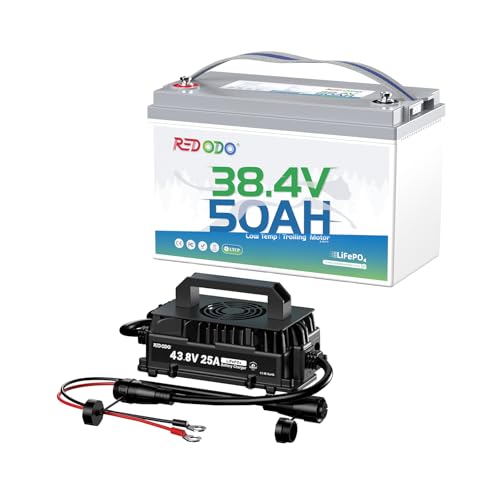
Redodo 36V 50Ah Trolling Motor Lithium Battery with Charger 43.8V 25A

Redodo 16V 30Ah LiFePO4 Battery with Charger 18.25V 10A for Fish Finder
Inside Each Recommended Option
For anglers running a trolling motor, livewell pump, and a fish finder through a full day, the Redodo 12V 100Ah LiFePO4 combo covers the usual workload without forcing a recharge at the dock. LiFePO4 chemistry (lithium iron phosphate, a lithium chemistry known for thermal stability and long cycle life) keeps the voltage flatter as the pack drains, so electronics behave the same at 50 percent as they do fresh off the charger. Compared to a flooded lead-acid of similar capacity, this pack weighs a fraction and accepts a higher charge rate, which matters when shore power is brief.
The bundled 14.6V 20A charger is the part most shoppers undervalue: it pushes the battery from empty to full in roughly five hours, and the dedicated profile protects the BMS (battery management system, the onboard circuitry that prevents overcharge, over-discharge, and short circuits) from the wrong voltage curve. For boat owners who treat the dock like a pit stop, that faster turnaround changes how the whole weekend feels.
Where It Delivers
- Bluetooth 5.0 (a low-energy wireless standard) monitoring via a phone app shows real-time voltage, current, and remaining capacity without climbing into a console.
- Low-temperature cutoff prevents charging below 32°F and stops discharge below -4°F, which protects the cells during cold-morning launches.
- A 20A dedicated charger matches the chemistry, removing the guesswork of pairing a generic power supply with a lithium pack.
- Flat voltage curve keeps fish finders and pumps running consistently through most of the discharge window.
- The 100Ah capacity supports a typical trolling motor at lower thrust settings for a full day on the water.
Honest Caveats
- The bundle may ship in two boxes on different days, so plan ahead if you need both pieces on launch morning.
- Like most LiFePO4 packs, you need a charger designed for the chemistry; an old lead-acid charger can underperform or trigger BMS protection.
Quick Facts
Right Fit For
Anglers running a 12V trolling motor and a few accessories on mid-sized fishing boats who want app-driven visibility.
Look Elsewhere When
The TEMGO 12V 300Ah LiFePO4 makes more sense for owners who need triple the capacity in a similar footprint.
Kayak anglers and small-boat owners rarely need a full 100Ah pack; they need something they can lift with one hand, slide behind a seat, and trust for a day of sonar and a small motor. The Redodo 12V 50Ah LiFePO4 sits in that comfortable middle ground. The chemistry matches the larger sibling above, so you get the same flat voltage behavior and long cycle life in roughly half the footprint.
The included 14.6V 10A charger is slower than the 100Ah bundle’s 20A unit, but for a 50Ah pack a full top-up still lands inside about five hours. If you mostly charge overnight at home or at a cabin, that slower pace is a non-issue. Compared to a 50Ah AGM (absorbent glass mat, a sealed lead-acid style), this lithium option weighs significantly less and accepts deeper discharges without damage.
Real-World Strengths
- Lower weight makes transport between kayak, truck bed, and storage much easier.
- LiFePO4 chemistry tolerates deeper discharge than lead-acid, so the rated 50Ah is closer to usable capacity.
- Bundled dedicated charger removes the need to research a separate compatible unit.
- Compact case fits inside common battery trays built for Group 24 footprints or smaller.
- Same stable voltage behavior as larger Redodo packs for consistent electronics performance.
Where It May Fall Short
- Half the capacity of the 100Ah option means runtime shrinks fast with a trolling motor at higher thrust settings.
- Slower 10A charger is fine overnight but limits quick turnarounds between back-to-back days.
Whose Shelf It Belongs On
Kayak anglers, jon-boat owners, and anyone powering a fish finder and a small outboard on a single 12V circuit.
Swap It Out When
The Redodo 12V 100Ah LiFePO4 is the better match for owners running a 12V trolling motor at higher thrust all day.
Most lithium packs on a boat are pure deep-cycle units: they hold steady voltage for house loads, but they are not built to crank an outboard. The VATRER POWER 12V 300Ah takes a different approach with a dual-mode BMS that switches between deep-cycle behavior and a starting profile capable of high instantaneous current.
The 300Ah capacity already covers a multi-day cabin cruiser’s worth of lights, pumps, and electronics. The starting capability means owners consolidating a starting bank and house bank into a single pack can simplify their wiring. Compared to the 100Ah Redodo above, this one trades a smaller footprint for the kind of headroom a towboat or bass boat with a hot-shot outboard actually needs.
What Earns Its Place
- 300Ah capacity supports extended weekends of house loads without recharging.
- App-based monitoring tracks state of charge, voltage, and current draw in real time.
- LiFePO4 chemistry keeps weight manageable compared to equivalent-capacity lead-acid banks.
- Long cycle life suits users who run deep discharges on every trip.
Things To Consider
- Larger physical size means you need a battery compartment that accommodates the heavier Group footprint.
- Dual-mode behavior is helpful but requires correct installation to use the starting feature safely.
Made For
Owners consolidating starting and house duties into a single lithium pack on larger fishing or family boats.
A Better Fit Elsewhere
The TEMGO 12V 300Ah LiFePO4 is a sensible swap for buyers who don’t need the starting feature and want a similar capacity at a different price point.
Higher-thrust trolling motors run on 24V, which traditionally meant wiring two 12V batteries in series. The Redodo 24V 100Ah LiFePO4 collapses that into a single pack, removing the cable clutter and the small imbalances that come from pairing two batteries of slightly different age.
Compared to the 12V 100Ah option above, the 24V model trades system compatibility for efficiency: a 24V system pulls half the current of an equivalent 12V setup, which means thinner gauge wire can do the same job and voltage drop on long cable runs shrinks dramatically. For boats with the motor mounted far from the battery compartment, that difference is more than academic.
Why It Works Well
- Single-pack 24V design simplifies wiring compared to a 12V series pair.
- Lower current draw lets you run smaller gauge wire without major voltage loss.
- Bundled 29.2V 20A charger matches the chemistry for safe, complete top-ups in roughly five hours.
- LiFePO4 chemistry keeps voltage stable through most of the discharge cycle for consistent motor speed.
Trade Offs
- You need a 24V-compatible trolling motor to use this battery correctly; mismatched systems risk damage.
- Heavier and bulkier than the 12V sibling, so check your battery tray dimensions before ordering.
Feature Snapshot
Best Suited To
Boat owners running 24V trolling motors who want a cleaner wiring layout than a series 12V pair.
Reach For A Different Pick When
The Redodo 12V 100Ah LiFePO4 remains the better choice for 12V systems, since it shares the chemistry and adds Bluetooth monitoring.
The Redodo 12.8V 100Ah LiFePO4 is the practical pick in this lineup: a 12V-class pack aimed at owners upgrading from AGM who want the same chemistry advantages without paying for the faster charger or Bluetooth monitoring. The 12.8V nominal voltage is simply the resting voltage of a 4-cell LiFePO4 pack, which behaves like a “12V” battery in any standard boat system.
The included 14.6V 10A charger is slower than the 20A bundle in pick 1, which is the main reason the package typically lands at a lower price. For most weekend anglers charging overnight between trips, a 10A charger is plenty. Where it falls behind is back-to-back day use with limited shore-power windows.
Useful Highlights
- Direct drop-in replacement for a Group-size lead-acid battery in most compartments.
- LiFePO4 chemistry tolerates deep discharge, so usable capacity is closer to the rated 100Ah.
- Lower-rate charger costs less and is adequate for overnight top-ups.
- Stable voltage under load keeps accessories operating consistently.
Practical Considerations
- No Bluetooth monitoring means checking state of charge requires a multimeter or voltmeter.
- 10A charging rate makes quick turnarounds harder when you’re moving boat to boat or campsite to campsite.
Feature Card
Perfect Match For
Boat owners doing a planned AGM-to-lithium swap who charge overnight and don’t need Bluetooth visibility.
Consider Something Else When
The Redodo 12V 100Ah LiFePO4 is the smarter upgrade for shoppers who want the faster 20A charger and app monitoring in the same footprint.
Where pick 1 leans on Bluetooth as its calling card, this Redodo 12V 100Ah LiFePO4 leans on a beefier 100A BMS. That spec matters when you wire accessories that draw hard at startup: a high-thrust trolling motor or a livewell pump can spike above what a smaller BMS will pass through. The higher BMS rating gives the pack more breathing room before protection circuits kick in.
The bundled 14.6V 20A charger matches the chemistry and brings a depleted pack back to full in roughly five hours. Compared to pick 5’s 10A charger, this setup shaves serious time off each recharge. For owners running a variety of marine accessories and not needing app monitoring, this version is often the more practical route.
Positive Takeaways
- 100A BMS handles accessory combinations that would trigger protection on a lower-rated pack.
- Fast 20A charger recovers overnight-to-launch turnarounds without sweating the charge window.
- Marine-rated build suits boats with a mix of motors, pumps, and electronics.
- LiFePO4 chemistry supports the deep cycle use case with a long service life.
Small Caveats
- No Bluetooth monitoring compared to pick 1, so state of charge requires manual checking.
- Same physical size as similar 100Ah units, so compartment fit is identical across these Redodo models.
Built With In Mind
Boat owners who run a mix of high-draw accessories and don’t want to babysit a charger schedule.
Where A Sibling Pick Shines
The Redodo 12V 100Ah LiFePO4 with Bluetooth monitoring is the better fit when you want to check state of charge from the helm.
Capacity is the single most underrated spec on a 12v boat battery, and the TEMGO 12V 300Ah makes that point clearly: triple the amp-hours of the standard 100Ah options in this list. That headroom translates to multi-day weekends with lights, a fridge, a stereo, and a trolling motor without watching the voltmeter.
Bluetooth and app monitoring let you keep tabs on remaining capacity without lifting a hatch, which matters when the battery lives under a console or behind a seat. The low-temperature cutoff keeps the cells safe during cold-morning launches, which is a common concern for boat owners in northern climates. Compared to the VATRER 300Ah above, the TEMGO focuses purely on deep-cycle use rather than a starting mode.
Key Advantages
- 300Ah capacity supports extended trips without shore power.
- Bluetooth and app monitoring give you visibility from your phone.
- Low-temperature cutoff protects cells in cold conditions.
- LiFePO4 chemistry handles deep discharge without the wear that ruins lead-acid banks.
A Few Limitations
- Bulkier and heavier than the 100Ah options, so verify compartment dimensions.
- Hazardous-materials shipping regulations apply, which can affect delivery timing.
Who It Suits Best
Anglers and cruisers who run house loads over multi-day trips and want app-based visibility at a glance.
Not Your Match When
The Redodo 12V 100Ah LiFePO4 is the smarter pick for smaller boats where weight and footprint matter more than raw capacity.
The Redodo 12V 165Ah LiFePO4 is the middle child of this list in the best possible way. It bumps capacity above the standard 100Ah without jumping all the way to 300Ah, and it does so in a Group 31 footprint that fits common marine battery trays. That placement makes it a strong fit for owners who want more runtime without re-engineering their battery compartment.
The bundled 14.6V 20A charger brings the same fast turnaround that the 100Ah pack offers, but on a larger capacity. Compared to pick 1, this version trades Bluetooth monitoring for roughly 65 percent more usable energy. For anglers who don’t need app visibility but do want a full day on the water with margin, the math often works out.
The Good Stuff
- 165Ah capacity covers a full day of trolling motor and electronics with room to spare.
- Group 31 footprint fits most standard marine trays without modification.
- Fast 20A charger matches the larger capacity for reasonable recharge times.
- LiFePO4 chemistry supports the deep cycle demands of repeated weekend use.
Points To Note
- Heavier than the 100Ah packs, so consider mounting and weight distribution for smaller boats.
- No Bluetooth monitoring compared to pick 1, so manual voltage checks remain the verification method.
The Right Fit
Boat owners who want a noticeable runtime upgrade over a 100Ah pack without stepping into 300Ah territory.
Skip It When
The TEMGO 12V 300Ah LiFePO4 is the better answer for owners who want maximum capacity and Bluetooth monitoring in a single pack.
High-thrust trolling motors in the 100–120lb range typically run on 36V, which historically meant wiring three 12V batteries in series. The Redodo 36V 50Ah Trolling Motor Lithium Battery wraps that into a single pack, simplifying the wiring and removing the imbalance headaches that come from aging 12V batteries in series.
The 43.8V 25A charger is unusually fast for the format, with a full top-up achievable in roughly two hours from a meaningful discharge. That quick turnaround matters for tournament anglers who shuttle between morning and afternoon sessions with limited dock time. Compared to the 24V option above, this pack steps up system voltage and drops current draw even further.
The Helpful Details
- Single-pack 36V design replaces a three-battery series setup.
- 25A charger is fast for the format, useful in tournament-style day use.
- LiFePO4 chemistry supports deep cycle use expected from trolling motors.
- Lower current draw compared to a 12V equivalent reduces cable sizing requirements.
Things To Weigh Up
- Limited to motors rated for 36V; using it on 12V or 24V motors will not work correctly.
- Higher upfront cost than a 12V system, which may not pencil out for casual anglers.
Quick Facts
Who Should Grab It
Tournament anglers and serious bass-boat owners running 36V trolling motors at higher thrust settings.
Another Choice May Suit
The Redodo 24V 100Ah LiFePO4 is the better fit for owners running 24V motors who don’t need the 36V step-up.
Modern fish finders and 360 sonar systems often want more than 12V, and the Redodo 16V 30Ah LiFePO4 delivers exactly that in a compact package. The 16V output suits electronics that run brighter screens and faster processing than standard 12V units, without forcing kayak anglers to carry a heavy deep-cycle pack.
The 18.25V 10A charger brings a depleted pack back to full in about three hours, which is a fast turnaround for the format. The 30Ah capacity is sized for sonar units rather than motors, so runtime is plenty for a long day of graphing but not for sustained thrust. Compared to the 12V 50Ah above, this is a much more focused tool for electronics-only setups.
Everyday Wins
- 16V output suits modern fish finders and 360 sonar systems that need more than 12V.
- Compact size fits kayak console trays and small-boat electronics mounts.
- 10A charger tops the pack up in roughly three hours from empty.
- LiFePO4 chemistry handles repeated shallow discharge cycles without wear.
Where It Is Less Suited
- Cannot run a trolling motor; designed strictly for electronics and sonar.
- Higher specific cost per watt-hour than larger 12V packs, which is normal for specialty voltages.
Perfect Match For
Kayak anglers and bank fishermen running 16V sonar units who want a compact lithium power source.
Look Elsewhere When
The Redodo 12V 50Ah LiFePO4 covers anglers who only need standard 12V for their fish finder.
What Matters Most Before Choosing A 12v Boat Battery
Match Battery Size To The System Voltage You Actually Run
Start by confirming whether your boat is a 12V, 24V, or 36V system. Mismatched voltages are the fastest way to damage a trolling motor or underpower your electronics. A 12V boat with a single motor and basic accessories usually pairs well with a 100Ah LiFePO4 pack, while higher-thrust setups step up to 24V or 36V.
Pick Capacity Around Your Longest Day On The Water
Capacity in amp-hours (Ah) translates roughly into hours of runtime for a given load. Estimate your average draw in amps, multiply by your longest day on the water, and you will know roughly how many amp-hours you need. For multi-day trips without shore power, stepping up to a 165Ah or 300Ah pack is the more relaxed choice.
Choose A Charger Built For The Chemistry
LiFePO4 packs want a charger profile around 14.4V to 14.6V, while lead-acid chargers typically float at lower voltages. Bundled chargers take the guesswork out, but if you are reusing an existing charger, confirm it matches the chemistry before plugging in.
Think About Cold-Weather Use
Cold cuts LiFePO4 capacity and can damage cells if charged below freezing. Low-temperature cutoff protection matters for northern boaters launching on cold mornings. Owners in mild climates can prioritize other features instead.
What Buyers Often Get Wrong On 12v Boat Battery Choices
Treating All “12V” Batteries The Same
A 12V AGM and a 12V LiFePO4 look similar on the shelf but behave very differently under load. Voltage curves, depth-of-discharge tolerance, and charging requirements all differ. Confirming chemistry before ordering saves headaches during installation.
Skipping The Compartment Check
Higher-capacity batteries tend to be larger and heavier. A 300Ah pack that promises all-day runtime is less useful if it doesn’t fit the existing tray. Always check group size (a standardized battery case dimension such as Group 24, 27, or 31) and terminal layout against your compartment before committing.
Assuming A Bigger Battery Solves Charging Problems
Capacity alone won’t fix a charging setup that’s too slow or uses the wrong profile. If you regularly run your battery below 50 percent, pair the upgrade with a charger that can fully refill it overnight or between sessions.
Frequently Asked Questions
How long does a 12V LiFePO4 boat battery typically last?
LiFePO4 chemistry commonly delivers thousands of cycles at moderate depth of discharge, which translates to many years of weekend use for most boat owners. The exact lifespan depends on how deeply you discharge it and how well the BMS is matched to your loads.
Can I replace a lead-acid battery with LiFePO4 directly?
In many cases yes, but confirm the charging system is compatible with lithium chemistry first. Some older marine chargers profile for flooded or AGM batteries and may not fully charge a LiFePO4 pack.
Do I need a special charger for a 12V boat battery?
If the battery is lithium, a charger designed for LiFePO4 chemistry is the safer choice. Bundled chargers in the picks above remove the guesswork, but standalone chargers should be matched to the chemistry.
What’s the difference between 12V, 24V, and 36V boat batteries?
The voltage refers to the system your motor and electronics are designed for. Higher-voltage trolling motors draw less current for the same thrust, which allows thinner cables and reduces voltage drop on long runs.
Is Bluetooth monitoring worth it on a marine battery?
For owners who store the battery in a hard-to-reach compartment, app visibility into state of charge is genuinely convenient. For batteries in open trays, a quick voltmeter check is often enough.
The Takeaway
A reliable 12v boat battery is less about chasing the largest amp-hour number and more about matching chemistry, capacity, and voltage to the way you actually use your boat. Walk through your system voltage, your longest day on the water, and your charging situation first, then let the right pack fall into place. The picks above cover most of the realistic setups you are likely to encounter, from kayak sonar builds to multi-day cabin cruiser runs.