One flicker of a power cut, and a half-finished render, a saved game, or a remote-work deadline can vanish. A UPS (uninterruptible power supply) sits between your gear and the wall, giving you time to save work, shut down cleanly, or ride out a brief outage without losing your place. The picks below cover everyday desktops, active-PFC workstations, compact home setups, network closets, and a couple of options for keeping an existing UPS alive longer.
Your Options, Compared

CyberPower CP1500AVRLCD3 Intelligent LCD UPS
CyberPower CP1500PFCLCD PFC Sinewave UPS

CyberPower EC850LCD Ecologic UPS
Oeveo UPS Mount 143 Wall Bracket

CyberPower ST425 Standby UPS

CyberPower ST625U Standby UPS with USB

APC APCRBC123 Replacement Battery Cartridge

CyberPower CP2000PFCRM2U PFC Sinewave Rackmount

CyberPower OR500LCDRM1U Smart App 1U UPS

CyberPower CP1500PFCRM2U PFC Sinewave Rackmount
What Each Pick Brings To The Table
A mid-size tower UPS with line-interactive topology (meaning it actively cleans up minor voltage dips and surges before resorting to the battery) and a clear front-panel LCD, the CP1500AVRLCD3 is the kind of model that fits naturally under a desk or beside a workstation without shouting for attention.
Automatic Voltage Regulation (AVR) gently nudges low and high utility power back into a safe range so the battery only kicks in when things go sideways. For most home and small-office setups running a desktop PC, monitor, and modem/router combo, that translates to clean shutdowns during short outages rather than sudden reboots.
The Value In It
- LCD panel shows load level, battery charge, and current draw at a glance
- AVR extends battery life by handling minor fluctuations without switching to battery mode
- Twelve outlets give you room for PC, monitors, peripherals, and networking gear
- Simulated sine wave output keeps standard desktop PSUs happy at a sensible cost
- USB connection pairs with monitoring software for graceful, automatic shutdowns
Things To Consider
- Simulated sine wave output may not suit active-PFC power supplies found in some newer workstations
- Tower body is taller than compact standby units, so under-desk clearance is worth measuring first
- Owners commonly report the fan ramping up under heavier loads in warmer rooms
Who It Suits Best
Home and small-office users running a conventional desktop, monitor, and internet gear who value a readable status display.
Where Another Pick Suits Better
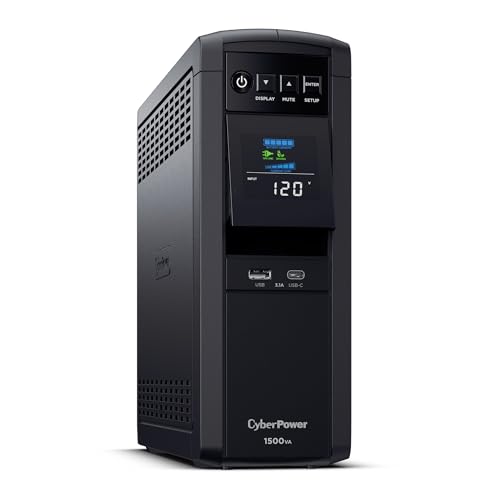
The CyberPower CP1500PFCLCD is the better match if your desktop uses an active-PFC power supply, since it outputs a true sine wave.
Where the CP1500AVRLCD3 uses simulated sine wave output, this sibling steps up to a true sine wave, which matters if your desktop uses an active-PFC (power factor correction) PSU. Active-PFC supplies can misbehave or shut down under simulated waveforms during long outages, so the smoother output here keeps modern workstations stable.
The color multifunction LCD panel delivers the same quick-glance feedback you get on the AVR sibling, with load level, runtime estimate, and battery status all in one place. Line-interactive topology with AVR handles day-to-day dips so the battery stays reserved for actual outages.
Key Advantages
- True sine wave output is compatible with active-PFC power supplies
- Multifunction color LCD keeps critical status readable without a computer
- AVR corrects minor voltage swings without draining the battery
- EMI/RFI filtering (shielding against electromagnetic and radio-frequency interference) reduces line noise on sensitive audio and network gear
Worth Noting
- Pricier than simulated sine wave alternatives with similar VA ratings
- Bulkier footprint may crowd a tight corner under a small desk
Quick Facts
Made For
Anyone running a modern workstation, gaming desktop, or small server with an active-PFC PSU who wants a clean shutdown every time.
Not Your Match When
The CyberPower CP1500AVRLCD3 covers you for less if your desktop uses a conventional (non-PFC) PSU and you don’t need true sine wave output.
The EC850LCD is a smaller standby UPS with a built-in LCD, designed to disappear behind a monitor or under a media console. Standby topology means it lets utility power pass through directly under normal conditions and only switches to battery when a real outage hits, which keeps the unit compact and light.
Ecologic features automatically cut power to idle peripherals when your computer shuts down or sleeps, which helps trim phantom loads in a home office. For modest desktops, a router, and a modem, the runtime is enough to save work and ride out typical brownouts.
Useful Highlights
- Compact tower footprint fits on a shelf or small corner of a desk
- LCD reports load, battery level, and estimated runtime in real time
- Ecologic outlets cut power to idle peripherals automatically
- Simulated sine wave output suits conventional desktop PSUs at this capacity
Room For Improvement
- Lower capacity than the CP1500-series towers, so it suits lighter loads
- No AVR, meaning brownouts below a threshold may trigger battery mode more often
Right Fit For
Modest home desks with a single PC, a monitor, and networking gear where space is at a premium.
Skip It When
The CyberPower CP1500AVRLCD3 is the better match if you need AVR and longer runtime for a full tower plus dual monitors.
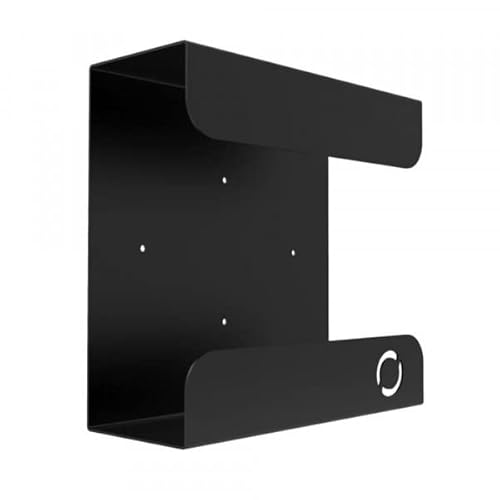
Not a battery backup itself, but a clever companion piece: the Oeveo UPS Mount 143 lets you hang a small-to-mid UPS on the wall instead of leaving it on the floor next to your desk or in the back of a wiring closet. The flat-black powder-coat finish blends into utility spaces without looking like a piece of hardware bolted to drywall.
Mounting hardware is included in the box, and the bracket is shaped to fit common APC and CyberPower mini-towers and rack-style units, depending on the model. It also comes in multi-packs if you need to organize several UPS units along a wall.
The Helpful Details
- 70 lb weight capacity covers most consumer and prosumer UPS units
- Flat-black powder coat resists scuffs in utility spaces
- Compatible with both APC and CyberPower models for mixed environments
- Multi-pack options help when organizing several units in a closet or rack room
Points To Note
- Wall mounting requires a stud or solid anchor to use the full weight rating safely
- Dimensions favor smaller form factors, so oversized rackmount UPS units will not fit
Best Suited To
Anyone who already owns a compatible UPS and wants to reclaim floor space in a home office, AV closet, or small server room.
Consider Something Else When
The CyberPower ST625U is a better starting point if you do not yet own a UPS and need actual backup power rather than just a mounting solution.
The ST425 is one of the smallest UPS units CyberPower makes, aimed at lighter loads like a compact desktop, a modem/router pair, and maybe a small monitor. Standby topology means the battery only kicks in when utility power drops or spikes outside acceptable limits, which keeps the unit simple and inexpensive.
For a basic home setup where the goal is just to keep the internet alive through a brownout or save work before a clean shutdown, the runtime is enough. Surge protection is built into every outlet, which keeps lightning-induced spikes from frying whatever you plug in.
The Upside
- Lightweight and compact enough to tuck behind a monitor or on a shelf
- Surge protection on every outlet guards against spikes and lightning events
- Enough runtime for a graceful shutdown on a modest desktop
- Simple design that does not require software setup to function
Small Caveats
- Lower VA rating limits how much gear you can plug in at once
- No LCD readout, so you only know the battery status from indicator lights
Who Should Grab It
Light-duty home users running a small PC plus networking gear who want basic outage protection without a big footprint.
Reach For A Different Pick When
The CyberPower ST625U is the better match if you want USB connectivity for software-managed shutdowns on a similar standby platform.
The ST625U is essentially a slightly larger ST425 with a USB monitoring port added. That extra port is the real story, since it lets CyberPower’s software (or compatible third-party tools) watch battery status and trigger an automatic shutdown if you’re away from the desk when the lights go out.
Standby topology keeps the unit affordable, and the higher capacity compared to the ST425 means you can power a modest desktop plus a router and modem simultaneously. For a home setup where you’d rather not be glued to the keyboard during storms, the auto-shutdown path is genuinely useful.
Advantages To Know
- USB port enables automatic, unattended shutdown through monitoring software
- Higher capacity than the ST425 for slightly more demanding desktop setups
- Surge protection on all outlets defends connected gear from spikes
Honest Caveats
- Standby topology means no AVR, so brownouts can trigger battery mode more readily
- Still a compact unit, so heavy gaming rigs and dual-monitor arrays may push it past its limits
- Owners commonly report the status LEDs alone don’t tell you how much runtime is left
Quick Facts
Whose Shelf It Belongs On
Home users running a modest desktop and home network who want unattended, automatic shutdowns during outages.
Look Elsewhere When
The CyberPower CP1500AVRLCD3 is the better match if your rig is hungrier and you want AVR plus a readable LCD for more headroom.
When an APC UPS reaches the end of its battery’s useful life, the cleanest path back to full runtime is a genuine APC replacement cartridge. The APCRBC123 is a sealed VRLA (valve-regulated lead-acid) pack, which means it ships non-spillable and is safe to handle without acid worries, and is designed specifically for SMT750RM2UC and BX1350M units.
Swapping the cartridge restores original runtime specifications rather than guessing with an off-brand cell. For anyone with an aging APC UPS that suddenly beeps at startup or shuts down the moment the lights flicker, this is often a more affordable fix than replacing the entire unit.
Everyday Wins
- Genuine APC cartridge tested for full compatibility with the listed UPS models
- Sealed VRLA design is safe to ship and install without special handling
- Restores the UPS to original runtime specifications when the old battery is worn out
A Few Limitations
- Compatible only with the specific APC UPS models listed; cross-checking your model number is essential
- Like all lead-acid cells, periodic replacement every few years is part of long-term ownership
The Right Fit
Owners of an APC SMT750RM2UC or BX1350M whose UPS battery is aging out and who want to restore runtime without replacing the whole unit.
Swap It Out When
The CyberPower CP1500AVRLCD3 is a better starting point if your old UPS is past saving and you’d rather move to a brand-new platform with a fresh warranty.
The CP2000PFCRM2U is the biggest UPS in this lineup, built into a 2U rackmount chassis for installation in a server rack or AV cabinet. True sine wave output and 2000 VA capacity make it a sensible choice for security systems, A/V receivers, and network switches that need clean, reliable power.
Like its smaller sibling, it includes AVR for handling minor fluctuations and EMI/RFI noise filtering to clean up electrical interference on the line. Rack ears are integrated, so it slides into a standard 19-inch rack without needing separate mounting hardware.
Where It Delivers
- High 2000 VA capacity supports multiple network and A/V components at once
- True sine wave output suits active-PFC power supplies in modern gear
- EMI/RFI filtering reduces electrical noise that can affect sensitive equipment
- 2U rackmount form factor fits standard 19-inch server and AV racks
Trade Offs
- Heavier and pricier than tower UPS units in this lineup
- Requires a rack or sturdy shelf for installation, unlike compact tower models
Quick Facts
Built With In Mind
Home-lab owners, AV enthusiasts, and small-business IT setups running multiple rack-mounted devices with active-PFC supplies.
A Better Fit Elsewhere
The CyberPower CP1500PFCRM2U is a smarter choice if you want sine wave protection in a rack but don’t need the higher 2000 VA capacity.
The OR500LCDRM1U slides into a single rack unit (1U) and pairs with CyberPower’s monitoring software for remote management, which is useful when your rack lives in a closet or back room. The LCD keeps basic status visible even without a connected computer.
At 500VA/300W with simulated sine wave output, it suits department servers, workstations, and telecom gear without active-PFC power supplies. AVR is built in for those small dips and spikes that would otherwise chew through battery cycles.
The Good Stuff
- 1U rackmount saves vertical space in compact server racks
- Smart App compatibility enables remote monitoring and management
- AVR corrects minor voltage dips without switching to battery mode
- Six outlets provide room for several network or telecom devices
Practical Considerations
- Simulated sine wave output is not ideal for active-PFC power supplies
- Lower watt rating caps how much gear you can plug in simultaneously
- Some owners find that rackmount ears can complicate placement in shallow cabinets
Perfect Match For
Small server-room and telecom-installation setups where remote monitoring and rack integration matter more than high capacity.
Another Choice May Suit
The CyberPower CP1500PFCRM2U is the stronger pick if your rack equipment uses active-PFC supplies and needs true sine wave output.
The CP1500PFCRM2U lands between the heavy-duty CP2000PFCRM2U and a tower unit: rackmount form factor with true sine wave output at a 1500 VA capacity. It is a sensible middle ground when you want rack integration without jumping to the biggest chassis in the lineup.
Like its siblings, AVR handles the everyday fluctuations and EMI/RFI filtering cleans up noise on the line. For A/V racks, network switches, and security gear with active-PFC power supplies, this strikes a balance between runtime, footprint, and the smoother waveform that modern PSUs prefer.
Why It Works Well
- True sine wave output matches active-PFC power supplies used in modern equipment
- 1500 VA capacity covers a small rack of mixed A/V and network gear
- 2U rackmount form factor integrates cleanly into existing racks
- AVR plus EMI/RFI filtering improves overall power quality for sensitive gear
Points To Keep In Mind
- Rackmount orientation requires rack rails or a sturdy shelf for support
- Costs more than the equivalent tower units with similar capacity
Quick Facts
Who Will Love This
Mixed A/V, security, and network racks where active-PFC gear is the norm and a true sine wave is worth the extra spend.
Where A Sibling Pick Shines
The CyberPower OR500LCDRM1U is the better fit when rack space is tight, the load is lighter, and simulated sine wave is acceptable.
Choosing Battery Backups For Computer That Fit Your Setup
Watts, VA, And How Long You Actually Need To Run
The first honest question is what you plan to plug in and how long it needs to survive an outage. A modest desktop with one monitor might draw around 200 to 300 watts, while a gaming PC plus dual monitors can easily climb past 500. Add your router and modem, and you have a baseline load.
UPS capacity is rated in VA (volt-amperes, a measure of apparent power), which roughly maps to watts for older equipment and slightly less for modern active-PFC supplies. Match capacity to your real load with some headroom; running a UPS at 80 percent or more of its rating cuts runtime sharply and stresses the battery.
Sine Wave Matters For Active-PFC Supplies
If your desktop uses an active-PFC power supply, a UPS that outputs true sine wave (sometimes called pure sine wave) keeps things stable. Simulated sine wave units cost less and work fine with conventional PSUs, but active-PFC supplies can misread the waveform during long outages and shut down.
For older desktops, basic home routers, and entry-level workstations, simulated sine wave is usually fine. For modern gaming rigs, workstations, and anything labeled “80 Plus” or “active PFC,” a true sine wave output is the safer bet.
AVR, Topology, And Day-To-Day Protection
Topology refers to how the UPS processes power day to day. Standby units let utility power pass through and switch over only during an outage, which is fine for light loads. Line-interactive units add AVR, which gently corrects minor voltage dips and surges without burning battery cycles.
If you live somewhere with frequent brownouts or older wiring, AVR adds noticeable runtime savings and reduces the number of full battery cycles. For rack gear in a closet, AVR also keeps equipment from rebooting every time the building’s HVAC kicks on.
Form Factor, Monitoring, And Long-Term Ownership
Tower UPS units sit on the floor or under a desk, while rackmount versions slide into a 19-inch rack. Measure your space first; a tower UPS with a tall battery compartment can crowd a small corner, and a rackmount UPS without proper rails is a recipe for a sagging shelf.
Monitoring software through a USB connection lets the UPS trigger automatic shutdowns when the battery runs low, which matters if you step away from the desk during storms. Over the long haul, plan on a battery replacement every few years; genuine replacement cartridges from the same brand restore runtime to original specifications.
Key Considerations Across These Picks
Where Shoppers Go Wrong
A common slip is buying the cheapest UPS and then plugging a hungry gaming PC into it, only to discover the runtime is measured in seconds. Another is assuming any UPS will protect an active-PFC workstation when it only outputs simulated sine wave, which leads to random shutdowns during long outages.
A third trap is forgetting that batteries age. A UPS that has been sitting on a shelf for two years may already have a weakened cell, and skipping the spec of the connected load is the fastest way to buy the wrong size.
What Separates Premium From Basic
The jump from entry-level to premium in this category usually buys true sine wave output, AVR for everyday dips, and higher VA capacity with longer runtime. You also tend to get better LCD feedback, USB or network monitoring, and surge protection rated for harsher environments.
The honest case for spending up is when your gear is expensive, your work depends on it, or your outlets see regular brownouts. For a basic home setup with light loads and clean utility power, a standby unit can be plenty.
Frequently Asked Questions
How Long Will A UPS Keep My Computer Running During An Outage?
Most consumer UPS units in this lineup give you anywhere from a few minutes to around 20 minutes on a modest desktop, depending on battery capacity and connected load. The goal is usually a graceful shutdown, not staying online for hours. For longer runtimes you need a larger battery or a generator.
Can A UPS Protect Against Lightning Strikes?
A UPS includes surge protection that can absorb small to moderate spikes, including indirect lightning-induced surges. A direct strike is another matter entirely, and no consumer UPS can promise to survive that. Proper grounding and a quality surge protector at the panel still matter.
Do I Need To Replace The Battery Eventually?
Yes. Sealed lead-acid UPS batteries typically last 3 to 5 years before capacity drops noticeably. When your UPS starts beeping at startup, shuts down under light load, or shows a replace-battery indicator, a genuine replacement cartridge from the same brand is the cleanest fix.
What Is The Difference Between Simulated And True Sine Wave Output?
Simulated sine wave approximates the smooth wall-outlet waveform in steps and works fine for most conventional power supplies. True sine wave matches the grid’s smooth curve and is required for active-PFC supplies in modern desktops, workstations, and some AV gear to behave reliably during long outages.
Will A UPS Work With A Gaming PC And Multiple Monitors?
Yes, provided the UPS capacity is sized for the total load. A gaming PC with a high-end GPU plus two monitors can easily draw 500 to 700 watts, so a 1500 VA unit with true sine wave is a more comfortable match than a compact standby unit in that scenario.
Bottom Line
The right battery backup depends on what you plug in, how long you need it to survive, and whether your gear uses an active-PFC supply. For a conventional desktop at home, the CyberPower CP1500AVRLCD3 covers the basics well. For a modern workstation or a small rack, the CP1500PFCLCD or one of the rackmount PFC siblings makes more sense. Match capacity to your actual load, plan for battery replacement in a few years, and your gear will thank you the next time the lights flicker.