An AGM battery (Absorbent Glass Mat, where a fiberglass mat holds the electrolyte rather than letting it slosh around) shows up in more places than most people expect. Daily drivers with start-stop systems lean on them for rapid recharge cycles. RV owners and off-grid solar users rely on the deep-cycle versions for steady, spill-proof power. Motorcycles, mobility scooters, and emergency lighting setups all benefit from the sealed, maintenance-free design.
The catch is that “AGM” covers a wide spread, from tiny 2.3Ah backup cells to 125Ah deep-cycle workhorses. Picking the wrong one means a battery that cranks fine on a Tuesday but taps out in a February cold snap. This roundup walks through ten options sized for real vehicles, marine cabins, solar banks, and small electronics, so you can match the right cell to the right job without overspending or under-spec’ing.
The Picks In Brief

HQST 12V 60Ah AGM Car Battery, Group 47 H5
Enersys Cyclon 0810-0004 D-Cell 2V 2.5Ah SLA

LiTime 12V 100Ah LiFePO4 Battery, Group 24

VMAX SLR125 AGM Deep Cycle 12V 125Ah (Pair)

Relistart 12V 6Ah SLA AGM Motorcycle Battery

Mighty Max MM-G24 Group 24 12V 70Ah AGM

Mighty Max MM-G26 Group 26 12V 45Ah AGM

ACDelco Gold 51RAGM Group 51R AGM Battery

Mighty Max ML2.3-12 12V 2.3Ah SLA AGM
Mighty Max MM-G31 Group 31 12V 100Ah AGM
More On The Choices That Made The List
The HQST Group 47 H5 lands squarely in the modern commuter lane. With 680 CCA (cold cranking amps, the rating that says how well a battery can start an engine in freezing weather) and 100 minutes of reserve capacity, it’s built for vehicles that shut off at every red light and need to restart cleanly the rest of the day.
Owners running cars with start-stop systems will appreciate that this cell is engineered specifically for the rapid partial-charge cycles those systems demand. Compare it to the deeper-cycle entries later in this list, and it’s clear HQST stayed focused on cranking duty rather than off-grid storage. The 9.5 x 6.9 x 7.6-inch case fits common H5 battery trays in many sedans and crossovers.
What It Does Well
- 680 CCA delivers reliable cold-weather starts down to around 0°F, with an operating window spanning roughly -40°F to 140°F for extreme climates.
- Higher charge acceptance than standard flooded batteries, which suits start-stop vehicles that recover energy quickly during braking.
- Maintenance-free sealed AGM design means no distilled water top-offs and no corrosion on nearby terminals.
- Group 47 H5 footprint matches a wide range of late-model sedans, SUVs, and light trucks without bracket modifications.
Things To Consider
- 60Ah is on the modest side for vehicles with heavy accessory loads (heated seats, big audio, aftermarket lighting).
- As with most AGM replacements, the alternator’s voltage regulator should be checked for compatibility to avoid undercharging.
Who It Suits Best
Daily commuters driving modern start-stop-equipped sedans and SUVs who need a direct-fit replacement sized for the H5 tray.
Where Another Pick Suits Better
Trucks and large-displacement engines see better reserve capacity from the Mighty Max MM-G31, which delivers 900 CCA and 140 minutes of reserve.
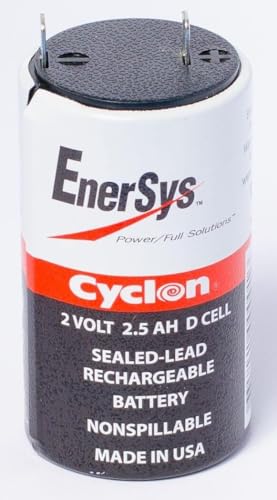
The Enersys Cyclon D-cell looks nothing like the car batteries above, and that’s the point. This is a 2-volt, 2.5Ah pure lead-tin sealed cell designed for emergency lighting, UPS (uninterruptible power supply) racks, telecom backup, and other critical standby roles where long life beats raw capacity.
Unlike the HQST or the Mighty Max auto batteries, the Cyclon is a specialty component, often wired in series strings to build higher-voltage battery packs. Its ten-year design life at 25°C and minimal gassing under normal float charging make it safe for offices, hospitals, and aircraft cabins.
Everyday Advantages
- Pure lead-tin chemistry delivers high power density per unit weight, packing more usable energy into a small footprint.
- Cycle life substantially exceeds standard SLA batteries, with the manufacturer citing up to 300 full discharge cycles.
- Minimal gassing under proper charging allows installation in occupied spaces without special venting.
- Stable voltage delivery across the discharge curve, similar in profile to nickel-cadmium cells, helps sensitive electronics run cleanly.
Worth Noting
- At just 2.5Ah, this single D-cell cannot run a vehicle or RV; it’s strictly a building block for larger battery banks.
- The premium lead-tin construction costs more per amp-hour than mainstream AGM batteries, so the value math only works for long-life critical applications.
Feature Snapshot
Right Fit For
IT and facilities teams assembling backup battery banks for UPS units, emergency lighting, or telecom gear where ten-year float life justifies the upcharge.
Reach For A Different Pick When
Anyone needing a turnkey RV or marine battery should consider the LiTime 12V 100Ah Group 24 lithium drop-in instead.
The LiTime Group 24 isn’t technically AGM (it’s LiFePO4 lithium, where lithium iron phosphate cells replace the lead-acid chemistry entirely), but it drops into the same BCI Group 24 tray used by many AGM RV batteries. That’s why it earns a spot on this list: it’s the swap-in upgrade for anyone whose old AGM finally gave up.
At roughly one-third the weight of a comparable Group 24 AGM and rated for up to 15,000 cycles, this cell changes the math for RV and marine owners who used to dread hauling heavy batteries in and out of compartments. The 1.28kWh usable capacity at 100% depth of discharge (the percentage of total capacity you can actually drain without harming the battery) leaves most 70Ah AGMs in the dust.
Strong Points
- Group 24 footprint fits standard RV battery trays without rewiring or custom brackets.
- Up to 15,000 cycles means a service life that can easily outlast two or three AGM replacements.
- 1.28kWh usable capacity versus roughly 0.5kWh from a 70Ah AGM at recommended discharge depth.
- Higher energy density helps trolling motors and marine electronics run longer between charges.
Trade Offs
- Not designed as a starting battery, so it can’t replace the HQST in a vehicle that needs cranking amps.
- Charging requires a lithium-compatible charger or solar charge controller; old AGM chargers may not reach the proper absorption voltage.
- Golf carts and electric jacks fall outside the recommended use cases according to the manufacturer.
Feature Rundown
Made For
RV and boat owners stepping up from heavy AGMs who want lighter weight, deeper usable capacity, and longer cycle life.
A Better Fit Elsewhere
Drivers needing a start-stop replacement should stay with the HQST Group 47 H5 or the Mighty Max MM-G24, which are built for engine cranking.
VMAX SLR125 ships as a matched pair of 12V 125Ah deep-cycle AGM cells, a configuration aimed squarely at solar arrays, wind turbines, and inverter stacks. Stack them in series and you get a 24V bank; run them parallel and you double amp-hours at 12V.
Where the Mighty Max MM-G31 is built for cranking amps, the SLR125 is built for slow, repeated discharges, which is exactly what off-grid renewable systems demand. The sealed AGM construction tolerates mounting in cabins and enclosed battery boxes without venting.
A Favorable Mix
- 125Ah per unit gives serious storage headroom for weekend cabins, off-grid sheds, and modest solar setups.
- Sealed AGM chemistry means no dangerous off-gassing during normal charging cycles.
- Pair configuration simplifies buying a matched battery bank instead of hunting for two compatible cells separately.
- Recommended pairing with the VMAX BC8S1215 smart charger for optimal multi-stage charging.
Honest Caveats
- Two large AGM cells add serious weight to a system; mounting hardware and floor support may need reinforcement.
- AGM deep-cycle chemistry still hits roughly 50% recommended depth of discharge, so a 250Ah bank yields about 125Ah of practical storage.
Best Suited To
Off-grid solar and small wind installers building a 12V or 24V storage bank who want a matched pair without piecing together individual cells.
Consider Something Else When
Weight-sensitive RV owners get more usable energy per pound from the LiTime 12V 100Ah lithium upgrade.
The Relistart 12V 6Ah is the small-format end of the AGM family. Think motorcycles, scooters, ATVs, and lawn equipment. Where the HQST tackles sedan engines, this little cell just needs to spin a single-cylinder starter a few times a week.
Sealed lead-acid AGM means you can mount it in any orientation without leaks, which is genuinely useful in tight motorcycle battery trays where the terminals end up pointed sideways or even upward.
What Helps Most
- Maintenance-free sealed design eliminates electrolyte checks during storage.
- Spill-proof construction tolerates vibration and rough terrain common in powersports use.
- Compact footprint fits common small-engine battery compartments without modification.
- Holds voltage well during off-season storage, reducing the need for a tender in mild climates.
Points To Keep In Mind
- 6Ah is far too small for any automotive, marine, or solar duty; its use case is narrow by design.
- Cold cranking performance drops noticeably below freezing, so snow-bike riders in northern climates may struggle on cold mornings.
Perfect Match For
Motorcycle, scooter, and small-engine owners wanting a low-maintenance replacement that mounts cleanly in tight spaces.
Skip It When
Vehicles needing engine cranking power should look at the Mighty Max MM-G24 or ACDelco Gold 51RAGM instead.
The Mighty Max MM-G24 hits the middle of the automotive AGM market: 710 CCA, 120 minutes of reserve capacity, BCI Group 24 sizing. For most mid-size sedans and crossovers, that combination reads as a familiar, well-rounded fit.
Compared to the smaller HQST Group 47 H5 above, the MM-G24 trades a slightly different case footprint for higher cranking amps and longer reserve runtime. The sealed AGM design also handles deep discharge recovery better than standard flooded batteries, which helps when accessories draw the battery down between starts.
Reasons It Performs
- 710 CCA delivers strong cold-weather starts for most climates north and south.
- 120 minutes of reserve capacity keeps accessories, infotainment, and lighting running if the alternator falters.
- Sealed AGM construction resists spills and tolerates higher vibration than flooded batteries.
- Deep discharge recovery means the battery bounces back from accessory drain better than conventional types.
Small Caveats
- Group 24 case is larger than H5 trays, so checking the battery tray dimensions before ordering avoids return headaches.
- Terminal orientation varies by vehicle; verifying positive-side post placement prevents cable-stretch surprises at install.
Quick Facts
Who Will Love This
Mid-size sedan and SUV owners replacing a tired OE battery with a maintenance-free AGM that fits Group 24 trays.
Look Elsewhere When
Import compact cars in Group 26 sizing should consider the Mighty Max MM-G26 instead.
The MM-G26 scales down to Group 26 dimensions, a smaller case that suits many Japanese compact cars, some European imports, and older domestic models with tighter engine bays. With 540 CCA and 80 minutes of reserve capacity, it handles smaller four-cylinder engines without breaking a sweat.
Position it as a sibling to the MM-G24 above. The smaller format trades cranking amps for a footprint that fits where the Group 24 simply won’t. For most commuters in temperate climates, 540 CCA is plenty for a reliable morning start.
The Upside
- Group 26 case fits a wide range of compact and import vehicles that can’t accommodate Group 24 batteries.
- Sealed AGM construction eliminates terminal corrosion common with flooded batteries in humid climates.
- Rechargeable design accepts standard AGM-compatible chargers without special hardware.
- Strong discharge recovery helps the battery survive accidental accessory drain (interior lights left on overnight).
Where It Is Less Suited
- 45Ah capacity and 540 CCA are below what most trucks, SUVs, and V6 engines demand in cold weather.
- 80-minute reserve capacity is shorter than the MM-G24, so heavy accessory loads drain it faster during alternator failures.
Built With In Mind
Owners of compact Japanese and import cars needing a maintenance-free replacement that matches the OEM Group 26 tray.
Another Choice May Suit
Larger engines and trucks should jump up to the Mighty Max MM-G31 for 900 CCA and 140 minutes of reserve.
The ACDelco Gold 51RAGM is the OEM-replacement lane of the AGM world. Group 51R is a common Honda, Nissan, Subaru, and Toyota fitment, and the “R” indicates reversed terminal polarity, a critical detail for vehicles with positive-post placement opposite the standard configuration.
ACDelco’s Gold line targets drivers who want the same fit, form, and function as the original factory battery. The sealed AGM format supports modern start-stop systems and high accessory loads typical of recent model-year vehicles.
Useful Highlights
- Group 51R with reversed terminals matches Honda, Nissan, Subaru, and Toyota battery trays without cable mods.
- Sealed AGM design supports repeated start-stop cycling common in newer commuter cars.
- Manufactured to meet original equipment standards for fit, form, and function.
- Backed by General Motors’ aftermarket parts program for consistent quality control.
Some Limits To Know
- 51R is a smaller case than Group 24 or 31, so it doesn’t suit larger engines or trucks that need more reserve capacity.
- Confirming the “R” polarity matters at purchase; the wrong terminal layout leads to installation headaches or cable damage.
Who Should Grab It
Honda, Nissan, Subaru, and Toyota drivers needing an OEM-spec AGM replacement that fits the factory 51R tray.
Swap It Out When
Owners of trucks and larger SUVs get more headroom from the Mighty Max MM-G31 Group 31 battery.
The Mighty Max ML2.3-12 is the smallest battery in this roundup: 12V, 2.3Ah, with F1 spade terminals and a 7.00 x 1.38 x 2.50-inch footprint. It’s not a starting battery; it’s a replacement cell for UPS units, emergency exit lights, kids’ ride-on toys, and small electronics projects.
Compare it to the Enersys Cyclon D-cell from earlier, and the ML2.3 is the consumer-grade cousin: lower cycle life, similar sealed AGM construction, much lower cost. The trade-off is service life, but for low-demand standby gear, the math usually works out.
The Good Stuff
- Compact dimensions slip into tight UPS battery compartments and small electronics enclosures.
- F1 spade terminals accept common quick-disconnect connectors for tool-free swaps.
- Sealed AGM chemistry permits installation in any orientation without leaks.
- Rechargeable design pairs with standard SLA-compatible chargers for periodic top-ups.
Practical Considerations
- 2.3Ah is essentially zero usable capacity for vehicles, RVs, or solar banks; the application window is narrow.
- Wire harnesses and mounting accessories are not included, so you may need to source spade adapters separately.
Right Fit For
Home and office users replacing depleted cells in UPS battery backups, exit-sign emergency lights, or small mobility devices.
Not Your Match When
Anyone needing engine cranking or RV house-bank capacity should move up to the Mighty Max MM-G24 or VMAX SLR125 pair.
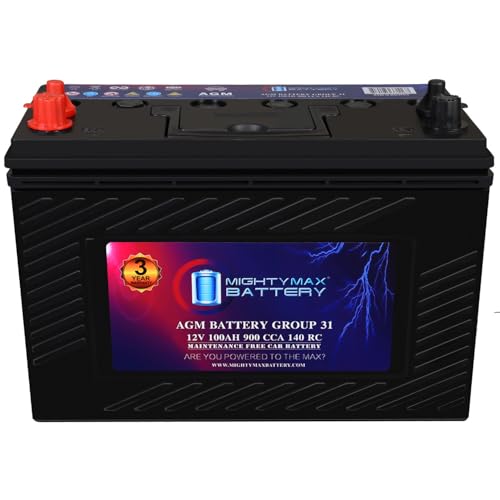
The MM-G31 sits at the heavy end of the auto AGM lineup: 900 CCA, 140 minutes of reserve capacity, BCI Group 31 case. Trucks, diesel pickups, large SUVs, and work vans are the natural fit, where smaller Group 24 or 26 batteries would struggle on cold mornings.
Against the MM-G24 reviewed earlier, the MM-G31 trades a larger footprint and heavier weight for substantially higher cranking amps and longer reserve runtime. For commercial-duty trucks with high electrical loads (plow lights, work radios, inverters), the extra capacity is the difference between starting on the first try and needing a jump.
Practical Advantages
- 900 CCA delivers confident cold-weather starting for large gasoline and diesel engines.
- 140-minute reserve capacity keeps accessories and work lighting running through alternator failures.
- Sealed AGM design resists vibration damage common in commercial truck applications.
- Deep discharge recovery helps the battery bounce back from accessory drain at job sites.
Points To Note
- Group 31 case is large and heavy; smaller vehicles may not have the tray space or bracket support to mount it safely.
- 100Ah at this size means extra cost and weight compared to the MM-G24, so the upgrade only pays off for the right engine size.
At A Glance
Whose Shelf It Belongs On
Truck owners, diesel drivers, and commercial fleet operators who need strong cold-cranking amps and generous reserve capacity.
Where A Sibling Pick Shines
Honda Civic or Toyota Corolla owners would be over-batteried; the Mighty Max MM-G26 is a friendlier Group 26 fit.
What To Weigh Before Picking An AGM Battery
Choosing an AGM battery comes down to matching three numbers to your use case: group size (the BCI tray footprint your vehicle or compartment expects), CCA for engine starting, and amp-hour capacity for anything that runs accessories or deep cycles.
Cranking-focused vehicles like commuter cars, trucks, and motorcycles care most about group size and CCA. A 540 CCA battery in Group 26 is plenty for a compact four-cylinder, while a 900 CCA Group 31 unit gives large engines comfortable cold-weather headroom. The HQST, Mighty Max MM-G24, MM-G26, MM-G31, and ACDelco Gold 51RAGM all live in this lane, with each mapped to a specific BCI tray and engine class.
Deep-cycle and off-grid use cases flip the priority to amp-hours and cycle life. Solar banks, RV house systems, and trolling motors benefit from cells like the VMAX SLR125 pair or the LiTime lithium upgrade. Reserve capacity and depth-of-discharge matter far more than peak cranking amps here, since the battery is delivering sustained current rather than a short burst.
Specialty roles call for their own rules. UPS backup, emergency lighting, and telecom gear want long float life and stable voltage, which is why the Enersys Cyclon D-cell exists in a category of its own. Tiny replacement cells like the Mighty Max ML2.3-12 serve consumer electronics where size and terminal type matter more than amp-hours.
A quick reality check helps avoid mismatches: confirm the BCI group your vehicle tray accepts, measure the old battery’s dimensions, and verify terminal polarity (standard vs. “R” reversed). Picking the right chemistry is only half the job; the physical fit is what makes the install go smoothly.
Key Considerations Across These Picks
Mistakes Worth Dodging
One common slip is treating “AGM” as a single category. Starting AGMs (HQST, Mighty Max MM-G24, MM-G26, MM-G31, ACDelco Gold 51RAGM) are built for short, high-current bursts. Deep-cycle AGMs (VMAX SLR125) handle slow, repeated discharges. Swapping one for the other shortens battery life. Another trap is assuming any AGM charger works for lithium. The LiTime 12V 100Ah needs a lithium-compatible charger or solar controller; an old AGM charger may undercharge it.
Where The Extra Money Goes
Higher-tier AGM models typically add plate thickness (more lead, longer service life), stronger internal compression (better vibration resistance), and tighter quality control. In the LiTime lithium upgrade, the premium buys higher energy density, longer cycle life, and a fraction of the weight. The honest read is that you pay for cycle count and weight savings, not just capacity. For most daily drivers, a mid-tier AGM is plenty, while off-grid and RV users see real value in stepping up to lithium or matched deep-cycle pairs.
Frequently Asked Questions
How long does an AGM battery typically last?
Most automotive AGM batteries last three to six years depending on climate, driving habits, and electrical load. Deep-cycle AGMs in solar or RV use can stretch longer with proper charge management, while lithium options like the LiTime can run thousands more cycles.
Can you replace a flooded battery with AGM without changing the charging system?
In most modern vehicles, yes. The alternator’s voltage regulator typically falls within the AGM charging window. Older vehicles with simple voltage regulators may need verification, since overcharging can shorten AGM life.
What does BCI group size actually mean?
BCI group size is a standardized case footprint defined by the Battery Council International. It tells you the physical dimensions and terminal layout of the battery, so you can match a replacement to the existing tray without guesswork.
Is a higher CCA rating always better?
Not always. Higher CCA helps in cold climates and large engines, but for compact cars in mild weather, oversized CCA simply costs more without meaningful benefit. Match CCA to your engine size and climate, not to a “more is more” assumption.
Do AGM batteries require special maintenance?
No routine maintenance is needed; the sealed design eliminates water top-offs and reduces terminal corrosion. Periodic charging during long storage and keeping the terminals clean is generally all that’s required.
Wrap Up
The right AGM battery is the one that fits your tray, matches your engine or load, and aligns with how often you actually cycle it. Start-stop commuters do well with Group 47 or Group 24 AGMs like the HQST or MM-G24, while trucks lean toward Group 31. Off-grid and RV owners get the most usable energy from a matched deep-cycle pair or a lithium drop-in. Specialty roles call for industrial-grade cells like the Enersys Cyclon or small-format replacements like the Mighty Max ML2.3-12. Match the format to the job and the rest usually falls into place.