Running a golf cart, forklift, or off-grid setup means the charger quietly decides whether your morning goes smoothly or stalls out. The right 48v lithium ion battery chargers cut downtime, protect expensive cells, and shrug off daily use. The wrong one cooks batteries or simply won’t wake them up. This list sorts through ten solid options built for carts, RVs, marine gear, and industrial kit, so you spend less time guessing and more time rolling.
Your Options, Compared

FORM 48 Volt Golf Cart Charger for EZGO

Mehrpow 48V Lithium Golf Cart Battery Kit

LiTime 12V 20A LiFePO4 Battery Charger

ESTSVN 25A 36V EZGO TXT Charger
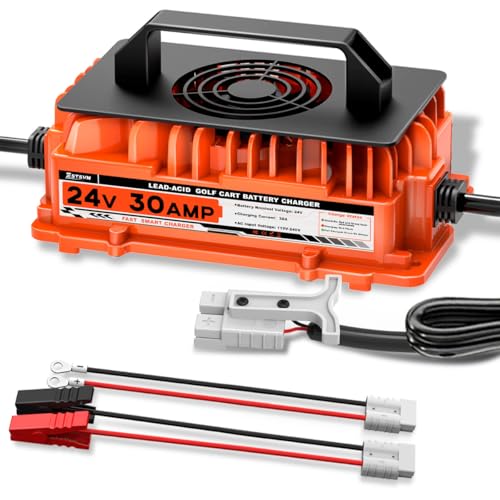
ESTSVN 30A 24V Forklift Charger

FORM 48 Volt Onboard Golf Cart Charger

ESTSVN 48V 18A LiFePO4 Charger

ESTSVN 50A 12V LiFePO4 Charger
FORM 48 Volt Golf Cart Charger for Club Car

ESTSVN 14.6V 30A LiFePO4 Charger
A Deeper Look At The Lineup
The FORM charger for EZGO RXV and TXT carts comes in roughly 80% lighter than the OEM unit it replaces, which matters when you’re hauling it from the garage to the cart on a hot afternoon. It uses the EZGO triangle plug, so most owners plug straight in without rewiring, and the 14-foot-plus cable gives slack for awkward garage layouts. Rated for 48V 15A output on lead-acid packs, it’s the kind of drop-in unit that suits neighborhood courses and weekend trail riders alike.
For anyone running an older EZGO on flooded lead-acid batteries, this charger feels purpose-built rather than adapted. It’s not trying to be a universal unit, and that focus shows in the plug fit and weight class. You give up lithium compatibility, which matters if you’ve already upgraded your pack, and the unit stays cool through a full charge thanks to active cooling.
Everyday Perks
- Triangle plug fits EZGO RXV and TXT carts out of the box.
- Lightweight body makes it easy to grab and store between uses.
- Long cable reaches awkward outlets and tucked-away parking spots.
- Cool-running design handles full charge cycles without throttling.
Things To Consider
- No lithium charging profile, so it won’t suit upgraded LiFePO4 packs.
- Hardwired triangle plug limits cross-brand flexibility if you switch carts later.
Feature Snapshot
Who It Suits Best
EZGO RXV or TXT owners still running lead-acid batteries who want a lighter OEM replacement without rewiring.
Look Elsewhere When
Cart owners with lithium or LiFePO4 upgrades should grab the FORM 48 Volt Onboard Golf Cart Charger instead for multi-chemistry support.
This isn’t a charger in the strict sense, but it earns its spot because anyone moving from lead-acid to lithium needs the foundation piece. The Mehrpow 48V 100Ah kit uses grade-A EVE LiFePO4 cells, balanced at the factory, and ships as a one-time installation with no complicated rewiring. It targets carts and 48V equipment where weight savings and cycle life matter more than upfront cost.
You get roughly 10,000 deep cycles at 80% depth of discharge, which translates into years of regular cart use before capacity drops meaningfully. Because lithium cells hate being fully drained, you’ll still want a charger with a proper LiFePO4 profile, which is where later entries on this list come in. The kit is non-returnable due to hazmat shipping rules, so ordering the right voltage the first time matters.
Why It Works Well
- Factory-balanced cells remove the guesswork from a lithium swap.
- Plug-and-play design cuts install time for weekend mechanics.
- Long cycle life beats lead-acid on cost-per-year over time.
Room For Improvement
- Hazmat-class shipping limits return options if sizing is wrong.
- Requires a separate LiFePO4-compatible charger for safe charging.
Made For
Cart owners committing to a full lithium conversion who already understand the charger side needs its own upgrade.
Skip It When
Drivers sticking with lead-acid batteries should look at the FORM 48 Volt Golf Cart Charger for EZGO for a simpler charging-only path.
The LiTime 12V 20A unit is built specifically for LiFePO4 batteries, meaning it delivers the 14.6V absorption that lithium chemistry needs to top off properly. It’s a smart charger (a unit that adjusts voltage and current automatically based on battery state) with a 0V activation mode that can revive packs drained so low a standard charger refuses to start. The Anderson connector (a polarized, high-current plug favored in RV and solar setups) and LED indicator make it friendly for RV, off-grid, and home backup banks.
At 20 amps it’s plenty of current for a single 12V deep-cycle battery but won’t keep up with a parallel four-bank setup. Six safety protections guard against common fault modes, though the unit is explicitly not waterproof, so marine use is out. For a shed, garage, or RV bay, it handles daily top-ups without complaint.
The Value In It
- 0V activation mode rescues deeply discharged LiFePO4 packs.
- Anderson connector simplifies RV and off-grid hookups.
- Six-layer safety suite covers common fault scenarios.
- LED status keeps charging state visible at a glance.
Trade Offs
- Not waterproof, so outdoor or marine mounting needs a cover.
- 20A output is light for multi-bank parallel setups.
At A Glance
Right Fit For
RVers and off-grid homeowners running a single 12V LiFePO4 bank who want a smart, safe daily charger.
Reach For A Different Pick When
Owners with larger 12V banks should consider the ESTSVN 50A 12V LiFePO4 Lithium Battery Charger for higher amperage.
The ESTSVN 25A charger targets 36V EZGO TXT carts running lead-acid packs, putting out up to 1250W through a D-style 2-pin plug. It’s built around an aluminum housing with a covered cooling fan, so heat dissipation stays consistent even on long summer charges. Compared to the FORM unit above, it trades EZGO’s triangle connector for the older D-shape and bumps current to shave charge time.
It suits carts used for hauling or long-course play where faster turnaround matters. The aluminum body shrugs off garage knocks, and the fan keeps the internals cooler than many plastic-shelled alternatives. It’s a lead-acid specialist, so anyone running lithium should skip it.
Notable Gains
- 25A output shortens charge cycles for daily drivers.
- Aluminum housing improves durability and heat shedding.
- D-style plug fits legacy EZGO TXT lead-acid carts.
Small Caveats
- Lead-acid only; no lithium charge profile built in.
- 36V output rules out 48V carts entirely.
Best Suited To
EZGO TXT owners with lead-acid packs who want a faster charge than standard 15A units deliver.
Where A Sibling Pick Shines
48V system owners get more flexibility from the FORM 48 Volt Golf Cart Charger for EZGO.
This 24V 30A unit sits in a different lane from the cart chargers above, built for forklifts, scissor lifts, pallet jacks, and floor scrubbers. The Anderson plug keeps connections tool-free, and the aluminum body with a covered fan holds up to dusty shop environments. It supports lead-acid packs only, with three charging modes for different battery states.
Workshop owners appreciate the fast turnaround between shifts, since 30A on a 24V system pushes a deep-cycle pack from empty faster than a 10A overnight unit. The trade-off is heat and noise; this is a working charger, not a quiet garage companion. For commercial cleaning crews and warehouse operations, that trade-off is worth it.
The Good Stuff
- 30A output suits multi-shift industrial duty cycles.
- Anderson plug makes battery swaps tool-free.
- Three charging profiles adapt to battery condition.
- Aluminum body handles shop dust and knocks.
Worth Noting
- Lead-acid only, so lithium conversions need a different charger.
- Cooling fan adds audible noise during long charge sessions.
Who Should Grab It
Small warehouse and cleaning crews running 24V lead-acid forklifts, pallet jacks, or floor scrubbers daily.
Not Your Match When
Golf cart owners will find more cart-specific fit in the ESTSVN 48V 18A LiFePO4 Lithium Battery Charger.
The onboard FORM charger bolts permanently to the cart, so you stop hauling a brick back and forth from the garage. It uses ring terminals (lugs that bolt directly to battery posts) for clean wiring and weighs roughly 80% less than the OEM onboard unit, which helps on already-heavy carts. It handles lead-acid, lithium, and LiFePO4 packs, making it a versatile choice if you plan to upgrade batteries later.
For carts parked outside or in shared storage, onboard charging eliminates the “where’s the charger” problem. The ring-terminal connection means installation takes basic tools and a few minutes, though routing the AC cord still needs thought. The trade-off is that a permanently mounted unit is easier to steal than a portable one.
A Strong Showing
- Multi-chemistry support covers lead-acid and lithium packs.
- Onboard mount removes daily hauling and storage hassle.
- Ring terminals offer solid, low-resistance battery connections.
- Lightweight design keeps cart weight close to OEM.
Honest Caveats
- Permanent mount raises theft risk in unsecured parking.
- Requires routing an AC inlet, which adds install complexity.
Quick Facts
Whose Shelf It Belongs On
Cart owners who want to charge in place and may switch battery chemistry down the road.
Swap It Out When
EZGO owners who prefer a portable plug-in charger should pick up the FORM 48 Volt Golf Cart Charger for EZGO instead.
This charger outputs 58.4V at 18A for 16-cell 48V (51.2V nominal) LiFePO4 packs, which is the right absorption target for that chemistry. It ships with M8 ring terminals, clips, and an Anderson plug, so you pick the connector that fits your setup without buying adapters. Input voltage runs from 100V to 240V AC, useful for varied outlet standards.
Where it shines is range of use: golf carts, forklifts, floor scrubbers, electric motorcycles, boats, and solar banks all fit the spec. The 18A rate lands between the conservative 15A cart chargers and the heavier 25A industrial units. For mixed-fleet owners, that flexibility is the whole point.
Real Benefits
- Three connector types ship in the box.
- Wide input voltage handles different outlet standards.
- Correct 58.4V absorption profile for LiFePO4 cells.
- Cross-application design fits carts, marine, and solar.
Some Limits To Know
- 18A output is moderate for very large-capacity packs.
- LiFePO4 only; no lead-acid profile for legacy batteries.
Perfect Match For
Multi-equipment owners with LiFePO4 packs across carts, marine gear, and off-grid solar setups.
Consider Something Else When
Pure lead-acid golf cart owners get a more focused fit from the FORM 48 Volt Golf Cart Charger for EZGO.
At 50A output on a 14.6V 12V LiFePO4 profile, this charger sits at the heavy end of the category. The metal casing shrugs off garage heat and bumps, and the cooling fan keeps temps in check during long sessions. It’s a sensible match for large RV banks, trolling motor setups, and marine battery walls that need fast turnaround.
Owners with deeply drained packs benefit from the 0V activation feature, which can wake cells left sitting too long. The unit is designed for 12V (12.8V nominal) LiFePO4 only, so using it on lead-acid risks undercharging. For serious amp-hour banks, the 50A rate is the difference between waiting hours versus waiting overnight.
Bright Spots
- 50A output refills large battery banks quickly.
- Metal casing handles heat and physical wear.
- 0V activation rescues neglected LiFePO4 packs.
- Cooling fan supports extended high-current charging.
Less-Strong Areas
- Requires a high-amperage outlet and circuit to run safely.
- LiFePO4 only; no compatibility with lead-acid banks.
Built With In Mind
RV and marine owners with large 12V LiFePO4 banks who need fast, daily high-current charging.
A Better Fit Elsewhere
Smaller 12V LiFePO4 users get right-sized current from the LiTime 12V 20A LiFePO4 Battery Charger.
This FORM unit mirrors the EZGO version above but uses Club Car’s circle plug for Precedent and DS carts. At roughly 80% lighter than the OEM Club Car charger, it’s a noticeable upgrade in daily handling. It supports lead-acid, LiFePO4, and lithium batteries, which keeps options open if the pack gets swapped later.
The 14-foot-plus cable reaches typical garage outlets without extension cords. For Club Car owners, the native plug fit removes any adapter guesswork. The 15A output is conservative but safe for overnight charging, which suits most residential users who plug in after the last ride of the day.
Real-World Strengths
- Club Car circle plug fits Precedent and DS without adapters.
- Multi-chemistry support future-proofs the purchase.
- Noticeably lighter than the OEM Club Car unit.
- Long cable reaches garage outlets comfortably.
Factors To Consider
- 15A output means longer charge times than 25A industrial units.
- Brand-specific plug rules out use on EZGO carts.
Spec Overview
Who Will Love This
Club Car Precedent and DS owners who want a lighter, multi-chemistry plug-in charger.
Where Another Pick Suits Better
Cart owners needing onboard mounting will find the FORM 48 Volt Onboard Golf Cart Charger a closer match.
Closing out the list, this 14.6V 30A charger covers 12V (12.8V nominal) LiFePO4 packs in RVs, boats, cars, and marine settings. The Anderson connector keeps hookups tool-free, and the aluminum body with a large cooling fan manages heat during extended sessions. It acts as a smart trickle charger once full, maintaining cells without overcharging them.
The 30A rate splits the difference between the lighter 20A LiTime unit and the heavier 50A ESTSVN model. For a single mid-size deep-cycle bank, it’s a comfortable daily driver that won’t sit at a full charge for hours. Owners report steady performance across seasonal temperature swings, which matters for outdoor-stored vehicles.
A Few Strong Suits
- 30A output suits mid-size 12V LiFePO4 banks.
- Anderson connector simplifies RV and marine hookups.
- Trickle-maintain mode protects cells at full charge.
- Aluminum body improves heat dissipation.
Points To Note
- LiFePO4-only design excludes lead-acid battery users.
- Higher amperage requires a properly rated AC circuit.
The Right Fit
RV, boat, and car owners with mid-size 12V LiFePO4 banks who want steady, daily smart charging.
Reach For A Different Pick When
Owners of large-capacity 12V banks will appreciate the higher 50A output of the ESTSVN 50A 12V LiFePO4 Lithium Battery Charger.
Matching Chargers To Your Battery Setup
Picking the right 48v lithium ion battery chargers starts with three honest questions: what’s the actual battery chemistry, what connector does the pack use, and how fast do you need it back in service. Chemistry matters most because lead-acid and lithium need different absorption voltages, and a mismatched charger either undercharges or quietly damages cells over time. Lithium iron phosphate (LiFePO4) packs in particular want a 14.6V (for 12V systems) or 58.4V (for 48V systems) absorption target to fully top off.
Connector fit is the next decision point. EZGO triangle, Club Car circle, Anderson, and ring terminals all coexist in this category, and adapters are rare. Matching your cart or pack to the right plug avoids splicing or guessing at polarity. For multi-chemistry fleets, dual-chemistry chargers like the FORM onboard unit earn their keep by handling both lead-acid and lithium packs.
Output current decides whether you wait overnight or top off between shifts. A 15A charger suits a cart used a few times a week, while a 25A or 30A unit keeps a daily workhorse rolling. Higher amperage demands a properly sized AC circuit, so check the outlet before chasing speed. For shop equipment and forklifts, that speed often matters more than portability.
Finally, installation context shapes the choice between portable and onboard units. Portable chargers store easily and reduce theft risk but add daily hauling. Onboard chargers charge in place but require routing an AC inlet and committing to permanent mounting. The right call depends on where the cart lives and how often you swap vehicles.
Smart Spending And Setup Notes
Common Shopping Slip Ups
The biggest mistake is grabbing a lead-acid charger for a lithium pack, or vice versa. The voltage profiles differ enough that mismatched charging either shortens cell life or leaves capacity stranded. Equally common is overlooking connector type and assuming adapters are universal. A few minutes checking the cart’s plug style saves the headache of returns.
What The Higher Tier Buys
Spending up usually buys faster charging, broader chemistry support, or onboard mounting convenience. The 25A and 30A models on this list cut charge times roughly in half versus entry-level 15A units. Multi-chemistry chargers add the freedom to swap batteries without buying a new charger, which pays off over years of ownership.
Frequently Asked Questions
Can a 48V lithium charger also charge lead-acid batteries?
Most 48V lithium chargers are chemistry-specific and don’t include a lead-acid profile. If you own mixed batteries, look for a multi-chemistry charger like the FORM onboard units, which handle both lead-acid and LiFePO4 packs.
How long does a 48V golf cart charger take to refill a pack?
Charge time depends on battery capacity and charger amperage. A typical 48V 100Ah pack with a 15A charger needs around 7 to 8 hours from empty, while a 25A unit cuts that to roughly 4 to 5 hours.
Is it safe to leave a lithium battery on the charger overnight?
Quality lithium chargers shift to a maintenance or float mode once the pack reaches full, making overnight charging generally safe. Still, periodic checks on battery temperature and connector condition are smart practice.
Do I need a special charger for LiFePO4 batteries?
Yes. LiFePO4 cells need a higher absorption voltage than lead-acid, and using the wrong charger leads to chronic undercharging. Any charger rated for LiFePO4 with the correct voltage profile is the safe choice.
Can a 48V charger work on a 36V system?
No. A 48V charger delivers too high a voltage for a 36V pack and risks damaging cells. Always match charger output voltage to the battery system’s nominal voltage.
The Takeaway
The best charger is the one matched to your battery chemistry, connector, and daily routine. EZGO and Club Car owners get clean plug-and-play results from the FORM units, while multi-equipment users will lean toward the flexible ESTSVN LiFePO4 chargers. Match the amp rating to how quickly you need the pack back in service, and confirm the outlet circuit can handle the load. With those boxes checked, charging becomes the easy part of cart or equipment ownership.