Swapping a tired lead-acid pack for a modern LiFePO4 (lithium iron phosphate) setup changes how a cart, RV, or off-grid solar rig feels on the road. You get steadier voltage under load, lighter weight, and far fewer headaches around maintenance. The 48V class has become the sweet spot for golf carts because it matches common motor controllers and keeps cable runs manageable. The nine options below cover a range of capacities, BMS (battery management system) ratings, and monitoring styles so you can match the pack to your terrain, range goals, and budget.
An Overview Of The Picks
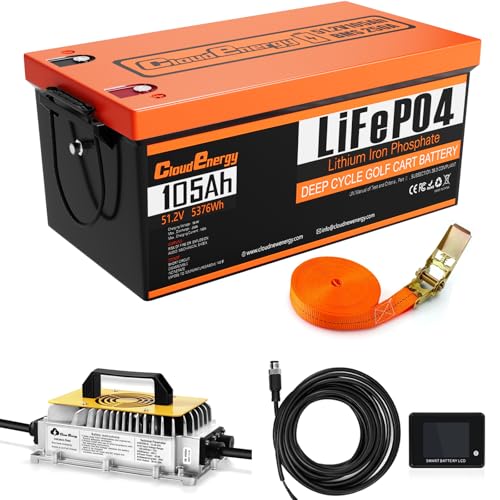
Cloudenergy 48V 105Ah LiFePO4 Lithium Golf Cart Battery

Mosasaur 48V 100Ah LiFePO4 Golf Cart Battery

OGRPHY 48V 105Ah Lithium Golf Cart Battery

Mehrpow 48V 100Ah Lithium Golf Cart Battery Kit

LOSSIGY 48V Lithium Golf Cart Conversion Kit

KEZIMO 48V 105Ah Lithium Golf Cart Battery

OGRPHY 48V 105Ah Lithium Battery with 18A Charger

OGRPHY 48V 100Ah Lithium Battery with Onboard Charger

LOSSIGY 48V 100Ah LiFePO4 Battery with Bluetooth BMS
More On The Choices That Made The List
The Cloudenergy 48V 105Ah pack arrives as a complete drop-in kit, including a 250A BMS, a retention strap, an 18A charger, and a touch-screen readout. The high BMS amp rating (the BMS is the safety board that governs charge and discharge) lets it push more current to demanding controllers, which matters when you tackle steep grades with a loaded four-passenger cart. Cloudenergy pairs that hardware with a mobile app for SOC (state of charge), voltage, and current readouts, so you can keep an eye on the pack from the clubhouse.
Compared to the lighter 100Ah options in this list, the extra five amp-hours add useful runtime on long neighborhood routes. For most backyard carts, the included touch monitor removes the guesswork from charging, though a few owners may find themselves wishing for a more weather-sealed display.
The Helpful Details
- 250A BMS supports heavy controllers and hilly courses.
- Touch monitor plus app gives real-time SOC and current.
- 6000+ cycle rating (a full charge-discharge counts as one cycle) supports years of daily use.
- Retention strap and charger ship in the box.
- LiFePO4 chemistry is thermally stable for garage storage.
Things To Consider
- Heavier than the 100Ah options, so lifting into a tight battery tray takes planning.
- App connectivity can drop in low-signal rural areas.
Best Suited To
Owners running 48V carts on hilly terrain who want extra surge capacity and dual monitoring options.
Skip It When
You carry a lighter load on flat ground; the Mosasaur 48V 100Ah LiFePO4 Golf Cart Battery is easier to lift and still covers most casual rounds.
Mosasaur leans into simplicity: a lead-acid case profile at 77 pounds means the pack slips into standard battery trays without adapter plates. The 200A BMS handles 10.24kW peak output, which is plenty for typical 48V motor controllers on flat to rolling courses. You also get an LCD touch screen and app monitoring, so the same data you’d see from Cloudenergy’s panel is available here.
Where this pack separates from the Cloudenergy option is the footprint. If your tray was originally sized for a GC2 or GC8 lead-acid bank, Mosasaur’s 20.55″ x 10.55″ x 8.74″ envelope is the closest fit on the list. For RVs and trolling motor setups, the lightweight build is a clear plus when you’re balancing payload.
Everyday Wins
- Drop-in lead-acid case saves rewiring time.
- 4000+ cycle rating covers years of weekend play.
- App and LCD give you two ways to check SOC.
- 77-pound weight keeps handling single-handed.
Worth Noting
- 18A charger is slower to top off than higher-amp units.
- 200A BMS has less headroom than Cloudenergy’s 250A board for steep climbs.
- Image listings vary, so confirm terminal layout before installing in a tight tray.
Right Fit For
Shoppers replacing a tired lead-acid bank who want minimal rewiring and a familiar form factor.
A Better Fit Elsewhere
If you regularly climb steep grades, the OGRPHY 48V 105Ah Lithium Golf Cart Battery delivers a higher 1000A peak surge for tougher terrain.
The OGRPHY 48V 105Ah sits in the same capacity class as the Cloudenergy pick but aims harder at raw surge performance. Its 200A BMS is paired with a claimed 1000A peak output for 3 to 5 seconds, which is the kind of headroom that helps when accelerating uphill with four passengers and a hill-launch. An 18A charger and a touch LCD monitor come bundled, so installation stays mostly plug-and-play.
Compared with the Mosasaur option, OGRPHY gives up a little in the “drop-in lead-acid” convenience and gains it back in cold-start confidence. Trolling motor users on bass boats will appreciate the 51.2V nominal output, which keeps the voltage steady under sustained draw.
Standout Benefits
- 1000A peak surge handles demanding hill launches.
- 10-year rated lifespan for long-term ownership.
- Touch LCD monitor delivers at-a-glance diagnostics.
- 18A charger included for a complete kit.
Trade Offs
- Heavier than 100Ah packs, so two-person install is wise.
- 200A continuous BMS still trails Cloudenergy’s 250A board.
Quick Facts
Who It Suits Best
Performance-minded cart owners running hilly courses or trolling setups where high surge current keeps the motor responsive.
Swap It Out When
Battery weight is a top concern; the Mosasaur 48V 100Ah LiFePO4 Golf Cart Battery is easier to maneuver and still delivers 10.24kW peak power.
Mehrpow leans hard on longevity. The kit uses 16 EVE grade-A prismatic cells (rigid, brick-shaped cells that pack energy densely and resist swelling) and rates the pack for over 10,000 deep cycles at 80% depth of discharge, which is well past the 4000-6000 range most competitors quote. If your cart is in daily service and you don’t want to revisit the battery compartment for a decade, that’s the headline number to chase.
One practical note: hazardous-materials shipping rules mean this item is non-returnable in most cases, so confirm the dimensions and terminal layout against your tray before ordering. The plug-and-play wiring harness helps shorten install time, though, especially compared to kits that need extra adapters.
What Earns Its Place
- 10,000+ deep cycles at 80% DOD outpaces most rivals.
- Grade-A EVE prismatic cells with balanced voltage.
- Plug-and-play conversion removes complex rewiring.
- LiFePO4 chemistry stays stable across temperature swings.
Room For Improvement
- Non-returnable due to hazmat shipping rules.
- Spec sheet is shorter than other picks; expect to confirm fitment directly.
Built With In Mind
Fleet operators and daily-driver cart owners who measure value in years rather than upfront cost.
Not Your Match When
You want a built-in touchscreen or app; the KEZIMO 48V 105Ah Lithium Battery for Golf Cart adds both without changing the form factor much.
The LOSSIGY kit stands out for offering both 100Ah and 150Ah capacity options on the same product page, which removes a guessing game for shoppers weighing range against payload. The 200A BMS, grade-A cells, and 4000+ cycle rating line up with the rest of this list, and the included charger and monitor round out a true conversion kit.
For shoppers chasing longer round-trip range from a single charge, stepping up to the 150Ah version gives roughly 7.68kWh of usable energy. The trade-off shows up in weight and tray fitment, so measure carefully if you’re moving from a smaller pack.
Positive Points
- Two capacity options (100Ah and 150Ah) cover range priorities.
- BMS guards against over-charge, over-discharge, and short circuits.
- 4000+ cycle lifespan for long-term daily use.
- Conversion kit includes charger and monitor.
Honest Caveats
- No app connectivity on the base listing.
- 150Ah version adds weight; check your cart’s payload rating.
Feature Snapshot
Whose Shelf It Belongs On
Cart owners who want a one-stop kit and need a choice between standard and extended range.
Look Elsewhere When
App-based remote monitoring matters to you; the OGRPHY 48V 105Ah Lithium Golf Cart Battery ships with full app control.
KEZIMO pairs a 105Ah LiFePO4 cell stack with both an onboard touch monitor and a phone app, giving you two screens for the same SOC and voltage readouts. The 200A BMS supports 10.24kW of continuous output, which is roughly 50% higher than the smaller 100Ah packs in this category. Grade-A prismatic cells keep the pack’s internal layout tidy and lower the risk of cell drift over time.
Where this option differs from the OGRPHY 105Ah pack above is in the software polish: KEZIMO’s app interface is generally described as more beginner-friendly, and the touch monitor gives audible and visual alerts on top of the data. For most owners, that combination shortens the learning curve for monitoring charge cycles.
A Favorable Mix
- Touch monitor and app cover two monitoring styles.
- 10.24kW continuous output handles startups and climbs.
- Grade-A cells lower long-term cell drift risk.
- Low self-discharge for off-season storage.
Points To Note
- Charger not always bundled; confirm before checkout.
- Display brightness can wash out in direct midday sun.
Made For
Tech-forward cart owners who want clear data readouts without pulling out their phone every time.
Reach For A Different Pick When
Bundled accessories matter; the Cloudenergy 48V 105Ah LiFePO4 Lithium Golf Cart Battery ships with both a charger and a retention strap in the box.
This OGRPHY variant focuses on broad controller compatibility, which matters if you’re retrofitting a less common cart brand. The 105Ah pack carries the same 200A BMS and 1000A peak surge as its siblings, but pairs them with marketing aimed at solar pairings as well as golf carts. The included 18A charger and touch monitor round out the kit.
Versus the Mehrpow option above, OGRPHY gives you richer monitoring at the cost of cycle-life claims. For off-grid solar banks, the same pack can be reconfigured with the right inverter settings, though you’ll want to confirm your charge controller’s absorption voltage.
Real-World Strengths
- Works with major 48V cart controllers out of the box.
- 1000A peak surge covers aggressive starts.
- Solar-friendly voltage profile for off-grid pairings.
- Touch monitor and mobile app included.
Less Ideal Details
- Cycle rating sits at 4000+, lower than Mehrpow’s claims.
- Solar setup requires compatible charge controller settings.
Perfect Match For
Cart owners who also run a small solar array and want one pack that can do both jobs with proper settings.
Consider Something Else When
Maximum cycle life is the priority; the Mehrpow 48V 100Ah Lithium Golf Cart Battery Kit advertises far longer deep-cycle endurance.
The standout feature here is the onboard 18A charger: it’s built into the battery housing, so you run a single cord to a standard outlet instead of hauling a separate brick to the cart. The 100Ah capacity stores roughly 5.12kWh, which is enough for most 18-hole loops on flat ground. The 200A BMS supports 10.24kW of continuous output and the same 1000A peak surge that the 105Ah OGRPHY packs deliver.
Compared to the KEZIMO option above, you trade the dedicated touch-monitor experience for charging simplicity. For most garage-kept carts, that swap is a win: just plug in when you park and unplug when you head out.
Practical Advantages
- Onboard charger simplifies the daily routine.
- 5000+ deep cycle rating from grade-A cells.
- 10.24kW continuous output handles most controllers.
- Single-cord charging fits standard outlets.
Things To Weigh
- Onboard charger adds weight over the chassis.
- Lower continuous capacity than the 105Ah siblings.
Key Product Details
Who Should Grab It
Garage-based owners who want the simplest charging experience without a separate brick on the floor.
Where A Sibling Pick Shines
If you’d rather charge off-board and keep the battery lighter, the KEZIMO 48V 105Ah Lithium Battery for Golf Cart offers similar capacity without the built-in charger.
LOSSIGY’s 100Ah kit trades a built-in display for Bluetooth diagnostics, which is a quiet win for RV and solar owners who already check state of charge through an inverter or shunt. The 200A BMS, grade-A prismatic cells, and 4000+ cycle rating keep it competitive with the rest of the list. Peak current of 1000A for 3-5 seconds is enough for most inverter surges when paired with a small microwave or coffee maker.
Versus the LOSSIGY conversion kit earlier, this variant leans toward off-grid use cases rather than cart drop-ins. If your priority is monitoring via an existing Victron, Renogy, or similar app ecosystem, Bluetooth-to-app relay avoids stacking another display.
Well-Handled Touches
- Bluetooth BMS feeds data to common solar apps.
- 1000A peak handles short inverter surges.
- Grade-A prismatic cells with balanced voltage.
- 10-year rated lifespan for long service.
Trade-Offs To Consider
- No built-in touch monitor; relies on phone or inverter.
- Bluetooth range can drop in metal enclosures.
Built With In Mind
Off-grid solar and RV owners who already track battery data through an inverter or shunt.
Where Another Pick Suits Better
Cart owners who want a visible readout at the dash; the Cloudenergy 48V 105Ah LiFePO4 Lithium Golf Cart Battery adds both a touch monitor and a phone app.
Choosing The Right 48V Lithium-Ion Pack For Your Setup
Capacity and BMS output dominate the buying decision, but the surrounding details matter just as much once you install the pack. Capacity is measured in amp-hours (Ah) and translates directly to runtime: a 100Ah pack at 48V holds about 5kWh of energy, while a 105Ah pack adds roughly 5% more usable capacity. For weekend rounds on flat ground, 100Ah covers most 18-hole loops, but hilly courses and four-passenger carts lean toward the 105Ah tier.
The BMS rating controls how much current the pack can safely deliver to your motor or inverter. A 200A BMS handles typical 48V controllers without breaking a sweat. Bumping to 250A gives you headroom for modified controllers, steeper launches, or accessories that draw heavy surges.
Chemistry choice is settled for you in this category. LiFePO4 is the standard for 48V mobility batteries because it stays thermally stable, tolerates deep discharges, and lasts far longer than NMC or lead-acid. Cycle life claims vary widely: 4000 cycles is the conservative baseline, while premium kits push past 10,000 at moderate depth of discharge.
Matching Capacity To Your Route
A 100Ah pack works for flat courses and short errands. For loaded carts or hilly terrain, 105Ah extends range enough to skip a mid-day charge. If your route includes long climbs or accessory loads, the 150Ah LOSSIGY option trades payload capacity for a full extra day of runtime.
BMS, Surge, And Controller Compatibility
Match the BMS continuous rating to your controller’s peak draw. Most 48V stock controllers pull well under 200A, so the 200A BMS options here are plenty. Modified or high-torque controllers benefit from the 250A Cloudenergy board, which prevents the BMS from cutting out under hard acceleration.
Monitoring And Charging Style
Touch monitors give instant readouts at the dash; apps add remote visibility. Bluetooth-only kits rely on your inverter or shunt for telemetry, which keeps the battery simpler but requires extra setup. Onboard chargers remove a separate brick from the cart and shorten the daily routine, while bundled off-board chargers are lighter and easier to swap if they fail.
Key Considerations Across These Picks
Pitfalls Shoppers Hit
The most common mistake is treating capacity as the only number that matters. A 100Ah pack with a weak 100A BMS will throttle a high-torque controller, leaving you crawling up hills. The other trap is ignoring tray dimensions: lithium packs are physically smaller than the lead-acid banks they replace, so adapter plates or shims may be needed. Finally, confirm the charger’s output matches the pack’s chemistry before plugging in, since a mismatched charger can shorten cell life.
Where The Extra Money Goes
Higher-tier packs buy three concrete upgrades: a stronger BMS for high-current controllers, more grade-A cells for longer cycle life, and richer monitoring (touch screens, apps, Bluetooth). For most casual cart owners, the mid-tier 200A BMS picks deliver the best balance. Daily drivers, modified carts, and solar banks see the most return from premium-tier features like the 250A Cloudenergy board or Mehrpow’s extended cycle rating.
Frequently Asked Questions
How long does a 48V lithium battery typically last?
Most LiFePO4 packs in this class are rated for 4000 to 6000 cycles at 80% depth of discharge, which translates to roughly 8-12 years for weekend-use carts and 4-6 years for daily fleet use.
Can I replace lead-acid batteries with lithium without changing my charger?
Not always. Lithium requires a charger with the correct absorption voltage (typically around 58.4V for a 48V pack), so most lead-acid chargers need to be swapped for the bundled lithium charger included with each kit above.
Will a 48V lithium battery work with my existing motor controller?
Most 48V controllers accept lithium drop-ins without modification, but always confirm the controller’s voltage cutoff and peak draw match the new pack’s BMS limits before installing.
Is a higher amp-hour rating always better?
Higher Ah means longer runtime but also more weight and a larger footprint. For flat courses and short trips, 100Ah is usually enough; for hilly terrain or longer routes, stepping to 105Ah or 150Ah pays off.
Do lithium batteries need maintenance?
LiFePO4 packs are largely maintenance-free compared to lead-acid, but owners commonly store them at roughly 50% SOC during off-seasons and avoid leaving them at 100% charge for extended periods to preserve cycle life.
Closing Remarks
The right 48V lithium-ion battery depends on your route length, terrain, and how much monitoring you want at your fingertips. Hilly courses and loaded carts benefit from the Cloudenergy 250A BMS, while drop-in simplicity points shoppers toward Mosasaur. For solar and RV pairings, the Bluetooth-equipped LOSSIGY kit integrates cleanly with existing apps. Whichever pick you land on, match the BMS rating to your controller, confirm tray dimensions before checkout, and you’ll get years of lighter, quieter, more reliable power.