A dead lithium battery mid-round kills a golf day. The same can happen on a worksite, a boat ramp, or a back-road campground where the only outlet is a long walk away. Picking the right 48V charger for your setup matters more than the battery itself, because the charger decides how fast you get back to work and how long those cells actually last.
How The Shortlist Stacks Up
How The Shortlist Stacks Up

48V Lithium Battery Golf Cart Batteries Kit

48V 105Ah Lithium Battery for Golf Cart
48V 18A LiFePO4 Charger 1250W IP67
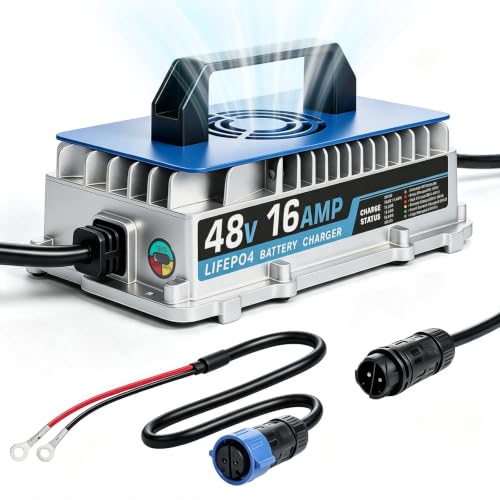
48V 16A LiFePO4 Charger 900W

48V 18A LiFePO4 Charger with Dual Mounting

25A 36V Golf Cart Charger for EZGO TXT
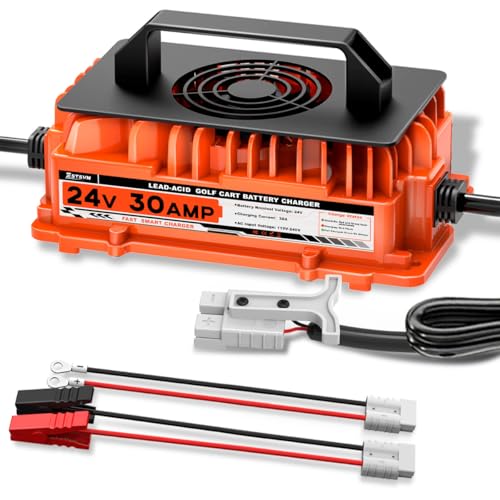
30A 24V Forklift Charger with Anderson Plug

48V 18A LiFePO4 Charger with Multi-Plug

50A 12V LiFePO4 Charger 14.6V

14.6V 30A LiFePO4 Charger with Anderson
The Details Behind The Selections
Pulling six heavy lead-acid batteries out of a cart and dropping in this 48V 100Ah LiFePO4 kit is the kind of weekend project that pays off every round afterward. The Mehrpow kit is sold as a complete upgrade package aimed at owners who want one swap rather than piecing cells together.
LiFePO4 (lithium iron phosphate) chemistry holds a steadier voltage through a discharge cycle than lead-acid, so your cart feels just as strong on hole 18 as on hole 1. For community carts logging multiple rounds a week, that consistency is the real reason to convert.
The Case For It
- Complete kit cuts sourcing guesswork for first-time converters.
- LiFePO4 chemistry shrugs off partial-charge cycling, so topping off between rounds does no harm.
- Plug-and-play wiring skips custom cable fabrication for most carts.
- Drop-in weight reduction improves hill-climbing response noticeably.
Honest Caveats
- The kit itself is the battery, so a matching 48V LiFePO4 charger (see pick 3 or 5) is a separate purchase.
- Hazardous-materials shipping rules mean delivery windows can stretch.
Quick Facts
Made For
Cart owners ready to retire their lead-acid pack and commit to a full lithium upgrade.
Consider Something Else When
The KEZIMO 48V 105Ah battery (pick 2) suits you better if app monitoring and a higher-output BMS matter more than a turnkey conversion kit.
The KEZIMO 48V 105Ah pack leans into the smart side of lithium ownership. A built-in touch monitor and companion app give you live voltage, current draw, and cell balance without cracking the seat box open.
Where the Mehrpow kit (pick 1) is the no-fuss hardware play, this one is for the owner who likes data. The BMS (battery management system) is rated for 200A continuous, which keeps the pack cool even on steep tee-box climbs.
A Favorable Mix
- On-board display and app remove guesswork on state of charge.
- 200A BMS handles aggressive acceleration without tripping protection.
- 105Ah adds a modest capacity bump over the common 100Ah pack.
Trade Offs
- App-dependent monitoring may frustrate owners who prefer simple plug-and-go indicators.
- Higher internal complexity means more potential failure points over a long service life.
Best Suited To
Tech-forward cart owners who want visibility into pack health and have Wi-Fi range at the storage shed.
Look Elsewhere When
The Mehrpow 100Ah kit (pick 1) is the cleaner fit for anyone running a community fleet who values simplicity over telemetry.
The RALBIL 18A, 1250W charger is built for people who hate waiting by the cart barn. Eighteen amps into a 48V LiFePO4 pack means a 100Ah battery comes back from empty in roughly five hours, which is the difference between a morning round and a morning-plus-afternoon round.
An IP67 rating (sealed against dust and brief immersion) lets it live outside without a cover. The 0V wake-up function revives packs that have sat dead long enough to trip most chargers’ protection circuits.
Key Advantages
- 18A output roughly halves charging time versus typical 10A chargers.
- IP67 housing tolerates rain and splash exposure in open storage.
- 0V wake-up can recover deeply discharged packs that standard chargers refuse.
Soft Spots
- Higher current means more heat under the housing, so mounting with airflow around it is wise.
- Fast charging above 80% slows anyway, so the last hour still drags.
Feature Snapshot
Who It Suits Best
Cart owners running back-to-back rounds who need a fast turnaround overnight.
Where Another Pick Suits Better
The RALBIL 16A charger (pick 4) makes more sense for occasional weekend use where a slower charge is perfectly fine.
The 900W, 16A version of RALBIL’s 48V line trades a little speed for a calmer thermal profile. Owners who plug in after a round and don’t need the cart again until tomorrow rarely notice the extra hour.
Compare that to the 18A unit (pick 3): same wake-up function and similar safety architecture, just dialed down. For a once-a-week cart, that lower current is a meaningful longevity advantage.
What Pays Off
- 16A keeps the charger cooler during long overnight sessions.
- Eight layers of built-in protection add redundancy for unattended overnight charging.
- 0V wake-up matches the feature set of the faster 18A sibling.
Some Limits To Know
- Six-hour-plus charge times test the patience of multi-round-day users.
- Lacks the IP67 sealing of the 18A unit, so outdoor mounting needs a cover.
Right Fit For
Recreational cart owners who charge overnight and value cooler-running hardware.
Swap It Out When
The 18A RALBIL (pick 3) is the better call if your cart sits outside uncovered and you need faster turnaround.
Where most 48V chargers ship with one mounting orientation, RALBIL drilled this one with ten holes so it sits flat or stands on its side. That sounds minor until you try to fit a brick-shaped charger into a tight battery bay.
It shares the 18A, 1250W, IP67 spec with pick 3, so the electrical conversation is identical. The difference is purely mechanical, and it matters most on custom carts and crowded engine bays.
Everyday Advantages
- Dual orientation frees up space in cramped cart battery compartments.
- Same IP67 rating as the flagship 18A unit, so outdoor placement stays safe.
- Ten mounting holes give installers real flexibility for non-standard layouts.
Points To Note
- Extra mounting hardware adds a small amount of installation planning.
- Functionally identical to pick 3, so it makes sense only if the orientation matters to you.
Perfect Match For
Owners working with non-standard battery bays or tight garage installations.
Another Choice May Suit
The standard RALBIL 18A (pick 3) is the simpler pick if your compartment has plenty of clearance.
The ESTSVN 36V charger sits in a different lane than the rest of this list. It is built for older EZGO TXT carts still running lead-acid packs, with the round D-style plug those carts expect.
Anyone with a 48V lithium cart should skip this. But for the legacy fleet owner, an OEM-style replacement charger at 25A gets the pack topped off before the next tee time.
Useful Touches
- 25A output refills lead-acid packs faster than most stock TXT chargers.
- Direct-fit D-style plug avoids adapter hassles on legacy carts.
- Aluminum housing helps shed heat during long charge cycles.
Where It Is Less Suited
- 36V lead-acid only: connecting to a 48V lithium pack will damage the cells.
- Charging profile designed for flooded lead-acid, not sealed AGM or gel.
Whose Shelf It Belongs On
EZGO TXT owners still running their original 36V lead-acid battery pack.
Skip It When
Anyone running a 48V lithium setup should jump to the RALBIL 18A charger (pick 3) instead.
The ESTSVN 24V, 30A charger lands in the industrial corner of this category. Forklifts, scissor lifts, pallet jacks, and floor scrubbers all run on 24V lead-acid banks, and an Anderson plug connection makes hookup a one-hand job.
Three charging modes built into one unit cover different battery states and chemistries common in warehouse gear. For a shop running mixed equipment, that versatility beats owning three separate chargers.
What Earns Its Place
- Anderson-style plug matches common forklift and pallet jack cabling.
- Three charging profiles handle different battery conditions without manual switching.
- Aluminum body with covered fan keeps temps in check during extended shop use.
Potential Drawbacks
- 24V output is wrong for any 48V golf cart or RV bank.
- Lead-acid charging profile is not safe for LiFePO4 banks.
Built With In Mind
Small warehouse operators and mobile service techs maintaining mixed 24V lead-acid fleets.
Reach For A Different Pick When
The ESTSVN 48V 18A charger (pick 8) fits any shop that has crossed over to lithium-powered carts or scrubbers.
The ESTSVN 48V 18A charger ships with three connector styles: M8 ring terminals, alligator clips, and an Anderson plug. That sounds like a small detail, but it is the difference between firing up the charger out of the box versus sourcing adapter cables for a week.
Where the RALBIL 18A unit (pick 3) is more weather-sealed, this one is more universally compatible. For owners running a 48V golf cart alongside a 48V electric outboard or RV pack, that flexibility pays off.
Well-Handled Touches
- Three included connectors cover most 48V LiFePO4 installations.
- Wide AC input range handles 100V to 240V, useful for international use.
- 18A output matches the higher-current carts in this category.
Practical Considerations
- No IP67 rating, so outdoor permanent mounting requires weather protection.
- Three connector options can confuse first-time installers, so labeling helps.
Feature Rundown
Who Should Grab It
Owners with mixed 48V lithium setups across cart, marine, and RV use cases.
Not Your Match When
The RALBIL 18A IP67 (pick 3) is the stronger pick for chargers that live outside year-round.
The ESTSVN 12V 50A charger drops the voltage but pushes serious current, aimed at trolling motors and large 12V LiFePO4 house banks. It is technically a 12V unit, but for boaters running 12V lithium banks in parallel, it is the headline pick in this roundup’s family.
The metal casing and cooling fan combination is built for sustained draw, which is exactly how trolling motors pull on a battery over a long day on the water.
The Practical Payoff
- 50A output recharges large trolling motor banks in a few hours.
- Metal casing handles marine heat and humidity better than plastic.
- 0V activation recovers deeply discharged 12V lithium banks.
Things To Weigh
- 12V only: not a fit for any 48V system.
- 50A draw needs a dedicated 15A+ AC circuit, which not every dock has.
Built With In Mind
Boaters with large 12V LiFePO4 trolling motor banks who recharge between fishing spots.
Reach For A Different Pick When
The ESTSVN 14.6V 30A (pick 10) is the right call for smaller banks that do not need 50A output.
The final pick is a smaller, cooler-running 12V 30A LiFePO4 charger for RV, boat, and car deep-cycle banks that do not need the heavy current of pick 9. Anderson connector in the box keeps installation simple.
The aluminum body and covered fan do the same thermal job at a calmer pace, which translates to quieter operation in a cabin or sleeper berth.
Where It Helps
- 30A output suits mid-size 12V LiFePO4 house banks without overkill.
- Anderson connector matches common RV and marine cabling.
- Aluminum housing and fan keep operating temps in check during overnight charging.
Things To Note
- Charging a 200Ah+ bank at 30A still means a full overnight session.
- Strictly 12V LiFePO4: cannot bridge to 24V or 48V configurations.
Right Fit For
RVers and smaller boat owners running compact 12V lithium house banks.
A Better Fit Elsewhere
The 50A ESTSVN (pick 9) is the upgrade path for anyone adding capacity or moving to high-draw trolling motors.
Picking The Right 48V Charger For Your Setup
Match Voltage And Chemistry First
A 48V LiFePO4 pack runs at 51.2V nominal and needs a charger that outputs 58.4V for the absorption stage. Drop a 48V lead-acid profile on a lithium bank and you cook the cells. Lead-acid chargers on this list (picks 6 and 7) cover older carts and forklifts and should stay in their lane.
Amperage Drives Downtime
Charging current is the headline number once voltage is locked in. An 18A charger refills a 100Ah pack in roughly five hours; a 16A unit takes closer to six, and a 10A stock unit pushes past ten. Heavy-use fleets benefit from the faster end; weekend-only owners rarely need to pay for it.
Look For Wake-Up And Protection Layers
Lithium packs left dead for months can drop below the cutoff voltage most chargers refuse to touch. A 0V wake-up function revives those banks safely. Multi-layer protection (overvoltage, overcurrent, short circuit, thermal) is standard on the better units in this category and worth verifying before purchase.
Sealing And Mounting Matter Outside
Chargers mounted in open sheds or boat lockers take a beating from weather. An IP67 rating (picks 3 and 5) means dust-tight and brief-immersion safe, which is the practical bar for permanent outdoor mounting. Otherwise, plan on a weatherproof enclosure.
Key Considerations Across These Picks
Common Shopping Slip Ups
The single most expensive mistake is buying a 36V or 24V charger for a 48V lithium bank, or vice versa. The connector shape may look identical, but the charging profile is not. Double-check your battery’s nominal voltage and chemistry before anything else. A close second is ignoring AC circuit capacity: a 1250W charger draws about 11A from a 120V outlet, which is fine on most household circuits but trips breakers on a shared 15A line with other loads.
Why Top Tier Costs More
The price gap between budget and premium LiFePO4 chargers usually lives in three places: build quality (sealed IP-rated housings versus open-faced units), protection circuitry (eight-layer versus four-layer), and wake-up circuitry that revives deeply discharged banks. For a charger that runs unattended overnight, those features pay for themselves the first time a power event or dead-cell situation hits. For occasional use in a controlled environment, mid-tier often does the job.
Frequently Asked Questions
Can I Use A 48V Lithium Charger On A Lead-Acid Battery?
No. Lithium chargers push higher absorption voltage (58.4V) and use a different charge profile than lead-acid units. Using one on a flooded lead-acid pack will damage the cells.
How Long Does A 48V Lithium Charger Take To Fill A 100Ah Pack?
Roughly five hours at 18A, six hours at 16A, and ten or more hours at 10A. Real-world times run longer because the final 20% of charge tapers off to protect cell health.
Do I Need An IP67-Rated Charger?
Only if the charger lives outside without a cover. Garage or shed installations can save cost by choosing a non-sealed unit and keeping it out of the weather.
What Is A 0V Wake-Up Function?
It is a recovery mode that slowly forces current into a deeply discharged lithium pack to bring it back above the protection cutoff. Without it, a long-dead pack looks like a brick to most chargers.
Can One Charger Cover Multiple Battery Types?
Only if the charger is explicitly multi-mode. The chargers on this list are designed for either LiFePO4 or lead-acid, and crossing them risks cell damage.
Bottom Line
The right 48V lithium battery charger comes down to your pack voltage, your patience for downtime, and where the charger lives between sessions. Match those three honestly, and the rest of the decision is just connector style and mounting space.