A 48V LiFePO4 battery (lithium iron phosphate, a lithium chemistry known for thermal stability and long cycle life) drops right into most modern golf carts, light EVs, trolling setups, and small solar banks. Upgrading from lead-acid means a lighter pack, deeper usable capacity, and thousands of cycles before you notice real degradation. The picks below cover standard 100Ah carts, extended-range 150Ah builds, and bundles that include the charger you actually need.
The Leading Options At A Glance
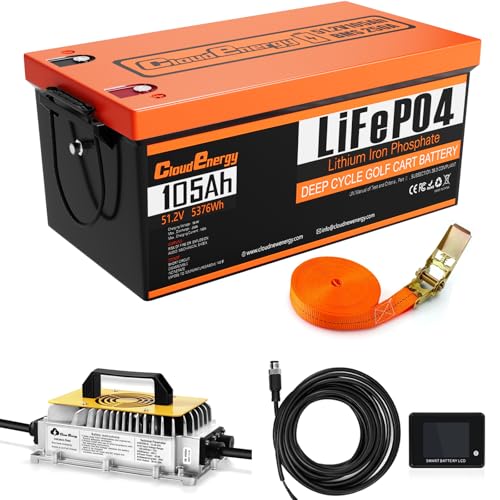
Cloudenergy 48V 105Ah LiFePO4 Golf Cart Battery

Mosasaur 48V 100Ah LiFePO4 Golf Cart Battery

HumsiENK 48V 100Ah Lithium Golf Cart Battery

OGRPHY 48V 105Ah Lithium Golf Cart Battery

Mehrpow 48V 100Ah Lithium Golf Cart Battery Kit

HumsiENK 48V 150Ah Extended Range Battery
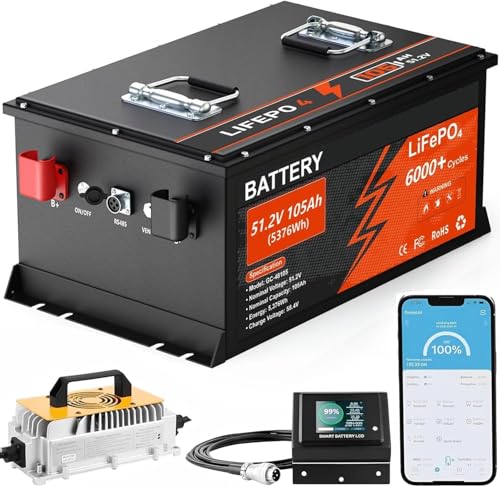
KEZIMO 48V 105AH Metal Case Lithium Battery

OGRPHY 48V 105AH Lithium Golf Cart Battery

OGRPHY 48V 100Ah Onboard Charger Battery

HumsiENK 48V 100Ah Metal Casing Battery
The Details Behind The Selections
Daily cart commuters who plug in at night and head out at dawn will appreciate how this Cloudenergy pack combines a 105Ah capacity with the charger already in the box. A built-in 250A BMS (battery management system, an electronic circuit that protects cells from overcharge, over-discharge, and shorts) keeps the cells balanced while the touch monitor gives you SOC (state of charge), voltage, and current without pulling out a multimeter. For a homeowner with a 4-passenger cart that sees 18 to 25 miles on a typical weekend loop, that’s the right amount of overhead.
The Bluetooth mobile app rounds out the package, so you can spot a sleeping cell from the kitchen instead of cracking open the seat well. Owners with a mix of paved paths and grass fairways report steady voltage under load, and the included retention strap cuts a small but real annoyance when reinstalling the battery hold-down.
Useful Strengths
- 250A BMS handles sustained hill climbs without voltage sag.
- Touch monitor plus mobile app give you redundant readouts.
- Charger ships in the box, no extra accessory hunt.
- Retention strap included, saves a trip to the hardware store.
Trade Offs
- Heavier than a 100Ah unit, expect a two-person lift on install day.
- App pairing occasionally drops after firmware updates, worth checking before a long ride.
Feature Snapshot
Made For
Regular cart commuters who want phone-level visibility and a charger included out of the box.
Look Elsewhere When
The HumsiENK 48V 150Ah Extended Range Battery suits owners who tow campers or run lifted carts that need far more usable energy per charge.
Anyone pulling a group-27 lead-acid case off the shelf will recognize the Mosasaur footprint on sight, and that is the whole point. At roughly 77 lb it weighs about half of a comparable flooded pack, which matters the first time you slide it into a basement storage bay. The compact 20.55 by 10.55 by 8.74 in case slots into existing trays with minimal fabrication.
RVers and small-boat owners with limited compartment space benefit most from the cut-down dimensions, and the included 18A charger means you can park the trailer and top up overnight. Compared to the Cloudenergy unit above, this one trades some peak capacity for a lighter, narrower build that handles tight battery boxes.
Standout Benefits
- Lead-acid case dimensions simplify drop-in replacement.
- 77 lb total makes solo installation realistic for most adults.
- Built-in 200A BMS supports typical golf cart motor controllers.
- Bluetooth app and LCD touch screen give dual monitoring paths.
Points To Note
- 100Ah may feel short for lifted carts, plan around 18 to 22 miles per charge.
- Documentation is lean, so budget a weekend for first-time setup.
Right Fit For
RV and marine owners looking for a lighter lithium swap that fits where lead-acid used to sit.
Skip It When
Drivers running 6-passenger carts with steep hills should reach for the HumsiENK 48V 150Ah Extended Range Battery, which carries the extra energy.
EZGO, Club Car, and Yamaha owners running the common 4x12V or 6x8V lead-acid setup will find this HumsiENK unit is sized to fit those bays without modification. The 90 lb weight still beats a full set of flooded batteries, and the IP65-rated aluminum-shell charger shrugs off the kind of splashing that ends up on a parked cart after a storm rolls through.
Where the Mosasaur above goes lighter, this HumsiENK leans into durability. Owners who store carts outdoors or wash them down at the end of a round benefit from the sealed aluminum housing around the charger electronics.
Where It Excels
- IP65 waterproof 58.4V aluminum-shell charger for outdoor storage.
- 23.35 x 10.47 x 8.54 in case aligns with standard lead-acid trays.
- Direct fitment across EZGO, Club Car, and Yamaha platforms.
- 90 lb keeps installation manageable without specialized lifting.
Honest Caveats
- 100Ah capacity is the floor for full-course outings, plan charging stops for back-to-back rounds.
- Charger cable is on the shorter side for carts parked far from the outlet.
Who It Suits Best
Cart owners on the three major brands who wash their equipment regularly and want a sealed charger that survives splashes.
A Better Fit Elsewhere
People running lifted carts with bigger tires and added weight should consider the HumsiENK 48V 150Ah Extended Range Battery for the extra range headroom.
Hill-heavy courses and trolling setups ask a lot of a battery in short bursts, and that is where the OGRPHY 105Ah pack earns its keep. The 200A BMS holds 10.24kW sustained output, while the 1000A (3 to 5 second) peak handles the surge when a cart climbs a 15-percent grade with four adults aboard. Grade A prismatic cells (rigid, rectangular lithium cells that handle heat well and resist swelling) anchor the build.
Trollers running against current for an afternoon benefit from the same surge capacity. Where the Cloudenergy above leans on monitoring extras, this one focuses raw output for high-load work.
Features That Help
- 1000A peak handles loaded climbs without throttling.
- 200A continuous discharge for high-draw motor controllers.
- Touch LCD monitor tracks SOC, voltage, and current at a glance.
- 18A charger included for overnight top-ups.
Small Limitations
- Heavier than lighter 100Ah picks, plan for two-handed install.
- Peak current spec is short-burst only, sustained draws still cap at 200A.
Best Suited To
Hilly course riders and trolling motor users who need real surge headroom for climbs and current.
Reach For A Different Pick When
Flat-terrain commuters chasing a lighter weight profile will do better with the Mosasaur 48V 100Ah, which trims pounds without giving up the BMS.
Fleet operators and rental-cart owners cycle batteries harder than anyone, and the Mehrpow kit leans into that reality. The deep-cycle rating tops 10,000 cycles at 80 percent depth of discharge (DoD, the percentage of total capacity drawn down before recharging), which puts it well above the 4,000 to 6,000 cycle packs elsewhere in this list. Sixteen EVE grade A cells with UL certification (Underwriters Laboratories, a third-party safety testing organization) make up the core.
The plug-and-play format matters when downtime costs money. A swap that would normally eat a Saturday finishes in an afternoon, since the wiring is preconfigured. Unlike the OGRPHY unit above, the focus here is cycle longevity rather than peak surge.
What Pays Off
- 10,000+ cycle rating at 80 percent DoD suits daily-use carts.
- Plug-and-play install skips custom wiring.
- UL-certified grade A cells anchor the safety claim.
- Solid choice for rental and fleet operators.
Things To Consider
- Higher cycle count usually pairs with a heavier case, plan the lift.
- Non-returnable shipping due to hazmat rules, inspect on delivery.
- Spec sheet is leaner than competitors, confirm dimensions before ordering.
Perfect Match For
Daily-use fleet or rental carts that rack up cycles faster than the average weekend rider.
Where Another Pick Suits Better
Weekend leisure users who rarely discharge below 50 percent will find the Cloudenergy 48V 105Ah pack delivers more monitoring convenience for the same money.
Lifted carts with oversize tires drain a standard pack quickly, and the HumsiENK 150Ah answers with 7.68kWh of usable energy. Six-passenger vehicles and heavy off-road buggies can stretch 60 to 80 miles on a single charge, which matters when the cart doubles as a neighborhood hauler. The same HumsiENK name as the 100Ah option above, but built around a fundamentally bigger energy reserve.
Compared to the Mehrpow kit, this HumsiENK trades cycle depth for raw capacity. You get fewer total cycles before noticeable degradation, but far more runtime per cycle.
A Strong Showing
- 7.68kWh total capacity for lifted and 6-seat carts.
- 60 to 80 mile range covers multi-day trips between charges.
- Built for power-hungry off-road buggies.
- Reduces range anxiety for neighborhood patrol routes.
Room For Improvement
- Larger footprint may not fit standard lead-acid trays without modification.
- Higher price-per-kWh than smaller packs, weigh against usage.
- Heavier overall, install with a second pair of hands.
Whose Shelf It Belongs On
Lifted 6-passenger cart owners and off-road buggy builders who need range far beyond a standard 100Ah pack.
Not Your Match When
Standard 2-passenger cart commuters will overspend on capacity they rarely tap, and the Cloudenergy 48V 105Ah pack covers those miles for less.
Farm and trail carts see more vibration than pavement-only setups, and the KEZIMO pack wraps its 16 A-grade LiFePO4 cells in a metal case rather than the plastic shells common elsewhere. That detail matters when a cart crosses washboard gravel at 12 mph for an hour. Continuous 200A discharge supports hill work, with peak output rated to 10.24kW.
The bundled 58.4V 18A charger covers overnight top-ups at standard outlets. Where the OGRPHY 105Ah unit above focuses on peak surge, this KEZIMO leans into physical durability for off-pavement use.
Where It Delivers
- Metal case handles vibration on rough trails.
- 10.24kW peak supports startup and climb surges.
- LCD touch monitor plus mobile app for redundancy.
- 58.4V 18A charger included.
Factors To Consider
- Metal case adds weight versus plastic-housed packs.
- 6,000+ cycle rating sits in the middle of the pack, not the top.
Who Should Grab It
Farm, ranch, and trail cart owners who care more about case rigidity than shaving the last few pounds.
Swap It Out When
Cycle-count-focused fleet operators should reach for the Mehrpow 48V 100Ah kit, which tops 10,000 cycles at 80 percent DoD.
Solar-bank owners who also run a cart will appreciate the OGRPHY 105AH second entry, which pairs a 200A BMS with both a touch monitor and a mobile app for double-checking state of charge. Grade A prismatic LiFePO4 cells anchor the pack, and the 4000+ cycle rating suits daily-solar-cycling rigs. Max 10.24kW continuous output handles typical motor controllers, with up to 51.2kW peak when a surge hits.
Compared to the OGRPHY 105Ah performance pick above, this sibling trims the peak current rating for a friendlier cycle life and lower price.
The Helpful Details
- Dual monitoring via touch panel and Bluetooth app.
- Compatible with major golf cart controllers on the market.
- UL-certified grade A prismatic LiFePO4 cells.
- Energy equivalent to roughly eight 12V 100Ah lead-acid units.
Worth Bearing In Mind
- 1000A peak is shorter-burst than the heavier OGRPHY sibling pick.
- 4000+ cycle rating sits below the Mehrpow kit for cycle depth.
Built With In Mind
Solar-plus-cart owners who want app-level visibility into pack health across both uses.
Consider Something Else When
Heavy cycle-depth fleet users should consider the Mehrpow 48V 100Ah kit, which posts the strongest cycle rating in this list.
Garage owners who hate dragging a separate charger out of a closet will like the onboard 18A LiFePO4 charger built into this OGRPHY 100Ah pack. You park the cart, plug a standard cord into the cart’s charge port, and the rest happens under the seat. The 200A BMS delivers 10.24kW continuous with 1000A peak for surges, and the 5.12kWh capacity handles typical 18-hole outings.
Same OGRPHY family as the 105AH sibling above, but the convenience angle is the onboard charger rather than extra monitoring. For most daily drivers, that tradeoff makes sense.
What Works In Its Favor
- Onboard 18A charger removes the separate brick.
- 1000A peak for heavy-loaded climbs.
- 5.12kWh capacity suits 18-hole days.
- Plug-and-play install for common carts.
Some Limits To Know
- Onboard charger adds a small weight penalty.
- Service access is tighter than packs with external chargers.
Who Will Love This
Daily cart drivers who park in a garage and want one cord, not two, to keep the pack topped up.
Another Choice May Suit
Owners who already own a quality external 48V charger will get more flexibility from the HumsiENK 48V 100Ah, which ships without an onboard unit.
Loaded 4-seater carts on hilly terrain put real stress on a battery, and the HumsiENK 100Ah Metal Casing pack is built around that scenario. The 200A smart BMS delivers 10.24kW continuous with a 700A peak burst for one second, which is the kind of muscle a 4-seater cart needs when it climbs a steep incline with four adults. The metal casing also adds a layer of physical protection on rough paths.
Compared to the KEZIMO above, this HumsiENK focuses on short-burst peak power rather than the steady 200A draw. For homeowners running loaded family carts, that profile fits how the cart actually gets used.
Strengths Worth Knowing
- 700A peak burst handles steep, loaded climbs.
- Metal casing for vibration and minor impact protection.
- 10.24kW continuous for typical motor controllers.
- Smart BMS for cell balancing and longevity.
Practical Considerations
- 100Ah base capacity may run short on extended back-to-back outings.
- Metal casing adds a few pounds versus plastic-housed packs.
The Right Fit
Loaded 4-seater cart owners on hilly properties who want a tougher case and strong peak bursts.
Where A Sibling Pick Shines
Riders chasing maximum range rather than peak muscle will appreciate the HumsiENK 48V 150Ah Extended Range Battery, which doubles down on capacity.
Picking a Pack That Fits Your Cart and Your Routine
Capacity and BMS rating drive most of the value here, but the surrounding details decide whether a pack feels right at home. Start with the battery’s footprint versus your existing tray, then look at the BMS continuous and peak ratings against your motor controller’s draw. Cycle rating matters when you cycle the pack daily, and matters less when it sits at partial charge between weekend rides.
Charger choice is the easiest detail to underestimate. An 18A charger fills a 100Ah pack in roughly five to six hours from empty, which works for overnight charging on a cart that pulls out once a day. Solar-bank owners running partial cycles throughout the day can usually accept a slower charger, since the pack refills gradually. Skip the temptation to over-buy capacity for a flat-terrain cart, because a heavier 150Ah pack can shorten range in some setups by adding drag on the motor.
Monitor placement matters more than it sounds. A touch monitor at the dash lets you check SOC before leaving the garage, while a Bluetooth app is handier for owners who store carts in a shed away from the house. Packs that offer both, like several on this list, simply remove the guesswork. Finally, confirm the warranty registration process before clicking buy, since hazmat shipping rules complicate returns on lithium packs if something arrives damaged.
Key Considerations Across These Picks
Pitfalls Shoppers Hit
The most common mistake is matching voltage without checking the BMS continuous rating. A 48V pack with a 100A BMS will throttle the moment a high-draw controller asks for more, leaving you parked halfway up a hill. Equally common, shoppers ignore the case dimensions and end up with a pack that needs fabrication to fit a stock tray. Always measure the battery box, including hold-down clearance, before ordering.
Why Top Tier Costs More
Higher-tier models in this category earn their premium through grade A cells, larger BMS headroom, and better monitoring. You are paying for cells that hold their capacity longer, a BMS that survives surge events without tripping, and housings that handle real vibration. For a weekend cart, a mid-range pack is plenty. For a daily-use fleet or a lifted off-road rig, the upgrade typically pays for itself in fewer replacements and fewer mid-ride BMS cutouts.