Swapping a heavy bank of lead-acid batteries for a single lithium pack changes how a golf cart feels under your foot. The car gets lighter, the charger works faster, and the maintenance schedule essentially disappears. The catch shows up in the buying process: every conversion kit claims the same cycle life, the same Bluetooth app, the same drop-in fit, and the differences between them actually matter for how your cart performs on hills, in cold weather, and after two or three seasons of weekend use. The list below sorts through nine current kits so you can match capacity, BMS amperage, and monitoring features to the way you actually drive.
A Fast Comparison Of The Options
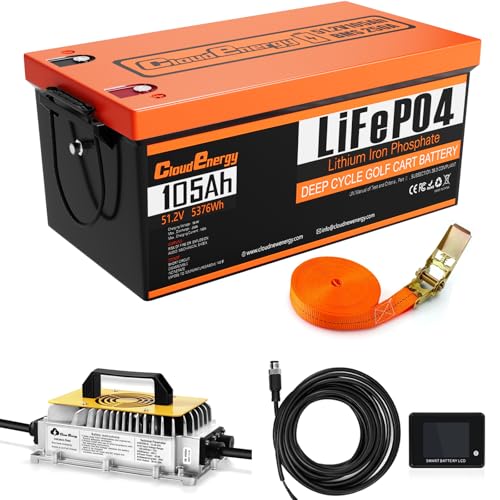
Cloudenergy 48V 105Ah LiFePO4 Lithium Golf Cart Battery 250A BMS

DC HOUSE 48V 100Ah Lithium Golf Cart Battery 200A BMS

TEMGO 48V 100Ah LiFePO4 Lithium Golf Cart Battery 200A BMS

LOSSIGY 48V Lithium Golf Cart Conversion Kit

Mehrpow 48V Lithium Golf Cart Batteries Kit

KEZIMO 48V 105Ah Lithium Battery for Golf Cart 200A BMS

DC HOUSE Metal Case 48V 100Ah Lithium Golf Cart Battery Kit

DC HOUSE 48V 50Ah Mini Lithium Golf Cart Battery Kit

LOSSIGY 48V 100Ah Deep Cycle Lithium Conversion Kit
Meet The Standout Selections
The Cloudenergy pack lands at the top of the list because it pairs a generous 105Ah capacity with a 250A BMS (battery management system, the circuit board that protects cells from overcharge, deep discharge, and shorts), giving it more headroom than most 200A alternatives when the cart climbs a steep ramp or hauls four passengers up a hill. In real-world terms, that extra 50 amps of BMS capacity shows up as smoother voltage under heavy load rather than a sudden sag that bogs the motor down.
The bundle includes a touch monitor and a mobile app, plus a retention strap, so the install feels closer to plug-and-play than to a rewiring project. Compared to the DC HOUSE 100Ah kit covered next, this one trades a little compactness for noticeably more amp-hour reserve, which matters if your weekend loop involves more than a quick nine holes.
Good Reasons To Consider
- 250A BMS supports heavier loads than most 200A units in this list
- 105Ah capacity translates to longer range between charges
- Touch monitor plus mobile app gives two ways to check state of charge
- Retention strap included so the pack stays seated over rough ground
- Drop-in form factor replaces a multi-battery lead-acid bank directly
Things To Consider
- Heavier than the 50Ah DC HOUSE mini pack, so payload and lift access matter
- App connectivity depends on Bluetooth range, which can drop behind metal cart bodies
Feature Snapshot
Built With In Mind
Daily cart users in larger communities who regularly drive four-passenger loads across hilly ground will benefit most from the higher BMS ceiling and longer range.
A Better Fit Elsewhere
Cart owners who only putt around a flat neighborhood on weekends may find the DC HOUSE 48V 50Ah Mini kit covers their shorter routes without the extra weight.
DC HOUSE keeps the formula simple: 100Ah of usable capacity, a 200A BMS, and a direct-replacement form factor that swaps out a string of 6V or 8V lead-acid batteries in one motion. That simplicity is exactly why this kit appeals to anyone performing their first lithium conversion and wanting the wiring to stay close to stock.
You lose the touchscreen monitor and app you get on the Cloudenergy and TEMGO kits, but the basic state-of-charge readout that most carts already have through their existing gauge still works. For most backyard owners who just want lighter weight and faster charging without learning a new app, this strip-down approach lands well.
Points In Its Favor
- Straightforward drop-in install that mirrors stock battery dimensions
- 200A BMS handles typical cart motors without strain
- Removes the heavy lead-acid bank in a single swap
- Cell-level protection against overcharge, deep discharge, and short circuits
Trade Offs
- No bundled monitor or app, so visibility into individual cell health is limited
- 200A ceiling may feel tight if you regularly haul four adults up steep grades
Whose Shelf It Belongs On
First-time converters on flat-terrain courses who want the lightest possible install without paying for features they will not check daily.
Swap It Out When
Households where the cart climbs steep driveways every trip will benefit more from the Cloudenergy 48V 105Ah pack and its 250A BMS ceiling.
TEMGO leans into the connected side of the lithium conversion market, packing a 2.8-inch LCD touch display, a Bluetooth app, and a 200A smart BMS into a 100Ah pack. The headline output figure of 10.24kW matches the KEZIMO 105Ah kit further down the list, so the difference comes down to monitoring interface and bundled accessories rather than raw capacity.
The kit includes the charger, the retention strap, and the monitor, so you are not sourcing extra parts to finish the install. For owners who actually want to watch individual cell voltages, fault history, and real-time current draw, the LCD plus app combination earns its place over the bare-bones 100Ah option from DC HOUSE.
What Stands Out
- 2.8-inch LCD touch display gives immediate readout without pulling out a phone
- Bluetooth app allows remote monitoring from the cart seat or garage
- 10.24kW peak output matches higher-capacity competitors
- Charger, strap, and monitor all included in the kit
Worth Noting
- At 100Ah it has slightly less range than the Cloudenergy 105Ah
- Touchscreen adds a small parasitic draw that needs occasional full recharges to recalibrate
Feature Snapshot
Made For
Tech-curious cart owners who like to see the numbers behind their vehicle and want a touchscreen dashboard upgrade at the same time as the battery swap.
Skip It When
Minimalist owners who would never open the app may prefer the stripped-down DC HOUSE 48V 100Ah kit and save the touchscreen budget.
The LOSSIGY kit earns its slot mostly because the listing offers both 100Ah and 150Ah capacity options under one product page, so a shopper weighing different range needs can compare without bouncing between listings. Each variant ships with a charger and monitor, and the cells are described as auto-grade A-grade LiFePO4 chemistry with a built-in BMS that protects against temperature extremes, short circuits, and over-current events.
The 100Ah variant sits close to the DC HOUSE kit in daily behavior, while the 150Ah option pushes into Cloudenergy territory for range. The trade-off appears in the BMS class: owners who push the cart hard may want to size up before committing.
The Case For It
- Two capacity options cover both short and long-range use
- BMS guards against high and low temperature extremes
- Charger and monitor included in both capacity tiers
Room For Improvement
- Cell brand and peak current are not specified, limiting comparison to others on the list
- Capacity choice forces a decision before install that cannot easily be reversed
Right Fit For
Cart owners undecided between 100Ah and 150Ah who appreciate seeing both capacity tiers with the same charger and monitor package.
Consider Something Else When
Anyone who already knows they want maximum range should jump straight to the Cloudenergy 48V 105Ah pack, which lists a higher BMS rating.
Mehrpow takes a long-life angle, advertising a cycle count above 10,000 deep cycles at 80% depth of discharge, paired with a 2C discharge rate that supports heavier momentary draws. The pack uses EVE-brand cells with UL certification on the cell level, which is the kind of detail that matters when a battery will sit under your cart seat for the better part of a decade.
The install stays simple with one-time wiring, plug-and-play connectors, and no requirement to change your cart’s controller. That ease matters because most home conversions happen on a Saturday morning with basic hand tools, and a kit that needs extra adapters or relay changes tends to stall halfway through.
Practical Advantages
- High claimed cycle count appeals to multi-season daily users
- 2C cells handle short bursts of high current without sag
- Plug-and-play install avoids rewiring the stock cart harness
- Cell-level UL certification adds a paper trail for safety review
Honest Caveats
- Listing lacks a touchscreen or Bluetooth module, so monitoring relies on the cart’s stock gauge
- Hazardous-materials shipping may slow delivery compared to standard lithium packs
Feature Snapshot
Best Suited To
Owners who plan to keep their cart for many seasons and want a battery rated for years of frequent charge cycles rather than weekend-only use.
Reach For A Different Pick When
Someone wanting Bluetooth cell-level monitoring should consider the TEMGO kit, which bundles an LCD screen and an app.
KEZIMO matches the 105Ah capacity of the Cloudenergy pack but tops the chart for claimed output, advertising a 10.24kW ceiling that runs roughly 50% higher than smaller-capacity alternatives. In practice, that extra headroom translates to firmer acceleration on grass inclines and steadier speed when the cart is fully loaded with passengers and gear.
The touch monitor and mobile app mirror what you get from TEMGO, so the kit leans toward owners who treat the cart like a small EV rather than a simple utility vehicle. Where it differs from Cloudenergy is the BMS ceiling at 200A versus 250A, so very heavy loads still favor the Cloudenergy pack.
Positive Takeaways
- 10.24kW maximum output for confident hill performance
- 105Ah capacity matches the longest-range kits on this list
- Touch monitor and app for at-a-glance state of charge
- Low self-discharge keeps the cart ready between weekends
Points To Note
- 200A BMS is lower than the 250A Cloudenergy ceiling under sustained load
- App updates depend on manufacturer support, which can lag behind phone OS upgrades
Who Will Love This
Cart owners in hill-heavy neighborhoods who want extra acceleration headroom and like checking battery stats from their phone.
Not Your Match When
Someone regularly towing a heavy utility trailer behind the cart should consider the Cloudenergy 48V 105Ah pack with its higher BMS ceiling.
Most lithium golf cart batteries ship in a soft-sided or plastic enclosure, so the metal-case version from DC HOUSE stands apart for owners who treat their cart like a farm or ranch vehicle. The reinforced shell protects the cells from branch strikes, tossed tools, and the kind of incidental abuse a work cart absorbs over a season.
On the electronics side, the kit keeps the same 100Ah LiFePO4 chemistry, 200A BMS, Bluetooth app, and LCD monitor that the other DC HOUSE model includes. The difference is durability of the housing, not capacity. Peak current is listed at 670A, which gives brief bursts during motor starts a bit more room than the standard DC HOUSE kit.
The Good Stuff
- Metal enclosure resists impacts better than typical plastic battery cases
- 670A peak current gives confident motor starts under load
- Bluetooth app and LCD monitor included
- 18A charger shortens turnaround between outings
Some Limits To Know
- Metal case adds a few pounds compared to the standard DC HOUSE kit
- Same 200A BMS ceiling as the lighter sibling, so very heavy sustained loads still favor higher-rated packs
Feature Snapshot
Perfect Match For
Ranch, farm, or off-road cart owners who want extra impact protection for the battery without sacrificing the connected monitoring features.
Where A Sibling Pick Shines
Owners running only paved paths may find the lighter DC HOUSE 48V 100Ah non-metal kit easier to lift during seasonal swaps.
The 50Ah Mini kit exists for a specific kind of cart owner: someone with a short, flat loop, a small-frame neighborhood cart, or a secondary vehicle that only needs to cover a few miles at a time. At half the capacity of the larger DC HOUSE kit, the pack drops a meaningful amount of weight and slides into carts where space under the seat is tight.
The trade is range. Two short trips and a charging session are realistic for a single pack, while a 100Ah or 105Ah unit handles a full day. Pair that with the kit’s compatibility across golf carts, lawnmowers, RVs, trolling motors, and off-grid setups, and you start to see the use case: a lightweight lithium module for vehicles that do not need deep daily cycling.
A Few Highlights
- Compact footprint fits carts and other 48V gear that larger packs cannot
- Substantially lighter than full-capacity lithium conversion kits
- Works across golf carts, lawnmowers, RVs, and trolling motors
- Stackable design helps when space is the limiting factor
Less Ideal Details
- 50Ah limits usable range to short neighborhood trips
- Lower capacity means heavier accessories or steep hills may drain the pack mid-route
Who Should Grab It
Owners of small carts, side-by-side runabouts, or compact utility vehicles where space and weight matter more than maximum range.
Look Elsewhere When
Anyone driving a full-size golf cart on a full 18-hole course should step up to the Cloudenergy 48V 105Ah kit for the extra capacity.
This LOSSIGY variant targets buyers who plan to move the same pack between a golf cart, an RV, or a small solar setup. At 5.12kWh of stored energy and a 1000A peak current rating for short 3-5 second bursts, it has enough headroom for inverter loads that smaller lithium modules struggle with.
The Bluetooth BMS ties into your phone for monitoring, and the deep-cycle LiFePO4 chemistry is rated for at least 4000 cycles, which lines up with multi-year solar storage use as much as it does weekend cart duty. The honest read is that this is a crossover product, and it shines brightest when you genuinely plan to use it in more than one vehicle.
A Few Strong Suits
- 1000A peak current handles short inverter or motor-start surges
- 5.12kWh capacity covers modest off-grid solar loads
- Bluetooth BMS exposes cell data on a phone
- Works in solar, RV, and golf cart setups
Practical Considerations
- Multi-use design means fewer cart-specific touches like a touch monitor
- Moving the heavy pack between vehicles requires planning for lift and storage
Feature Snapshot
The Right Fit
Owners with a cart, an RV, or a small off-grid solar array who want one lithium pack that can serve more than one system over its lifespan.
Consider Something Else When
Cart-only owners will get more cart-specific features, like the touch monitor on the Cloudenergy kit, by staying with a dedicated conversion battery.
What Matters Most Before Choosing 48v Golf Cart Lithium Battery Conversion Kits
Capacity versus range. Ah (amp-hours) describes how much energy the battery holds, and a 100Ah pack roughly delivers twice the runtime of a 50Ah pack under the same load. Match the capacity to the route, not to the wish list, because doubling the Ah also doubles the weight and the price.
BMS amperage. The BMS rating, usually listed as 100A, 200A, or 250A, sets the ceiling on continuous current draw. Higher numbers give firmer acceleration on hills and with heavy passenger loads, while a lower ceiling is fine for flat, lightly loaded carts.
Monitoring extras. Some kits bundle an LCD touch monitor and a Bluetooth app, while others rely on the cart’s existing gauge. Monitoring costs add to the price but make it easier to spot cell imbalance before it becomes a problem.
Physical fit. Lead-acid batteries stack in a tray, and the lithium replacement must match the tray dimensions, terminal layout, and voltage of the original bank. Most drop-in kits handle this directly, but very small carts may need the 50Ah mini footprint.
Charging hardware. A bundled lithium-compatible charger matters because lead-acid chargers can overcharge lithium cells if left connected past full. Bundled chargers eliminate that risk from day one.
Smart Choices For Lithium Conversion Shoppers
Mistakes Worth Dodging
Buying by cycle count alone. A 10,000-cycle rating assumes proper depth-of-discharge discipline, not a guarantee. Charging before the pack drops below 20% and avoiding storage in extreme heat matters more than the headline cycle number.
Ignoring the BMS ceiling. Under-specced BMS systems trip during heavy acceleration or long hill climbs, which leaves you stranded mid-route. Match the BMS amperage to your cart’s motor and your typical load.
Forgetting about the charger. A leftover lead-acid charger connected to a lithium pack can push voltage past the safe ceiling. Plan to use the bundled lithium charger from day one or buy a compatible unit separately.
When Paying More Pays Off
Higher-tier kits justify their cost in three places: a larger BMS ceiling for hilly or heavy-load use, bundled monitoring that catches cell imbalance early, and metal enclosures or reinforced BMS hardware for work-cart conditions. For weekend putters on flat ground, the price gap rarely translates to extra capability you would notice, but for daily drivers or work carts, the upgrade usually pays back through longer service life and fewer roadside issues.
Frequently Asked Questions
How long does a 48V lithium golf cart battery usually last?
Most LiFePO4 packs in this category are rated for at least 4000 cycles, and some advertise higher. In a typical weekend-use scenario, that translates to roughly ten years before noticeable capacity loss.
Do I need to change my cart’s charger when switching to lithium?
Yes. Lead-acid chargers can push voltage past the lithium safe ceiling. The kits on this list bundle a compatible lithium charger, so you can use what arrives in the box.
Can I install a lithium conversion kit without rewiring the cart?
Most drop-in kits on this list use the same wiring footprint as the original lead-acid bank. Owners typically remove the old batteries, drop the lithium pack into the tray, reconnect the existing terminals, and secure the retention strap.
Will cold weather affect lithium golf cart batteries?
LiFePO4 cells lose usable capacity below freezing and charge more slowly in very cold conditions. Owners in northern climates commonly store the cart in a heated garage overnight during deep winter.
Are lithium golf cart batteries safe to leave on the charger?
The bundled chargers in this category shut off or drop to a maintenance stage when the pack reaches full charge, so leaving the cart plugged in for a day or two is generally safe. Owners commonly avoid leaving any lithium pack plugged in for weeks at a time as a precaution.
The Takeaway
The right conversion kit depends less on which brand advertises the most cycles and more on how you actually drive your cart, where you store it, and whether you want phone-level visibility into cell health. Match the Ah to the loop, match the BMS to the load, and confirm the kit ships with a lithium-compatible charger before pulling the trigger on the swap.