A 36V system quietly runs a surprising slice of life, from golf carts rolling down fairway paths to neighborhood runabouts, forklifts in light commercial settings, and small solar banks on off-grid cabins. The charger matters more than people think. It decides how fast you get back on the road, how long your batteries last, and whether your pack quietly loses capacity over time.
This roundup covers the practical range: lithium-focused onboard units, rugged lead-acid workhorses for golf carts, and a small-mobility option for Razor-style scooters. Every pick here was chosen for a specific use case, with honest trade-offs included.
The Leading Options At A Glance

FORM 36V Lithium LiFePO4 Battery Charger for Golf Carts
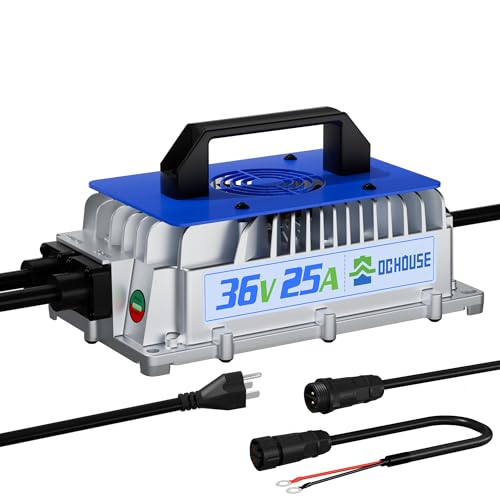
DC HOUSE 36V 25A Lithium Battery Charger

EPOWREY 25AMP Lithium Battery Charger for 36 Volt LiFePO4

FORM 36 Volt Golf Cart Charger for EZGO TXT

FORM 36 Volt Onboard Golf Cart Battery Charger

FORM 36 Volt Charger for EZGO Marathon (SB-50)

FORM 36 Volt Charger for Club Car, EZGO & Yamaha

MODZ Max36 15 AMP EZGO Marathon Battery Charger

Battery Charger for Razor Dirt Rocket MX500/MX650
36 Volt 20 Amp Golf Carts Charger for EZGO & Yamaha
Meet The Standout Selections
The first item on the list is a purpose-built LiFePO4 charger, not a lead-acid unit dressed up for lithium. It delivers 18A through ring terminals, and the onboard design lets you bolt it to the cart instead of treating it like a garage accessory.
If you’ve upgraded a Club Car, EZGO, or Yamaha to a 38.4V lithium pack, this one matches that chemistry directly. Compared to the FORM lead-acid picks later in this list, it skips the universal plug dance in favor of cleaner wiring.
Where It Excels
- LiFePO4-specific charge profile protects long-term battery health
- Onboard mounting with ring terminals keeps cabling tidy
- Maintains a fraction of the weight of typical OEM units
- Set-and-forget maintenance mode extends pack longevity
Worth Noting
- Not a fit for older 36V lead-acid carts still running flooded cells
- Ring-terminal install is more involved than a plug-and-play model
Key Advantages
Right Fit For
Golf cart owners who’ve moved to LiFePO4 chemistry and want a charger that speaks the battery’s language from day one.
Look Elsewhere When
You still run flooded lead-acid batteries; the FORM lead-acid Crowfoot unit is a more honest match there.
DC HOUSE pushes higher current at 25A, which shortens the wait if you run a sizeable lithium bank. The IP65 rating (an international dust and water-jet protection standard) makes it a real candidate for outdoor enclosures, shed walls, or mobile solar trailers.
Where the FORM onboard unit targets clean cart installs, this one fits the broader “battery on a shelf” crowd. It also has a 0V wake-up function for packs that have dropped below normal resting voltage, which can save a brick that looks dead but isn’t.
Bright Spots
- 25A output trims charging time on larger 36V packs
- 0V activation can recover deeply discharged lithium cells
- Operates from 100V to 240VAC input for flexible power sources
Trade Offs
- No plug-and-play connector, so wiring is on you
- Not lead-acid compatible, so it’s a one-chemistry tool
Made For
Off-grid lithium banks and workshop setups where faster turnaround and weather sealing outweigh convenience features.
Swap It Out When
You want a tidy cart-mounted install; the FORM 36V Lithium LiFePO4 charger with ring terminals is the cleaner route.
EPOWREY pitches its 25A charger at the broadest audience on this list. It claims compatibility with golf carts, RVs, marine use, electric outboards, forklifts, and home solar, which makes it a “one charger, many packs” tool.
Compared to the DC HOUSE model above, the EPOWREY leans on the same current class but markets harder to vehicle owners. Ring terminals simplify onboard mounting on carts and trailers.
What Works In Its Favor
- 25A output handles large packs without long overnight waits
- Broad compatibility covers carts, boats, RVs, and solar banks
- Ring terminals lend themselves to permanent onboard installs
- Targets a 12-string LiFePO4 configuration for full 36V systems
Honest Caveats
- Marketing covers a wide range, so verify connector and chemistry match before buying
- Outdoor durability claims aren’t spelled out the way the FORM and HTAXSCC units spell them out
Feature Snapshot
Best Suited To
Multi-vehicle households juggling lithium setups across carts, boats, and trailers who want a single charger on the bench.
Another Choice May Suit
Hardcore off-grid users may prefer the DC HOUSE 25A charger’s 0V wake-up for recovery scenarios.
This FORM unit speaks the EZGO TXT dialect with the Powerwise D-style plug. The WeatherShield internal coating plus IP67 casing (IP67 means dust-tight and submersible up to one meter for short periods) makes it forgiving when the cart sits outside through shoulder seasons.
Notice it accepts lead-acid, AGM, LiFePO4, and lithium batteries, so a single charger covers owners who haven’t committed to one chemistry. That flexibility is rare in this niche.
Key Advantages
- IP67 waterproof rating with internal WeatherShield coating
- Battery sensing technology adapts to lead-acid, AGM, and lithium chemistries
- Automatic maintenance mode kicks in once the pack tops up
- Drastically lighter than the OEM EZGO charger it replaces
Soft Spots
- Plugged specifically for the D-style TXT socket, so it won’t help a Marathon owner
- Single-cart focus, not a multi-vehicle tool
Perfect Match For
EZGO TXT owners in damp climates who store carts outside and want one charger that handles today’s battery and tomorrow’s upgrade.
Reach For A Different Pick When
You run an EZGO Marathon with an Anderson SB-50 plug; the FORM SB-50 charger fits that port directly.
Where the FORM TXT charger above is plug-specific, this onboard model goes the other direction with ring terminals. It mounts directly to the cart and fits custom builds, retrofits, and non-OEM configurations.
It also covers lead-acid, AGM, lithium, and LiFePO4 chemistries, which makes it a workshop favorite when you don’t know what walk-in cart will need power.
Why It Works Well
- Ring terminals for permanent onboard mounting
- Chemistry-agnostic design suits mixed fleet needs
- Lightweight compared to the OEM units it replaces
Points To Keep In Mind
- Wiring install is more involved than a plug-in model
- No weather-sealed plug means routing matters for outdoor carts
Feature Rundown
Whose Shelf It Belongs On
Cart builders and small-shop techs who want one onboard charger to keep reaching for across varied customer setups.
Where Another Pick Suits Better
Stock EZGO TXT owners should pick the FORM D-Style Plug charger instead for direct socket compatibility.
This is FORM’s answer for the Anderson SB-50 socket found on EZGO Marathon carts. The 16ft power cable is the headline feature for anyone whose outlet sits far from the parking spot, removing the need for an extension cord.
It also handles lead-acid, LiFePO4, and lithium packs, so a single charger covers pre- and post-upgrade Marathon carts.
Notable Gains
- Extended 16ft cables for awkward garage or carport layouts
- Multi-chemistry support from lead-acid through LiFePO4
- Anderson SB-50 plug fits older Marathon carts without adapters
Where It Is Less Suited
- Plug is Marathon-specific, so it won’t help non-Marathon carts
- Charging current is moderate, not the fastest option in this list
Who Should Grab It
EZGO Marathon owners whose garage outlet sits far from the cart, eliminating extension-cord hassle.
Consider Something Else When
You need faster turnaround; the HTAXSCC 20A Crowfoot charger pulls harder off the same socket.
The Crowfoot plug on this FORM unit is the most broadly compatible connector in the golf cart world. If you bounce between Club Car, EZGO, and Yamaha carts in your neighborhood, this one plug covers the lot.
The 16ft total cable run keeps it practical in detached garages and carports, much like the Marathon SB-50 model above. It is positioned as a lead-acid unit, though, so lithium users should look elsewhere.
Useful Touches
- Crowfoot plug fits Club Car, EZGO, and Yamaha carts
- Extended 16ft cabling for distant outlets
- Significantly lighter than the OEM units it replaces
A Few Limitations
- Positioned primarily for lead-acid, less optimized for lithium
- 18A is moderate, not the speediest choice
Spec Overview
Built With In Mind
Multi-brand cart owners with Crowfoot sockets who want one charger that crosses brands and chemistry lines for flooded packs.
Not Your Match When
You run lithium exclusively; the FORM 36V Lithium LiFePO4 charger with ring terminals is purpose-built for that.
The MODZ Max36 stays narrowly focused on EZGO Marathon carts with the SB-50 Anderson plug. Its IP67 rating matches the FORM TXT charger, and the brand leans hard on Plug & Forget technology for unattended charging.
At 15A, it sits at the slower end of this list, which is a meaningful trade-off worth weighing. For lighter weekend carts, the slower current is gentler on aging batteries.
What Earns Its Place
- IP67 sealing for water, dust, and vibration resistance
- Plug & Forget automatic charging profile
- Tuned specifically for the EZGO Marathon SB-50 socket
Where It May Fall Short
- 15A is slower than the 18A to 25A options elsewhere
- Plug locks it to Marathon carts only
Who Will Love This
EZGO Marathon owners with older batteries who prefer a gentler charging profile over fastest-possible turnaround.
A Better Fit Elsewhere
Frequent-use Marathon drivers may want the FORM 36V Marathon SB-50 charger for the extra current.
This entry steps away from carts entirely and addresses the world of small electric mobility. It is a direct replacement charger for the Razor Dirt Rocket MX500, MX650, and EcoSmart Metro scooters, which are common in family garages.
Compared to the cart chargers above, the use case is much smaller scale, but it solves a real “I lost the original charger” problem. Keep the part number in mind when ordering, since Razor uses several chargers across models.
What Makes Sense
- Direct-fit replacement for three popular Razor models
- Saves the cost of replacing the whole scooter
- Compact size fits in a kitchen drawer
Less Ideal Details
- Only fits specific Razor part numbers, not universal
- Not a real candidate for any cart or off-grid use case
The Right Fit
Parents and teens who own a Razor MX500, MX650, or EcoSmart Metro and need a clean replacement charger.
Skip It When
You actually need a cart charger; the FORM onboard LiFePO4 unit is the appropriate scale.
HTAXSCC closes the list with the toughest build in the roundup. The die-cast aluminum alloy casing (versus typical plastic shells) and IP67 rating put it at the front of the pack for outdoor durability.
At 20A, it also charges faster than most of the FORM units in the lead-acid category, while still fitting the broad Crowfoot plug pattern. The 16ft cable keeps it practical in detached setups.
Practical Pluses
- Die-cast aluminum alloy casing for serious durability
- IP67 sealing handles outdoor storage confidently
- Smart charging with standby mode and reverse polarity protection
- 20A output speeds turnaround for daily cart use
- 16ft total cable reaches distant outlets without extensions
Practical Considerations
- Lead-acid profile, not optimized for lithium
- Heavier than the FORM plastic-shelled alternatives
Feature Card
Perfect Match For
Cart owners who keep the rig outdoors, run lead-acid packs, and want a fast, rugged charger they can leave plugged in.
Look Elsewhere When
Lithium is the goal; the FORM onboard LiFePO4 charger has the right chemistry profile.
What To Weigh Before Choosing Your 36 Volt Battery Charger
Match The Chemistry First
The single biggest mistake shoppers make is pairing a lead-acid profile with a lithium pack, or vice versa. Lead-acid chargers push higher absorption voltages that degrade LiFePO4 cells over time, and lithium chargers simply won’t fill a flooded pack correctly. Identify your battery type (flooded, AGM, LiFePO4, or lithium) before comparing connectors or amperage.
Connector And Cart Compatibility
Plug type matters more than people expect. EZGO TXT, EZGO Marathon, Club Car, and Yamaha all use different standard connectors (D-style, SB-50, Crowfoot). Universal chargers exist, but they only help if your current connector matches. For older carts, ring-terminal onboard units may fit where a plug charger won’t.
Amperage And Charging Speed
Higher amps shorten recharge time but can stress batteries if the pack is undersized or older. A typical 36V cart pack sits around 18A for routine charging, with 25A units aimed at faster turnaround or larger lithium banks. For small scooter packs, gentle lower-amp charging often extends cell life.
Environment And Durability
Outdoor storage or damp garages push you toward IP65 or IP67 sealed units with aluminum or coated-steel casings. Indoor storage opens up lighter plastic-housed units, which are easier to handle but less forgiving around water and dust.
Key Things To Keep In Mind Across These Picks
Pitfalls Shoppers Hit
Many people buy the highest-amp charger they see and assume faster is better. For older lead-acid packs, that extra current shortens cell life. Match amperage to the battery’s recommended charging rate, not the charger’s marketing. Another common slip is overlooking the plug type and ending up with an adapter-heavy setup that introduces resistance and heat.
Where The Extra Money Goes
Spending up in this category typically buys three things: weather sealing for outdoor storage, multi-chemistry profiles for future upgrades, and onboard mounting hardware that eliminates cable mess. None of those matter for a small indoor scooter, but for a daily-driven golf cart, they tend to justify the cost over time.