Managing three batteries on a single boat demands a charger that handles each bank independently, adapts to varying chemistries, and survives a damp, vibration-heavy environment. Anglers who run a trolling motor, a cranking battery, and a house bank need predictable charging performance between trips, not a slow trickle that leaves them guessing. The right onboard charger quietly tops off everything overnight and gets back to fishing the next morning. This roundup breaks down ten solid 3 bank onboard marine battery chargers suited to different setups, battery combinations, and budgets.
A Fast Comparison Of The Options

Minn Kota Precision MK-318PCL 3-Bank Marine Charger
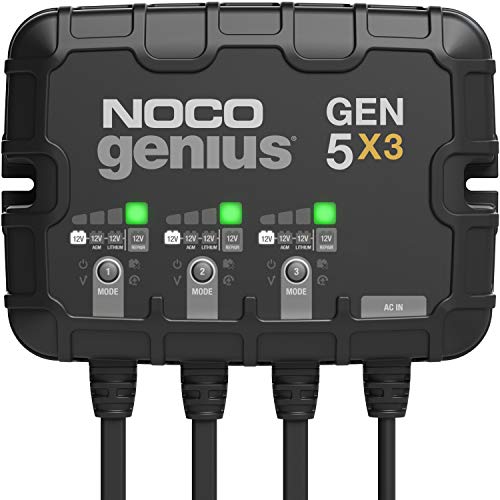
NOCO GEN5X3 12V 15A 3-Bank Marine Charger

FirstPower Pro 3 Bank 5X3 Marine Charger
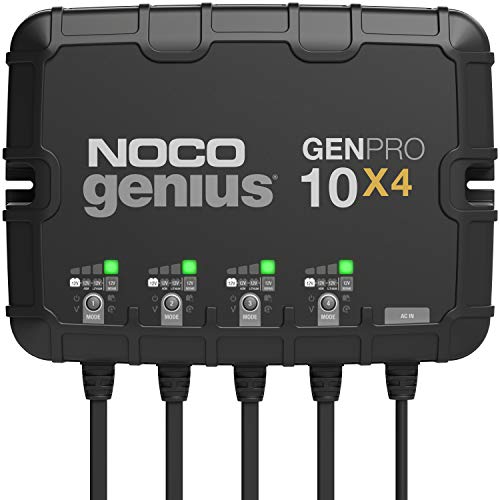
NOCO GENPRO10X4 12V 40A 4-Bank Charger
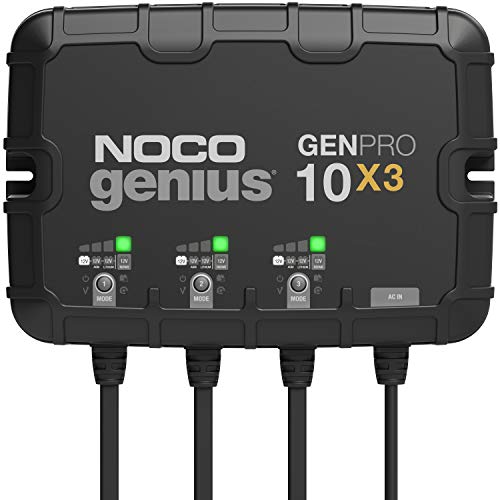
NOCO GENPRO10X3 12V 30A Marine Charger

Minn Kota MK 330D 3-Bank Digital Charger

Anegine 3 Bank 5A Marine Charger with LCD
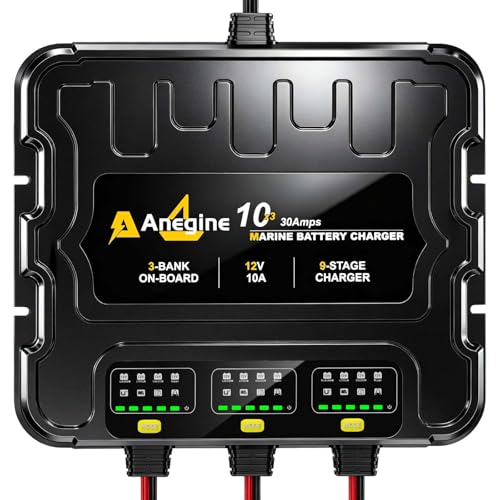
Anegine 3 Bank 10X3 30A Marine Charger
LiTime 3 Bank 12V 10A LiFePO4 Charger
Anegine 2 Bank 10A IP68 Marine Charger
Taking A Closer Look At The Options
Boats running a mix of trolling and cranking batteries often need different charge profiles for each bank, and the Minn Kota Precision MK-318PCL answers that with independent chemistry selection. Each of its three banks can be set for 12V AGM, flooded lead-acid, gel, or lithium LiFePO4 cells, so the charger isn’t forcing one compromise curve across batteries that prefer different treatment. A built-in microprocessor (a small chip that automatically adjusts voltage and current through the charging cycle) keeps the output precise throughout each stage.
Automatic temperature compensation (the charger’s ability to adjust output based on how hot or cold the surrounding air is) helps maintain stable charging in an unconditioned garage or a sun-baked dock. At 6 amps per bank, it suits mid-sized banks rather than the largest house systems. For anglers balancing different battery types on the same rig, this is a thoughtful middle-ground pick.
Where It Helps
- Independent per-bank chemistry selection, including LiFePO4
- Microprocessor-controlled multi-stage charging for precise voltage
- Temperature compensation keeps output stable in fluctuating conditions
- Solid fit for boats running AGM, gel, and lead-acid banks side by side
- Established brand with deep marine electronics history
Worth Noting
- 6 amps per bank is modest for very large deep-cycle banks
- Installation space needs to accommodate a longer onboard housing
Right Fit For
Anglers running mixed-chemistry banks who want per-bank tuning and reliable brand support.
A Better Fit Elsewhere
Boats with larger deep-cycle house banks benefit from the NOCO GENPRO10X3, which delivers 10 amps per bank.
Tighter bilge lockers and center-console compartments leave little room for bulky onboard hardware, and the NOCO GEN5X3 is built to slip into those awkward spots. Its fully sealed, waterproof housing stands up to splash, salt spray, and the general dampness that accumulates in unventilated boat compartments. At 5 amps per bank across three banks, it’s a maintenance-leaning charger rather than a fast-recovery workhorse.
Each bank runs independently, so one deeply depleted battery doesn’t drag down the others. Support for flooded, AGM, gel, and lithium chemistries gives it decent versatility across boats with mixed banks. For boaters who want a sealed, no-fuss charger that disappears into the boat, this is a smart space-conscious pick.
Well-Handled Touches
- Compact waterproof housing fits tighter mounting areas
- Independent per-bank charging for balanced recovery
- Compatible with lead-acid and lithium chemistries including LiFePO4
Trade Offs
- 5 amps per bank is on the lighter side for large house banks
- Sealed design limits user serviceability if issues arise
Made For
Boaters with limited installation space who prioritize sealed waterproof construction.
Swap It Out When
Boats needing faster recharge times should consider the FirstPower Pro 3 Bank 5X3 for similar sealing at a similar amp count.
Sealed onboard charging used to mean spending on premium-tier hardware, but the FirstPower Pro 3 Bank 5X3 brings IP68-rated waterproofing (a rating indicating the unit can withstand continuous submersion) to a more approachable price point. Three banks run at 5 amps each, delivering a combined 15 amps for charging lead-acid, AGM, calcium, and lithium batteries in parallel.
Mode selection covers SLA, lithium, and calcium chemistries, so it adapts to most recreational battery banks you’ll find on fishing boats. Owners commonly report that the sealed housing holds up well in splash-prone locations, though some installation planning is needed to keep cable runs tidy. For value-focused shoppers, this hits a sensible balance between capability and cost.
Why It Works Well
- IP68 fully sealed construction at an approachable price
- Three-mode chemistry selection covering common battery types
- Parallel charging across three banks saves dock time
- Compatible with starter, deep-cycle, and marine lithium banks
Honest Caveats
- 5 amps per bank limits fast recovery for larger banks
- Brand recognition is lower than legacy marine-electronics names
Who It Suits Best
Recreational anglers who want sealed three-bank charging without stretching into premium pricing.
Consider Something Else When
Rigs with deep-cycle house banks needing 10 amps per bank suit the Anegine 3 Bank 10X3 more directly.
Some boats run a fourth battery, whether for a bow thruster, additional house capacity, or a dedicated electronics bank, and standard 3 bank onboard marine battery chargers simply don’t have enough outputs. The NOCO GENPRO10X4 addresses that with four independent banks, each delivering a full 10 amps. That’s 40 amps of total onboard charging capacity for rigs with serious electrical demands.
Like its smaller siblings, the GENPRO10X4 is fully sealed and waterproof, ready for damp bilge mounting. Chemistry support spans flooded, AGM, gel, and lithium LiFePO4, making it adaptable if you eventually swap a bank for lithium. For boaters running four-battery systems who need real charging muscle, this is a logical step beyond typical three-bank hardware.
What Earns Its Place
- 10 amps per bank across four independent outputs
- Compatible with lead-acid and lithium chemistries
- Fully sealed waterproof housing for marine environments
- Strong fit for rigs with thrusters or expanded house banks
Points To Keep In Mind
- Overkill for boats with only three battery banks
- Larger physical footprint demands more installation planning
Best Suited To
Four-battery rigs and serious cruisers who need charging capacity beyond what standard 3 bank models offer.
Look Elsewhere When
Three-bank boats don’t need the extra output; the NOCO GENPRO10X3 delivers 10 amps per bank in a three-bank layout.
Deep-cycle house banks can take hours to recover on a low-amp charger, eating into fishing weekends. The NOCO GENPRO10X3 pushes 10 amps per bank across three banks, delivering 30 amps of total output, which noticeably shortens the recovery time for larger battery groups. It’s also fully sealed for damp mounting locations, so you don’t trade durability for power.
Each bank operates independently with support for lead-acid and lithium chemistries, including LiFePO4. Compare that to the NOCO GEN5X3 reviewed earlier, which delivers only 5 amps per bank. The trade-off is a larger housing that demands more installation space, but for serious anglers pushing big trolling runs or overnight house loads, the extra output is genuinely useful.
Real Benefits
- 10 amps per bank accelerates recovery for large banks
- Sealed waterproof housing built for marine environments
- Independent banks prevent cross-drain between batteries
- Chemistry coverage for AGM, gel, flooded, and lithium
Points To Note
- Higher output requires careful cable and breaker sizing
- Larger housing footprint than 5-amp models
Perfect Match For
Anglers running 10-amp-per-bank requirements for deep-cycle house banks who want faster turnaround.
Reach For A Different Pick When
Boats with smaller banks and tight compartments suit the NOCO GEN5X3’s smaller sealed footprint.
The Minn Kota MK 330D has been on the water for many seasons, and its longevity speaks to a design that’s been refined through years of real-world feedback. Each of the three banks delivers 10 amps, and the digital microprocessor design manages voltage and current precisely throughout the charge cycle. For anglers who keep boats for a decade or more, proven hardware carries weight.
Automatic temperature compensation adjusts output based on ambient conditions, helping performance stay consistent in unheated garages or humid summers. It predates the latest sealed-only trend, so installation planning should consider ventilation around the housing. For multi-season reliability, this remains a go-to workhorse.
Positive Takeaways
- 10 amps per bank across three banks
- Microprocessor-based digital charge management
- Temperature compensation for varied ambient conditions
- Long-running design with established track record
A Few Limitations
- Older design lacks the latest sealed waterproof housing
- No dedicated lithium chemistry profile in current spec
Who Should Grab It
Anglers prioritizing long-term proven reliability over the latest sealed-housing trend.
Not Your Match When
Boats needing sealed waterproof mounting in splash-prone areas suit the Anegine 3 Bank 10X3 more directly.
Chargers typically work silently in the background, but the Anegine 3 Bank 5A model adds an onboard LCD that surfaces charging status without requiring a multimeter or app. The screen shows per-bank mode and progress, which is genuinely useful when troubleshooting a battery that’s not holding a charge. IP68 waterproofing keeps the unit sealed against marine moisture.
Three modes handle lead-acid, AGM, and lithium LiFePO4 chemistries, and overcharge protection stops the cycle once each bank reaches full. Owners commonly appreciate the LCD for quick sanity checks, though the display brightness can be tough to read in direct sunlight. At 5 amps per bank, it’s tuned for maintenance and recovery rather than rapid turnaround.
Bright Spots
- Onboard LCD shows per-bank charging status
- IP68 sealed housing for damp mounting locations
- Overcharge protection across all three banks
- Multi-chemistry support including LiFePO4
Small Caveats
- 5 amps per bank is modest for larger banks
- LCD readability can struggle in bright sunlight
Right Fit For
Anglers who want visible charging feedback without relying on phone apps or external meters.
Where Another Pick Suits Better
Boats needing higher per-bank amps benefit from the Anegine 3 Bank 10X3, which also has an LCD.
Combining the LCD feedback of its 5-amp sibling with a stronger 10 amps per bank, the Anegine 3 Bank 10X3 targets anglers who want both visibility and recovery speed. Total output reaches 30 amps, which trims hours off charging for deep-cycle house banks after a long day on the water. The sealed housing carries an IP68 rating for marine moisture protection.
Per-bank chemistry selection covers lead-acid, AGM, and lithium LiFePO4, with independent charging on each output. Overcharge protection and temperature compensation come standard. For owners who want higher amp output plus an LCD status display, this checks more boxes than either feature alone.
Key Advantages
- 10 amps per bank across three outputs
- LCD shows per-bank charging progress
- IP68 sealed housing for damp marine environments
- Overcharge protection with temperature compensation
- Compatible with lead-acid, AGM, and lithium batteries
Trade Offs
- Larger housing demands more installation space
- Heavier output requires properly rated wiring
Who Will Love This
Boaters who want LCD status visibility plus the faster recovery of 10 amps per bank.
Skip It When
Tighter installations where the 5-amp Anegine 3 Bank 5A LCD model fits the boat better.
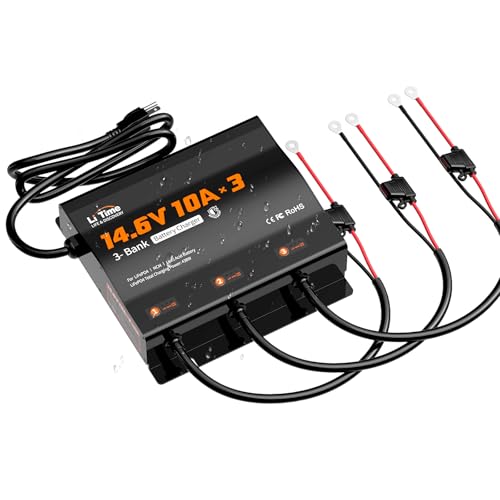
LiFePO4 batteries charge at different voltages than lead-acid, and using the wrong profile can undercharge them or stress the cells over time. The LiTime 3 Bank 12V 10A charger is engineered specifically around a 14.6V output target suited to 12V LiFePO4 packs. Three banks deliver 10 amps each, so lithium banks recover at a useful pace.
The sealed waterproof housing handles bilge and splash-prone mounting. Support also covers AGM, gel, and traditional flooded cells, which helps during a transition period when some banks may still be lead-acid. For fully lithium-converted boats, the tuned voltage profile is a meaningful upgrade over multi-chemistry chargers that approximate lithium curves.
Everyday Wins
- 14.6V output optimized for 12V LiFePO4 charging
- 10 amps per bank for faster lithium recovery
- Waterproof sealed housing for marine mounting
- Multi-chemistry fallback for mixed-bank boats
Possible Compromises
- Lithium focus means slightly reduced optimization for lead-acid
- Higher cost than general-purpose three-bank units
Built With In Mind
Boats running 12V LiFePO4 banks that benefit from voltage profiles tuned specifically for lithium chemistry.
A Different Pick May Suit
Lead-acid-heavy boats get broader chemistry support from the Minn Kota Precision MK-318PCL.
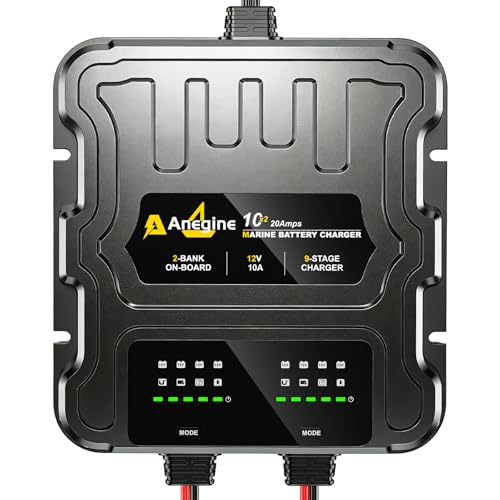
Smaller boats with just a trolling and cranking battery don’t need three-bank capacity, and the Anegine 2 Bank charger keeps things simple at 10 amps per bank. The sealed IP68 housing handles damp mounting areas, and an LCD readout shows charging status without requiring external tools. Total output of 20 amps is enough for healthy recovery on dual-bank setups.
Chemistry support covers lead-acid, AGM, gel, and lithium LiFePO4, with overcharge protection included. It’s a sensible option for jon boats, kayaks with trolling motors, or compact rigs where a full three-bank unit would be overkill. For shoppers with two-battery setups, this hits the right balance of features without the extra hardware.
Practical Advantages
- 10 amps per bank across two outputs
- IP68 sealed construction for damp bilge areas
- LCD display for quick status checks
- Multi-chemistry support with overcharge protection
Worth Bearing In Mind
- Two-bank capacity limits it to smaller battery configurations
- Overkill if your boat only runs a single battery
Whose Shelf It Belongs On
Boaters with two-battery setups who want sealed waterproof charging without three-bank overhead.
Where A Sibling Pick Shines
Three-bank boats need the Anegine 3 Bank 10X3 for matching 10-amp output with an extra output.
Matching A Charger To Your Battery Bank Setup
Choosing the right onboard charger starts with knowing how many batteries you run and what chemistry each one uses. Three-bank chargers cover a trolling bank, a cranking bank, and a house bank, which is the most common recreational layout. Per-bank amperage matters: 5 amps suits smaller banks and lighter recovery loads, while 10 amps per bank noticeably shortens turnaround on larger deep-cycle groups. Multi-stage charging (the charger adjusting voltage through bulk, absorption, and float phases) and automatic temperature compensation both help maintain long-term battery health, especially in unconditioned storage areas.
Chemistry compatibility is the next filter. If any bank runs LiFePO4, the charger needs a lithium-specific profile to avoid undercharging the cells. Lead-acid, AGM, and gel banks are broadly interchangeable in profile requirements, so a charger with selectable modes handles them all. For mixed rigs running both lead-acid and lithium banks, look for per-bank chemistry selection so each output gets the right curve.
Waterproofing and mounting footprint deserve attention too. IP68 sealing (the highest common ingress protection rating, meaning dust-tight and submersible) handles bilge splash and spray better than vented housings, though it typically limits user serviceability. Measure the intended mounting space before ordering; larger 10-amp-per-bank models need more clearance than compact 5-amp units. Finally, independent per-bank charging is non-negotiable, since shared-output chargers can let one weak battery drag down the others.
Smart Picks Across This Category
Common Shopping Slip Ups
The most frequent misstep is buying a charger with more banks than you actually need, which adds cost and bulk without real benefit. Two-battery boats don’t need three-bank hardware. Another common trap is overlooking chemistry support: a charger without a LiFePO4 profile will undercharge lithium banks, leaving you with reduced runtime despite full indicator lights. Buyers also sometimes underestimate cable and breaker requirements for higher-amp models, leading to installation headaches or underwired systems.
What Separates Premium From Basic
Higher-tier onboard chargers typically deliver 10 amps per bank instead of 5, with fully sealed waterproof housings and per-bank chemistry selection. Multi-stage charging profiles, automatic temperature compensation, and built-in diagnostics like LCD displays or app connectivity also tend to appear at the premium tier. The upgrade is worth it when your boat runs larger deep-cycle banks, lives in harsh marine environments, or uses lithium chemistry where voltage precision matters most. For modest setups with smaller batteries and garage storage, basic chargers handle the job without the extra investment.
Frequently Asked Questions
How many amps per bank do most anglers actually need?
For typical trolling and house banks in the 80-100Ah range, 5 to 10 amps per bank covers recovery within a reasonable overnight window. Larger banks above 100Ah benefit from 10 amps per bank to keep charging times reasonable.
Can one charger handle both lead-acid and lithium batteries?
Yes, as long as it has selectable per-bank chemistry modes that include a LiFePO4 profile. Each bank runs independently, so a mixed setup is straightforward with the right charger.
Is IP68 waterproofing necessary for an onboard charger?
Not strictly, but it dramatically reduces corrosion and failure risk in damp bilge environments. For open boats or splash-prone installations, IP68 sealing is worth the modest cost premium.
What’s the difference between a maintainer and a charger?
A maintainer delivers a small float current (a low, steady voltage to keep a full battery topped off) to keep topped-off batteries healthy during storage, while a charger provides higher current to recover depleted banks. Quality onboard chargers do both in sequence.
Do onboard chargers run continuously without damage?
Modern multi-stage chargers are designed for continuous connection, dropping to a float stage once the battery reaches full. Leaving them plugged in during off-season storage is standard practice and helps extend battery life.
The Takeaway
Three-bank onboard chargers give you predictable, independent charging for the trolling, cranking, and house banks that keep a fishing boat running. The right pick depends on your battery chemistry, bank sizes, and how much installation space you have to spare. Match the amps per bank to your largest battery group, and prioritize per-bank chemistry selection if any bank is lithium. Your next trip starts with batteries that are ready when you are.