A dead battery has a way of choosing the worst possible moment: a frosty Monday commute, a grocery run with headlights left on, a Sunday road trip that finally has to happen. If your vehicle calls for a Group 24F, finding the right unit can feel oddly technical. Dimensions, terminal orientation, CCA rating, AGM versus flooded, start-stop compatibility; each spec quietly decides whether the swap takes twenty minutes or a whole afternoon. This roundup cuts through that noise. Every pick below is a 24F, sized for the same BCI footprint, so the differences live in chemistry, cranking strength, and long-term durability. You’ll find a balanced mix of lead-acid AGM workhorses and one newer solid-state option, all aimed at reliable cold starts and steady accessory power across seasons.
The Lineup, Simplified

Odyssey ODX-AGM24F Extreme Series Battery

Weize Platinum AGM Battery BCI Group 24F

MARXON Group 24F AGM Battery 12V 70Ah

Autocessking Group 24F AGM Battery
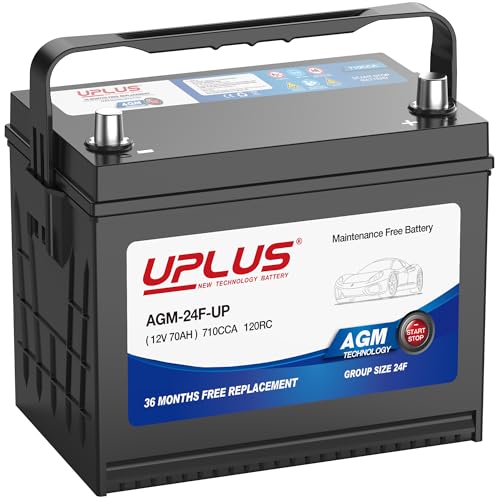
UPLUS BCI Group 24F AGM Battery

Interstate Batteries MTX AGM Group 24F

Goodyear 24F-AGM Platinum Series Battery

Daakmax Platinum AGM Group 24F Battery

Mighty Max MM-G24F AGM Battery

Lipower Group 24/24F Solid State Battery
A Breakdown Of The Leading Choices
The Odyssey ODX-AGM24F opens this list because it’s aimed squarely at drivers who want extra cranking headroom. Part of Odyssey’s Extreme Series, this Group 24F unit is built for engines that demand strong, immediate starts: think colder mornings, heavier accessory loads, and vehicles that sit unused for stretches. If your commute is short and your battery barely has time to recharge between drives, the heavier-duty plate design is worth a look.
Compared to the more common 710 CCA units from Weize and MARXON later in this list, the Odyssey leans toward thicker internal construction for vibration resistance and deeper cycling tolerance. In practical terms, that translates into steadier voltage during start-stop events and a longer working life under tough conditions. The trade-off shows up in weight and, depending on retailer, cost. For most commuters, a standard AGM is plenty; for cold-climate or work-truck use, this one earns its place.
Features That Help
- Extreme-series engineering aimed at higher cranking bursts and deep-cycle resilience
- AGM construction that resists vibration, a common failure point on rougher roads
- Group 24F footprint, so it drops into the standard BCI tray without modification
- Better suited than most to vehicles with heavy parasitic accessory loads
Points To Keep In Mind
- Heavier than typical 24F units, so the swap may be a two-person lift
- Premium pricing tier may not suit a budget replacement scenario
Right Fit For
Daily drivers in cold climates or anyone running accessories that pull the battery down between drives.
Look Elsewhere When
You just need a routine commuter swap, in which case the Weize Platinum AGM Battery BCI Group 24F delivers similar core specs at a lower tier.
The Weize Platinum AGM earns its spot as the practical middle-ground choice. It’s a 12V, 70Ah absorbed glass-mat (AGM) battery rated at 710 CCA and 120 minutes of reserve capacity, with a 36-month warranty backing the purchase. Terminal layout is left-negative, right-positive, matching the standard 24F orientation. Dimensions land at roughly 10.75″ long, 6.81″ wide, and 8.98″ tall, so it fits the typical 24F tray.
For most daily drivers doing regular commutes, this is the spec set that quietly gets the job done. Unlike the Odyssey at the top of the list, the Weize doesn’t claim extreme-series plate construction; instead, it leans into mainstream AGM reliability at an accessible tier. Owners commonly appreciate the maintenance-free sealed design, meaning no topping off with distilled water.
Reasons It Performs
- 36-month warranty, longer than several competitors in this category
- Standard BCI Group 24F dimensions for direct-fit replacement
- AGM sealed construction, safe to mount in orientations other than upside-down
- 710 CCA provides consistent cold-weather starting for most passenger vehicles
Trade-Offs To Consider
- CCA matches several competitors, so the value is in warranty rather than raw cranking
- Not specifically marketed for heavy start-stop cycling, unlike UPLUS or Autocessking
Best Suited To
Budget-minded commuters who want mainstream specs backed by a longer-than-average warranty.
A Better Fit Elsewhere
Drivers with start-stop technology may prefer the MARXON Group 24F AGM Battery 12V 70Ah for its more explicit start-stop framing.
The MARXON Group 24F sits comfortably in the middle of the pack, and that’s exactly why it works for so many people. It’s a 12V 70Ah AGM unit rated at 710 CCA with 120 minutes of reserve capacity, dimensions close to 10.7″ long, 6.77″ wide, and 8.98″ tall. Terminal orientation follows the standard left-negative, right-positive layout. Maintenance-free operation means you install it and largely forget about it.
This is a sensible pick for drivers who don’t want to overthink the swap. Compared to the Weize’s 36-month warranty, MARXON keeps specs similar without the longer coverage window. In return, owners typically get a straightforward, no-frills AGM built for the everyday start-and-drive routine.
Where It Delivers
- 710 CCA and 120 RC match mainstream Group 24F expectations
- Maintenance-free sealed AGM, ideal for hard-to-reach battery trays
- Standard BCI Group 24F footprint for direct replacement
Worth Noting
- Warranty terms are less generous than competitors offering 36-month coverage
- Specs mirror several alternatives, so the choice often comes down to availability and support
Who Should Grab It
Hands-off daily drivers who want a sealed AGM that drops in and starts the car.
Not Your Match When
You specifically want the longest warranty coverage, in which case the Weize Platinum AGM Battery BCI Group 24F is the stronger pick.
The Autocessking Group 24F is built for vehicles with start-stop systems, where the engine cycles off at traffic lights and the battery has to absorb constant micro-restarts. It’s a 12V, 70Ah AGM unit rated at 710 CCA and 120 RC, with the same standard left-negative, right-positive terminal orientation as other picks on this list.
The standout feature is leak-proof construction: the acid is suspended in glass-mat material rather than freely sloshing inside the case. That’s a real-world ownership benefit, especially in vehicles with battery trays near heat-sensitive components or those prone to vibration. In our view, this is a sensible upgrade from a flooded battery if your car shuts off at every stop.
What Helps Most
- AGM sealed design resists spills and corrosion around the tray
- Glass-mat suspension supports faster recovery between start-stop cycles
- Standard BCI Group 24F dimensions for broad vehicle compatibility
Honest Caveats
- CCA rating matches several alternatives, so gains are in cycle life rather than raw power
- Less brand recognition than Interstate or Odyssey in the AGM space
Whose Trunk It Belongs In
Start-stop vehicle owners wanting a sealed AGM that handles repeated cycling without leaking.
Swap It Out When
You drive a non-start-stop commuter and want maximum cold-cranking headroom, in which case the Odyssey ODX-AGM24F Extreme Series Battery is the stronger match.
The UPLUS BCI Group 24F AGM is positioned as a premium start-stop battery, and the spec sheet backs that up: 12V, 70Ah, 710 CCA, 120 RC, all wrapped in maintenance-free AGM construction. Dimensions match the standard Group 24F footprint at roughly 10.7″ by 6.77″ by 8.98″, with left-negative, right-positive terminals. For modern vehicles that cycle the engine aggressively, that’s the kind of consistency worth budgeting for.
Compared to the Weize earlier in this list, UPLUS leans into the start-stop framing more explicitly. The honest read is that for a daily commuter, both batteries will start the car; the difference appears in how gracefully they handle repeated engine-off moments in traffic.
Points In Its Favor
- Designed specifically for start-stop driving cycles
- Maintenance-free sealed AGM, no water top-ups needed
- Standard Group 24F dimensions simplify installation
Factors To Consider
- Premium tier pricing versus mainstream AGM alternatives
- No 36-month warranty noted in the source, unlike Weize or Daakmax
Built With In Mind
Drivers of modern start-stop sedans and crossovers who want a battery engineered for repeated cycling.
Reach For A Different Pick When
You drive an older vehicle without start-stop and want longer warranty coverage; the Weize Platinum AGM Battery BCI Group 24F delivers similar core specs.
The Interstate Batteries MTX AGM is a familiar name in the replacement battery space, and this Group 24F carries the brand’s pure-lead AGM construction. That means more lead content packed into the plates, which translates into longer expected service life and stronger performance under repeated cycling. Spec-wise, it lands at 12V, 70Ah, and 710 CCA, with the standard left-negative, right-positive terminal layout.
Interstate’s compatibility guide is worth pulling up before purchasing, since the MTX line is specifically engineered for start-stop vehicles. If your car shuts off at red lights, this is the kind of battery that takes that workload in stride. Compared to the UPLUS earlier in the list, the difference is brand-specific engineering and warranty terms rather than headline specs.
Useful Touches
- Pure-lead AGM design for longer cycle life
- Built to meet or exceed start-stop vehicle starting requirements
- Standard Group 24F dimensions for straightforward installation
Small Caveats
- Warranty terms vary by retailer and aren’t always prominently listed
- Heavier than some alternatives due to higher lead content
Made For
Long-term reliability seekers driving start-stop equipped vehicles.
Skip It When
You’re on a tight budget and don’t need premium AGM construction, in which case the MARXON Group 24F AGM Battery 12V 70Ah handles routine replacement duty well.
The Goodyear 24F-AGM Platinum Series carries a familiar name into a familiar spec class: 12V, 70Ah, 710 CCA, and 120 minutes of reserve capacity, all in a sealed AGM case. Standard left-negative, right-positive terminal orientation. The interesting twist is mounting flexibility: this battery can be installed in multiple positions, except fully upside-down, which helps when working with cramped or oddly shaped engine bays.
If you’ve ever wrestled with a battery tray that doesn’t quite line up with the stock orientation, you’ll appreciate that flexibility. In our view, this is a quietly practical feature that matters more in older custom installations than in stock commuter cars.
What Makes Sense
- Multi-position mounting simplifies installation in non-standard trays
- Sealed AGM construction resists leaks during temperature swings
- Standard Group 24F dimensions for broad vehicle compatibility
A Few Limitations
- Cannot be mounted fully upside-down, so vertical-flange installations still need careful placement
- CCA and Ah match mainstream competitors rather than exceeding them
Perfect Match For
Extreme climate drivers with non-standard battery trays who need flexible mounting.
Consider Something Else When
You drive a stock-configuration commuter and want maximum warranty duration; the Daakmax Platinum AGM Group 24F Battery pairs similar specs with a 36-month warranty.
The Daakmax Platinum AGM lines up with the most common 24F spec sheet on this list: 12V, 70Ah, 710 CCA, 120 RC. Dimensions measure 10.75″ long, 6.81″ wide, and 8.98″ tall, with left-negative, right-positive tapered terminals. Where it separates itself is the warranty: 36 months of coverage, which is a meaningful detail for high-mileage commuters who cycle batteries more frequently.
Versus the Weize earlier in the list, you’re looking at nearly identical headline specs, so the practical difference is often brand recognition and retailer support rather than performance. If your commute racks up miles, having that warranty window is reassuring.
The Good Stuff
- 36-month warranty, longer than most Group 24F AGM competitors
- Standard BCI Group 24F dimensions for direct-fit replacement
- Maintenance-free AGM sealed design
Less-Strong Areas
- Specs mirror several alternatives rather than exceeding them
- Brand recognition is lower than Interstate or Odyssey
Who Will Love This
High-mileage commuters who burn through batteries and want a longer warranty behind the swap.
Another Choice May Suit
If your vehicle has start-stop technology and you want engineering aimed at that workload, the Interstate Batteries MTX AGM Group 24F is a more targeted fit.
The Mighty Max MM-G24F rounds out the mainstream AGM options with familiar specs: 12V, 70Ah, 710 CCA, and 120 minutes of reserve capacity. The sealed AGM design resists spills, and the brand highlights deep-discharge recovery, which is the ability to bounce back after the battery has been drained harder than a normal start would demand.
That’s a useful trait for vehicles with aftermarket accessories, like upgraded sound systems or auxiliary lighting, that pull the battery down when the engine is off. In most cars, this is overkill; in accessory-heavy builds, it’s the kind of resilience that prevents a dead battery from spoiling a weekend.
What Pays Off
- Strong deep-discharge recovery for accessory-heavy builds
- Sealed spill-proof AGM construction
- Standard Group 24F dimensions for broad compatibility
Minor Gripes
- Warranty terms vary and aren’t always prominently listed in source materials
- Core specs match several alternatives in this category
Who Should Grab It
Owners of vehicles with heavy aftermarket accessory loads who want a battery that recovers from deep drains.
Look Elsewhere When
You drive a stock commuter and want the longest warranty, in which case the Daakmax Platinum AGM Group 24F Battery covers 36 months.
The Lipower Group 24/24F is the outlier on this list: a solid-state battery rather than a traditional AGM or flooded lead-acid unit. Solid-state designs use a different internal cell architecture, which the manufacturer claims supports a much longer service life and a higher number of deep cycles than conventional lead-acid batteries. A multi-year warranty is part of the package.
That’s a meaningful shift in chemistry, and it comes with caveats worth considering. Older vehicles with alternators designed for lead-acid batteries may not charge a solid-state unit optimally, and not every mechanic is familiar with the format yet. If you’re an enthusiast comfortable with newer battery technology and your vehicle is modern enough to handle the charging profile, this is the kind of upgrade that could outlast two or three AGM replacements.
Where It Excels
- Solid-state chemistry targets longer lifespan than lead-acid alternatives
- Compatible with both Group 24 and 24F fitments
- Multi-year warranty backing the purchase
Honest Caveats
- Higher upfront cost than mainstream AGM options
- Charging system compatibility may need verification on older vehicles
Built With In Mind
Enthusiasts with modern vehicles who want a longer-lasting alternative to traditional AGM chemistry.
A Better Fit Elsewhere
If you drive a stock commuter and just need a reliable drop-in AGM, the Weize Platinum AGM Battery BCI Group 24F is a more conservative choice.
Choosing a Group 24F That Fits Your Vehicle
Before pulling the trigger, the most important step is confirming the fit. Group 24F refers to a Battery Council International (BCI) size standard, which is a set of physical dimensions and terminal positions that automakers follow. Measure your old battery’s length, width, and height, then compare against the spec sheet. Terminal orientation matters too: most Group 24F batteries use left-negative, right-positive, but verifying with your vehicle’s manual avoids a frustrating return.
Next, match the chemistry to your driving pattern. AGM (Absorbed Glass Mat) batteries suspend acid in fiberglass mats rather than letting it pool, which makes them sealed, spill-resistant, and better suited to vehicles with start-stop systems or accessory-heavy electrical loads. If your car shuts off at traffic lights, AGM is the right call. If you drive an older vehicle without start-stop and rarely use accessories with the engine off, a flooded lead-acid battery still does the job, but most of the picks above are AGM because that format dominates the modern 24F market.
Cold Cranking Amps (CCA) deserve attention in colder climates. CCA measures how much current a battery can deliver at 0°F for 30 seconds while maintaining voltage. A 710 CCA rating, common across this list, handles most passenger vehicles in moderate climates. Reserve capacity (RC), measured in minutes, indicates how long the battery can run accessories if the alternator fails; 120 minutes is the standard here. For a daily commuter doing short trips, prioritize CCA. For a vehicle with lots of electronics, RC matters more than you might think.
Key Considerations Across These Picks
Wrong Turns To Avoid
The most common mistake is assuming any Group 24F will fit any vehicle that calls for one. Terminal orientation varies between Group 24 and 24F, and a reversed layout can mean cables won’t reach. Another pitfall is overpaying for cranking amps you don’t need: most modern vehicles start comfortably at 600 to 700 CCA, so chasing 800+ rarely pays off. Finally, ignoring warranty terms is a quiet mistake. Batteries fail, and a 36-month warranty (like the Weize or Daakmax offer) saves a future swap cost.
Where The Extra Money Goes
Stepping up from a budget AGM to a premium unit typically buys three things: thicker internal plates for longer service life, better cycling tolerance for start-stop vehicles, and stronger vibration resistance for trucks or rougher roads. Brands like Odyssey and Interstate invest in plate chemistry and lead purity, which extends how long the battery holds capacity. For a stock commuter doing standard miles, the mid-tier AGM picks deliver the best balance. For heavy-use vehicles or extreme climates, the premium tier earns its keep.
Frequently Asked Questions
What does Group 24F mean for a car battery?
Group 24F is a Battery Council International (BCI) size standard that defines the battery’s physical dimensions and terminal layout. It ensures the battery fits the vehicle’s tray and that cables reach the posts without modification.
Can I replace a flooded battery with an AGM in my car?
In most cases, yes, as long as the new battery matches the required group size, CCA, and terminal orientation. AGM batteries charge at slightly different voltage profiles, so vehicles with smart charging systems may need a brief reset, but the swap is generally straightforward.
How long does a Group 24F AGM battery typically last?
Under normal driving conditions, AGM batteries in this category tend to last four to six years. Vehicles with heavy start-stop cycling or extreme temperatures may see shorter life, while gentler use can extend it.
Is a higher CCA rating always better?
Not always. CCA matters most in cold climates where engines require more cranking force. In moderate climates, a 710 CCA battery is sufficient for most passenger vehicles, and paying more for higher CCA rarely delivers a noticeable improvement.
Do I need to maintain an AGM battery?
No. AGM batteries are sealed and maintenance-free, meaning no water top-ups and no corrosion cleanup around the terminals beyond occasional cleaning. The trade-off is that they cost more upfront than flooded alternatives.
The Takeaway
The right Group 24F battery is the one that matches your vehicle’s fitment, your climate’s demands, and your typical driving pattern. AGM remains the dominant format for good reason, and most picks on this list will outlast a flooded unit by a comfortable margin. Match the spec sheet to your owner’s manual, verify terminal orientation, and you’ll find a battery that quietly does its job for years.