A dead battery ruins your day at the worst possible time, whether you’re prepping the boat for launch or trying to start a seasonal truck that sat all winter. Two bank battery chargers handle two batteries at once, which matters for anyone running a starter plus a house bank, or maintaining a pair of vehicles on the same circuit. After digging through current options, these ten picks cover garage tinkering, marine use, and lithium setups worth planning around.
The Shortlist At A Glance

NOCO GENIUS2X4 4-Bank Battery Charger
Battery Tender Plus 2 Bank Multibank Charger

Minn Kota Precision MK-220PCL On-Board Marine Charger

NOCO GENIUS2X2 2-Bank Battery Charger

ProMariner Gen 3 ProSport 20 Amp 2 Bank Marine Charger
Wavlink 2 Bank 20A Marine Battery Charger IP68

2 Bank Marine Battery Charger 20A 12V IP68

NOCO GENIUS2 2A Smart Battery Charger

2 Bank Marine Battery Charger 5X2 10A

LiTime 2 Bank 12V 10A LiFePO4 Charger
More Details On Our Top Picks
The NOCO GENIUS2X4 earns the top slot because it stretches past the two-bank norm without losing the brand’s well-known “set it and forget it” attitude. Each bank handles its own 6V or 12V lead-acid or lithium-ion battery, which means your classic car, your daily driver, the lawn tractor, and the boat cranking battery can all stay topped off in the same corner of the garage. A built-in thermal sensor adjusts output based on ambient temperature, so a cold January morning or a hot August afternoon won’t push the charger into overcharge territory.
Where it pulls ahead of the smaller NOCO GENIUS2X2 later in this list is raw throughput, since four banks run in parallel rather than stepping down. Most owners pair it with a permanent mounting spot and a bank of extension cords for ring-terminal leads.
Noteworthy Benefits
- Four independent channels cover an entire small fleet without swapping leads
- Thermal compensation keeps the charge curve honest across seasons
- Doubles as a desulfator (a recovery mode that breaks down lead-sulfate buildup on aging plates), useful for reviving neglected batteries
- Compatible with lithium LiFePO4 (lithium iron phosphate) up to 40Ah alongside conventional flooded and AGM (absorbent glass mat) cells
Trade Offs
- The four-bank footprint is heavier and bulkier than the GENIUS2X2, so wall mounting takes planning
- You pay a premium for the extra two channels, even when you only need two banks today
- Lead wires are functional but not marine-grade, so saltwater boaters usually add heat-shrink and dielectric grease at the lugs
Who It Suits Best
Hobbyists juggling a classic car, a tractor, and a motorcycle, or any shop wanting one wall-mounted unit that quietly maintains the whole collection.
Where Another Pick Suits Better
Saltwater anglers should look at the Minn Kota Precision MK-220PCL further down, since it’s built specifically for bilge environments and offers per-bank chemistry profiles.
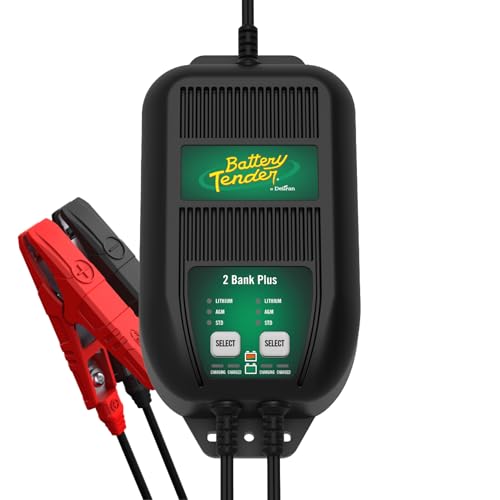
The Battery Tender Plus has been the gentle caretaker of stored vehicles for years, and the two-bank version simply doubles down on that reputation. Each side pushes 1.25 amps, slow by marine standards but ideal for keeping a motorcycle or a second car at full charge through a long winter. The integrated float stage (a low-voltage hold mode that kicks in once the battery is full) is the headline feature here, since it prevents the overcharging damage that basic trickle chargers tend to inflict on neglected batteries.
It’s a quieter, smaller alternative to the GENIUS2X4 above, and a sensible step up from a single-bank wall wart. Most owners clip it on, park the cars, and check back in spring.
Positive Points
- Float maintenance mode prevents the slow overcharge damage that wrecks stored batteries
- Two completely independent encased banks, so a fault on one side does not knock out the other
- Works globally on common AC mains, which helps if you travel with vehicles between regions
- Handles flooded, sealed maintenance-free, and AGM lead-acid chemistries with the same profile
Things To Consider
- 1.25 amps per bank is too slow for topping off a deeply discharged large battery in a hurry
- No dedicated lithium LiFePO4 mode, so newer lithium packs need a different charger
- The enclosure is meant for a garage shelf, not a wet bilge
Made For
Anyone storing a pair of cars, motorcycles, or ATVs through the off-season and wanting a plug-and-forget solution that won’t cook the batteries.
Consider Something Else When
Boaters with live trolling batteries should look at the ProMariner Gen 3 ProSport, since it offers waterproof construction and far faster amp delivery.
The Minn Kota Precision MK-220PCL speaks directly to anglers who run different battery chemistries on the same hull. Each of the two banks delivers 10 amps and lets you select a charge curve tailored to the chemistry on that bank, which matters when a flooded starting battery sits next to a lithium LiFePO4 house bank. Compare that to the Wavlink and MVMOD marine options below, which deliver the same 10 amps per bank but use simpler shared profiles.
It’s a premium-tier piece of marine hardware, and the on-board mounting style means it lives behind a bulkhead rather than on the garage floor. Owners chasing the longest possible runtime on a trolling day appreciate the optimization.
A Strong Showing
- Bank-by-bank chemistry selection handles flooded, AGM, gel, and lithium LiFePO4 from a single unit
- 10 amps per bank is enough to refill a deeply depleted trolling battery overnight
- On-board design means no loose cords rattling around the deck
- Built around longer runtimes and shorter charge times, the original Minn Kota selling point
Worth Noting
- The on-board form factor requires a permanent mounting spot and running AC shore power to it
- Premium pricing versus the Wavlink and MVMOD options, even with similar amp output
- Overkill for small jon boats that only run a single starting battery
Right Fit For
Anglers with mixed-chemistry setups, like a flooded cranking battery paired with a lithium trolling battery, who want a single charger that respects both profiles.
Look Elsewhere When
A budget-conscious boater running a single chemistry pair will get more value from the FirstPower Pro 5X2, which covers the basics at a lower tier.
The NOCO GENIUS2X2 takes everything that makes the four-bank version appealing and trims it down to a tidy two-bank unit. It covers 6V and 12V lead-acid plus lithium LiFePO4 up to 40Ah on each bank, so it handles a small car-and-motorcycle garage without taking up much shelf space. The same thermal compensation and desulfation features carry over from the larger GENIUS2X4 above.
Where the GENIUS2X2 falls short versus the ProMariner ProSport further down is marine ruggedness, since NOCO positions this as a garage charger first and foremost. For shop duty, though, the size advantage is meaningful.
Strong Points
- Compact two-bank chassis fits on a workbench or wall mount without dominating the space
- Covers lead-acid and lithium LiFePO4 chemistries with the same hardware
- Thermal sensor adjusts output to match ambient temperature
- Functions as a charger, maintainer, trickle charger, and desulfator in one box
Room For Improvement
- Not designed for bilge or marine mounting, so boaters should choose a waterproof unit instead
- The 40Ah ceiling is fine for cars and powersports but limiting for large deep-cycle battery banks
- Two banks only, so anyone managing more than two batteries needs the four-bank GENIUS2X4
Best Suited To
Garage hobbyists maintaining a daily driver and a second vehicle, or a motorcycle and ATV pair, in a clean indoor space.
A Better Fit Elsewhere
Anyone mounting under a boat seat or in a wet engine bay should reach for the Wavlink 2 Bank 20A Marine Charger with its IP68 (full dust-tight and continuous-submersion) sealed housing.
ProMariner’s ProSport 20 stands apart from the other marine entries thanks to its Distributed on Demand technology, which directs 100% of available amps to the bank that needs it most. A boat with a deeply discharged house battery and a healthy starting battery gets all 20 amps pushed to the weak bank until it catches up. Compare that to the Wavlink 2 Bank 20A below, which splits the output evenly.
The waterproof construction and 12/24V compatibility make this a serious upgrade for larger vessels. Most owners mount it in the engine compartment and forget it until fault LEDs (if any) signal attention.
Features That Help
- Distributed on Demand reroutes charging current to whichever bank needs it most
- LED status indicators flag specific bank faults, which saves troubleshooting time
- Supports 12V and 24V systems, useful for bigger boats with 24V trolling circuits
- Waterproof housing handles bilge splash and rain exposure without issue
Points To Note
- Larger and heavier than the Wavlink and MVMOD options, so mounting location needs to be sturdy
- No dedicated lithium mode, so lithium banks need a dedicated LiFePO4 charger
- Higher price point reflects the marine-grade engineering
Who Will Love This
Boat owners running asymmetric battery loads, where one bank often works harder than the other, on a hull with 12V or 24V electrical architecture.
Not Your Match When
A small jon boat with a single flooded pair will find the FirstPower Pro 5X2 more than enough and easier on the wallet.
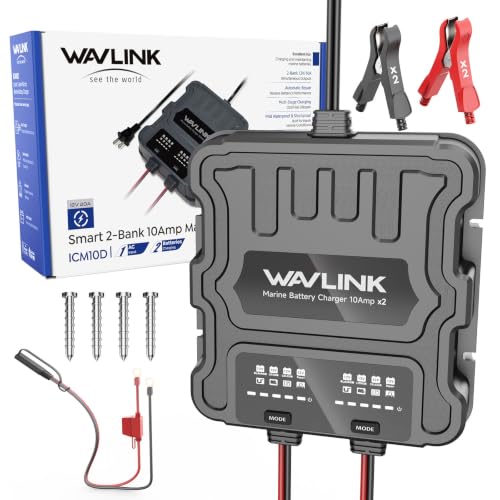
The Wavlink 2 Bank 20A Marine Charger earns its place here primarily because of the IP68 sealed enclosure, which is rated for full dust ingress and continuous water submersion. For boaters who splash through saltwater or keep their craft moored in the rain, that rating is more than marketing, since it means the charger can live in the wettest part of the hull. Each bank delivers 10 amps independently, with no cross-interference.
Capacity coverage spans 30Ah to 300Ah batteries, which is a generous range compared to the NOCO GENIUS2X2’s 40Ah ceiling. The trade-off, depending on your perspective, is bulk.
Practical Advantages
- IP68 sealed aluminum housing handles splash, spray, and brief submersion
- Independent bank channels avoid the cross-talk issues seen on shared designs
- Supports a 30Ah to 300Ah range per bank, covering small and large marine banks alike
- On-board form factor keeps cords tidy inside the hull
Softer Spots
- Owners commonly report the fan noise during heavy charge sessions
- 10 amps per bank is shared equally, so a deeply discharged bank waits for the other to catch up
- Larger footprint than the Battery Tender Plus above, so smaller dry lockers will feel crowded
Perfect Match For
Saltwater boaters and anyone needing a fully sealed charger that lives in the wettest part of the hull without corroding out.
Skip It When
A non-marine setup that just needs gentle maintenance will be cheaper and simpler with the NOCO GENIUS2X2.
This MVMOD marine entry runs each bank on its own circuit, which keeps the two batteries from influencing each other during the charge cycle. The IP68 housing matches the Wavlink above, and the 10 amps per bank matches the Minn Kota Precision further up the list. Where it pulls ahead of those options is the chemistry coverage, since SLA (sealed lead-acid), AGM, lithium LiFePO4, and calcium profiles all sit inside the same unit.
It’s a quiet, well-rounded marine charger for boats running mixed battery types.
Everyday Advantages
- Independent circuits prevent one bank’s state from confusing the other
- Chemistry coverage spans SLA, AGM, lithium LiFePO4, and calcium batteries
- IP68 sealed housing matches the marine environment
- Onboard mounting keeps the deck clear of loose gear
Points To Keep In Mind
- Brand recognition is newer than Minn Kota or ProMariner, which may matter for warranty comfort
- 10 amps per bank is fixed, with no on-demand redistribution like the ProSport
- Documentation is sometimes thinner than the legacy brands
Who Should Grab It
Boaters running a starter battery and a deep-cycle house battery of different chemistries who want one sealed charger that handles both.
Another Choice May Suit
Anyone already running ProMariner accessories or expecting the longest possible track record should stick with the ProMariner ProSport 20 above.
The NOCO GENIUS2 is technically a single-bank charger, but it earns a spot here because it’s the smartest small-shop starting point for someone new to the world of battery maintenance. It handles 6V and 12V lead-acid plus lithium LiFePO4 batteries up to 40Ah, with the same thermal compensation and desulfation modes as its bigger siblings. Owners use it on motorcycles, lawn equipment, and classic cars where one bank is enough.
Where it diverges from the rest of the list is its single-bank simplicity. Step up to the GENIUS2X2 above when you need a second channel.
A Favorable Mix
- Compact single-bank design fits anywhere, from a workbench drawer to a kitchen counter
- Built-in thermal compensation matches the larger NOCO units
- Functions as charger, maintainer, trickle charger, and desulfator in one box
- Compatible with cars, motorcycles, ATVs, and classic vehicles without adapter changes
Honest Caveats
- One bank only, so anyone managing more than one battery needs the GENIUS2X2
- 2 amps is slow for reviving a deeply discharged large battery
- The 40Ah ceiling excludes large deep-cycle banks
Built With In Mind
First-time charger shoppers who own one or two small vehicles and want a forgiving, chemistry-agnostic unit to learn on.
Swap It Out When
Managing a small fleet is easier with the NOCO GENIUS2X4 at the top of this list, which handles four banks from a single outlet.
The FirstPower Pro 5X2 lands at the lower end of the marine charger output range with 5 amps per bank. That sounds modest, but for smaller boats with a starting battery and a modest house bank, the slower output is gentler on the plates and produces less waste heat inside the sealed chassis. Three charging modes (SLA/AGM, lithium, and calcium) cover the common marine chemistries, and the IP68 housing matches the wetter marine options above.
Compared to the Wavlink and MVMOD 10-amp marine entries, this one prioritizes battery longevity over speed. For weekenders who aren’t drawing the house bank down daily, that trade makes sense.
What Earns Its Place
- Lower 5A-per-bank output is gentler on battery plates over many cycles
- Three chemistry modes cover the most common marine battery types
- IP68 sealed housing handles the splash and spray of marine mounting
- 24/7 onboard charging claim, so it can stay connected between trips
A Few Limitations
- 5 amps per bank takes noticeably longer to refill a deeply depleted bank
- Less established track record than legacy marine brands
- Overkill for small jon boats running a single battery
The Right Fit
Weekend boaters with modest house banks who prioritize battery longevity over fast turnaround between trips.
Where A Sibling Pick Shines
Daily anglers pulling big trolling loads should reach for the Minn Kota Precision MK-220PCL, whose 10 amps per bank recharges overnight.
The LiTime charger closes out the list as a purpose-built option for LiFePO4 (lithium iron phosphate) banks, which need a specific 14.6V absorption voltage (the peak voltage the charger holds during the main charging phase) that lead-acid profiles do not provide correctly. Each bank delivers 10 amps and runs independently, with a 90V to 260V AC input range that handles shore power worldwide. The waterproof construction keeps it viable for marine mounting.
Compared to the NOCO GENIUS2X2 above, this unit skips the desulfation tricks that lead-acid batteries benefit from, since LiFePO4 chemistry doesn’t accumulate sulfate. It’s the right pick when both banks are lithium.
Everyday Wins
- 14.6V output is the correct absorption voltage for LiFePO4 banks
- Wide 90V to 260V AC input handles international shore power
- 10 amps per bank fills a typical 100Ah lithium pack in roughly 10 hours
- Waterproof housing supports marine and outdoor mounting
Where It May Fall Short
- Wrong tool for lead-acid batteries, which the dedicated LiFePO4 profile can undercharge
- Two banks only, so larger lithium arrays need additional chargers
- No lead-acid recovery mode for neglected starter batteries
Whose Shelf It Belongs On
Off-grid setups, solar sheds, and boat builds running dedicated LiTime or other LiFePO4 battery banks in matched pairs.
Reach For A Different Pick When
A mixed lead-acid and lithium setup needs a flexible charger like the Minn Kota Precision MK-220PCL, which lets you set profiles per bank.
What To Weigh Before Choosing a 2 Bank Battery Charger
Two-bank chargers live in a few distinct worlds: the garage, the marine bilge, and the off-grid shed. Picking the right unit starts with where it will actually live and what kind of batteries it will touch. A garage charger for stored cars rarely needs waterproofing, but a marine charger without IP-rated sealing is a one-season purchase. Amp output per bank matters next, since 1.25 amps is plenty for a stored motorcycle but painfully slow for a depleted trolling battery.
Chemistry support is the third filter. Lead-acid flooded and AGM batteries share forgiving profiles, but lithium LiFePO4 packs need a higher absorption voltage and tighter charge termination. A charger that lacks a dedicated lithium mode will undercharge LiFePO4 banks, leaving you with less usable capacity than the nameplate rating suggests. If both banks share a chemistry, simpler chargers work well. If they differ, look for per-bank chemistry selection.
Output, Amperage, And Charge Speed
Amps per bank determine how fast a deeply discharged battery comes back. Slow 1.25A-per-bank units like the Battery Tender Plus are gentle maintainers, while 10A-per-bank marine chargers refill a 100Ah trolling battery overnight. Faster charging usually means more heat inside the chassis and a louder fan, which matters in a quiet cabin.
Chemistry Compatibility
Look for chargers that explicitly list your battery type, whether that’s flooded, AGM, gel, calcium, or lithium LiFePO4. Generic “12V” profiles cover lead-acid families but typically undercharge lithium. Match the charger to the batteries you actually own, not the ones you might buy someday.
Form Factor And Mounting
On-board marine chargers install permanently behind a bulkhead, which keeps cords tidy but requires AC shore power routing. Portable garage chargers like the GENIUS2X2 sit on a shelf and clip on as needed. Pick based on whether the batteries come to the charger or the charger goes to the batteries.
Waterproofing And Durability
An IP68 rating means the unit tolerates splash and brief submersion, which matters in a bilge or an outdoor shed. Lower ratings are fine for a climate-controlled garage. Marine-grade aluminum housings dissipate heat better than plastic, especially at higher amp outputs.
Smart Choices Before You Commit
Pitfalls Shoppers Hit
The most common mistake is buying a charger rated for the wrong chemistry, especially undercharging lithium LiFePO4 banks with a lead-acid profile. Another misstep is overestimating amp needs, since faster charging produces more heat and noise without a real benefit for small stored batteries. Finally, skipping the mounting location plan leaves you with extension cords snaking across a wet bilge, which is both ugly and a corrosion risk.
What Separates Premium From Basic
Higher-tier chargers justify the cost through per-bank chemistry profiles, distributed on-demand amp routing, and waterproof aluminum housings. For a garage storing two cars, the basic tier is enough. For a boat with mixed battery loads, the premium tier pays back through longer battery life and faster turnaround between trips. The honest read is that the upgrade matters most when the charger lives in a harsh environment or drives dissimilar battery banks.
Frequently Asked Questions
Can a 2 bank battery charger run both banks at different chemistries?
Yes, but only on chargers that explicitly support per-bank chemistry selection, like the Minn Kota Precision MK-220PCL. Basic chargers use a single profile for both banks, which works only when both batteries share a chemistry.
How many amps per bank do I need for a trolling battery?
A 100Ah trolling battery typically needs 10 amps per bank to refill overnight. Smaller weekender banks can get away with less, while high-drawage setups benefit from the higher end of the marine range.
Is an IP68 charger worth it for a garage?
For a clean, dry garage, IP68 is unnecessary. For a damp basement, a shed, or any marine mounting, the sealed housing prevents corrosion and shortens repair bills over time.
Can I leave a 2 bank charger connected for months?
Most modern smart chargers with float or maintenance modes are designed for long-term connection. Battery Tender Plus units in particular are built around months-long float maintenance, while higher-amp marine chargers can stay connected between trips.
Will a lithium charger damage a lead-acid battery?
Yes. A lithium LiFePO4 charger’s 14.6V absorption voltage overcharges lead-acid batteries, boiling off electrolyte and shortening their life. Match the charger to the chemistry on each bank.
Bottom Line
Two-bank battery chargers solve a common problem: keeping a starter and a house battery, or a pair of vehicles, healthy without swapping cords or buying two single-bank units. For most people, the right pick depends on where the charger will live. Garage owners with seasonal vehicles tend to land on the NOCO GENIUS2X2 or the Battery Tender Plus, while boaters gravitate toward the Minn Kota, Wavlink, or MVMOD marine units. Lithium-only builds need the LiTime profile. Match the charger to your batteries, your mounting spot, and how often you’ll actually be around to babysit the process.