Two batteries, one charger, no guesswork. A solid 2 bank onboard marine battery charger keeps your starting and house banks topped up so the engine fires on the first crank and the trolling motor keeps humming through the afternoon. The ten models below cover a wide spread of amps, chemistries, and mounting realities, from sealed workhorses for saltwater skiffs to lithium-focused units for anglers running LiFePO₄ banks.
The Lineup, Simplified
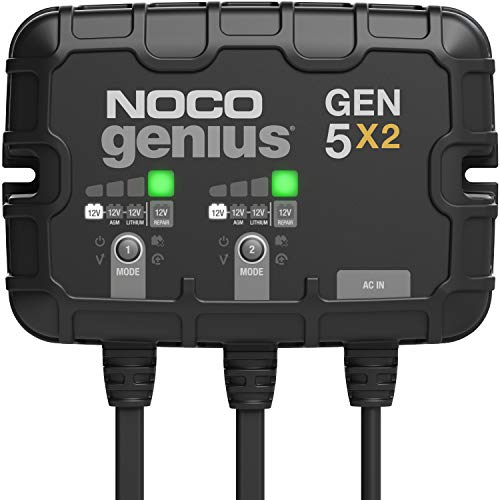
NOCO GEN5X2 12V 10A 2-Bank OnBoard Marine Battery Charger & Maintainer

Minn Kota Precision MK-220PCL On-Board Marine Battery Charger

NOCO GENPRO10X2 12V 20A 2-Bank OnBoard Marine Battery Charger & Maintainer

ProMariner Gen 3 ProSport 20 Amp 12/24V 2-Bank Marine Charger
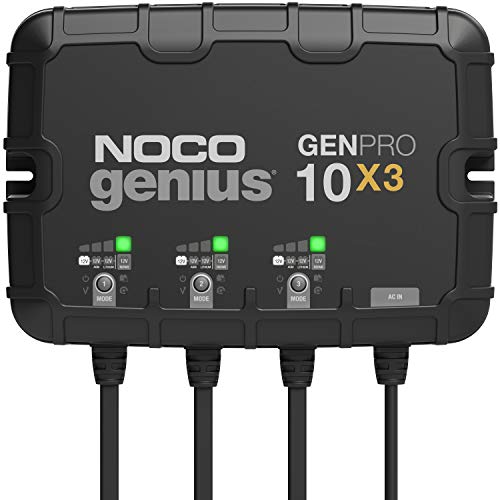
NOCO GENPRO10X3 12V 30A 3-Bank OnBoard Marine Battery Charger & Maintainer

anegine 3 Bank 12V 5A/Bank IP68 Waterproof LCD Marine Charger
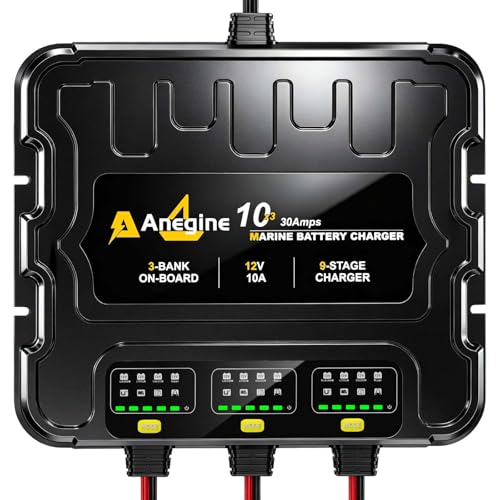
anegine 3 Bank Marine Battery Charger 10X3, 30A (10A/Bank)

FirstPower Pro 2 Bank Marine Battery Charger 5X2, 10A (5A/Bank)

LiTime 2 Bank 12V 10A LiFePO4 Battery Charger, 14.6V Output
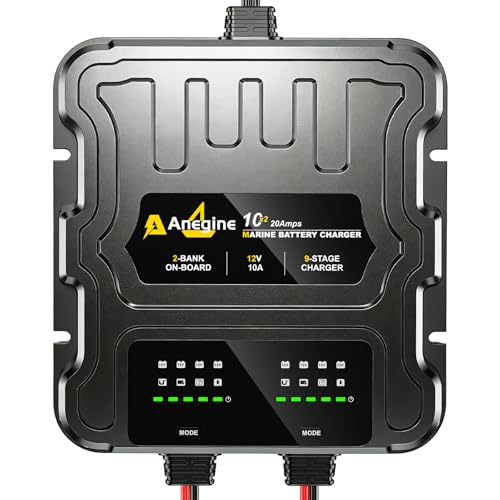
anegine 2 Bank Marine Battery Charger, 20A (10A/Bank) 12V IP68
The Strengths Of Each Pick
The NOCO GEN5X2 is the kind of onboard charger that disappears into a console or splashwell after install, then quietly does its job for years. The fully-sealed IP68 housing shrugs off spray and washdowns, which matters on bay boats where the charger lives inches from the bilge. Each bank puts out 5 amps independently, so a starting battery and a small trolling motor bank both stay topped without babysitting.
Where this unit shines is in tight installations. Compared with the bulkier Minn Kota MK-220PCL later in the list, the GEN5X2 trades raw amperage for a noticeably smaller footprint. Owners running flooded, AGM, gel, or lithium (LiFePO₄, the safe lithium chemistry for marine use) get a single chemistry profile per bank, which keeps setup simple.
Points In Its Favor
- IP68 fully-sealed housing tolerates wet lockers and salt spray
- Independent bank control so a weak starting battery cannot starve the house bank
- Compact form factor fits consoles and splashwells where bulkier units will not
- Multi-chemistry support covers flooded, AGM, gel, and lithium without a second charger
- Built-in temperature compensation adjusts charge voltage as conditions change
Soft Spots
- 5 amps per bank is light for large house banks used heavily overnight
- No LCD readout, so you rely on indicator lights for charge status
Built With In Mind
Skiff and bay boat owners running two modest 12V banks who want a sealed, set-and-forget charger in a tight space.
Where Another Pick Suits Better
If your house bank routinely drops below half overnight, the NOCO GENPRO10X2 (Pick 3) pushes 10 amps per bank and recovers deep cycles much faster.
Minn Kota’s Precision MK-220PCL targets anglers who push their trolling motor hard and want a charger that knows the difference between a flooded deep-cycle and a modern LiFePO₄ house bank. Each bank outputs a full 10 amps, and you can pick a charge profile per bank rather than choosing one chemistry for the whole unit. That is a real edge when one side is a starting battery and the other is a lithium trolling bank.
Where this charger earns its place is recovery speed. After a long day running a 24V or 36V trolling system off a single 12V source (with the second 12V in series), the MK-220PCL pushes 10 amps to each bank, cutting dock time noticeably. Compared with the smaller NOCO GEN5X2 at Pick 1, this is a step up in amperage but also a noticeably larger physical footprint.
Noteworthy Benefits
- Per-bank chemistry selection matches starting and house banks independently
- 10 amps per bank returns deep-cycle batteries to full charge in a reasonable window
- Lithium-optimized profile suits LiFePO₄ house banks without manual tweaks
- Well-regarded brand support network in the trolling motor community
- Marine-rated build stands up to long seasons at the ramp
Things To Consider
- Bulkier than compact NOCO GEN5X2 (Pick 1), so plan mounting space
- Higher output generates more heat in enclosed compartments
Whose Tackle Box It Belongs In
Anglers running Minn Kota or similar trolling motors who want one charger that handles a flooded starting battery and a LiFePO₄ house bank on separate profiles.
Consider Something Else When
If you do not need lithium-specific profiles and just want the cheapest sealed 2-bank charger for a small skiff, the FirstPower Pro 5X2 (Pick 8) is a more focused fit.
The GENPRO10X2 is the GEN5X2 grown up: same sealed IP68 housing, same multi-chemistry brain, but with 10 amps per bank instead of 5. That extra headroom changes how you use the boat. A house bank drained by a fridge, lights, and an inverter can come back to full overnight, where a 5-amp charger would still be climbing to absorption (the long, lower-current phase of a charge cycle) by morning.
You will notice the case is heavier and runs warmer than Pick 1. That is normal for the extra power density and is why mounting in a ventilated area, not a sealed foam-filled compartment, is wise. For boaters stepping up from a single-bank charger or a tired old Guest or ProMariner unit, this is the kind of upgrade that pays for itself the first time the house bank actually reaches 100%.
Reasons It Performs
- 10 amps per bank cuts charge times on mid-sized house banks
- Sealed IP68 housing survives spray and damp bilges
- Independent charging for flooded, AGM, gel, and lithium
- Repair-mode function can help recover deeply discharged batteries
- Temperature compensation protects batteries in engine rooms and warm climates
Honest Caveats
- Heavier than the compact GEN5X2 (Pick 1) and needs solid mounting
- Overkill for a single trolling motor and small electronics load
The Right Fit
Boaters with mid-sized house banks, electric anchors, and inverter loads who need real recovery amperage, not just maintenance charging.
Look Elsewhere When
For three-battery offshore rigs with bigger house banks, the NOCO GENPRO10X3 (Pick 5) gives you the same per-bank amps with an extra output.
ProMariner’s ProSport 20 has been a marina workhorse for years, and the Gen 3 version keeps that reputation intact. The standout feature is Distributed on Demand, which sends 100% of available amps to any battery that needs them, then redistributes as conditions equalize. For boaters who keep mismatched batteries (an older starting battery next to a fresh house bank) that flexibility prevents the strong bank from hogging the charge.
The dual 12/24V capability also makes this charger genuinely useful on outboards and dual-battery setups where the system voltage varies. Compared with the all-newer NOCO GENPRO10X2 at Pick 3, the ProMariner trades fancy indicators for a proven analog display and a more conventional fan-cooled housing.
A Favorable Mix
- Distributed on Demand automatically balances amp output between banks
- Compatible with 12V and 24V system configurations
- Clear status indicators flag wiring and battery faults at a glance
- Lightweight aluminum housing dissipates heat well
- 20-amp total output handles mid-sized house banks comfortably
Worth Noting
- Not a fully-sealed unit, so mounting location matters in wet bilges
- Fan-cooled design adds a moving part that can fail in dusty environments
Made For
Boaters running mixed-age battery banks who want automatic current balancing without constant manual monitoring.
Not Your Match When
If your install lives in a damp splashwell or under a leaning post exposed to spray, the sealed NOCO GENPRO10X2 (Pick 3) is a safer sealed-housing alternative.
The GENPRO10X3 sits one rung above the 2-bank GENPRO10X2 (Pick 3), trading the 20-amp total for 30 amps across three independent outputs. That extra bank is the difference between a charger you can use and a charger that actually fits a center console with a starting battery, a house bank, and a trolling motor bank on dedicated circuits. Each bank still puts out 10 amps, so you are not giving up per-bank performance to get the third output.
The housing is fully potted, meaning the electronics are encased in epoxy or a similar compound that locks out moisture and vibration, with an IP68 rating, which suits the rough life of a saltwater offshore bracket. Compared with the anegine 3-bank options later in the list, the NOCO carries a longer track record in pro circles and costs a bit more for that confidence.
A Few Highlights
- Three independent 10-amp banks handle starting, house, and trolling separately
- IP68 sealed housing stands up to saltwater spray and dunking
- Multi-chemistry support for flooded, AGM, gel, and lithium
- Compact for a 3-bank unit, fitting where older 3-bank chargers will not
- Repair mode can recover deeply discharged batteries that other chargers will not touch
Trade-Offs
- Pricier than budget 3-bank units like the anegine 3 Bank 5A/Bank (Pick 6)
- Requires three dedicated battery leads routed to the bank locations
Best Suited To
Center console and offshore owners running three battery banks who want sealed, name-brand reliability over budget savings.
A Better Fit Elsewhere
If a 3-bank charger is overkill for two batteries, the NOCO GENPRO10X2 (Pick 3) gives the same per-bank amps with one fewer output.
The anegine 3-bank 5A/Bank unit brings three charging channels and an LCD screen to a much lower cost than the name-brand competition. For owners who want each battery on its own independent circuit without paying for NOCO-level branding, this is a sensible middle ground. The IP68 sealed housing and multi-chemistry support check the same boxes as more established options.
Where it falls behind is recovery speed. Five amps per bank is fine for maintenance and gentle recharges, but a deeply drained house bank will take a long evening on the dock. The LCD readout is genuinely handy for checking status at a glance, something missing on the NOCO GEN5X2 at Pick 1.
Where It Excels
- Three independent 5-amp banks cover starting, house, and accessory banks
- Built-in LCD display shows charging status without indicator-light guessing
- IP68 sealed housing handles splashwell and bilge mounting
- Multi-chemistry support covers flooded, AGM, gel, and lithium
Soft Spots
- 5 amps per bank is light for any deeply discharged house bank
- Brand is newer with a thinner long-term reputation track record
Who Should Grab It
Multi-battery setups on a tight budget where maintenance charging matters more than fast recovery, like pontoons and runabouts.
Skip It When
For faster recovery on bigger house banks, the anegine 3 Bank 10X3 at Pick 7 doubles the per-bank amps for only a modest step up in cost.
The 10X3 is what happens when you take the budget-friendly 3-bank concept from Pick 6 and give it 10 amps per bank. That bump turns a maintenance charger into something that can actually recover a tired house bank overnight. For larger pontoons and cruisers with three batteries and heavier accessory loads, this fills a real gap between the anegine 5-amp unit and the pricier NOCO 3-bank option.
The trade-off shows up in heat output and the need for adequate ventilation. A 30-amp 3-bank charger under full load runs warm, so sealed foam compartments are off the table. For most installs, a vented lazarette or under-console area works well.
The Helpful Details
- 10 amps per bank recovers deep-cycle house banks in reasonable time
- Three independent banks isolate starting, house, and trolling circuits
- Sealed housing rated for marine bilge and splashwell environments
- Multi-chemistry compatibility covers most common marine battery types
A Few Limitations
- Generates more heat than 5-amp-per-bank units and needs ventilation
- Newer brand means fewer long-term reliability data points
Perfect Match For
Larger pontoons and trailerable cruisers with three batteries who want faster charging without the NOCO price premium.
Reach For A Different Pick When
If brand reputation and pro-grade sealing matter most for a saltwater application, the NOCO GENPRO10X3 (Pick 5) is the safer long-term call.
FirstPower Pro’s 5X2 is the chemistry-flexible option in this list, offering three selectable charge modes (SLA/AGM, lithium, and calcium, an older lead-acid formulation that needs a higher absorption voltage) on top of the standard IP68 sealed housing. For owners running mixed or older battery types, that flexibility can matter more than raw amperage. Each bank outputs 5 amps, which is plenty for maintaining batteries between trips.
The honest read is that this unit prioritizes versatility over speed. Boaters who routinely discharge deep-cycle banks overnight will want more amps per bank. For towboats, garage-kept runabouts, and smaller setups where batteries sit topped up between weekends, the lower output is rarely the limiting factor.
Key Advantages
- Three selectable chemistry modes handle mixed and older battery types
- Sealed IP68 housing tolerates wet lockers and engine bays
- Independent bank control prevents cross-discharge issues
- 24/7 maintenance mode keeps batteries topped during storage
Soft Spots
- 5 amps per bank is modest for big house banks used hard overnight
- Mode-switching requires user attention to chemistry selection
Who Will Love This
Garage-kept boats and tow vehicles with mixed battery chemistries where maintenance charging is the primary job.
Not Your Match When
For lithium-only setups needing a higher 14.6V absorption target, the LiTime 2 Bank LiFePO₄ Charger (Pick 9) is purpose-built for that chemistry.
The LiTime 2 Bank charger is built for one job: charging 12V LiFePO₄ batteries to their full 14.6V absorption target. That voltage is critical for unlocking the full capacity of a LiFePO₄ cell, and chargers designed for lead-acid chemistries often top out lower and leave lithium banks sitting at 80-90% capacity indefinitely. For all-lithium setups, this matters more than a brand-name badge.
The wide 90-260V AC input range is genuinely useful for international travel or generator-powered shore charging. Owners commonly report that the 15A fused wall cord adds a layer of safety when running off household outlets. Compared with the multi-chemistry NOCO GENPRO10X2 at Pick 3, this unit trades flexibility for laser focus on lithium.
What Works In Its Favor
- 14.6V output reaches full LiFePO₄ capacity, unlike lead-acid chargers
- 10 amps per bank charges lithium banks at a reasonable rate
- Wide input voltage range works with generators and shore power worldwide
- Sealed waterproof housing suits marine and RV environments
- 15A fused wall cord adds safety on household outlets
Points To Keep In Mind
- LiFePO₄-only profile means flooded or AGM batteries should not use it
- Limited brand track record compared with NOCO or Minn Kota
Built With In Mind
Anglers and boaters who have committed to LiFePO₄ house banks and want a charger that actually finishes the job.
Look Elsewhere When
For mixed lead-acid and lithium banks, the Minn Kota MK-220PCL (Pick 2) lets you select chemistry per bank.
This anegine 2-bank unit delivers the same 10 amps per bank as the NOCO GENPRO10X2 (Pick 3), then adds an LCD display for live status readouts. For owners who like to glance at a screen and see voltage and charge stage per bank, that display is a real convenience over the indicator-light approach used by NOCO. The IP68 sealed housing and multi-chemistry support cover the same bases as more expensive competitors.
Where the trade-off sits is in long-term track record. anegine is a newer entrant compared with NOCO or ProMariner, so there are fewer multi-season reliability reports to draw from. For boaters who replace chargers every few years as part of a battery upgrade cycle, that is rarely a deal-breaker.
What Earns Its Place
- 10 amps per bank matches premium NOCO output at lower cost
- LCD display shows per-bank voltage and charge stage at a glance
- IP68 sealed housing fits splashwell and bilge installs
- Multi-chemistry support covers flooded, AGM, gel, and lithium
- 240W total output handles mid-sized house banks efficiently
Honest Caveats
- Brand is newer with thinner long-term reliability data than NOCO
- LCD adds complexity that can fail in extreme conditions
The Right Fit
Mid-sized house bank owners who want premium-tier amps per bank with a visible status display at a competitive cost.
Where Another Pick Suits Better
For owners who prefer a more established brand with longer reliability history, the NOCO GENPRO10X2 (Pick 3) is the conservative choice at a similar amp output.
Choosing The Right 2 Bank Marine Battery Charger For Your Boat
Match Amperage To Your House Bank Size
The rule of thumb many boaters follow is choosing a charger that delivers 10% to 20% of your house bank’s amp-hour capacity per bank. A 100Ah house bank paired with a trolling circuit feels right on a 10-amp charger, while a small starter battery barely notices a 5-amp output. The compact NOCO GEN5X2 (Pick 1) handles modest loads fine, but a deeply discharged bank on a 5-amp charger can take the better part of a day to recover. For bigger house banks or heavy overnight use, stepping up to 10 amps per bank from a unit like the NOCO GENPRO10X2 (Pick 3) or the anegine 20A unit at Pick 10 cuts dock time dramatically.
Confirm Chemistry Support Before You Buy
Lithium (LiFePO₄) batteries charge to a higher voltage (around 14.6V) than flooded or AGM lead-acid batteries, so a charger built for one chemistry may undercharge the other. For mixed banks, look for per-bank chemistry selection, which the Minn Kota MK-220PCL (Pick 2) offers. For pure lithium setups, a dedicated charger like the LiTime 2 Bank LiFePO₄ unit (Pick 9) reaches the full absorption voltage that multi-chemistry chargers sometimes miss. Lead-acid-only boats have more flexibility and can prioritize raw amps or sealing over chemistry switching.
Sealing And Mounting Location Matter In Saltwater
IP68 means the unit can handle submersion, which is the standard you want for any marine install exposed to spray or sitting low in the bilge. Sealed units like the NOCO GEN5X2 and GENPRO10X2 (Picks 1 and 3) survive wet compartments far better than fan-cooled models like the ProMariner ProSport 20 (Pick 4), which performs best in a drier, vented locker. Saltwater anglers should treat sealed construction as non-negotiable; brackish and freshwater boaters have more flexibility, but sealing still extends charger life.
Choose Independent Bank Control For Mixed-Age Banks
Batteries of different ages or states of charge pull current unevenly. Chargers with truly independent outputs (most modern onboard units) prevent a healthy bank from sitting idle while a weak bank hogs all the amperage. The ProMariner’s Distributed on Demand system (Pick 4) automates this balancing for you, while simpler independent outputs on the NOCO and anegine models achieve a similar result through per-bank charging stages. Boaters running banks of different ages or capacities benefit most from this feature.
Smart Strategies Before You Buy
Where Shoppers Go Wrong
The most common slip is buying a charger based on total amps rather than amps per bank. A 20-amp 2-bank unit that delivers 10 amps per bank is meaningfully different from a 20-amp unit that splits unevenly or sends only 5 amps per side. Another trap is assuming any “marine” charger handles lithium, when in fact many lead-acid-targeted chargers top out at voltages that leave LiFePO₄ banks undercharged. Always confirm the chemistry list and the per-bank output before committing, especially for boats running mixed banks or new lithium upgrades.
The Upgrade Payoff
Spending up on a higher-amperage, sealed, multi-chemistry charger like the NOCO GENPRO10X2 (Pick 3) or the LiTime lithium-focused unit (Pick 9) pays off the first time your house bank reaches full charge overnight rather than limping to 80% by morning. The jump from a basic fan-cooled unit to a fully potted sealed charger also extends service life in saltwater environments, where corrosion kills lower-tier electronics in a few seasons. For boaters who keep their rigs more than three or four years, the upgrade usually pencils out in avoided replacements and longer battery life.
Frequently Asked Questions
How Many Amps Per Bank Do Most 2 Bank Marine Chargers Deliver?
Most 2 bank chargers deliver either 5 amps per bank for maintenance-focused units or 10 amps per bank for faster recovery. Pick a higher-amperage model when your house bank regularly drops below half overnight. Lower-amperage units work fine for keeping topped-off batteries healthy between trips.
Can A 2 Bank Charger Handle Lithium Batteries?
Many can, but only if the charger explicitly lists lithium or LiFePO₄ support and reaches the required 14.6V absorption voltage. Lead-acid-only chargers will leave lithium banks undercharged. The LiTime 2 Bank LiFePO₄ Charger (Pick 9) and the Minn Kota MK-220PCL (Pick 2) both address lithium correctly, with the LiTime unit dedicated to that chemistry alone.
Do I Need A Waterproof Charger For An Enclosed Bilge?
Enclosed bilges collect moisture from condensation, washdowns, and the occasional leak, so a sealed IP68 charger is the safer choice even in supposedly dry installs. Fan-cooled or non-sealed units like the ProMariner ProSport 20 (Pick 4) work in vented lockers but suffer in damp compartments. For saltwater trailers and splashwell mounts, fully sealed is essentially mandatory.
Is A 2 Bank Charger Enough For A Boat With Three Batteries?
Not quite. A 2 bank charger handles two batteries independently; a third battery usually needs its own bank, which means stepping up to a 3-bank model like the NOCO GENPRO10X3 (Pick 5) or one of the anegine 3-bank options (Picks 6 and 7). Some owners parallel two batteries on one bank, but that defeats the per-bank monitoring most chargers provide.
How Long Does It Take To Charge A Deeply Discharged House Bank?
Charge time depends on bank size and charger output. A 100Ah house bank discharged to 50% needs to absorb about 50Ah; a 10-amp-per-bank charger recovers that in roughly five to six hours of bulk charging (the high-current first phase), plus several more hours of absorption. A 5-amp-per-bank unit can take the better part of a day under the same conditions.
Closing Thoughts
Your battery bank setup, water environment, and how hard you run accessories between trips should drive the choice more than any single spec sheet. Compact boaters with modest house banks and saltwater exposure tend to land on sealed 5-amp units like the NOCO GEN5X2, while anglers and cruisers with lithium banks gravitate toward purpose-built or per-bank-selectable chargers. Whatever you choose, mounting in a dry, ventilated spot with proper fusing will outlast any brand-name badge on the box.