A dead battery on a Saturday morning ride is the kind of problem you solve once, not twice. Choosing the right 12v motorcycle battery comes down to matching your bike’s specs, climate, and how often you ride. This roundup breaks down nine sealed, maintenance-free options across lead-acid AGM, gel, and lithium formats, so you can find the right pick for your scooter, ATV, or sport bike without second-guessing the fit.
The Leading Options At A Glance

KMG YT12C Battery for Yamaha YFA-1 Breeze 125cc

Mighty Max YTX7A-BS GEL for Suzuki LTZ90 Quad
Mighty Max YB9A-A for Suzuki LT-F 160 M
Mighty Max YB9A-A for Suzuki LT160 E QuadRunner

Mighty Max YTX6.5L-BS SLA AGM 12V Battery

MotoBatt MBTX4U 12V 4.7Ah AGM Battery

TYKOOL LFP9-BS-STD Lithium Powersports Battery

TYKOOL LFP14-BS-STD Lithium ATV/UTV Battery
Mighty Max YTX9-BS for Kawasaki Ninja 300
Taking A Closer Look At The Options
Vintage Yamaha Breeze 125cc riders know the pain of tracking down a battery that actually matches a discontinued quad. KMG’s YT12C sits in that rare sweet spot, factory-sealed so you skip the acid-filling dance entirely, and built around lead-calcium chemistry that holds voltage through long winters in the garage. Compared to the lithium options that come later in this list, this one trades weight savings for predictable, budget-friendly replacement.
For owners of 1989-2004 YFA-1 Breezes, the YT12C form factor drops in without modification. In typical riding scenarios (short trail loops, seasonal yard work, light farm duty), the sealed design means you install it once and largely forget about it, which is exactly what a maintenance-free battery should do.
The Helpful Details
- Sealed AGM construction eliminates electrolyte top-offs entirely.
- Lead-calcium plates hold charge longer during storage than conventional lead-antimony designs.
- Drop-in fit for 1989-2004 Yamaha YFA-1 Breeze 125cc models.
- Resists vibration on rough trails better than flooded batteries.
Things To Consider
- Heavier than lithium alternatives if weight matters for your setup.
- Battery life on vintage quads often depends on charging-system health, so a weak stator can shorten service life.
At A Glance
Made For
Vintage Yamaha Breeze 125cc owners who want a sealed, low-maintenance replacement that fits without modification.
Consider Something Else When
Riders chasing serious weight savings should look at the TYKOOL LFP9-BS-STD Lithium Powersports Battery instead.
Where the KMG YT12C targets vintage Yamaha quads, this Mighty Max unit addresses a different problem: a Suzuki LTZ90 or LTR 450 that sits through cold months between rides. The gel-electrolyte formula (where the acid is suspended in a thick paste rather than liquid) gives this battery a slower self-discharge rate than conventional AGM, so it holds voltage longer in storage. That’s the kind of detail that matters when you only fire up your quad a handful of times each season.
The non-spillable gel also reduces leak risk on aggressive terrain, which owners commonly report as a meaningful upgrade over older flooded designs. At 6Ah and 105 CCA, it’s a moderate-output battery best suited to smaller-displacement quads rather than big V-twin bikes.
Useful Touches
- Slower self-discharge rate than AGM means longer storage readiness.
- Non-spillable gel paste reduces leak risk on side-hill or rough trails.
- Works across wider temperature ranges than standard lead-acid batteries.
- Maintenance-free sealed design, no electrolyte checks needed.
Trade Offs
- Lower CCA than the larger YTX9-BS models reviewed later, so not ideal for high-compression engines.
- Gel batteries need a compatible charger; using a standard lead-acid charger at high rates can shorten life.
Who It Suits Best
Suzuki LTZ90 and LTR 450 owners who ride seasonally and need a battery that holds charge through off-months.
Look Elsewhere When
Big-displacement riders should reach for the Mighty Max YTX9-BS SLA Battery for Kawasaki 300 EX300 Ninja instead, since it delivers higher cranking amps.
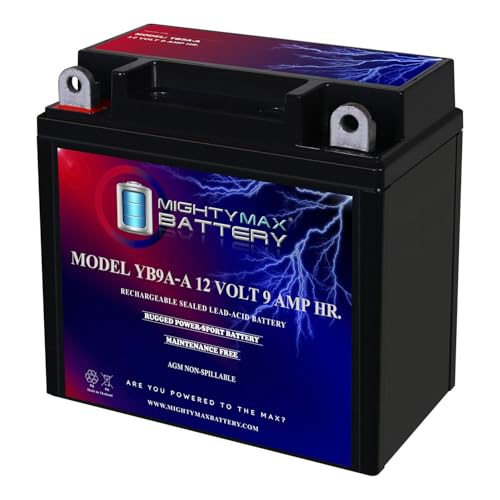
This Mighty Max YB9A-A is built for a very specific use case: getting a 1991 Suzuki LT-F 160 M back on the trail without rewiring the harness. At 9Ah and 130 CCA, it offers noticeably more cranking muscle than the smaller YTX7A-BS gel unit covered earlier, which makes it a better match for older bikes with less efficient starters. The SLA/AGM (sealed lead-acid, absorbed glass mat) spill-proof design also means you can mount it in various positions, handy when the factory battery tray has rusted out.
The trade-off shows up in weight: at 5.30 x 3.00 x 5.25 inches with positive terminal on the left, this is a chunkier battery than the lithium options on this list. For most yard, farm, and trail applications, that bulk is the cost of dependable lead-acid reliability.
Benefits That Matter
- 130 CCA delivers solid cranking for older small-displacement engines.
- Spill-proof SLA/AGM construction allows flexible mounting orientation.
- Recovers from deep discharge better than many flooded batteries.
- Backed by a one-year manufacturer warranty.
Worth Noting
- No wire harness or mounting accessories included, so you may need to reuse existing hardware.
- Heavier than lithium alternatives like the TYKOOL LFP9-BS-STD covered later in this roundup.
Right Fit For
1991 Suzuki LT-F 160 M owners who want a direct-fit replacement with stronger cranking than smaller-capacity batteries.
A Better Fit Elsewhere
Weight-conscious riders get more value from the TYKOOL LFP14-BS-STD Lithium Battery, which cuts roughly 8 lbs versus comparable lead-acid units.
Nearly identical in spec to the YB9A-A reviewed just above, this version is tailored to the 2003 Suzuki LT160 E QuadRunner, so you skip the part-number cross-reference step. Same 9Ah capacity, same 130 CCA, same SLA/AGM sealed construction. For owners of that specific model year, that spec matchup is the entire value proposition.
In real-world use, this battery behaves the same as its sibling: reliable cold cranking for a 160cc engine, vibration resistance for trail riding, and the convenience of a maintenance-free design. The one-year warranty is standard for the Mighty Max lineup.
Well-Handled Touches
- Confirmed fit for 2003 Suzuki LT160 E QuadRunner, no guesswork on dimensions.
- High-discharge rate handles starter loads without voltage sag.
- Wide operating temperature range suits both summer and winter riding.
- Sealed AGM design resists shock on uneven terrain.
Honest Caveats
- No wire harness included; reusing factory cables is necessary.
- Lead-acid weight is meaningful compared to the lithium options covered later.
Best Suited To
2003 Suzuki LT160 E QuadRunner owners who want a plug-and-play replacement sized correctly for their model.
Swap It Out When
Riders running a 2003 LT160 with accessories like a winch should consider the higher-output TYKOOL LFP14-BS-STD Lithium Battery instead.
Shifting from quads to smaller street bikes, the YTX6.5L-BS fills a tight slot. At 5.42 x 2.60 x 3.98 inches with positive on the right and negative on the left, it tucks into the battery compartments of many small-displacement scooters, dual-sports, and entry-level motorcycles. The 70 CCA output is on the modest side, but for engines under 250cc with light starter loads, that’s usually enough headroom.
What sets this apart from the larger Mighty Max units is its compact footprint without sacrificing the maintenance-free convenience of AGM. Owners of bikes with limited battery tray space commonly find this size a clean fit where full-size Yuasa-equivalent batteries won’t drop in cleanly.
Reasons It Performs
- Compact dimensions suit tight battery compartments on small bikes.
- Sealed AGM construction means zero maintenance once installed.
- Mounts in any orientation without leak risk.
- Recovers from deep discharge better than typical flooded cells.
Points To Note
- 70 CCA limits it to smaller engines; not suitable for large V-twins.
- Listing ships battery and screws only, so plan to reuse existing wiring hardware.
At A Glance
Who Will Love This
Scooter riders and small-displacement motorcycle owners who need a compact, maintenance-free drop-in battery.
Another Choice May Suit
Sport bike riders wanting more cranking headroom will find the TYKOOL LFP9-BS-STD Lithium Powersports Battery a more capable upgrade.
MotoBatt takes a different approach than the Mighty Max lineup. The MBTX4U uses more lead per cell than most comparable batteries, and it arrives fully charged, so installation is closer to plug-and-play than the unsealed replacements of years past. It cross-references to the YTX4L-BS, YT4L-BS, YB4L-A, and YB4L-B, covering a wide range of small-bike models.
For commuters and frequent riders, the practical upside is reliability over time. The sealed AGM design tolerates vibration on rough roads, and the two-year replacement warranty signals the manufacturer expects it to last. It’s a sensible upgrade over the cheapest off-brand replacements if you ride daily.
Standout Benefits
- Higher lead content per cell extends cycle life versus budget replacements.
- Arrives fully charged, no initial break-in or electrolyte filling required.
- Cross-references to multiple Yuasa part numbers for broad compatibility.
- Two-year replacement warranty from MotoBatt.
Smaller Limitations
- 4.7Ah capacity is on the low side, so it suits smaller engines rather than touring bikes.
- Heavier than the lithium options like the TYKOOL LFP9-BS-STD covered later in this roundup.
Feature Snapshot
Perfect Match For
Daily commuters on small-displacement bikes who want a maintenance-free battery that arrives ready to install.
Reach For A Different Pick When
Riders running a larger engine needing 400+ CCA should consider the TYKOOL LFP14-BS-STD Lithium Battery instead.
The first lithium entry in this roundup marks a sharp shift in philosophy. Where the Mighty Max and KMG batteries trade weight for cost, the TYKOOL LFP9-BS-STD uses LiFePO4 (lithium iron phosphate) chemistry that weighs roughly a third of an equivalent lead-acid unit. That matters for sport bike riders chasing flickability on twisty roads or racers trimming every gram.
The IP66 rating (meaning dust-tight and protected against powerful water jets) is a meaningful upgrade for wet-weather riders, and the integrated digital volt readout lets you check state-of-charge at a glance. The 240 CCA output delivers strong cranking even in cool weather, and the deep-cycle rating exceeds traditional lead-acid by a wide margin.
The Upside
- About one-third the weight of comparable lead-acid batteries.
- 240 CCA delivers instant cranking for mid-size sport bike engines.
- IP66 rating handles rain, splashes, and pressure-washer proximity.
- Digital voltage readout built into the top of the case.
- 2,000+ deep cycles versus roughly 300 for typical AGM.
A Few Limitations
- More expensive per unit than lead-acid replacements, depending on retailer.
- Some older bikes with basic charging systems may need a lithium-compatible regulator to avoid overcharging.
Quick Facts
Built With In Mind
Sport bike riders running Ninja 400, Z650, CBR600F4i, KTM Duke 390, GSX-R600, or similar mid-displacement machines who want meaningful weight savings.
Skip It When
Big-touring or ATV owners should consider the TYKOOL LFP14-BS-STD Lithium Battery for higher capacity output.
Scaling up from the LFP9, the LFP14-BS-STD is built for serious cranking loads. At 400 CCA and 8Ah, it has the muscle to start big-displacement adventure twins, side-by-side UTVs, and high-compression ATV engines. It drops roughly 8 lbs compared to a stock YTX14-BS lead-acid unit, which lowers the center of gravity on touring bikes noticeably.
The digital readout and IP66 rating carry over from its smaller sibling, so you get the same weatherproofing and on-battery diagnostics. For Honda Rancher 420, Foreman 500, or Kawasaki Brute Force 750 owners, this is a credible upgrade over the OEM battery once the lead-acid unit starts showing its age.
Positive Takeaways
- 400 CCA handles large-displacement twin and V-twin engines.
- Cuts around 8 lbs compared to a comparable YTX14-BS lead-acid battery.
- IP66 housing stands up to mud, rain, and trail spray.
- Digital voltage readout simplifies pre-ride checks.
Where It Is Less Suited
- Higher upfront cost than lead-acid replacements.
- Some charging systems on older UTVs may need a voltage regulator upgrade to play nicely with lithium chemistry.
Core Details
Whose Shelf It Belongs On
Adventure riders, ATV, and UTV owners running Honda Rancher 420, Foreman 500, or Kawasaki Brute Force 750 platforms who want lighter weight and stronger cranking.
Not Your Match When
Small-displacement commuters are better served by the lighter and less expensive Mighty Max YTX6.5L-BS SLA AGM Battery.
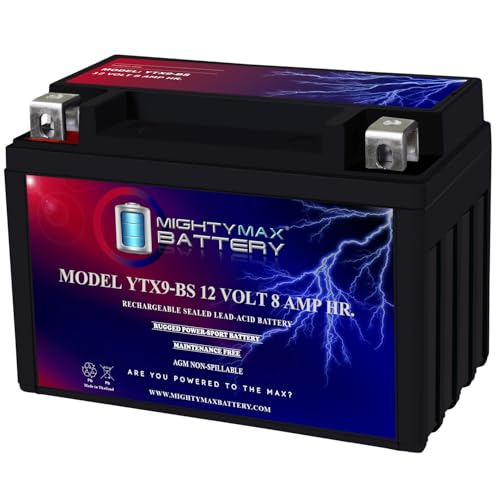
Closing out the roundup is a battery tuned specifically for the 2015-2016 Kawasaki Ninja 300 ABS. The YTX9-BS delivers 8Ah and 135 CCA, which is the right output range for a 300cc parallel twin with ABS load demands. The sealed SLA/AGM design handles vibration from sport riding and recovers from deep discharge better than older flooded units.
For Ninja 300 riders specifically, this is a confirmed-fit option that drops into the stock battery tray. The one-year warranty is standard, and the maintenance-free design means once it’s in, you only need to remember seasonal charging if you let the bike sit.
Useful Strengths
- 135 CCA handles the Ninja 300’s parallel-twin starter load with room to spare.
- Sealed AGM construction mounts in any position without leak risk.
- Wide operating temperature range for year-round riding.
- One-year manufacturer warranty included.
Things To Weigh
- Heavier than the lithium equivalents from TYKOOL covered earlier.
- No wire harness included; reuse factory cables and hardware.
Who Should Grab It
2015-2016 Kawasaki Ninja 300 ABS owners who want a direct-fit, no-fuss replacement from a familiar lead-acid format.
Where Another Pick Suits Better
Riders looking to shed weight from their Ninja 300 should look at the TYKOOL LFP9-BS-STD Lithium Powersports Battery instead.
What Matters Most When Picking A 12v Motorcycle Battery
Match The Part Number First
The single biggest mistake you can make is ordering a battery that doesn’t physically fit. Measure your existing battery’s length, width, and height, then check the terminal polarity before clicking through. The Mighty Max YTX9-BS for the Kawasaki Ninja 300 and the KMG YT12C for the Yamaha Breeze both demonstrate how model-specific these replacements can be.
Cold Cranking Amps And Capacity
Cold Cranking Amps (CCA) measures how much current a battery can deliver at 0°F for 30 seconds while staying above a minimum voltage. Capacity, measured in amp-hours (Ah), tells you how long the battery can run accessories with the engine off. For cold-climate riders or larger engines, prioritize higher CCA. For bikes with winches or heated gear, prioritize higher Ah.
AGM, Gel, And Lithium Tradeoffs
AGM batteries (like the Mighty Max YB9A-A units) are the mainstream choice: affordable, vibration-resistant, and broadly compatible. Gel batteries (like the Mighty Max YTX7A-BS) hold charge longer off-season. Lithium batteries (like both TYKOOL models) cut weight dramatically and last more cycles, but cost more upfront and may need charging-system upgrades on older bikes.
Climate And Riding Frequency
Cold winters push the value of higher CCA. Long storage periods between rides favor gel or lithium chemistries with low self-discharge. Daily commuters benefit most from the higher cycle life of lithium or premium AGM units like the MotoBatt MBTX4U.
Key Considerations Across These Picks
Pitfalls First Timers Often Hit
The most common buying mistake is chasing the cheapest replacement without checking dimensions or terminal polarity. A battery that’s 0.5 inches too tall won’t seat in the tray. Polarity reversed can short your electrical system during installation. Cross-reference your bike’s OEM part number, then confirm the physical measurements before ordering.
What The Higher Tier Buys You
Premium lithium batteries like the TYKOOL LFP9-BS-STD and LFP14-BS-STD deliver three things at once: roughly two-thirds the weight of lead-acid equivalents, 2,000+ deep cycles versus 300 for typical AGM, and built-in voltage readouts. The trade-off is the price tag and the occasional need for a lithium-compatible charging system. For frequent riders, commuters, and anyone trimming weight on a sport bike or adventure rig, the upgrade typically pays for itself in lifespan.
Frequently Asked Questions
How long does a 12v motorcycle battery typically last?
Sealed AGM and gel batteries generally last three to five years with regular use, while lithium batteries can stretch beyond that with proper charging-system compatibility. Storage habits and climate both affect actual lifespan.
Can I use a lithium battery in an older bike designed for lead-acid?
Often yes, but some older bikes with basic regulators may need a lithium-compatible charging controller to avoid overcharging. Checking your stator output voltage is worth the ten minutes before committing.
What does CCA mean for a motorcycle battery?
Cold Cranking Amps (CCA) measures the current a battery delivers at 0°F for 30 seconds. Higher CCA means stronger starting power in cold weather or for high-compression engines.
Is a higher Ah rating always better?
Not necessarily. Higher amp-hours (Ah) means longer accessory runtime but often comes in a larger physical case. Match Ah to your bike’s battery tray size and your typical accessory load.
Do these batteries ship fully charged?
Most sealed AGM and gel units ship ready to install. Lithium batteries also arrive charged but benefit from a top-off charge before first use if they’ve been sitting in inventory.
Closing Remarks
The right 12v motorcycle battery comes down to matching your bike’s part number, choosing the right chemistry for your climate, and sizing CCA to your engine. For vintage Yamaha and Suzuki quad owners, the KMG and Mighty Max lead-acid units offer proven reliability. For sport bike and adventure riders chasing weight savings, the TYKOOL lithium models deliver meaningful performance gains. Use this roundup as a starting point, confirm your fitment, and pick the chemistry that fits how and where you actually ride.