Anyone who flies RC drones, services car batteries, or maintains a fleet of vehicles eventually runs into the same wall: you need to know what’s actually inside a battery before trusting it. A solid capacity tester tells you whether a LiPo pack is balanced before flight, whether your car battery will survive another winter, or whether that “dead” battery just needs a slow top-off. The picks below split into two camps, RC hobby cell meters for hobbyists, and heavy-duty 12V/24V automotive analyzers for shops and daily drivers. Either way, the right tool turns guesswork into a five-second readout.
A Fast Comparison Of The Options

RC CellMeter-7 Digital Battery Capacity Checker

ANCEL BST600 12V/24V Lead-Acid Battery Tester

SUPULSE LiPo Battery Checker Tester

RC Cellmeter 7 Digital Battery Capacity Checker
Blomiky 5-in-1 LiPo/Li-ion Battery Balancer

ANCEL BA101 Plus 6V/12V Car Battery Tester

ANCEL BA101PRO 12V/24V Battery Tester

ANCEL BA101 12V Car Battery Tester

FLY RC Cellmeter 7 Digital Capacity Checker

ANCEL BT521 12V Tester & Smart Maintainer
A Closer Look At Each Pick
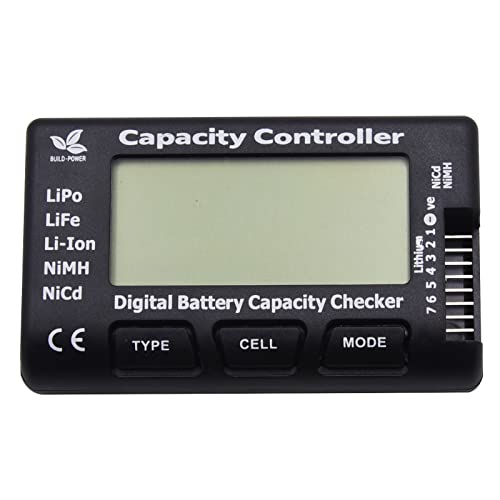
The RC CellMeter-7 by FPVKing is the kind of small, inexpensive cell checker that lives in a flight bag rather than on a workbench. It plugs directly into a balance lead, reads each cell’s voltage, and shows you the pack total in a couple of seconds. For drone racers and RC car owners who treat batteries as disposable, that’s exactly enough information to know whether a pack is safe to run.
It handles the usual chemistries: LiPo, LiFe, Li-ion, NiMH, and NiCd, so most hobby packs are covered. The screen is small but legible at arm’s length, and the device itself weighs almost nothing. Owners commonly report that the unit feels light enough to toss in a backpack without thinking about it.
Benefits That Matter
- Reads NiCd and NiMH packs from 4 to 7 cells and lithium packs from 2 to 7 cells, covering nearly every common hobby format.
- Lightweight and small enough to leave plugged into a balance lead without adding bulk to your gear.
- Displays per-cell voltage, total voltage, and the gap between highest and lowest cells at a glance.
- Useful entry-level price for newcomers who just need a sanity check before charging.
Things To Consider
- There is no internal balancing function; this is a checker, not a charger.
- Display is basic and harder to read in bright outdoor sunlight.
Quick Facts
Built With In Mind
Casual RC hobbyists who need a no-frills voltage readout before charging and don’t want to spend on shop-grade tools.
Look Elsewhere When
Owners juggling lithium, NiMH, and NiCd packs who want a single unit that also balances cells should look at the Blomiky 5-in-1 instead.
The ANCEL BST600 is built for working environments. It tests 12V and 24V lead-acid batteries across 100 to 2000 CCA, then prints the results on the spot through a built-in thermal printer. Where the smaller cell checkers on this list just show numbers, this one leaves a paper trail you can hand to a customer or file in a service binder. For shops running fleet diagnostics, that record-keeping angle is the whole point.
It pulls SOH (State of Health), SOC (State of Charge), measured CCA, voltage, and internal resistance in a single workflow, and pairs those readings with cranking and charging system tests. The 100 to 2000 CCA range covers most light-duty vehicles as well as heavier trucks and equipment.
Good Reasons To Consider
- Built-in thermal printer creates paper receipts customers can keep or shops can archive.
- Tests both 12V and 24V systems, so it works across cars, trucks, RVs, and boats.
- Reports SOH, SOC, internal resistance, plus cranking and charging tests in one workflow.
- 100 to 2000 CCA range covers nearly every common lead-acid battery on the road.
Worth Noting
- Larger and heavier than a basic handheld, so it’s better suited to a bench than a glove box.
- Thermal paper rolls are a consumable you need to keep stocked.
The Right Fit
Small repair shops and fleet maintenance teams that want documented test results for each vehicle rather than a screen-only reading.
Consider Something Else When
Home mechanics who only test the family car a few times a year may find the ANCEL BA101PRO easier to live with.
The SUPULSE LiPo checker lives in the same pocket-sized category as the RC CellMeter-7 above, but it’s marketed to pilots who mix LiPo, Li-ion, and Li-Mn (Lithium Manganese) packs. Li-Mn chemistry shows up in smaller consumer devices and some radio gear, and not every cell meter lists it. For pilots who fly one Li-Mn pack alongside a stack of standard LiPos, that extra coverage avoids swapping between two devices.
Like the other RC meters on this list, it shows individual cell voltages, the total pack voltage, the lowest cell, the highest cell, and the voltage gap between them. The NiMH and NiCd coverage mirrors the CellMeter-7 at 4 to 7 cells, while lithium packs span 2 to 7 cells.
Reasons It Performs
- Supports Li-Mn in addition to the usual LiPo, Li-ion, and LiFe chemistries.
- Compact body that fits in a field box alongside a charger.
- Clear readout of voltage gap, which is the leading indicator of pack imbalance.
- Same broad 2 to 7 cell lithium range as the other RC meters in this roundup.
Room For Improvement
- Display is functional but plain; no backlight advertised for night sessions.
- Lead connectors may feel loose on heavily used balance plugs.
Who Should Grab It
Drone and RC pilots who own a mix of LiPo and Li-Mn packs and want one meter that handles both.
A Better Fit Elsewhere
Hobbyists who also want active cell balancing should look at the Blomiky 5-in-1 instead of a read-only meter.
The RCpow Cellmeter 7 takes the same basic Cellmeter 7 platform that shows up under multiple brand names and aims the spotlight at the screen. With a 2.1-inch display, it shows larger numbers than the smaller cell checkers on this list, which matters when you are squinting at a pack in low light or holding the meter at arm’s length.
It covers the standard chemistry lineup: LiPo, LiFe, Li-ion, NiMH, and NiCd, with the familiar 2 to 7 cell lithium and 4 to 7 cell NiMH/NiCd ranges. The display modes match the other RC meters here: per-cell voltage, total voltage, lowest cell, highest cell, voltage gap, and remaining battery percentage.
Noteworthy Benefits
- Larger 2.1-inch screen reads clearly from a distance or in dim conditions.
- Shows remaining capacity as a percentage, which is faster than reading individual cell numbers.
- Compatible with the same balance lead standards used by most RC chargers.
- Handy for older hobbyists or anyone who finds the tiny Cellmeter 7 screens hard to read.
Honest Caveats
- Slightly larger body than competing pocket meters, so it crowds a small field bag.
Feature Snapshot
Best Suited To
Hobbyists who test batteries in the garage or on the bench and want a bigger, more legible display.
Skip It When
Pilots who value pack size above all else will find the smaller RC CellMeter-7 (Item 1) easier to slip into a pocket.
The Blomiky 5-in-1 earns its name by combining testing and balancing in one device. The first four picks on this list only read voltage, but this one adds a balance function for 2S to 7S LiPo, Li-ion, and LiFe packs. A long press on the “TYPE” button puts it into balancing mode, which is genuinely useful for packs that drift over time.
It tests NiMH and NiCd packs from 4 to 7 cells via TX or RX plugs, and lithium packs from 2 to 7 cells using JST EH and JST XH connectors. The lithium voltage range of roughly 7.4V to 25.9V covers everything from a small 2S receiver pack to a high-voltage 7S flight battery.
Everyday Perks
- Adds balancing to the usual cell meter readout, so it doubles as a maintenance tool.
- Accepts both JST EH and JST XH balance connectors, the two most common standards.
- Handles 2S through 7S LiPo, Li-ion, and LiFe packs in the same session.
- NiMH and NiCd testing through TX/RX plugs means it covers older radio gear, too.
Points To Keep In Mind
- Balancing is slower than a dedicated balance charger, so owners commonly use it for top-up work rather than full rebalances.
- More menu steps to learn than a read-only meter like the SUPULSE above.
Made For
RC hobbyists who want one device that handles voltage checks and light balancing on LiPo, Li-ion, and LiFe packs.
Reach For A Different Pick When
Pilots who only need quick voltage checks before charging will get faster results from a read-only cell meter.
The ANCEL BA101 Plus stretches the original BA101’s reach into the 6V world, which is where vintage cars, motorcycles, and many small engine batteries live. Most household 12V automotive testers refuse to even power up on a 6V system, so this one earns its keep for owners of older vehicles.
It also widens the CCA range down to 20, so small motorcycle and lawn tractor batteries sit inside the tested envelope rather than below it. Coverage spans Regular Flooded, AGM Flat Plate, AGM Spiral, GEL, and EFB batteries from 20 to 2000 CCA, plus cranking and charging system checks.
What Works In Its Favor
- Tests 6V systems, which most automotive meters ignore.
- 20 CCA lower bound covers small motorcycle and powersports batteries.
- Supports AGM Spiral and EFB types alongside flooded and GEL cells.
- Reports SOH, SOC, voltage, internal resistance, and CCA in one workflow.
Trade Offs
- Does not test 24V systems; commercial truck owners should look at the BST600 or BA101PRO instead.
Whose Shelf It Belongs On
Garages that service a mix of classic 6V cars, motorcycles, and modern 12V vehicles from the same toolbox.
Not Your Match When
Commercial drivers working on 24V truck electrical systems need a tester that covers that voltage class.
The ANCEL BA101PRO is the step-up option aimed at owners of larger vehicles. Trucks, SUVs, RVs, boats, and heavy duty equipment usually run on 12V or 24V lead-acid batteries, and this tester handles both classes in the same session. The 2.8-inch color display is also a meaningful upgrade over monochrome screens, especially in a dimly lit garage bay.
Like the smaller ANCEL models on this list, it covers Regular Flooded, AGM Flat Plate, AGM Spiral, GEL, and EFB batteries. The 100 to 2000 CCA range spans everything from a compact car battery to a large marine or RV house battery.
Standout Benefits
- Tests 12V and 24V lead-acid systems, which covers most light commercial vehicles.
- 2.8-inch color display makes readings easier to parse in low-light bays.
- Cranking and charging system tests run alongside battery health readings.
- AGM Spiral and EFB coverage suits modern start-stop vehicles.
Small Caveats
- Heavier than pocket testers, so it stays on the workbench rather than riding in the glove box.
- 100 CCA lower bound rules out small motorcycle batteries that the BA101 Plus handles.
Right Fit For
RV owners, marine enthusiasts, and small fleet operators who need one tester for mixed 12V and 24V equipment.
Swap It Out When
Owners focused only on 12V classic cars and motorcycles may prefer the lighter BA101 Plus with its 6V support.
The original ANCEL BA101 has been on the market for years, which usually means firmware bugs are long since ironed out and the user community has worked through every edge case. It targets 12V lead-acid batteries in the 100 to 2000 CCA range and adds cranking and charging system analysis to the usual battery health readout.
For home mechanics who want to test the family car, a spare truck, or a boat battery without paying for shop-grade hardware, the BA101 hits a comfortable middle ground. It reports SOH, SOC, voltage, current, and CCA, then runs a starter test and an alternator test so you can tell whether the problem is the battery or the rest of the electrical system.
A Few Strong Suits
- Combines battery health, cranking, and charging tests in one workflow.
- 100 to 2000 CCA range covers most 12V vehicles on the road.
- Long-standing model with widespread community use and documentation.
- Handheld form factor that fits in a glove box or toolbox drawer.
Practical Considerations
- Limited to 12V systems, so 24V trucks need a different tool.
- Smaller screen than the BA101PRO, which can feel cramped at first.
Perfect Match For
Weekend home mechanics who mainly test their own cars and want charging system checks included.
Another Choice May Suit
Garages handling 24V trucks and heavy equipment should consider the BA101PRO or the BST600 with printer instead.
The FLY RC Cellmeter 7 is one of the lowest-priced cell meters on the market, which is why it ends up in a lot of first-time hobby kits. It covers the same chemistry lineup as the RC CellMeter-7 in Pick 1 (LiPo, LiFe, Li-ion, NiMH, NiCd) and the same cell ranges (4 to 7 cells NiCd/NiMH, 2 to 7 cells lithium), so for most pilots the readouts will be indistinguishable.
The display is plain and the build is light, but for someone who just wants to know whether a pack is safe before charging, that simplicity is the appeal. There’s no menu to navigate, no balancing function to trigger, and no settings to forget.
Where It Helps
- Among the most affordable cell meters that still cover the major RC chemistries.
- Same 2 to 7 cell lithium and 4 to 7 cell NiMH range as pricier competitors.
- Simple plug-and-read operation with no menu layers to learn.
- Lightweight body that survives being tossed into a kit bag.
Trade-Offs To Consider
- No backlight or large-screen variant, so outdoor reading can be tricky.
- No balancing function, so a separate balance charger is still required.
Who It Suits Best
Casual RC beginners or backup-meter seekers who want a functional read-only device without spending much.
Where Another Pick Suits Better
Hobbyists who value a bigger, easier-to-read display should look at the RCpow Cellmeter 7 from Pick 4 instead.
The ANCEL BT521 is the only pick on this list that combines a tester with a 5A smart maintainer. That means it doesn’t just tell you whether a battery is healthy, it can also nurse it back to a usable charge when the answer is “borderline.” For seasonal vehicles that sit for months, that two-in-one approach removes the need to buy a separate maintainer.
It checks SOC, SOH, internal resistance, rated and actual CCA, plus starter and charging system performance. Then it can switch modes and act as a maintenance charger, which is helpful when a battery shows surface charge but hasn’t been driven enough to recover.
Where It Excels
- Combines a battery tester with a 5A smart maintainer in one unit.
- Reports SOC, SOH, internal resistance, and CCA before deciding to charge or replace.
- Includes starter and charging system tests for a full diagnostic workflow.
- Useful for motorcycles, classic cars, and boats that sit through the off-season.
Some Limits To Know
- Limited to 12V lead-acid batteries, so 24V systems are out of reach.
- Not a fast charger; the 5A rate is meant for maintenance, not jump-starting a dead battery.
Quick Facts
Who Will Love This
Owners of seasonal vehicles who want one device to test, maintain, and gently charge a stored battery.
Not Your Match When
Drivers who only need a quick reading on a daily-driver battery can save money with a tester-only ANCEL BA101.
What Matters When Shopping For A Battery Capacity Tester
Chemistry coverage is the first fork in the road. RC hobbyists need LiPo, LiFe, Li-ion, NiMH, and NiCd support, while automotive users focus on lead-acid types like flooded, AGM, and GEL. A tester that doesn’t recognize your battery chemistry is essentially a brick, so this matters more than raw feature count.
Cell count and voltage class are the next gate. RC meters should support 2S through 6S LiPo at minimum, while automotive testers must match your vehicle’s electrical system: 6V for older cars and motorcycles, 12V for modern vehicles, and 24V for trucks and heavy equipment. A 24V-capable tester is overkill for a motorcycle, but a 12V-only tester on a 24V system can give misleading readings.
The readout format shapes daily use. Per-cell voltage tells you whether a pack is balanced, while percentage readings and gap numbers speed up field decisions. CCA (Cold Cranking Amps) and internal resistance readings matter most for automotive use, since they predict how the battery will behave under load. Look for cranking and charging tests too, because a bad alternator can masquerade as a bad battery.
Portability and display quality depend on where you test. Pocket cell meters belong in flight bags and field boxes, while bench-top testers with built-in printers suit shops that need paper records. A color display helps in dim garages, and a backlit screen helps during night RC sessions. Pick the form factor that matches your routine rather than chasing the most features.
Smart Considerations Across These Picks
Mistakes Worth Dodging
Buying a tester without checking your battery chemistry is the most common slip. The RC CellMeter-7 is useless for a 12V car, just as the ANCEL BA101 won’t read a 6S LiPo. Match the tool to the battery type before anything else. Skipping the voltage class check is the second tripwire: a 12V-only tester attached to a 24V system can return nonsense or refuse to power on. Always confirm 6V, 12V, or 24V support before connecting.
When Paying More Pays Off
Higher-priced picks like the ANCEL BST600 and BA101PRO add features that earn their keep in specific settings: thermal printers for shop records, 24V support for fleet work, and color displays for low-light bays. If you test one car a year, a basic BA101 will do. If you service multiple vehicles weekly, the printer alone on the BST600 can justify the upgrade in saved shop time. The same logic applies on the RC side, where the Blomiky 5-in-1’s balancing feature saves the cost of a separate balancer for hobbyists with large LiPo collections.
Frequently Asked Questions
What does a battery capacity tester actually measure? A capacity tester measures the voltage of each cell (or the pack as a whole), and on automotive models, internal resistance and CCA. Together those numbers tell you how much usable energy a battery holds and whether it’s likely to deliver under load.
Can one tester work for both RC batteries and car batteries? Not really. RC cell meters are built for low-voltage lithium and NiMH packs through balance leads, while automotive testers connect via clamps and speak the lead-acid language. The two worlds use different connectors and chemistries, so most shoppers end up with separate tools.
How often should a car battery be tested? Twice a year is a reasonable rhythm for most daily drivers, with one test before winter and one before summer. Batteries that sit for storage benefit from a pre-season check, which is also where a tester-maintainer like the ANCEL BT521 earns its keep.
Is a higher CCA rating always better? Higher CCA means the battery can deliver more current in cold conditions, but a tester compares measured CCA to the battery’s rated CCA. A 1000 CCA battery testing at 950 is healthier than a 600 CCA battery testing at 580, even though the raw number is lower. The percentage matters more than the absolute figure.
Do RC cell meters need calibration? Most hobby cell meters are factory-calibrated and don’t offer user calibration. Owners commonly rely on the consistency between packs as a sanity check, and replace the meter when readings start drifting noticeably.
Wrap Up
The right battery capacity tester depends on what you actually own: a small Cellmeter 7 for RC hobby packs, a BA101-series analyzer for everyday automotive work, and a BST600 or BA101PRO for shops and fleet duty. Match the chemistry, the voltage class, and the readout style to your situation, and the rest of the decision tends to fall into place. Any of the picks above will give you a clear answer where a guess used to be.