Battery tender leads rarely reach a wall outlet without help. A bike in a tight garage, a stored ATV across the yard, a car parked nose-in on a steep driveway; these are the everyday situations where a short factory cable stops being enough. The right extender turns a charger into something you actually use, not something that sits in a drawer. This list sorts the best options by length, gauge, connector type, and use case so you can match the cable to the job, not the other way around.
A Side-By-Side Look

Battery Tender Junior 12V, 750mA Charger and Maintainer

Battery Tender Ring Terminal Harness Accessory Cable 18″
Battery Tender Junior 12V, 800mA Charger (Lead Acid/Lithium)

NOCO GC008 X-Connect M10 XL Eyelet Terminal Accessory
Battery Tender 25 Foot Extension SAE Cable

GOODYEAR Heavy Duty Jumper Cables 4 Gauge 16 ft
Battery Tender 6 Foot Extension SAE Cable
EPAuto 4 Gauge x 20 Ft Heavy Duty Jumper Cables

Energizer Jumper Cables 30 ft, 1 Gauge, 800A

NOCO GC004 X-Connect 10-Foot Extension Cable
A Breakdown Of The Leading Choices
Storage kills more powersports batteries than riding does. The Battery Tender Junior is built for the months between rides, holding a 12V battery at a healthy float voltage without the slow overcharge that a basic trickle unit delivers. Plug it in, walk away, and the four-stage program (initialization, bulk, absorption, float) handles the rest. You’ll want to add one of the SAE extension cables from later in this list if your outlet sits more than a few feet from the bike.
Compatibility is broad: 12V lead-acid, flooded, AGM, and gel cell batteries all work, which covers most motorcycles, ATVs, lawn tractors, and classic cars. Owners commonly route the SAE plug out through a small fender gap so connecting becomes a one-handed snap. For a commuter who parks in a freezing garage all winter, this is the kind of tool you forget about until spring, when the bike fires on the first try.
The Case For It
- Four-stage charging program protects against overcharge during long storage
- Works across flooded, AGM, and gel cell lead-acid batteries
- Compact size fits in a saddlebag or under a workbench
- Float mode keeps the battery topped up indefinitely without damage
Trade Offs To Consider
- Factory lead is short, so most setups need an extension cable for practical reach
- Lead-acid only; lithium riders should look at the 800mA Junior covered later
Whose Shelf It Belongs On
Weekend riders and classic car owners who store vehicles for months at a stretch and want a low-maintenance float charger they can trust.
Reach For A Different Pick When
Riders running lithium batteries get better chemistry support from the Battery Tender 800mA Junior (022-0199-DL-WH).
Once you’ve decided to commit to a Battery Tender setup, the question becomes how to leave the bike plugged in without reattaching alligator clips every time. The 18-inch ring terminal harness solves that with two bolts and an SAE quick disconnect that lives near the battery. Bolt the rings on, tuck the lead along the frame, and the SAE plug stays accessible for fast hookups.
The integrated 3-amp fuse is a quiet safety net. SAE quick disconnect, the same two-pin plug Battery Tender chargers use, means this pairs cleanly with the Junior above, the Plus, and the multi-bank units. Riders with a clean garage and a permanent parking spot tend to leave one of these bolted on year-round, then move the charger between bikes as needed.
A Strong Showing
- 18-inch lead gives enough slack to route the SAE plug to a convenient spot
- 3-amp fuse adds a layer of protection at the battery end
- Standard SAE plug fits every Battery Tender unit in this lineup
- Installs once and stays put, no more wrestling with alligator clips
Minor Gripes
- Lead-acid focused design; lithium compatibility depends on the charger, not the harness
Best Suited To
Multi-bike households that want a permanent connection point on each battery so swapping the charger takes seconds, not minutes.
Skip It When
You already own NOCO Genius chargers and want eyelets sized to fit; the NOCO GC008 X-Connect M10 XL Eyelet Terminal Accessory is a closer match.
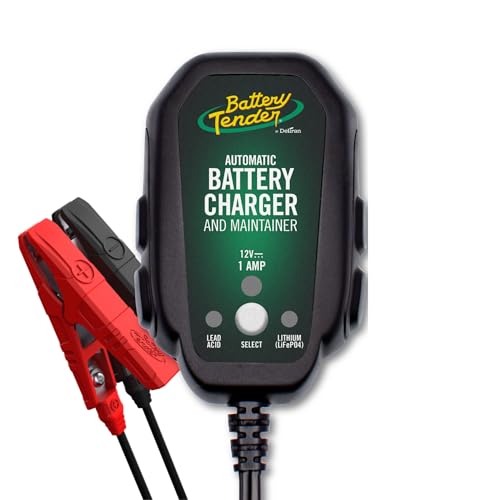
Chemistry confusion is the silent killer of garage charging setups. The 800mA Junior answers it head-on with a button that switches between lead-acid (AGM, flooded, gel) and lithium (LiFePO4) charging profiles. If your garage holds a mix of bikes, with one running an older AGM battery and another on a new lithium pack, you stop needing two chargers.
The ISM microcontroller (a tiny onboard computer that regulates voltage and current stages) adapts the charge curve to whichever mode you select, so swapping between profiles is genuinely safe rather than just tolerated. The 800mA output is meaningfully stronger than the 750mA Junior covered earlier, which shortens recovery time on deeply discharged batteries. Combined with the SAE quick disconnect, it drops into any setup already wired with a Battery Tender ring harness.
Strengths Worth Knowing
- Selectable lead-acid and LiFePO4 profiles in one unit
- Higher 800mA output speeds up recovery on deeply discharged packs
- Smart microcontroller tailors each charging stage to the selected chemistry
- Compatible with the same SAE accessories used across the Battery Tender line
Points To Note
- Slightly higher cost than the single-chemistry Junior
- Mode must be selected manually before each charging session
Key Advantages
Perfect Match For
Garages running mixed battery types where a single dual-profile charger beats juggling two single-purpose units.
A Better Fit Elsewhere
Riders loyal to lead-acid only will save money going with the 750mA Junior reviewed above.
NOCO’s Genius chargers earned a loyal following for good reason, and the X-Connect ecosystem is a big part of it. The GC008 is the eyelet half of that system, a permanent mount lead with M10 ring terminals sized for most automotive and powersports battery posts. The lie-flat profile is the detail that matters: the lead hugs the battery rather than sticking up, which keeps it out of the way under a hood or seat pan.
Compatibility runs deep. G750, G1100, G3500, G7200, and G4 chargers pair up, and the entire current Genius line (GENIUS1, GENIUS2, GENIUS2X2, GENIUS2X4, GENIUS5, GENIUS10) takes the same X-Connect plug. One wiring job on the bike, and you can swap chargers freely. Note that NOCO’s Boost and Boost X UltraSafe Lithium jump starters use a different plug and aren’t compatible, so don’t expect crossover there.
The Helpful Details
- Lie-flat design tucks cleanly into tight engine bays
- M10 eyelets fit a wide range of battery post sizes
- Pairs with nearly every NOCO Genius charger on the market
- Permanent installation frees you from alligator clips
Honest Caveats
- Not compatible with NOCO Boost or Boost X jump starters
- NOCO-only ecosystem; won’t fit Battery Tender SAE leads without an adapter
Who Should Grab It
Existing NOCO Genius owners who want a clean, permanent eyelet mount on a battery they charge frequently.
Look Elsewhere When
Your garage runs Battery Tender chargers instead, where the Battery Tender Ring Terminal Harness is the right shape and pinout.
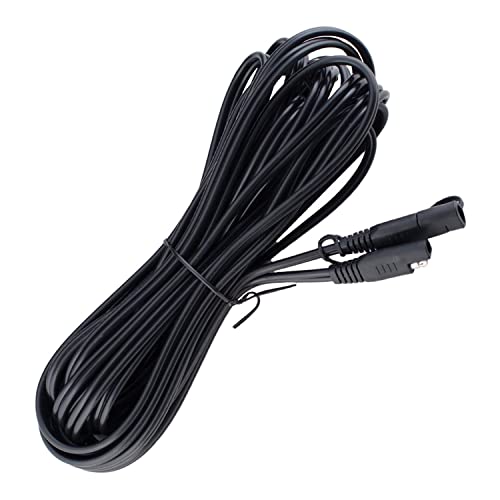
Twenty-five feet changes the conversation. A bike in a detached shed, a side-by-side in the corner of a barn, or a project car across the driveway becomes reachable without dragging an extension cord to a charger. The SAE quick disconnect on both ends matches every Battery Tender charger in the Junior, Plus, 2-Bank, 4-Bank, 5-Bank, and 10-Bank family, so this drops into an existing setup without adapters.
The honest read is that 25 feet is overkill for a one-bike garage, but for multi-vehicle households or shops with widely spaced parking, it’s the most practical length Battery Tender makes. The shorter 6-foot and 12-foot versions (covered later in this list) handle tighter spaces. For seasonal storage where the outlet and the bike aren’t anywhere near the same wall, this is the cleanest answer.
Key Advantages
- 25-foot reach covers detached sheds, barns, and large driveways
- SAE quick disconnects on both ends for tool-free connections
- Compatible with the full Battery Tender charger lineup
- Extends an existing setup without buying a new charger
Softer Spots
- Extra cable is awkward to coil neatly in a small garage
- Voltage drop (a small loss of power over a long cable run) on a 25-foot lead can be noticeable on heavy bulk charging, though float maintenance handles it fine
Made For
Multi-vehicle households and small workshops where the charger lives far from the parking spot.
Not Your Match When
Your charger and battery sit within a few feet of each other; the 6-foot extension covered below handles that more cleanly.
Jumper cables aren’t a maintainer, but they earn a spot in any realistic battery-cable kit. The GOODYEAR 4-gauge, 16-foot set focuses on the two qualities that matter when you’re standing in a parking lot at midnight: enough copper to actually crank a dead battery, and a jacket that stays flexible when the temperature drops. The PVC insulation is rated to handle cold-weather coiling without cracking.
Sixteen feet is the sweet spot for most car-to-car jumps. You can park nose-to-nose, side-by-side, or even slightly offset without stretching. The included carrying case keeps the trunk tidy and prevents the cables from tangling with everything else in there. For commuters, this is the kind of gear you forget about until the morning your car won’t start, and then you really care that it works.
The Practical Payoff
- 4-gauge wire delivers strong current flow for reliable jump starts
- 16-foot length handles awkward parking orientations
- Cold-flexible PVC jacket stays workable in winter
- Carrying case keeps cables tangle-free in a trunk
Details To Watch
- Not a maintenance tool; this only helps in a dead-battery emergency
- 16 feet is tight for large truck-to-truck jumps where the Energizer 30-footer covered later is the better call
Quick Facts
Right Fit For
Daily commuters and family drivers who want a reliable emergency jumper set stashed in the trunk year-round.
Consider Something Else When
You drive a large truck or run a tow operation; the longer, heavier-gauge Energizer 30-foot set fits those jobs better.
Not every garage needs 25 feet of slack. The 6-foot SAE extension covers the common case where the wall outlet sits across the floor from the parking spot, close enough to reach with a short, tidy run. Coiled neatly, this lead disappears under a bench or hangs on a hook without becoming the cable mess you keep tripping over.
Same SAE quick disconnect standard as the 25-foot version above, so it pairs with every Battery Tender charger in the lineup. The shorter run also means no perceptible voltage drop, which keeps bulk charging efficient on deeply discharged batteries. For one-bike garages and apartment dwellers storing a scooter near an outlet, this is the right amount of cable and not an inch more.
Positive Takeaways
- 6-foot reach handles typical single-bike garage layouts
- SAE quick disconnects match the rest of the Battery Tender ecosystem
- Short length avoids voltage drop on heavy bulk charging
- Coils tightly for low-profile storage
Practical Considerations
- Won’t reach a battery more than a few feet from the outlet
- Same ecosystem limitations as the 25-foot version; this is a Battery Tender-only cable
Who It Suits Best
Apartment dwellers and single-bike owners who charge in a tight space and want a tidy, short extension.
Swap It Out When
The charger and battery sit on opposite ends of a long garage or detached building; step up to the Battery Tender 25-foot extension covered earlier.
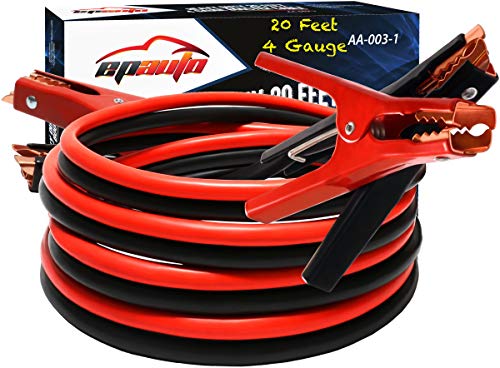
Anyone who’s fought a knotted mess of cables in a dark parking lot knows that tangle resistance matters as much as gauge. EPAuto’s 4 AWG, 20-foot set focuses on that day-of-use frustration. The insulation jacket is engineered to resist tangling and stay flexible, so the cables uncoil cleanly and pack back up without turning into a snarl.
Twenty feet lands between the GOODYEAR 16-foot set and the Energizer 30-foot pro-grade option covered elsewhere in this list. For mid-size SUVs and crossovers where battery terminals sit a bit farther apart, that extra slack helps. The 4-gauge copper gives you the current flow you need to crank a dead V6 without worrying about thin-wire voltage drop. Stashed in a trunk, this is a quiet, dependable piece of insurance.
The Good Stuff
- 4 AWG wire delivers strong current for reliable jump starts
- 20-foot length bridges SUV-to-car and crossover-to-truck gaps
- Tangle-resistant jacket cuts down on dark-parking-lot fumbling
- Flexible insulation stays workable across seasons
Less Ideal Details
- Emergency-only tool, no maintenance function
- For heavy-duty diesel or tow service, the Energizer 1-gauge 30-footer is the better tool
Built With In Mind
Family SUV and crossover owners who want enough reach for awkward battery terminal positions without buying pro-grade gear.
Where A Sibling Pick Shines
Truck and road-service operators should reach for the Energizer 30-foot, 1-gauge set, which is built for heavier engines.
Tow trucks, road-service fleets, and anyone with a full-size diesel needs more than a passenger-car jumper set. The Energizer 1-gauge, 30-foot set is built for that tier. One gauge is the thickest common jumper cable wire, and 30 feet lets you pull up behind a stranded vehicle and reach the battery without repositioning your tow truck. The 800A rating handles up to 8-liter gasoline and 6-liter diesel engines.
The included permanent installation kit is the differentiator. You can hardwire one end of the system to your service vehicle and use the quick connect plug to attach the jumper lead on demand, no fumbling under the seat to find the cables. The thick vinyl coating, spring-loaded clamps, and comfortable grip handles keep the connection secure even on corroded terminals. For most home garages this is overkill, but for road-service work, it earns its weight.
Noteworthy Benefits
- 1-gauge wire handles heavy-duty gasoline and diesel jump starts
- 30-foot reach works for tow-truck-to-stranded-vehicle positions
- Permanent installation kit with quick connect plug
- Spring and grip handles keep clamps secure on corroded posts
Possible Compromises
- Heavier and bulkier than passenger-car jumper sets
- Permanent install kit requires a one-time wiring commitment in the service vehicle
Technical Snapshot
Made For
Road-service fleets, tow operators, and rural property owners who jump-start heavy engines in awkward positions.
Not Your Match When
You only need an emergency jumper for a daily-driver car; the GOODYEAR 16-foot or EPAuto 20-foot set is more proportionate.
NOCO’s X-Connect line is as much about accessories as it is about chargers, and the GC004 10-foot extension fills the middle ground between a fixed eyelet lead and a heavy-duty shop run. Ten feet covers a single-car garage where the charger sits on a workbench and the car parks a few feet away, or a driveway where the outlet sits in the garage and the car pulls up at the curb.
Compatibility is broad across the current and legacy NOCO Genius family: G750, G1100, G3500, G7200, G4, GENIUS1, GENIUS2, GENIUS2X2, GENIUS2X4, GENIUS5, and GENIUS10. As with the GC008 eyelet accessory, NOCO’s Boost and Boost X jump starters use a different plug and aren’t compatible, so don’t plan to bridge those systems with this cable.
Where It Helps
- 10-foot length fits typical single-car garage or driveway layouts
- Extends any X-Connect-equipped charger without buying new hardware
- Compatible with nearly the entire NOCO Genius charger family
- Clean alternative to dragging a household extension cord to the driveway
Small Limitations
- NOCO X-Connect plug means it doesn’t bridge to Battery Tender SAE gear without an adapter
- Not compatible with NOCO Boost or Boost X jump starters
Who Will Love This
NOCO charger owners who need a moderate reach boost for a car parked just outside the garage.
A Better Fit Elsewhere
Battery Tender households get the same kind of mid-range reach from the 12-foot SAE extension in that brand’s lineup.
Picking The Right Reach For Your Garage
Length is the headline number, but it’s not the only one that matters. Match the cable to the chemistry, the connector, and the climate it will live in.
Connector compatibility comes first. SAE quick disconnect (a standardized two-pin plug common to Battery Tender products) and NOCO X-Connect are not interchangeable. If your charger uses one plug, buying the other brand’s extension means adapters and frustration. Before measuring distance, confirm the connector on your charger matches the cable you plan to buy.
Wire gauge matters for jump-start sets, less for maintainer extensions. Maintainer cables carry tiny currents to top off a battery, so gauge is rarely an issue. Jumper cables carry hundreds of amps to crank an engine, where thicker wire (lower gauge number) means less voltage drop and more reliable starting. 4 gauge handles most passenger cars; 1 gauge is the right call for trucks and diesels.
Length should match the real layout, not the worst case. Measure from the outlet to the farthest spot a vehicle might park, then add two or three feet of slack for routing around obstacles. Buying 25 feet for a 6-foot run creates a cable coil you’ll trip over. Buying 6 feet for a 20-foot real layout leaves you stretching and straining the connector.
Climate and storage shape the jacket choice. PVC insulation stays flexible in cold weather but can stiffen over years of trunk heat. If the cables live outdoors or in an unheated garage, look for jackets rated for the temperature range you actually face, not just the one on the spec sheet.
Permanent versus portable is a workflow question. Eyelet harnesses bolted to a battery turn charging into a one-snap job, ideal for vehicles that sit for months. Portable clamps make more sense for vehicles you drive daily and want to be able to jump-start on the road.
What To Weigh Before You Commit
Pitfalls Shoppers Hit
The most common mistake is buying the wrong connector family and discovering it after the package is open. SAE and X-Connect look similar at a glance, but the pin arrangements differ and adapters are clunky at best. Second on the list is overestimating reach; a 25-foot cable that lives coiled on the floor is more tripping hazard than helper. Finally, mixing battery chemistry and charger profile silently damages lithium packs over time; if you ride a lithium-equipped bike, confirm the charger explicitly supports LiFePO4 before plugging in.
Why Top Tier Costs More
Premium jumper sets earn their higher price through thicker copper, heavier-duty clamps, and jackets engineered for extreme cold or repeated coiling. In the maintainer world, higher tiers usually buy you dual-chemistry support, smarter microcontrollers, or permanent-mount hardware. For a daily-driver commuter who jumps once every few years, the mid-tier gets the job done. For road-service work, heavy diesel engines, or storage in extreme climates, the upgrade pays for itself in reliability.
Frequently Asked Questions
What is the difference between SAE quick disconnect and NOCO X-Connect?
SAE is a two-pin plug standard used by Battery Tender and several other maintainer brands, while NOCO X-Connect is NOCO’s own locking plug. They look similar but have different pin arrangements, so cables from one ecosystem don’t fit chargers from the other without an adapter.
How long should a battery cable extender be?
Match the length to your real layout. Measure from the outlet to the farthest parking spot, add a few feet of routing slack, and buy that. Anything longer becomes a coiled mess; anything shorter forces you to reposition vehicles.
Can I use a battery tender extension cable with lithium batteries?
The extension cable itself only carries current and doesn’t care about chemistry. The charger on the other end does, so confirm your charger supports LiFePO4 lithium before connecting it to a lithium battery, regardless of which extension you use.
Do thicker jumper cables really make a difference?
Yes. A lower gauge number means thicker copper wire, which reduces voltage drop during the high-current burst of cranking an engine. For larger engines, especially diesel, thicker wire makes the difference between a quick start and a sluggish one.
Is it safe to leave a battery tender connected for months?
Yes, when the charger has a proper float mode that drops to a maintenance voltage once the battery is full. The four-stage programs on quality maintainers are designed for exactly this kind of long-term storage connection.
Wrap Up
The right cable is the one that matches your charger, your chemistry, and your real-world layout. Measure twice, confirm the connector, and don’t overspend on length you won’t use. Anything from this list will get the job done if it fits your setup, so the choice comes down to which trade-offs matter most for your garage.