The right battery bank with a solar panel turns a dead phone or a stalled campsite into a non-event. You get quiet, portable electricity that follows you from a tailgate to a remote trailhead, and you stop sweating grid outages. This list covers full-size power stations, compact travel chargers, and protective cases for them, so you can match the kit to your gear, not the other way around.
A Quick View Of The Lineup

BLUETTI AC200L Portable Power Station 2048Wh

Carrying Case Fits Jackery 1000 v2/500 v2/BLUETTI

EF ECOFLOW Solar Generator Delta 3 1024Wh

BLUETTI AC180 Portable Power Station 1152Wh 1800W

EF ECOFLOW River 2 Max 500 + 160W Panel

BLAVOR Solar Power Bank 10,000mAh Wireless

Powkey 200W Portable Power Station 192Wh

SOARAISE 48000mAh Solar Power Bank Wireless
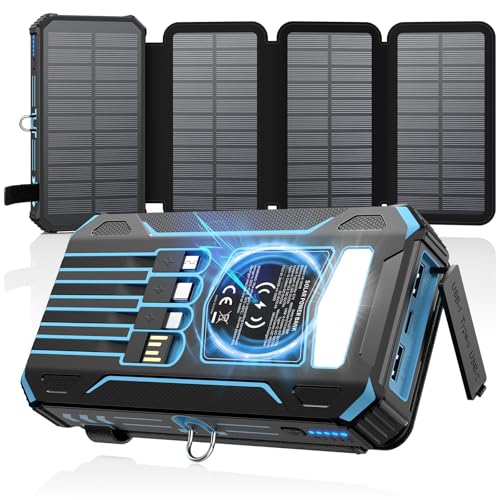
SOARAISE 48000mAh Solar Battery Pack Wireless

Solar Power Bank 48000mAh 4 Cables Wireless
More On The Choices That Made The List
The BLUETTI AC200L sits at the top end of the portable power station class, pairing a 2048Wh LiFePO4 (lithium iron phosphate, a battery chemistry known for long cycle life and thermal stability) battery with a 2400W AC inverter. You can run a full-size fridge, a microwave, or a job-site power tool for meaningful stretches without recharging.
For whole-home backup or a multi-day off-grid cabin stay, this is the kind of capacity that lets you skip the gasoline generator. Compared to the smaller Powkey 192Wh station later in this list, this is roughly ten times the stored energy in a heavier, stationary form.
Strong Points
- 2048Wh base capacity that expands to 8192Wh with add-on packs, giving you room to scale as your needs grow.
- LiFePO4 cells rated for far more charge cycles than older lithium-ion chemistries, so daily use does not eat the battery.
- 2400W continuous AC output handles most household appliances, not just phones and laptops.
- Multiple expansion battery options (B300K, B210, B300, B230) let you mix capacity and budget.
- Fast AC recharging at roughly 45 minutes for a full top-up, useful before forecasted storms.
Things To Consider
- At roughly 60 pounds, the unit is not something you toss in a backpack; plan a stationary spot.
- No solar panel is included in the box, so budget separately for panels if off-grid charging matters to you.
- Expansion batteries add cost quickly, so the total outlay climbs fast when you chase the full 8192Wh ceiling.
Feature Snapshot
Who It Suits Best
Homeowners in storm-prone regions and anyone running a small off-grid cabin or van setup who needs true appliance-level power.
Look Elsewhere When
Backpack campers and weight-conscious travelers get better value from the Powkey 200W 192Wh station, which is roughly an order of magnitude lighter.
The LEFOR·Z carrying case is a small accessory with a specific job: protect a portable power station while you drive or haul it to a campsite. Sized at roughly 32 × 24 × 25cm, it fits the Jackery 500/1000 v2 and BLUETTI Elite 30 V2/100 V2 stations listed in the product name.
It uses a tear-resistant and waterproof outer shell with a thick inner lining, so a stray hose or a sandy truck bed does not scratch the LCD. You get a tidy place to stow cables and a small solar panel too.
Reasons It Performs
- Waterproof, tear-resistant shell reduces scuffs and weather exposure on the road.
- Thick padded lining absorbs the bumps of a trunk or RV storage bay.
- Outer dimensions of 32 × 24 × 25cm fit several popular mid-size stations.
- Helpful for keeping the station’s bundled cables and adapters in one place.
Worth Noting
- Verify your specific station’s dimensions before ordering; mismatched sizing renders the case useless.
- Larger units like the BLUETTI AC200L reviewed above will not fit; you need a bigger case for those.
Right Fit For
Anyone with a mid-size Jackery or BLUETTI station who drives to campsites and wants to keep dust, scratches, and the odd splash off the unit.
Consider Something Else When
Owners of the heavy-duty BLUETTI AC200L need a different, larger case sized for roughly 42 × 28 × 39cm-class units.
The EcoFlow Delta 3 ships with a 220W bifacial solar panel (a panel that collects light from both its front and rear faces, gaining extra yield from reflected light), which makes it a true plug-and-play solar generator rather than just a station. The 1024Wh LiFePO4 battery pairs with an 1800W AC inverter, and the headline number is the recharge time: roughly 56 minutes from a wall outlet.
Solar is slower, around 5.8 hours with one 220W panel or 2.9 hours with two, which is reasonable for sunny weekends. Compared to the BLUETTI AC180 further down, this bundle arrives panel-included, so you skip the separate shopping trip.
Practical Pluses
- AC wall recharge from empty to full in roughly 56 minutes, faster than most stations in this size class.
- 220W bifacial panel included in the box, so you can deploy it the day it arrives.
- 1800W output handles everything except the heaviest kitchen appliances.
- Expandable capacity up to 5kWh within the EcoFlow ecosystem for users who want to grow later.
Trade Offs
- Solar recharge is much slower than AC; partial shade drops input noticeably.
- Bifacial panels only help when there is a bright reflective surface behind them, which is not always practical on grass or dirt.
Best Suited To
Time-pressed campers and short-term renters who want one box that arrives panel-and-station ready.
Skip It When
Buyers who already own a 200W-class panel should look at the BLUETTI AC180, which offers similar capacity for less when paired with an existing array.
The BLUETTI AC180 lands in a sweet spot between the giant AC200L and the compact Powkey 192Wh unit. The 1152Wh LiFePO4 battery and 1800W AC output cover weekend camping, a one-night blackout, or a tailgate without breaking your back or your budget.
AC wall charging hits a full tank in roughly one hour at 1440W input, and the BLUETTI app can lift the output ceiling to 2700W for short bursts when you need to push past the rated wattage.
Practical Advantages
- One-hour wall recharge cuts downtime between trips or outages.
- 1152Wh storage covers a weekend of phones, lights, and a small fridge.
- Eight output outlets handle mixed loads without adapter juggling.
- App-controlled 2700W boost mode helps with high-draw startups.
- Solar input up to 500W speeds up off-grid refills when the sun cooperates.
Some Limits To Know
- No solar panel ships in the box, so the total bill rises once you add one.
- The 2700W boost is a short-term mode, not a continuous rating.
Key Product Details
Who Should Grab It
Weekend campers and apartment dwellers who want outage-grade capacity without the size or cost of a whole-home system.
Reach For A Different Pick When
Shoppers who want a panel-included bundle should consider the EcoFlow Delta 3, which arrives with a 220W bifacial panel in the box.
The River 2 Max 500 is the gentlest on-ramp in the EcoFlow lineup, and pairing it with a 160W panel makes it a tidy first solar generator. The LiFePO4 battery is rated for 3000+ charge cycles, which EcoFlow translates to roughly a decade of regular use.
At 1000W AC output, you can run eleven devices at once without tripping overload. The included panel recharges the station in roughly four hours of solid sun, or about an hour from a wall outlet.
The Good Stuff
- LiFePO4 chemistry with 3000+ cycle rating for years of daily top-ups.
- Included 160W panel saves the separate purchase step.
- Four-way recharging (AC, solar, car, USB-C) covers most scenarios.
- 1000W output is enough for roughly 80% of household plug-in appliances.
Honest Caveats
- IP68 rating covers the panel, not the station itself, so keep the power brick out of heavy rain.
- 512Wh storage is enough for a day, not a weekend, in most setups.
Made For
First-time solar owners who want a panel-and-station bundle that arrives ready to unfold and use.
A Better Fit Elsewhere
Multi-day off-grid campers get more runtime from the BLUETTI AC180, which holds more than twice the capacity.
The BLAVOR 10,000mAh power bank is a pocket-scale solar charger aimed at phones, tablets, and small accessories. Unlike the full-size stations in this list, it slips into a backpack and tops up your daily driver while you hike, commute, or wait out a flight delay.
USB-C output at 20W plus wireless charging cover most modern phones, and the solar panel on the back is meant as an emergency backup rather than a primary input.
Everyday Wins
- 10,000mAh capacity handles two to three phone charges in real-world use.
- USB-C with 20W output speeds up compatible phones and tablets.
- Wireless charging pad frees you from cable hunting in airports.
- Built-in flashlight helps during power outages and tent nights.
Practical Considerations
- The integrated solar panel is a slow trickle in real sun; treat it as emergency backup only.
- Won’t power laptops or any AC appliance, so it complements rather than replaces a station.
Perfect Match For
Daily commuters and travelers who need a lightweight top-up for a phone and small accessories without hauling a station.
Where Another Pick Suits Better
Anyone running a CPAP machine or a laptop off-grid should reach for the Powkey 200W 192Wh station, which has AC outlets.
The Powkey 200W weighs just 4.7 pounds and measures 7.1 × 5.3 × 5.5 inches, so it carries more like a lunchbox than a generator. The 192Wh LiFePO4 battery feeds a 200W AC inverter, enough for laptops, lights, a small fan, or a Nintendo Switch on a long ride.
You get a foldable handle that flattens for backpack storage. The unit charges laptops, tablets, smartphones, and a mini fridge, though that last one is short-lived at this capacity.
The Practical Payoff
- 4.7-pound carry weight is easy for backpack and bike campers.
- LiFePO4 chemistry outlasts cheaper lithium-ion banks in the same form factor.
- 200W AC outlet covers most personal electronics plus light tools.
- Compact 7.1 × 5.3 × 5.5 inch shell fits under a desk or in a car trunk.
A Few Limitations
- 192Wh capacity is a half-day of casual use, not a multi-day supply.
- 200W ceiling will not drive kettles or hair dryers, which need more headroom.
- No solar panel is included, so add that purchase if you plan to camp off-grid.
Feature Card
Whose Shelf It Belongs On
Backpack campers and photographers who want light, grab-and-go power for personal electronics rather than appliance-grade output.
Not Your Match When
Household backup users get more runtime from the BLUETTI AC180, which carries roughly six times the capacity in a larger but still portable shell.
The SOARAISE 48000mAh power bank trades raw output for versatility. You get a lithium-polymer cell (a soft-pack battery chemistry that favors slim shapes and light weight) plus four integrated cables so a household can charge phones, tablets, and earbuds without rummaging through drawers for the right cord.
Four solar panels unfold from the body for direct sun charging, which is faster than single-panel competitors but still slow compared to a 100W rigid panel. The wireless pad on top covers a phone placed face-up.
What Works In Its Favor
- Four built-in cables remove the daily cable hunt for families.
- 48000mAh capacity handles multiple phone refills per trip.
- Four-panel fold-out array improves solar yield over single-panel rivals.
- Wireless charging pad adds convenience on the go.
Potential Drawbacks
- Lithium-polymer cells generally offer fewer charge cycles than LiFePO4.
- Solar charging rate still lags behind a dedicated 100W panel, so plan for wall top-ups.
Who Will Love This
Family trip organizers who need to keep four or five personal devices alive without packing a bag of cables.
Swap It Out When
Solo campers who care more about cycle life and weight than cable variety should consider the BLAVOR 10000mAh for daily top-ups.
This SOARAISE variant focuses on the same 48000mAh cell and four-panel fold-out array, presented under a “battery pack” framing. The intent is the same as the prior SOARAISE entry, with the four integrated cables and a wireless top-up pad for travel-friendly charging.
Owners commonly rely on the unit as a long-weekend companion for camping or road trips where a wall outlet is rare. Lithium-polymer gives a slimmer feel in the hand than a LiFePO4 brick, which matters when it rides in a backpack.
A Few Strong Suits
- Same large 48000mAh capacity as the sibling SOARAISE unit, useful for multi-device trips.
- Fold-out quad-panel array yields better solar input than single-panel units.
- Wireless charging adds convenience for Qi-compatible phones.
- Four integrated cables reduce packing in shared travel bags.
Worth Bearing In Mind
- The lithium-polymer cell delivers fewer cycles than LiFePO4 rivals in the same capacity range.
- Solar charging is still a slow trickle, so carry a wall adapter for the primary refill.
Built With In Mind
Long hiking weekends and road trips where the group brings phones, cameras, and earbuds but not laptops.
Where A Sibling Pick Shines
Solo photographers who need cycle-life durability get more value from the EcoFlow River 2 Max 500 station with a real 160W panel.
The third SOARAISE-styled power bank in this list keeps the same 48000mAh lithium-polymer cell and four-panel solar array, marketed for car-camping groups where multiple people share one charger. Four built-in cables and a wireless pad cut down on the bag clutter that usually piles up at a campsite.
The trade-off is the same as its siblings: small solar yield per day, and a cell chemistry that ages faster than LiFePO4. For a group that mostly wants phone top-ups, the convenience wins out.
What Earns Its Place
- High solar panel count for the category, supporting faster ambient refills.
- 48000mAh capacity covers several days of phone use for a small group.
- Wireless top-up pad works for Qi-compatible devices.
Details To Watch
- Lithium-polymer chemistry means a shorter usable life than LiFePO4 power stations.
- Solar charging still needs a wall outlet as the primary refill source.
Key Attributes
Whose Shelf It Belongs On
Car-camping groups and large families who charge phones and tablets from a shared pool rather than individual bricks.
Swap It Out When
Buyers who want a 160W panel-included bundle and longer cycle life should look at the EcoFlow River 2 Max 500 station.
What Matters Most Before Choosing Battery Banks With Solar Panel
Capacity versus portability is the first call you make. A 2048Wh station can run a fridge for hours, while a 192Wh pack can keep a laptop alive through a long flight. Match the watt-hours to the worst day you can imagine, not the best one.
Inverter rating matters just as much. A 200W inverter tops out at small electronics, while 1800W and up covers most kitchen gear. Surge capacity helps with motors and compressors that pull a brief spike on startup.
Battery chemistry sets the lifetime story. LiFePO4 cells tolerate thousands of cycles, which makes them the right pick for daily or weekly use. Lithium-polymer packs are lighter but wear faster, so they fit occasional travel rather than permanent backup.
Charging inputs decide your flexibility. Stations with high-watt solar inputs (500W and up) refill fast in good sun, while USB-C car outlets help on road trips. Built-in cables and wireless pads are nice for travel chargers but rarely matter on full-size stations.
Finally, consider the panel pairing. A station without a bundled panel needs a separate purchase, and a panel’s wattage caps the station’s solar input. Check the two together before you commit.
Key Considerations Across These Picks
Common Slip Ups Shoppers Hit
Treating solar watt-hours like AC watt-hours creates confusion. A 48000mAh power bank rated at 5V equals about 240Wh, not enough to compare apples-to-apples with a 1024Wh station. Always convert to Wh before comparing.
Forgetting expansion paths locks you out later. A station that supports add-on batteries protects your upgrade, while a fixed-capacity unit forces a full replacement when your needs grow. Plan two or three years out.
Assuming “solar included” means full kit. Many stations ship panel-free. A panel adds cost and weight, and matching wattages matters, since a 100W panel on a 500W-capable station wastes potential.
When Paying More Pays Off
The jump from a 192Wh pack to a 1024Wh+ station is more than capacity. You also get an AC inverter, a longer-lasting LiFePO4 cell, faster recharge speeds, and the ability to run appliances, not just phones.
Higher-tier stations also tend to include better app control, more ports, and stronger surge handling. If your use case includes outages, a mid-size or larger station earns its keep the first time the grid goes dark.