A flooded basement is the kind of problem you only think about once, usually right after it happens. Heavy rain plus a power outage is the classic double-whammy that catches most homeowners off guard. The primary pump can’t run without electricity, and within hours you could be looking at damaged drywall, ruined flooring, and a remediation bill that dwarfs any pump’s cost. Battery backup sump pumps keep water moving when the grid goes down, and the right one buys you hours of protection instead of minutes. The picks below cover the main approaches: battery-driven units that run off a deep-cycle marine battery, water-powered backup systems that tap your municipal supply, and combo units that pair a primary pump with a built-in backup. Your sump pit size, water table, and tolerance for maintenance will point you toward the right fit.
The Main Contenders

VIOPUMPO 2500W Sump Pump Backup Battery System

Basepump HB1000-PRO Water Powered Backup Sump Pump

Basement Watchdog Big Dog CONNECT 3,500 GPH (BWD12-120C)

Wayne Preassembled Primary & Battery Backup Combo

Basement Watchdog Special CONNECT 2,890 GPH (BWSP)

VIOPUMPO 2500W Sump Pump Battery Backup System
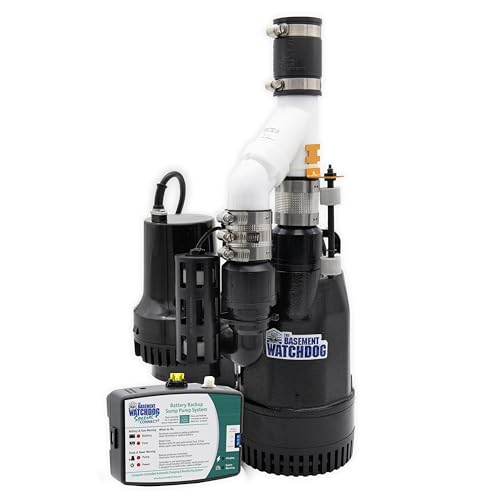
Basement Watchdog Combo Preassembled (CITS-50)

Basepump RB750-EZ Water Powered Backup Sump Pump

Westinghouse 1/2 HP Sump Pump with 12V Battery Backup
What Each Pick Brings To The Table
The VIOPUMPO 2500W sits in a category of its own: it’s an inverter, not a pump. You wire your existing AC sump pump into it, and when grid power drops, it seamlessly switches to battery power and keeps the pump running. A pure sine wave output (clean, grid-like electricity rather than the choppier modified sine wave) means sensitive electronics and motor-driven equipment stay safe, which matters for homeowners with variable-speed or newer pumps.
For most basements with a standard 1/2 HP primary pump, this is the most flexible path to whole-outage protection. You get to keep the pump you already trust while adding a serious layer of redundancy. The remote controller with LCD screen gives you real-time status, and automatic switching means there’s no scrambling to throw a switch when the lights flicker.
Benefits That Matter
- Pure sine wave output protects motors and electronics from the wear caused by rougher waveforms
- Automatic switching means no manual intervention during a sudden outage
- LCD remote controller surfaces status at a glance, so you can monitor from the living space
- Keeps your existing pump in the loop rather than forcing a full replacement
- Strong fit for whole-basement outages that last hours rather than minutes
Trade Offs To Consider
- Requires a deep-cycle battery (commonly sold separately), which adds to total cost
- Installation calls for basic electrical comfort, or a professional, depending on your setup
Right Fit For
Homeowners who already trust their primary pump and want a serious inverter-style backup that can run it for hours during long outages.
Consider Something Else When
You’d rather have a fully preassembled combo in a single box, in which case the Basement Watchdog Combo Preassembled (CITS-50) is the more turnkey route.
Unlike the battery-driven units elsewhere on this list, the Basepump HB1000-PRO runs entirely on municipal water pressure. There’s no battery to charge, no inverter to install, no runtime anxiety. As long as city water is flowing, this pump moves up to 22 gallons per minute. For homes with consistently high water tables or chronic flooding during storms, that flow rate is the headline feature.
The trade is operational rather than electrical: the unit consumes roughly two gallons of city water for every gallon it pumps out. Homeowners on metered water will see that on the bill. You also need adequate municipal pressure (typically 40 PSI or more) for the unit to perform to spec. Where those conditions are met, this is the closest thing to set-and-forget protection.
Why It Works Well
- Up to 22 GPM flow rate handles the heaviest basement flooding scenarios
- Zero electrical components mean no batteries, no charging, no power-supply worries
- Automatic activation kicks in when the primary pump fails or the water rises
- Long service life, since there is no battery to wear out
Worth Noting
- Uses about 2 gallons of municipal supply per gallon pumped, which adds up on metered bills
- Requires sustained city water pressure to deliver rated output
- Not suited for homes on private wells, since well pumps typically need power too
Feature Snapshot
Who Should Grab It
Homeowners with high water tables, frequent storms, and reliable city water who want the highest possible flow with zero battery maintenance.
Skip It When
You’re on a private well or you watch your water bill closely, in which case the Basepump RB750-EZ offers the same battery-free approach at a gentler flow rate.
Where the VIOPUMPO inverter handles your existing pump, the Big Dog CONNECT is its own pump, and a powerful one. Rated at 3,500 gallons per hour at zero lift, it outpumps most residential backups by a wide margin. The copper-wound motor is the kind of detail that hints at longevity rather than disposability, which is what you want from a unit that may sit idle for months before springing into action.
The “CONNECT” piece comes from a USB port that accepts an add-on WiFi module. With it installed, you get text, email, or push notifications when the pump cycles, when power is lost, or when the battery needs attention. For homeowners who travel or maintain a second property, that remote visibility is the difference between catching a problem at hour one and discovering it at hour twenty.
Key Advantages
- 3,500 GPH at zero lift handles serious inflow with headroom to spare
- Copper-wound motor points to longer service life under heavy cycling
- WiFi add-on sends real-time alerts for power loss, pump activity, and battery status
- Remote terminal integrates with home security systems for layered monitoring
Points To Keep In Mind
- WiFi module is sold separately, which adds to total spend
- Battery is sold separately, typically a deep-cycle marine unit
- Higher output means higher draw, so runtime on a single battery is shorter than smaller backups
Best Suited To
Homeowners in flood-prone regions who want high capacity, copper-motor durability, and the option to receive alerts on their phone when away from home.
A Better Fit Elsewhere
You have a small sump pit and only modest inflow, where the more compact Basement Watchdog Special CONNECT 2,890 GPH (BWSP) will fit and save space.
The Wayne combo arrives fully preassembled, which is the whole pitch. Where most backup systems expect you to pair a primary pump with a secondary unit (and sometimes figure out the plumbing yourself), this one ships with both pumps mounted and plumbed. Top-suction design on the primary reduces clogging from debris that settles at the bottom of the pit, which matters in older homes where sump pits collect sediment.
You still need to add a deep-cycle battery, either 40 amp-hour or 75 amp-hour depending on how much runtime you want. The 75-amp option pushes runtime significantly longer during extended outages. For first-time installers who want one box to put in the pit without sorting through fittings, this combo shortens the learning curve.
Where It Delivers
- Preassembled design eliminates the most common install headaches
- Top-suction primary pump reduces clogging from settled debris
- Accepts either a 40 or 75 amp-hour battery for flexible runtime
- Single-purchase combo removes the guesswork of matching components
Honest Caveats
- Battery is not included and must be sourced separately
- Combo footprint is larger than a backup-only unit, which matters in tight pits
Who Should Grab It
First-time installers and DIYers who want both pumps in one package, pre-plumbed, and ready to drop into the pit with minimal fabrication.
Swap It Out When
Your existing primary pump is still healthy and you only need a backup layer, where the Basement Watchdog Special CONNECT 2,890 GPH (BWSP) covers the gap without replacing what works.
The “Special” in the name refers to its slender pump housing, designed to fit narrow sump pits where the larger Big Dog won’t physically fit. Plenty of older homes and tight retrofits have pits in the 12-inch range that simply can’t accept a chunkier backup. Rated at 2,500 GPH at zero lift, you give up some capacity compared to the Big Dog but gain compatibility with cramped installs.
The user-friendly control panel is a small but meaningful upgrade. Instead of cryptic LEDs, it lights up with plain-language warnings and tells you what to do. The fluid-level sensor monitors battery electrolyte (the liquid acid inside a lead-acid battery) and alerts you before it drops below the safe range, which extends battery life in a way most homeowners never think about until the battery dies early.
Practical Advantages
- Compact pump body fits narrow and shallow pits that rule out larger backups
- Copper-wound motor suggests long service life under cycling duty
- Control panel displays plain-language diagnostics rather than blinking codes
- Battery-fluid sensor protects against low electrolyte that shortens battery life
- WiFi-capable via an add-on module, matching its bigger sibling’s connectivity
Some Limits To Know
- Lower flow rate than the Big Dog CONNECT means less margin for extreme inflow
- Battery sold separately, as is standard across the category
- WiFi module is an add-on purchase
Core Details
Who Will Love This
Homeowners with small or narrow sump pits who still want copper-motor durability and clean diagnostic feedback in a backup-only footprint.
Reach For A Different Pick When
Your pit has the room and your inflow is heavy, where the Basement Watchdog Big Dog CONNECT 3,500 GPH (BWD12-120C) gives you substantially more output.
Like its sibling at #1, the second VIOPUMPO is an inverter rather than a pump. The headline difference is the three AC outlets and 25-amp operating current, which lets you power multiple sump pumps at once, or a primary plus an additional dehumidifier or critical basement circuit during an outage. For homes where flooding risk is severe enough to warrant redundant pumping, that’s the deciding factor.
The pure sine wave output matters even more here, since you’re potentially running several inductive loads (devices with motors that create electromagnetic resistance) at the same time. Modified sine wave inverters can cause those motors to run hot or hum, while pure sine wave keeps them running as the manufacturer intended. The LCD remote controller carries the same monitoring benefit as the first VIOPUMPO unit.
Notable Upsides
- Three AC outlets support multiple sump pumps or pumps plus accessories
- 25A operating current handles demanding combined loads
- Pure sine wave output protects connected motors from waveform stress
- Automatic grid-to-battery switchover for seamless outage handling
Where It May Fall Short
- Heavier draw on the battery bank means shorter runtime per charge than smaller inverters
- Battery sold separately, which is a notable line-item for the full system
Feature Snapshot
Right Fit For
Homeowners with high-stakes basements who want to power two sump pumps (or a pump plus a critical accessory) from one battery inverter during long outages.
Where Another Pick Suits Better
You only need to back up a single pump and prefer to keep the spend modest, where the first VIOPUMPO unit on this list handles the same core job with a simpler outlet count.
The CITS-50 is the full-system answer for homeowners replacing everything at once. The primary pump uses a ½ HP copper-wound PSC (Permanent Split Capacitor) motor, which is the kind of build that suggests both efficiency and longevity. PSC motors tend to run cooler and last longer under continuous duty than standard induction designs, which adds up over years of cycling.
The backup system watches the pump, the power, and the battery around the clock. When something is off, the controller sounds an alarm, illuminates the relevant indicator, and (with the WiFi add-on) can ping your phone. Pre-plumbed construction cuts the install time considerably compared to assembling components yourself.
Practical Pluses
- PSC motor design runs cooler and tends to outlast standard induction motors
- 24-hour monitoring of pump, power, and battery conditions
- Preassembled and preplumbed for faster, simpler installation
- WiFi add-on supports text, email, and push notifications
Worth Bearing In Mind
- Higher total spend than a backup-only unit, since you’re buying a full replacement system
- Battery sold separately, which is standard but still an add-on cost
Perfect Match For
Homeowners replacing an aging primary pump who want a coordinated system with monitoring baked in, rather than mixing mismatched components.
A Better Fit Elsewhere
Your existing primary pump is still in good shape, where the Basement Watchdog Special CONNECT 2,890 GPH (BWSP) layers in backup protection without touching the working pump.
The RB750-EZ is the smaller sibling of the HB1000-PRO and shares the same battery-free philosophy. Up to 15 gallons per minute under rated conditions covers moderate inflow without the maintenance of a deep-cycle battery. For homeowners who don’t want to think about electrolyte levels, charging cycles, or eventual battery replacement, that simplicity has real appeal.
The flow rate is meaningfully lower than its bigger sibling, so it suits homes with average sump pit activity rather than chronic heavy flooding. As with any water-powered unit, you’ll use municipal water as the operating medium, so metered homeowners should expect that line item on the bill during extended incidents.
Bright Spots
- No battery means no charging, no replacement cycle, no maintenance
- Automatic activation when primary pump fails or water rises
- Simple installation compared to inverter-based systems
- Long service life with minimal moving consumables
Practical Considerations
- 15 GPM is meaningfully lower than the HB1000-PRO’s 22 GPM
- Uses municipal water at roughly a 2:1 ratio, which adds to water bills
- Requires adequate municipal pressure (typically 40 PSI or more)
Feature Snapshot
Made For
Homeowners who want reliable backup without the battery maintenance cycle, and whose inflow is moderate rather than extreme.
Look Elsewhere When
Your basement sees heavy inflow during storms, where the Basepump HB1000-PRO provides substantially more flow from the same battery-free platform.
The Westinghouse unit brings serious primary-pump muscle: up to 5,200 gallons per hour, which is among the highest figures on this list. The integrated vertical float switch is the kind of design choice that reduces the failure modes associated with tethered or diagonal floats, since vertical floats tend to be less prone to hang-up in narrow pits.
The 12-volt battery backup kicks in automatically when power drops, taking over without homeowner intervention. The battery itself is sold separately, so factor that into the total. For households whose sump pits see substantial daily water movement, the primary capacity here is the headline advantage.
Strengths Worth Knowing
- Up to 5,200 GPH primary output handles high daily water volume
- Vertical float switch design resists hang-up in tight basins
- Automatic backup takeover during power loss
- Compact footprint for a high-capacity pump
Factors To Consider
- Battery not included, so the full system cost runs higher than the headline figure
- High draw during backup operation shortens runtime on smaller batteries
Feature Snapshot
Whose Shelf It Belongs On
Homeowners with heavy daily inflow who want a high-capacity primary pump with backup capability integrated into the same unit.
Where A Sibling Pick Shines
You already have a strong primary pump and just need the backup layer, where the Basement Watchdog Big Dog CONNECT 3,500 GPH (BWD12-120C) is the more focused backup-only answer.
What Matters Most When Picking A Battery Backup Sump Pump
Pump Type And Power Source
The first fork in the road is whether you want a battery-driven backup or a water-powered one. Battery-driven units pair with a deep-cycle marine battery and run your existing or bundled sump pump off stored DC power converted to AC (alternating current, the standard wall-outlet power your pump expects). Water-powered units use municipal supply pressure as the operating medium, sidestepping batteries entirely. Each approach has trade-offs: battery units give you runtime tied to battery size, while water-powered units trade water usage for unlimited runtime as long as city water flows.
Flow Rate And Lift Capacity
GPH (gallons per hour) at zero lift tells you what the pump does when water barely needs to rise. Real pits almost always have vertical lift to push water up and out, so the 10-foot lift figure matters just as much. A pump that delivers 3,500 GPH at zero lift but only 1,500 at 10 feet of lift is going to feel underpowered in a deep pit. Match the rating to your actual pit depth and expected inflow rather than chasing the biggest number on the spec sheet.
Battery Type And Maintenance
If you go battery-driven, you’ll be choosing between standard flooded lead-acid batteries and AGM (Absorbent Glass Mat) or gel variants. Flooded batteries need periodic electrolyte checks and topping off with distilled water. AGM and gel are sealed and maintenance-free, but cost more upfront. For most homeowners, the maintenance angle is the deciding factor: an untended flooded battery loses capacity over time and may die right when you need it most.
Pit Size And Physical Fit
Backup pumps add bulk to your sump pit, and many pits were sized for a single pump. Measure the diameter and depth before choosing. The Basement Watchdog Special CONNECT exists specifically because its predecessor didn’t fit narrow retrofits. A preassembled combo system like the Wayne or Basement Watchdog CITS-50 takes up even more room, so always check pit dimensions against the manufacturer’s minimum clearance spec before committing.
Monitoring And Alerts
Modern backups range from a basic LED indicator to a full control panel with plain-language diagnostics, plus optional WiFi modules that ping your phone. For frequent travelers or anyone who can’t easily check the basement, the WiFi add-on pays for itself the first time it catches a problem early. For homeowners who are home most days, the basic diagnostic panel may be all you need.
Picking Between Standard And Premium Tiers
Common Buying Slip Ups
The most common mistake is buying a backup pump sized for the average day and forgetting about the storm scenario. Your primary pump handles everyday inflow, but during a multi-day storm the inflow may double or triple. The other slip is forgetting the battery itself: many of these systems ship without one, and a backup pump with no battery is just plumbing. Finally, owners sometimes install a backup and never test it, only to discover during a real outage that the float is stuck or the battery is dead.
Where The Extra Money Goes
Higher-tier models typically spend their budget on three things: better motors (copper-wound or PSC designs that last longer), higher output (more gallons per hour at meaningful lift), and smarter monitoring (diagnostic panels, WiFi alerts, fluid sensors). None of those matter on a calm Tuesday, but they all pay off during the kind of storm where you actually need the pump. For most homes, the upgrade is worth it when your basement has finished space, expensive storage, or any history of water intrusion. For unfinished utility spaces with low inflow, a standard model is plenty.
Frequently Asked Questions
How long will a battery backup sump pump run during an outage?
Runtime depends almost entirely on battery capacity (measured in amp-hours) and pump draw. A 75 amp-hour battery with a moderate-draw backup typically runs 5 to 8 hours of intermittent cycling, while a 100+ amp-hour battery can stretch beyond 12 hours. Heavier pumps and continuous cycling shorten runtime considerably.
Do I need a professional to install a battery backup sump pump?
It depends on the unit and your comfort level. Battery backup pumps that drop into an existing pit alongside your primary pump are often a manageable DIY project with basic tools. Inverter-based systems like the VIOPUMPO units involve 110V wiring, and any work you’re unsure about should be handled by a licensed electrician.
Can a water-powered backup work if my area loses municipal water during storms?
Water-powered units need flowing city water to operate. During severe regional events, municipal pressure can drop or service can be interrupted, which means a water-powered backup loses its power source at exactly the wrong time. Homes in areas prone to widespread infrastructure failure may want a battery-based unit instead, or both.
How often should I test my backup sump pump?
A quick test every two to three months is a sensible cadence. Lift the float manually, confirm the pump activates, and listen for smooth operation. Also check the battery terminals for corrosion and top off electrolyte if you have a flooded lead-acid unit. Annual battery voltage testing catches batteries that are aging out before they leave you unprotected.
Is a battery backup worth it if my primary pump rarely runs?
Yes, because the failure mode you’re protecting against is exactly the rare event. Power outages during heavy rain are uncommon but predictable in pattern. The cost of a backup system is modest compared to even a single cleanup from inches of basement water, and the value compounds over the years you own the home.
Closing Remarks
The right battery backup sump pump is the one that fits your pit, matches your inflow, and runs without attention when you need it most. Inverter units like the VIOPUMPO pair nicely with trusted primary pumps, water-powered systems like the Basepump line trade water bills for zero battery anxiety, and combo units like the Basement Watchdog CITS-50 deliver a coordinated system in one box. Match the approach to your situation rather than chasing the highest spec, and your basement stays dry through whatever the next storm throws at it.