When the trail stretches past the last plug point and your headlamp’s last bar flickers, the battery you packed becomes more than a gadget. It becomes a safety net. These picks cover the range of backcountry users, from ultralight thru-hikers to weekenders powering laptops at alpine camps.
The Choices Worth Comparing

JUOVI 45W 20000mAh Power Bank with Detachable Cable

ELECOM NESTOUT 15000mAh Rugged Power Bank (Beige)

ELECOM NESTOUT 15000mAh Rugged Power Bank (Black)

ELECOM NESTOUT 15000mAh Rugged Power Bank (Gray)

OKZU 5V 20000mAh Lightest Heated Clothing Battery Pack
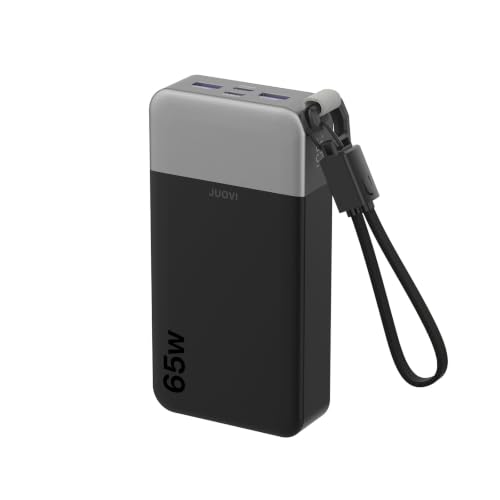
JUOVI 65W 20000mAh Laptop Power Bank with Detachable Cable

INIU Smallest 20000mAh 22.5W Power Bank

VRURC 20000mAh 4-Built-in-Cables Power Bank

JUOVI 90W 20000mAh Laptop Power Bank with Detachable Cable
Why These Options Stand Out
The JUOVI 45W 20000mAh Power Bank is the kind of pack that disappears into a hip belt and rarely complains. A 20000mAh cell gives you roughly four to five phone top-ups, which is enough for a long weekend of navigation, music, and a few camera batteries. The dual USB-C ports output up to 45W through PD 3.0 (Power Delivery 3.0, a fast-charging standard that negotiates the right voltage with your device), enough to refill a tablet at full speed rather than trickling it overnight.
The included detachable cable is a quiet win. Forgetting the right cord at home is the most common backpacker failure mode, and shipping one in the box cuts that risk on the first trip. For thru-hikers resupplying in small towns, this kind of redundancy saves real time.
Strengths Worth Knowing
- 45W PD 3.0 output supports tablets and larger phones at full throttle.
- 20000mAh capacity covers a four to five phone-charge weekend comfortably.
- Detachable USB-C cable included, removing the most common packing mistake.
- Dual USB-C ports allow simultaneous device and headlamp charging.
Things To Consider
- No IP rating listed, so owners commonly treat it as splash-resistant rather than rainproof.
- At 45W it will not fast-charge most modern laptops.
Who It Suits Best
Weekend backpackers running a phone, headlamp, and occasional camera on two to three night trips.
Skip It When
Your kit includes a laptop that needs serious wattage; the JUOVI 65W 20000mAh Laptop Power Bank handles that load.
Where the JUOVI is a quiet multitasker, the ELECOM NESTOUT 15000mAh Rugged Power Bank is built for punishment. IP67 means it is fully sealed against dust and can survive temporary immersion in water (the “6” in dust, the “7” in water depth up to one meter for 30 minutes). The shock-rated body shrugs off the kind of drops that crack slimmer bricks. Its fuel-bottle silhouette is also a hint: this is a power bank designed to live in a bear canister’s side pocket or a bikepacking harness.
Capacity drops to 15000mAh compared with the JUOVI above, but for hikers who value survivability over raw watt-hours, the trade is fair. You get roughly three full phone charges, plus enough overhead to top up a headlamp and a GPS unit across a week.
Why It Works Well
- IP67 sealing keeps the pack functional after a stream crossing or heavy rain.
- Shock-absorbent shell is widely reported to handle trail drops well.
- 32W PD output fast-charges phones and most smaller tablets.
- Vintage fuel-bottle form factor fits standard bottle pockets on packs.
Worth Noting
- 15000mAh gives up some runtime compared with the JUOVI’s 20000mAh.
- Heavier per watt-hour than typical slim bricks due to the rugged shell.
Feature Snapshot
Right Fit For
Backpackers who ford streams, ride bikes, or camp in shoulder-season rain and need a pack that keeps working when wet.
Look Elsewhere When
You want maximum capacity without the rugged shell; the INIU Smallest 20000mAh 22.5W Power Bank gives more watt-hours in a lighter package.
Same internals as the beige sibling, but the black finish changes how the NESTOUT lives on the trail. Darker shells hide scuffs better and don’t reflect light at night, which matters when you’re charging by headlamp and trying to avoid drawing attention at a roadside campsite. Functionally, you get the same IP67 sealing, same 32W PD output, same shock tolerance.
Compared with the JUOVI 45W at the top of this list, the NESTOUT trades raw capacity for environmental protection. For most winter, four-season, and kayak-camping scenarios, that is a smart swap.
What Makes Sense
- Non-reflective black shell works well for low-light or stealth camping.
- 32W PD output matches the beige variant, with no spec compromise.
- IP67 rating confirmed by manufacturer for dust and water immersion.
Points To Note
- Capacity stays at 15000mAh, so longer routes still need careful budgeting.
- Bulkier than non-rugged bricks of similar watt-hour rating.
Made For
Hikers and paddlers who need a sealed pack that handles rain, splash, and drops without flinching.
Consider Something Else When
Weight matters more than weatherproofing; the INIU Smallest 20000mAh 22.5W Power Bank is the trimmer pick.
The gray NESTOUT rounds out the color trio without changing the underlying spec sheet. For travelers flying to a trailhead, the neutral tone blends into a laptop bag or carry-on, avoiding the “gadget” look that can attract attention in transit. The IP67 and shock ratings carry over identically.
On a multi-week hut-to-hut route, this color version tends to suit hikers who already carry a lot of gray gear and prefer their electronics to match. Otherwise, your decision between this and the black or beige NESTOUT comes down to aesthetics.
A Strong Showing
- Identical 32W PD output and IP67 build as the beige and black variants.
- Neutral finish suits minimalist kit lists and travel setups.
- Solid choice for users who already own gray backpacks or shells.
Honest Caveats
- Same 15000mAh ceiling, so power-hungry users still need a bigger pack.
- No fast-charge advantage over the black or beige versions.
Best Suited To
Travelers and minimalist packers who want rugged performance in a low-key color.
A Better Fit Elsewhere
You need laptop-grade output; the JUOVI 90W 20000mAh Laptop Power Bank is the right step up.
The OKZU 5V 20000mAh Heated Clothing Battery Pack exists for a specific niche: powering 5V USB-input heated apparel. That includes most consumer heated vests, jackets, and hoodies on the market, plus accessories like stadium seat heaters and camping-chair warmers. The 20000mAh cell is light for its size, which matters when you are already wearing a heavy parka.
The catch lives in the spec. This pack only outputs 5V at 2A, which is not enough to run 7.4V or 12V heated gear. Backpackers using higher-voltage apparel should look at dedicated heated-clothing batteries instead.
Benefits That Matter
- 20000mAh capacity supports long heated-clothing sessions in cold weather.
- Lightweight build compared with rugged packs of similar capacity.
- 5V USB output is compatible with most mainstream heated vests and jackets.
Some Limits To Know
- Only outputs 5V, so it is not compatible with 7.4V or 12V heated apparel.
- 2A current ceiling is slow for tablets or laptops.
Who Will Love This
Winter hikers and campers running standard 5V heated vests, hoodies, or stadium-style seat heaters.
Swap It Out When
You run 7.4V or 12V heated gear; this model is the wrong voltage match for those systems.
The JUOVI 65W 20000mAh Laptop Power Bank jumps from phone-filler territory into genuine workhorse status. With 65W PD output, this pack can refill a 14-inch MacBook Pro to around half capacity in roughly 40 minutes, which is enough to push through several hours of writing or photo edits at camp. It also runs two USB-C and two USB-A ports simultaneously, so a laptop, phone, earbuds, and headlamp can all charge at once.
For digital nomads splitting time between coffee shops and trail towns, this is a meaningful step up from the 45W JUOVI. The trade is weight and cost; you carry a heavier brick and pay for the extra wattage.
Strong Points
- 65W PD output fast-charges most modern laptops at full speed.
- Four ports (two USB-C, two USB-A) handle a full desk setup on the trail.
- Detachable cable included for grab-and-go packing.
- 20000mAh gives roughly one full laptop top-up plus several phone charges.
Practical Considerations
- Heavier than phone-focused power banks of similar capacity.
- No rugged rating, so it expects gentle handling in transit.
Perfect Match For
Remote workers and through-hikers who edit photos, write, or run GPS-heavy laptop tasks from the trail.
Another Choice May Suit
You need maximum wattage for power-hungry laptops; the JUOVI 90W 20000mAh Laptop Power Bank pushes higher.
The INIU Smallest 20000mAh 22.5W Power Bank is built around a high-density cell that crams full capacity into a body around 11 ounces. For an ultralight kit, that ratio changes the math: you can carry genuine multi-day power without crossing the one-pound threshold. The built-in nylon lanyard doubles as a USB-C cable, which is clever for packing minimalism, although some users prefer detachable cables for long-term wear.
The 22.5W output is on the modest side, especially next to the 65W and 90W JUOVI models. It will fast-charge most phones but will not push a laptop at full speed. For day hikers and weekend trips centered on phones and headlamps, that limit rarely matters.
Key Advantages
- 20000mAh in a sub-12-ounce package, unusually dense for the category.
- Nylon lanyard cable removes the need to pack a separate cord.
- 22.5W output fast-charges most modern phones.
Trade-Offs
- 22.5W ceiling is too slow for laptop fast-charging.
- No IP or rugged rating listed, so it expects dry, gentle conditions.
Quick Facts
Whose Shelf It Belongs On
Ultralight backpackers and day hikers who want maximum capacity at minimum pack weight.
Reach For A Different Pick When
You need laptop-grade output; the JUOVI 65W 20000mAh Laptop Power Bank is the better fit for working on the trail.
The VRURC 20000mAh 4-Built-in-Cables Power Bank solves a problem that comes up most on group trips. With USB-C, Lightning, Micro-USB, and USB-A cables built into the chassis, plus an extra USB and USB-C output port, this pack can charge nearly any device a hiking partner carries. No one has to root through a shared pack looking for the right cord.
Compared with the NESTOUT line, the VRURC is a soft-shell pack. It is best treated as a base-camp charger rather than a deep-water companion. For families, scout groups, or anyone sharing power, the convenience is hard to beat.
Positive Takeaways
- Four built-in cable types cover almost any device on the trail.
- 20000mAh supports multiple users over a long weekend.
- Extra USB and USB-C ports add flexibility for two more devices.
Small Caveats
- No IP rating listed, so it is not suited to wet conditions.
- Built-in cables can wear over years of repeated folding.
Best Suited To
Group leaders, families, and shared-tent campers who need one charger that covers everyone’s device mix.
Where A Sibling Pick Shines
You hike solo in wet weather; the ELECOM NESTOUT 15000mAh Rugged Power Bank handles stream crossings better.
The JUOVI 90W 20000mAh Laptop Power Bank tops this list by wattage. A single USB-C port pushes up to 90W, which is enough to fast-charge demanding laptops, including a 13-inch MacBook Air to about half capacity in 30 minutes. PD and QC (Quick Charge) protocols are both supported, so Android fast-chargers and iPhones both fill quickly.
For trail users editing video or running a full work setup at camp, this is the pack that removes the wall-outlet anxiety. For everyone else, the 65W JUOVI above is probably the smarter buy. The honest read is that 90W is overkill for most phones and headlamps, but worth it if a laptop is on the gear list.
The Upside
- 90W per port supports demanding laptops at near-wall-outlet speeds.
- 20000mAh capacity gives roughly one full laptop refill plus phone charges.
- Detachable USB-C cable included.
- PD and QC protocols cover both iPhone and Android fast-charge paths.
Where It Is Less Suited
- Highest weight in this roundup due to the larger power electronics.
- No rugged or water resistance rating confirmed.
Technical Highlights
Who Should Grab It
Power users running laptops, drones, or camera gear on multi-day routes where wall outlets are far away.
Not Your Match When
Your kit is phone-and-headlamp only; the JUOVI 45W 20000mAh Power Bank covers that kit at a lower weight and likely lower cost.
What Matters Most Before Choosing Backpacking Battery Packs
Capacity vs. Weight
Capacity is measured in milliamp-hours (mAh), but the number that matters on a trail is watt-hours (Wh), because Wh accounts for voltage and reflects usable energy. A 20000mAh pack at 3.7V holds about 74Wh, enough for four to five phone charges or one laptop top-up. Thru-hikers carrying weeks of food and gear typically aim for 60 to 80Wh total; weekend backpackers can get by on 30 to 40Wh.
Weight per watt-hour is the second metric worth tracking. The INIU Smallest 20000mAh 22.5W Power Bank leans into density, while the NESTOUT line trades grams for a sealed shell. Pick the ratio that matches your terrain and weather.
Output Wattage and Device Match
Wattage determines whether your pack can fast-charge a laptop or only trickle a phone. Anything below 30W is fine for phones and headlamps; 45W handles tablets; 60W and up is the threshold for most modern laptops. Using PD or QC protocols means the pack negotiates the right voltage, which protects battery health on both ends.
Matching output to your devices prevents a common trail frustration: plugging in overnight only to wake up at 40%. A simple inventory of watt-hungry gear before you buy pays off over hundreds of miles.
Durability and Weather Protection
IP ratings follow a two-digit code: the first digit rates dust protection (0 to 6), the second rates water (0 to 9). IP67, the rating on the NESTOUT line, means full dust sealing and temporary immersion protection. For backpackers who ford streams, kayak-camp, or hike in shoulder-season rain, that rating is the difference between a working charger and a brick.
Shock resistance matters too. A rigid outer shell absorbs drops on granite, while a soft-shell pack in the same situation tends to dent or split. If you carry your battery loose in a pack, durable construction is the first line of defense.
Key Considerations Across These Picks
Mistakes Worth Dodging
The most common slip-up is buying capacity you will never use. A 20000mAh brick is wasted weight on a one-night hammock trip where a 10000mAh pack would do. The opposite mistake is under-buying: showing up to a five-day route with a phone-only charger and no overhead for a headlamp or GPS.
The second pitfall is voltage mismatch. Heated apparel users sometimes grab a 5V pack when their gear actually runs on 7.4V or 12V, and laptop users sometimes pick a 30W brick for a 65W machine. Reading the input spec on the device, not just the battery, prevents both.
When Paying More Pays Off
The step up to a higher-wattage pack, like the JUOVI 65W or 90W models, costs more in dollars and grams but unlocks laptop charging. For digital nomads, that means a real workday at a wall-free campsite. For everyone else, the upgrade rarely justifies itself.
Rugged certification is the other place premium money actually buys something. IP67 sealing and a shock-rated body are real engineering costs that show up when you drop the pack on rock, drop it in a creek, or use it in freezing rain. Budget travelers on mild trails can skip it; four-season users should not.
Frequently Asked Questions
How many mAh do I really need for a weekend backpacking trip?
A 10000 to 15000mAh pack covers a weekend of phone, headlamp, and occasional GPS use for most people. If you also power a camera or drone, step up to 20000mAh for safety.
Can I take a battery pack on a plane?
Most airlines allow power banks under 100Wh in carry-on luggage, which covers every pack in this roundup. Packs above 100Wh usually require airline approval and must travel in carry-on, not checked bags.
Do I need a power bank with a specific fast-charge protocol?
Match the protocol to your phone. USB-C PD covers most modern iPhones and Android flagships. Older Android phones may rely on QC for fastest charging, so verify your device’s spec before buying.
Is a rugged power bank worth the extra weight?
Rugged packs earn their weight on wet trails, winter routes, and kayak or bikepacking trips. For fair-weather weekend hiking on established trails, a lighter non-rugged option is usually enough.
How do I store a power bank between uses?
Owners commonly store packs at around 50% charge in a cool, dry place to preserve cell health. Avoid leaving a fully charged or fully drained pack in a hot car, since heat and full states of charge both shorten battery lifespan over time.
Wrap Up
The right pack depends on your trail, your weather, and your gear list. For ultralight weekends, the INIU’s density wins. For rough and wet routes, the NESTOUT line earns its place. For laptop users, the JUOVI 65W or 90W steps up to real workhorse status. Pick the ratio that matches your miles, and your gear will stay powered from trailhead to trailhead.