A dead battery is one of those failures that never comes at a good time. Whether you commute year-round, store a classic over winter, or run an RV that sits idle for weeks, the right absorbed glass mat (AGM) battery keeps headlights bright, infotainment stable, and the engine turning over on the first try. The ten picks below cover everyday drivers, off-grid setups, motorcycles, and high-demand start-stop vehicles, so you can match capacity, footprint, and terminal layout to the way you actually drive.
A Quick View Of The Lineup
PickWhy We Picked ItBest ForAction

Upgrade PickLiTime 12V 100Ah RV Lithium LiFePO4 Battery (Group 24)
Drop-in lithium replacement
RV and marine use

Solar Ready PickVMAX SLR125 AGM Sealed Deep Cycle 12V 125Ah Batteries (2-Pack)
Twin-pack solar storage
Off-grid solar banks

High Output PickWeize Platinum AGM BCI Group 94R H7 Automotive Battery
Strong cold cranking
Full-size daily drivers
Compact ChoiceRelistart 12V 6AH Sealed AGM Motorcycle Battery
Sealed small-format power
Motorcycles and scooters
Daily DriverMighty Max MM-G24 Start and Stop AGM Battery (Group 24)
Sealed start-stop reliability
Mid-size commuter cars
Small Footprint PickMighty Max MM-G26 AGM Battery (Group 26)
Compact Group 26 fit
Compact cars and sedans
Tight engine bays

OE Fit PickACDelco Gold 51RAGM AGM Battery (Group 51R)
Factory-style replacement
Compact Japanese vehicles
Well Rounded PickWeize Platinum AGM BCI Group 48 H6 Automotive Battery
Balanced H6 dimensions
Crossovers and mid-size SUVs
Heavy Duty PickMighty Max MM-G31 Start and Stop AGM Battery (Group 31)
Large-format cranking reserve
Trucks and work vehicles
![]()
Value PickWeize Platinum AGM BCI Group 47 H5 Automotive Battery
Compact H5 dimensions
Small European and import cars
A Breakdown Of The Leading Choices
The LiTime 12V 100Ah swaps a traditional AGM in a Group 24 footprint for a lithium iron phosphate (LiFePO4) chemistry that weighs roughly a third less and holds about 1.28 kWh of usable energy. For RVers and trailer owners tired of hauling heavy house banks, that difference shows up the moment you lift it out of the compartment. It also lists up to 15000 cycles, which suggests years of weekend and full-time use before capacity dips noticeably, depending on depth of discharge habits.
Drop-in fitment means you can replace an AGM without reworking the wiring, and the higher energy density helps run trolling motors, lights, and small inverters more efficiently on longer trips. Owners commonly report steadier voltage under load compared with the AGM it replaces.
Everyday Wins
- ✓Group 24 case matches common AGM trays for an easy swap.
- ✓Substantially lighter than the lead-acid unit it replaces.
- ✓Long cycle rating supports deep cycling without rapid wear.
- ✓Holds voltage steady while running trolling motors or inverters.
- ✓Higher usable capacity for solar banks and house circuits.
Things To Consider
- •Not designed for engine cranking, golf carts, or jack systems.
- •Charging system may need a lithium-compatible profile.
Who It Suits Best
RV, marine, and solar users who want a lighter house bank and far more cycles than a lead-acid battery can offer.
Consider Something Else When
The Weize Platinum AGM BCI Group 94R H6 Automotive Battery suits drivers who need true engine-starting cranking amps in a passenger vehicle instead of house-bank storage.
This VMAX SLR125 two-pack is built for stationary off-grid storage rather than engine cranking. Each unit delivers 125Ah of deep-cycle capacity, and pairing them gives you a 250Ah bank at 12V or a 24V string for inverters, depending on how you wire the system. The sealed AGM design recombines gases internally, so installation does not require venting in most setups.
Off-grid households running wind turbines or solar arrays commonly report eight to ten years of float service when these are kept on a smart charger, so longevity depends a lot on charge profile. Compared with the LiTime unit above, this is a heavier lead-acid solution, but it is a proven platform for renewable banks.
Real-World Strengths
- ✓Two batteries arrive pre-matched for a 24V bank or parallel capacity.
- ✓Sealed construction avoids leaks and gas venting indoors.
- ✓Designed for deep daily cycling from solar or wind input.
- ✓Long float life when paired with a multi-stage charger.
Points To Note
- •Substantial weight makes mounting and transport a two-person task.
- •Not suited as a starting battery for vehicles.
- •Needs a compatible smart charger to reach full lifespan.
Made For
Off-grid installers, cabin owners, and renewable energy builders running solar arrays or wind turbines.
A Better Fit Elsewhere
The LiTime 12V 100Ah RV Lithium LiFePO4 Battery suits RV travelers who want lighter weight and far more cycles in a single unit.
The Weize Platinum Group 94R brings serious cranking muscle to full-size daily drivers. With 850 cold cranking amps (CCA) and an 80Ah capacity, it covers vehicles with higher electrical demand, including those running heated seats, larger infotainment stacks, and accessory lighting. Reserve capacity sits at 140 minutes, so accessories stay alive longer at idle if the alternator ever falters.
That power does come with footprint requirements. At 12.4 inches long, 6.89 inches wide, and 7.48 inches tall, this battery fits the Group 94R/H7 tray and uses tapered terminals with the negative on the left. Verify your existing terminal layout and tray dimensions before ordering to avoid a fitment issue at install.
Features That Help
- ✓850 CCA supports reliable cold-morning starts in colder climates.
- ✓140-minute reserve capacity covers accessory load at idle.
- ✓AGM cycle life reportedly runs up to twice a conventional flooded battery.
Trade Offs
- •Case size demands a Group 94R/H7 tray, limiting vehicle fitment.
- •Heavier than smaller-format AGM options in this list.
Feature Snapshot
| | Feature | Specification | Why It Matters |
|---|
| Group size | BCI 94R (H7) | Confirms fit in larger vehicle battery trays. |
| CCA | 850 | Strong cold-start reserve for bigger engines. |
| Reserve capacity | 140 minutes | Keeps accessories running if charging dips. |
| Dimensions | 12.4 x 6.89 x 7.48 in | Match against existing tray space. |
| Terminal orientation | Left negative, right positive | Prevents cable reach issues on install. |
Best Suited To
Owners of full-size sedans, crossovers, and trucks that call for Group 94R with high cranking output.
Look Elsewhere When
The Mighty Max MM-G24 Start and Stop AGM Battery suits drivers needing a Group 24 footprint for a smaller engine bay.
The Relistart 12V 6Ah sealed lead-acid AGM is built for powersports rather than the family car. Its small footprint and sealed construction suit motorcycles, scooters, ATVs, and lawn equipment that sit for weeks between rides. Sealed lead-acid (SLA) AGM tech holds voltage during storage, so you are less likely to find a dead bike when spring rolls around.
The spill-proof casing resists corrosion around terminals and mounts in any orientation, which is handy on a bike that leans into corners. Capacity is modest, so it powers a starter motor and basic lighting, not heated gear or larger accessories.
What Helps Most
- ✓Sealed, spill-proof build handles vibration and odd mounting angles.
- ✓Low self-discharge keeps charge during seasonal storage.
- ✓Maintenance-free design needs no water top-ups.
Worth Noting
- •Capacity is small, so it suits powersports, not larger vehicles.
Who Should Grab It
Motorcycle, scooter, and ATV owners who want a sealed, set-and-forget battery for seasonal riding.
Swap It Out When
The Mighty Max MM-G26 AGM Battery suits small cars that need real cranking power in a compact format.
The Mighty Max MM-G24 is a workhorse replacement for mid-size commuter cars with start-stop systems. At 710 CCA and 70Ah, it has enough punch to crank a four-cylinder on a frosty morning while supporting the constant accessory draw that modern vehicles place on the battery every time they coast to a stop. Reserve capacity is rated at 120 minutes for accessory support.
The sealed, spill-proof AGM design recovers well from the deep discharge cycles common in stop-and-go city driving. It mounts in Group 24 trays, which fits a wide range of sedans and crossovers, depending on the OEM tray layout.
Practical Pluses
- ✓710 CCA handles cold starts across most climates.
- ✓Deep discharge recovery suits start-stop driving patterns.
- ✓Sealed design tolerates under-hood heat and vibration.
Less Ideal Details
- •Reserve capacity is moderate, so heavy accessory loads drain it faster.
Key Specs
| | Feature | Specification | Why It Matters |
|---|
| Group size | BCI 24 | Matches common mid-size car trays. |
| CCA | 710 | Reliable cold-weather starting. |
| Reserve capacity | 120 minutes | Keeps accessories alive at idle. |
The Right Fit
Daily commuters and stop-and-go city drivers who need a sealed AGM that survives repeated shallow cycles.
Not Your Match When
The Mighty Max MM-G31 Start and Stop AGM Battery fits owners of full-size trucks who need higher reserve and cranking output.
The MM-G26 is a smaller Group 26 AGM sized for compact cars and sedans where tray space is tight. With 540 CCA and 45Ah, it covers lighter four-cylinder engines and modest accessory loads. Reserve capacity sits at 80 minutes, so it supports basic electronics if the alternator briefly drops offline.
It uses the same sealed AGM construction as the larger Mighty Max units above, so you get similar spill-proof and vibration-tolerant behavior in a smaller case. Output is modest compared with the Group 24 sibling, which is the real trade-off here.
Practical Advantages
- ✓Compact Group 26 case fits tighter engine bays.
- ✓Sealed AGM resists leaks during hard cornering or rough roads.
- ✓Recovers from accessory drain between short trips.
Worth Bearing In Mind
- •540 CCA is on the lower side for very cold climates.
- •80-minute reserve means limited accessory support at idle.
Whose Shelf It Belongs On
Compact car and sedan owners who need a tidy-fit AGM and do not push heavy electrical loads.
Reach For A Different Pick When
The Weize Platinum AGM BCI Group 47 H5 Automotive Battery suits import cars that need a similar compact case but slightly different dimensions.
The ACDelco Gold 51RAGM is a factory-style replacement built for compact Japanese vehicles and other applications that specify the Group 51R footprint. Its OE-focused design matches the fit, form, and function expected of a General Motors-grade part, which makes installation straightforward for the right vehicle.
AGM construction handles the electrical demands of small cars and import sedans, and a 36-month warranty backs the work for typical daily driving. It is not the highest-output unit on this list, but it lands where the factory tray expects it.
What Earns Its Place
- ✓Group 51R case matches OEM trays in many compact Japanese cars.
- ✓Sealed AGM design supports modern accessory loads.
- ✓Backed by a multi-year warranty for everyday use.
Honest Caveats
- •Not a universal fit, so verify Group 51R spec before ordering.
Perfect Match For
Compact Japanese and import vehicle owners who want a direct OE-style AGM replacement.
Where A Sibling Pick Shines
The Mighty Max MM-G26 AGM Battery covers compact cars that use the Group 26 tray instead of Group 51R.
The Weize Platinum H6 fits a wide range of crossovers and mid-size SUVs that call for the Group 48 footprint. Output sits at 760 CCA with a 70Ah rating, so it covers larger alternators and accessory setups without strain. Reserve capacity is rated at 120 minutes.
Compared with the Group 94R above, this is a slightly more compact case at 10.94 inches long, which is helpful in vehicles with shallower trays. Terminal orientation follows the standard left-negative, right-positive layout. Confirm your existing tray dimensions and clamp style before installing to avoid clearance issues.
Useful Touches
- ✓760 CCA handles mid-size engines in varied climates.
- ✓Group 48/H6 dimensions suit many popular crossovers.
- ✓120-minute reserve keeps accessories online at idle.
Where It May Fall Short
- •Capacity is modest for trucks or heavy accessory builds.
Quick Facts
| | Feature | Specification | Why It Matters |
|---|
| Group size | BCI 48 (H6) | Standard fit for many crossovers. |
| CCA | 760 | Strong starting in cooler weather. |
| Reserve capacity | 120 minutes | Buffers accessory load at idle. |
Right Fit For
Crossover and mid-size SUV owners who want a balanced Group 48 AGM with solid cranking and accessory support.
Skip It When
The Mighty Max MM-G31 Start and Stop AGM Battery suits owners running heavier accessories or work-truck electrical setups.
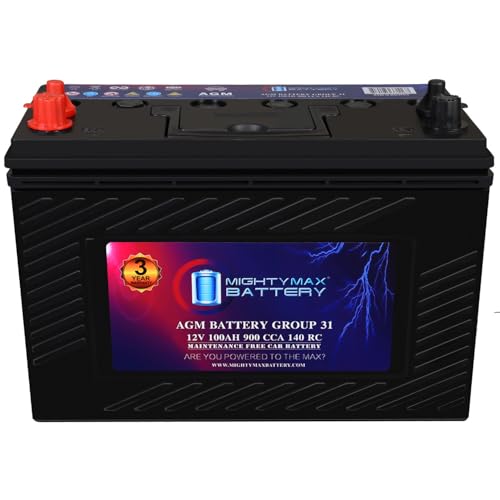
The MM-G31 is the largest of the Mighty Max start-stop trio, designed for full-size trucks and work vehicles that draw serious current. With 900 CCA and 100Ah of capacity, it cranks big V6 and V8 engines and keeps plow lights, inverters, and tool chargers happy at idle. Reserve capacity is rated at 140 minutes, so accessories stay alive longer if the alternator takes a break.
The Group 31 footprint is larger than the H6 and Group 24 units above, so confirm tray space and hold-down hardware before ordering. Once mounted, the sealed AGM construction handles vibration from rough roads and deep accessory cycling.
What Pays Off
- ✓900 CCA covers large-displacement engines in cold weather.
- ✓140-minute reserve supports heavy accessory and tool loads.
- ✓Sealed AGM handles deep discharge cycles from work use.
Things To Weigh
- •Heavy battery demands solid mounting hardware.
- •Large footprint rules out smaller vehicle trays.
Feature Rundown
| | Feature | Specification | Why It Matters |
|---|
| Group size | BCI 31 | Standard for trucks and heavy-duty vehicles. |
| CCA | 900 | Confident cold cranking for big engines. |
| Reserve capacity | 140 minutes | Sustains accessories under heavy load. |
| Capacity | 100Ah | Plenty of headroom for tools and lights. |
Built With In Mind
Full-size truck and work vehicle owners who push heavy electrical loads and need long accessory runtime at idle.
Another Choice May Suit
The Weize Platinum AGM BCI Group 94R H6 Automotive Battery fits drivers needing strong cranking without the Group 31 footprint.
The Weize Platinum H5 covers the compact import and European cars that specify the Group 47 case. At 680 CCA and 60Ah, it handles smaller engines and modest accessory demands with a 100-minute reserve capacity. The 9.52-inch length fits where larger Group 48 or 94R batteries simply will not drop in.
AGM construction gives it longer cycle life than a conventional flooded battery, which matters in stop-and-go city traffic. Tapered terminals follow the left-negative, right-positive orientation, so cables reach without modification in most setups.
What Makes Sense
- ✓Compact Group 47/H5 case suits small import cars.
- ✓680 CCA covers lighter engines in most climates.
- ✓AGM design outlasts conventional flooded replacements.
Less Ideal Details
- •Lower CCA and capacity limit very cold-weather confidence.
- •Modest reserve for vehicles with heavy accessory draw.
Best Suited To
Small European and import car owners who need a tidy-fit AGM that meets the Group 47 specification.
Where Another Pick Suits Better
The Mighty Max MM-G26 AGM Battery suits compact cars that require a Group 26 footprint rather than Group 47.
What To Weigh Before Choosing Automotive AGM Batteries
AGM batteries, or absorbed glass mat batteries, use a fiberglass mat soaked in electrolyte rather than free-flowing liquid acid. That construction resists vibration, mounts in different orientations, and recharges faster than a flooded battery, which is why newer vehicles with start-stop systems and regenerative braking rely on them.
Match The Group Size To Your Tray
BCI group numbers describe the case dimensions and terminal layout, not the capacity. The Group 94R, H6, H5, 24, 26, and 31 units in this list each fit specific trays, so measuring your existing battery and comparing length, width, and terminal position prevents a frustrating return. Getting this wrong is the most common ordering mistake in the category.
Once the case fits, the next decision is cranking amps versus reserve capacity. Vehicles with heavy electrical demand, like trucks running plows or work lights, benefit from higher reserve (RC) ratings so accessories stay alive at idle. Smaller commuter cars usually need less reserve and can prioritize fit and CCA.
Cranking Amps Versus Reserve Capacity
CCA (cold cranking amps) measures starting power at zero degrees Fahrenheit, while RC (reserve capacity) measures how long the battery can run accessories if the alternator fails. Cold-climate drivers should weight CCA more heavily, while owners running inverters and tool chargers should focus on RC. The two ratings tell different stories, and the right balance depends on your climate and electrical habits.
AGM batteries also tolerate deeper discharge cycles than flooded batteries, which matters for vehicles with start-stop systems that cycle the battery many times per trip. For RV and marine use, that same depth tolerance extends to running house loads, though dedicated house banks like the VMAX SLR125 above are tuned for that purpose.
Warranty And Expected Service Life
Most automotive AGM batteries in this range come with multi-year warranties, which is a useful proxy for how the manufacturer expects them to age. Warranties cover defects, not wear from deep discharge or chronic undercharging, so a healthy charging system remains essential. Keeping the battery on a smart maintainer during long storage periods helps AGM units reach the upper end of their expected lifespan.
Smart Considerations Across These Picks
Common Buying Slip Ups
The most frequent ordering mistake is choosing by amp-hour or CCA alone and overlooking group size, which leads to returns when the case does not drop into the tray. Terminal orientation also catches shoppers off guard, since a left-negative layout differs from a right-negative one and cables do not always reach across the top. Always measure the existing battery and check the terminal diagram in the product listing before checkout.
What The Higher Tier Buys
Stepping up to a higher-output AGM gets you more CCA, longer reserve capacity, and often a longer warranty, which matters most for trucks, work vehicles, and cold-climate drivers. The trade-off is weight and price, since heavier plates and denser active material push cost up. For most daily drivers in moderate climates, a mid-tier AGM delivers all the reliability needed without overspending on capacity the vehicle will not use.
Frequently Asked Questions
QWhat Does AGM Mean In A Car Battery?
AGM stands for absorbed glass mat, a design where the electrolyte is held in fiberglass mats between the plates. This makes the battery sealed, spill-proof, and more resistant to vibration than a flooded lead-acid battery, while also supporting deeper discharge cycles common in start-stop driving.
QHow Long Do Automotive AGM Batteries Typically Last?
Most automotive AGM batteries last three to five years in typical daily driving, with longer life possible when the charging system is healthy and the battery is not chronically discharged. Climate, driving habits, and accessory load all affect how quickly capacity fades, so a battery tender helps during long storage.
QCan An AGM Battery Replace A Standard Flooded Battery?
In most vehicles, an AGM battery can replace a flooded battery as long as the group size and terminal layout match, though the charging system may need a recalibration or an AGM-compatible profile. Some start-stop vehicles are designed specifically for AGM chemistry, so always check the owner’s manual before upgrading.
QIs A Higher CCA Rating Always Better?
A higher cold cranking amp rating means stronger starting power in cold weather, but oversized CCA does not improve daily driving in warm climates. Choose a CCA rating that meets or slightly exceeds your engine’s requirement, then prioritize reserve capacity if you run accessories at idle.
QDo AGM Batteries Need A Special Charger?
AGM batteries charge at slightly different voltages than flooded batteries, so a smart charger with an AGM setting helps reach full capacity and extends service life. Using a flooded-only charger risks undercharging the AGM over time, which shortens its useful life in off-grid and RV setups.
Bottom Line
The right AGM battery comes down to matching your tray size, climate, and electrical demands. Start with the group number, then weigh cranking amps and reserve capacity against how you actually drive. Cold-climate commuters and work-truck owners need different things from a battery, and this lineup covers both ends of that spectrum without overselling either one.