A dead battery is one of the worst ways to start a morning, and more often than the battery itself, the culprit is a corroded or loose terminal. Quality auto battery terminal connectors keep current moving reliably from the post to the cable, whether you’re driving a daily commuter, a work truck, or a weekend project car. The ten picks below cover different setups, from simple OEM replacements to multi-cable distribution blocks for audio builds.
Your Options, Compared

DLronwey Battery Terminal Connectors Military Spec Heavy Duty with Copper Lugs

Kaas Battery Terminal Connectors Colored Anode Top Post 12-Way Clamps

Kaas Lead Acid Battery Terminal Clamps 4-Way with OEM Adapter

Made in Taiwan 9-Way Battery Terminal Connectors Adapter Set

Lead Military Style Battery Terminal Zinc Plated Steel Fasteners Pair

Insulated Battery Power Junction Post Block 3/8 Lug Stainless Steel Stud
DLronwey Battery Terminal Connectors Military Spec with Anti Corrosion Washers

Kaas 8-Way Lead Acid Battery Terminal Connector with OEM Adapter

Kaas 8-Way Lead Acid Battery Terminal Connector Metallic Silver Heavy Duty

DLronwey Battery Terminal Connectors Military Spec Heavy Duty 8-Lug Kit
The Strengths Of Each Pick
For a full battery service, this DLronwey kit arrives with everything needed in a single box: two heavy-duty terminal posts, color-coded red and black military-style covers, anti-corrosion washers, four copper ring lugs rated for 2-gauge cable, and heat-shrink tubing for sealing the crimps. The alloy construction targets strong conductivity and corrosion resistance, which matters most if your vehicle sits outside or runs through wet weather regularly.
Compared to a bare replacement clamp, this kit eliminates the separate trip to the parts store for lugs and boots, so weekend installers and daily-driver owners can finish the swap in one sitting. The included heat-shrink adds a clean professional look once the cables are re-crimped. Most users will find the included hardware covers the typical sedan, SUV, or light truck setup without extras.
Practical Advantages
- Complete kit with copper lugs, covers, and anti-corrosion washers included
- Military-style covers add a tidy look under the hood while shielding posts from splash
- Anti-corrosion washers help slow the green buildup that kills connection quality
- Heat-shrink tubing gives crimped cables a sealed, professional finish
- Storage case keeps small parts together between uses or in a shop drawer
Worth Noting
- Alloy content varies across production runs, so verify cable fit before crimping
- Two terminals limit you to a single-battery setup; multi-battery builds need more pieces
Who It Suits Best
Daily-driver owners tackling a full terminal and lug refresh on a car, truck, or SUV in a single afternoon.
Consider Something Else When
The Kaas 8-Way Lead Acid Battery Terminal Connector suits installers running several amplifiers or accessories more cleanly.
The Kaas 12-way clamps turn the battery post into a true distribution hub, accepting cables from 8 AWG up to 4/0 AWG (XL). The red positive and blue negative color coding makes polarity mistakes much harder, and the easy-to-tighten head design reduces the chance of a loose clamp on rough roads. Compatibility with SAE, DIN, and EN tapered top posts covers most vehicles on the road today.
This pair shines in builds where multiple accessories draw from the same battery. Audio systems, light bars, onboard compressors, and dual fuel pumps all benefit from dedicated cable landings instead of daisy-chained rings. The anodic oxidation treatment on the contact surface targets steady current flow over time. For most custom wiring projects, this is the kind of clamp that prevents weekend headaches later.
Points In Its Favor
- Twelve cable landings per clamp eliminate messy splitter rings under the hood
- Broad AWG range covers everything from signal wiring to inverter feeds
- Polarity color coding cuts install errors on rushed weekend jobs
- Multi-standard post fit works on imported and domestic tapered terminals
Trade Offs
- The footprint is taller than OEM clamps, so confirm hood clearance in shallow bays
- More connection points mean more places to torque and recheck seasonally
Feature Snapshot
Made For
Car audio builders and off-grid tinkerers running several amplifiers, inverters, or auxiliary loads from one battery.
Look Elsewhere When
A simple daily-driver clamp swap calls for the Kaas 4-Way Lead Acid Battery Terminal Clamps, which keeps wiring closer to OEM.
Where the previous Kaas clamp aims at heavy accessory builds, this 4-way pair keeps things closer to factory dimensions. It fits SAE, DIN, and EN tapered top posts and supports the same 8 AWG to 4/0 AWG cable range, so most stock wiring drops in without re-crimping. The included OEM top-post adapter means there’s no cutting or modifying of the existing factory clamp on vehicles that still rely on the original cable.
This is the clamp most people reach for when a corroded OEM terminal needs replacing but the rest of the wiring is sound. Four landings still leave room for an occasional accessory tap without turning the bay into a bird’s nest. It fits well under stock covers on common sedans and crossovers.
Positive Points
- OEM top-post adapter preserves the factory cable end on newer vehicles
- Compact 4-way profile slips under most factory battery covers
- Wire range covers stock 6 AWG and lighter accessory wiring in one clamp
Honest Caveats
- Only four landings limit expansion on builds with stacked accessories
- Adapter adds a connection point that should be rechecked after the first heat cycle
Best Suited To
DIYers replacing worn factory terminals on a commuter or family vehicle without rewiring the whole harness.
Skip It When
You are running six or more accessory circuits and need the Kaas 12-Way Battery Terminal Connectors instead.
This Kaas set is built around A6061-T6 aluminum with documented material reports from SGS, which sets it apart in a category where alloy claims often go unverified. The 9-way layout handles positive and negative distribution without forcing cable stacking, and the build origin in Taiwan suggests tighter manufacturing controls than cheaper alternatives.
For vehicles with serious accessory loads, the combination of verified aluminum conductivity and extra landings pays off. Long-term owners who keep their trucks or vans for a decade will appreciate the documented material story. It’s overkill for a stock daily but earns its keep on overland rigs and commercial vans.
Real Benefits
- A6061-T6 aluminum platform with documented SGS material and conductivity reports
- Nine cable landings handle most accessory stacks without splitter rings
- Taiwanese manufacturing origin suggests tighter production tolerances
Where It May Fall Short
- Premium positioning may overshoot the needs of a simple battery swap
- Aluminum contact surfaces benefit from anti-corrosion treatment in salty climates
Who Will Love This
Long-term owners running winches, lighting banks, and inverter systems who want verified material sourcing on their electrical backbone.
A Better Fit Elsewhere
The DLronwey Military Spec kit covers a simpler commuter swap at a lower entry cost for owners without heavy accessory loads.
The Quick Cable lead terminals are aimed straight at fleet, agricultural, and heavy-equipment use, where brute durability matters more than accessory count. The lead body delivers the same low resistance shops have trusted for decades, while zinc-plated steel fasteners and long 3/8-inch studs give plenty of room for additional power leads. Exceeding military spec A52425-1 and A52425-2 signals a serious-duty part rather than a parts-store special.
The low 3/4-inch profile keeps the clamp tucked under most hood lines without fighting for clearance. Pairing positive and negative in one matched set keeps polarity straightforward for shop technicians. For most light-vehicle owners it does more than required, but for trucks running plow motors or auxiliary hydraulics, that headroom is exactly the point.
The Upside
- Solid lead construction built for repeated thermal cycling in work vehicles
- Long 3/8-inch studs allow additional power connections for plow or pump leads
- Low 3/4-inch profile preserves hood clearance in tight engine bays
Points To Keep In Mind
- Lead weight makes the clamp heavier than alloy alternatives, which matters on small batteries
- No accessory landings, so auxiliary wiring needs separate distribution hardware
Technical Highlights
Perfect Match For
Fleet mechanics and farm operators who need a clamp that handles vibration, weather, and repeated accessory additions.
Another Choice May Suit
The DLronwey Military Spec kit suits weekend installers who want lugs and covers bundled with the clamp in one box.
The Advance MCS junction post takes a different approach entirely. Instead of clamping onto a battery post, it bolts down somewhere else on the chassis or panel and becomes a remote power or ground landing point. The 3/8-inch stainless steel stud handles serious current, and the composite insulating base means it can mount to metal without shorting through the panel.
This is the part that earns its place in relocated battery setups, trailer wiring, and dual-battery trays where the original post is buried under a seat or behind a panel. Custom builders chasing clean engine bays use junction blocks like this to keep cables tidy. Most commuters won’t need one, but custom builds often do.
The Helpful Details
- Composite insulating base lets the block bolt directly to metal panels
- Stainless steel stud resists corrosion in wet or salty environments
- Red and black pairing keeps positive and ground landings clearly separated
Practical Considerations
- Not a direct battery post replacement, so it pairs with another clamp on the post itself
- Requires planning for mounting location and cable routing during install
Right Fit For
Custom installers relocating a battery to the trunk or rear of a van who need a clean under-hood power and ground landing point.
Swap It Out When
A straight battery-post replacement fits the Kaas 4-Way Lead Acid Battery Terminal Clamps more directly without a remote block.
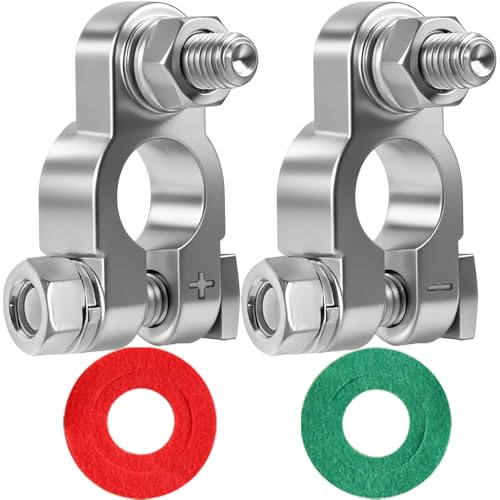
This stripped-down DLronwey kit drops the copper lugs and heat-shrink to focus on the core clamp, covers, and anti-corrosion washers. The military-spec terminal design stays the same, so the connection quality matches the larger kit, while the smaller scope keeps it approachable for owners who only need to replace worn clamps on a stock harness.
For a sedan or compact truck where the existing cable ends are still healthy, this is a no-frills path to fresh posts and corrosion protection. Pairing the included washers with a dielectric grease dab slows the green buildup that drags down charging over time. You may find yourself adding lugs separately if cables ever need re-crimping.
Real-World Strengths
- Copper terminal body targets low resistance and steady cranking performance
- Anti-corrosion washers slow the green buildup common on daily-driven vehicles
- Red and black covers keep polarity obvious and posts shielded from splash
Less Ideal Details
- No lugs or heat-shrink included, so any cable rework needs separate parts
- Two-terminal scope limits use on dual-battery or accessory-heavy setups
Built With In Mind
Light-truck and car owners refreshing factory terminals on a stock harness without adding accessories.
Where A Sibling Pick Shines
The larger DLronwey kit with copper lugs covers owners re-crimping cables at the same time as the clamp swap.
This 8-way Kaas connector lands between the 4-way and 12-way models in the same lineup, with room for two 2/0 AWG and two 1/0 AWG cables per side. The OEM top-post adapter preserves factory cable ends on vehicles where cutting the original clamp would trigger wiring headaches. The same anti-loosening head design carries over from the other Kaas models.
It hits the sweet spot for someone adding a subwoofer, light bar, or air compressor without going full custom. Eight landings keep the wiring organized without leaving unused ports. Most installers upgrading a single accessory will find this is plenty of headroom.
Everyday Perks
- Eight landings cover a subwoofer, lighting, or compressor without going overboard
- OEM adapter protects factory cable integrity during the upgrade
- Anti-loosening head design reduces re-tightening on rough roads
Small Caveats
- Adapter adds a stack-up that needs careful torque to avoid resistance creep
- Higher landing count costs more than the 4-way sibling for similar installs
Whose Shelf It Belongs On
Weekend hobbyists adding one or two accessories to a daily-driven car or truck without rewiring the entire harness.
Reach For A Different Pick When
A purely stock replacement without accessory work calls for the simpler Kaas 4-Way Lead Acid Battery Terminal Clamps.
Functionally identical to the previous 8-way Kaas clamp, this version swaps the standard finish for a polished metallic silver look that pops under hood lighting at car shows. The same 2/0 AWG and 1/0 AWG hole pattern handles real-world loads, so owners aren’t paying for appearance alone. The clean finish also wipes down easier than textured coatings when dusting the bay before an event.
Show car owners building magazine-ready engine bays appreciate the visual upgrade without sacrificing the proven electrical layout. Daily drivers see less benefit, since the finish lives under a hood most of the time. Where presentation matters, the silver finish earns its place.
Everyday Wins
- Polished metallic finish adds visual polish under hood lighting
- Smooth surface wipes clean without trapping dust between shows
- Same 8-way electrical layout as the standard Kaas model
What To Weigh
- Premium finish costs more without adding electrical capability over the standard 8-way
- Polished surface can show oxidation faster in coastal climates without protection
Who Should Grab It
Show car and weekend cruiser owners building an engine bay presentation around visible accessories.
Not Your Match When
A purely functional clamp swap on a commuter makes the standard Kaas 8-Way the smarter spend.
The expanded DLronwey kit doubles the lug and heat-shrink count of the earlier kit, with eight copper ring lugs, four covers, and four anti-corrosion washers. That’s enough hardware to cover dual-battery setups, full boat or RV banks, and four-post marine installations. The same alloy body and military-style covers carry over, so the connection quality matches the smaller kit.
Owners running auxiliary battery trays or marine battery banks find this scope saves multiple trips to the parts store. The included storage case keeps the extra hardware organized between projects. Most single-battery vehicles will leave pieces unused, so the smaller kit still suits simpler jobs.
What Makes Sense
- Eight copper lugs cover dual-battery, RV, or four-post marine setups
- Four terminal covers support projects with multiple battery banks
- Storage case keeps the larger hardware count organized between jobs
A Few Limitations
- Extra hardware adds cost over single-battery swaps where most pieces go unused
- Larger scope makes it harder to stash in a small toolbox between uses
The Right Fit
Boat owners, RV enthusiasts, and overlanders running multi-battery banks that need matched hardware in one box.
Skip It When
A single-battery sedan or truck swap fits the smaller DLronwey kit without paying for hardware that sits in the case.
What Matters Most Before Choosing Auto Battery Terminal Connectors
The right clamp comes down to three questions: how many cables need to land on each post, what gauge range the cables use, and whether the vehicle’s post matches SAE, DIN, or EN tapered top posts. Most sedans and light trucks only need a basic clamp with one or two landings, while audio builds and overland rigs want distribution blocks with multiple ports.
Material choice matters more than branding in this category. Lead and copper bodies have decades of field history, while aluminum clamps weigh less and resist corrosion when properly treated. Whatever you choose, anti-corrosion washers and dielectric grease do more for long-term reliability than exotic finishes.
Cable gauge compatibility is the easiest detail to get wrong. A clamp that accepts 8 AWG to 4/0 AWG covers most needs, but a clamp limited to 2 AWG won’t accept the heavier feeds an inverter demands. Match the clamp’s range to your largest planned cable, and the smaller wires will still fit.
Post type catches a lot of first-time installers. SAE tapered top posts are standard on most American and Japanese vehicles, while DIN and EN posts show up on many European imports. The clamps listed here cover all three standards, so confirm your battery style before ordering.
Key Considerations Across These Picks
Pitfalls Shoppers Hit
A common slip-up is buying a clamp without checking cable gauge range. A clamp that only accepts up to 2 AWG forces a re-crimp when adding a heavier inverter feed later, and that’s an afternoon nobody wants. Another mistake is overlooking post style, which leads to a clamp that physically won’t seat on a DIN post from a European vehicle.
What The Higher Tier Buys
Premium models like the Made in Taiwan 9-Way set earn their cost through documented material sourcing and tighter manufacturing tolerances. For commercial vans and overland rigs running heavy loads daily, that documentation means fewer surprises over a decade of service. For a commuter that sees a fresh battery every five years, the lower tier covers the need without the same peace of mind.
Frequently Asked Questions
How do I know which post type my battery has?
Look at the top of the battery. SAE tapered posts are the most common on American and Japanese vehicles and have a slight inward taper. DIN and EN posts from European vehicles are also tapered but slightly different in diameter, though many modern clamps handle both standards in one part.
Can I reuse my existing cable ends with a new terminal clamp?
In most cases, yes. Many of these clamps include OEM top-post adapters that preserve the factory cable end without cutting. The cleanest result comes from crimping fresh ring lugs onto the cable and bolting them to the new clamp, especially when adding heavier accessory wiring.
How often should battery terminals be inspected?
A quick visual check every oil change interval catches corrosion early. For vehicles in coastal or winter-salt regions, a closer look every few months helps, since salt accelerates the green buildup that creeps under covers.
Are more cable landings always better?
Not necessarily. Each unused landing is a potential corrosion entry point if left open, and extra hardware raises cost without benefit on simple installs. Match the landing count to your actual accessory count plus one or two extras for future additions.
Do I need anti-corrosion washers if I use dielectric grease?
They serve different roles. Anti-corrosion washers sit between the clamp and the post to slow chemical reaction at the metal contact, while dielectric grease seals out moisture on the threads and connections. Using both together is standard practice for long-lasting terminals.
The Takeaway
Pick the clamp that matches your cable count, gauge, and post style, and don’t overspend on landings you’ll never use. For a commuter swap, the Kaas 4-Way or DLronwey anti-corrosion kit covers the basics cleanly, while accessory-heavy builds reach for the 8-Way or 12-Way distribution models. A solid terminal swap pays you back every time the engine fires on the first try.