Group 31 footprints show up everywhere from bass boats to long-haul RVs, and the lithium conversion wave has reshaped what shoppers actually want in this size class. Lead-acid Group 31 batteries still anchor countless battery trays, but lithium iron phosphate (LiFePO4) replacements now drop straight into the same space while shaving serious weight and stretching cycle life well past what AGM can deliver. You will see plenty of LiFePO4 picks below because that is where the format is heading, with a few dual-purpose marine options for anglers who need real cranking amps.
The list below covers Bluetooth monitoring, self-heating cold-weather builds, low-temperature BMS (Battery Management System, the onboard circuit that protects a lithium pack from overcharge, deep discharge, and shorts) cutoffs, and drop-in Group 24/27/31 footprints that make the swap painless. Every pick lists a clear use case, so match the battery to your motor, your climate, and how often you actually discharge it.
A Fast Comparison Of The Options

Litime 12V 100Ah Trolling Motor LiFePO4 Battery (2-Pack)

Litime 12V 100Ah Trolling Motor LiFePO4 Battery (2-Pack)

Power Queen 12V 100Ah LiFePO4 Lithium Battery with Self-Heating

Power Queen 12V 100Ah Trolling Motor LiFePO4 Battery

Redodo 12V 100Ah Ultra-Mini LiFePO4 Bluetooth Deep Cycle Battery

Power Queen 12V 100Ah LiFePO4 Group 31 Lithium Battery

Power Queen 12V 100Ah LiFePO4 Group 24 RV Lithium Battery
Redodo 12V 100Ah Dual Purpose Group 27 Lithium Starting Marine Battery

Redodo Lithium 12V 100Ah Dual Purpose Group 27 Marine Battery
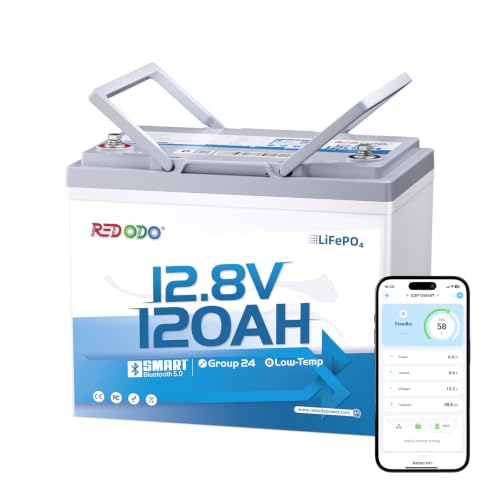
Redodo 12.8V 120Ah Bluetooth LiFePO4 Group 24 Battery
Meet The Standout Selections
Anglers running 24V or 36V trolling setups will appreciate that this LiTime bundle ships two matched 100Ah LiFePO4 batteries wired for the motor of your choice. Bluetooth monitoring pulls battery state, charge level, and basic system checks straight to your phone, which means fewer trips to open the compartment mid-trip.
The BMS shuts charging down below freezing and blocks discharge below a hard low-temp threshold, so you do not have to babysit the pack during early spring launches. For a weekend angler who wants long runtime and app visibility, the two-pack format is a clean answer to the perennial “one battery or two” debate.
The Upside
- Bluetooth app shows voltage, state of charge, and cycle data without opening the compartment
- Built-in cold-charge cutoff protects cells in shoulder-season weather
- Two-pack format simplifies the jump from 12V to 24V or 36V trolling systems
- Low self-discharge suits boat owners who store rigs between trips
Worth Noting
- Lithium chemistry still requires storage above freezing for long off-season periods
- Two-pack footprint needs measured bay space before ordering
Made For
Anglers running 12V to 36V trolling motors who want phone-based monitoring and a two-pack that arrives ready to wire.
Where Another Pick Suits Better
For cold-climate anglers who launch in freezing temps, the Power Queen self-heating pack handles sub-zero mornings more gracefully.
Compared with the first LiTime bundle, this twin-pack leans harder into crossover duty between boat and camper. The 100A BMS keeps overcharge, deep discharge, and short-circuit faults from taking the pack down, which matters when you are running both a trolling motor and an RV house load off the same chemistry.
For a hybrid household that swaps gear between a small boat and a camper van, the two-pack format covers either a 24V trolling rig or a 12V RV bank wired in parallel. Owners commonly report clean installs and steady voltage under inverter draw, which is the real test for a deep-cycle pack.
The Practical Payoff
- Versatile enough for boat trolling motors or an RV house bank
- 100A BMS guards against the usual lithium failure modes
- Two-pack removes the question of whether one battery will hold up to your weekend
- LiFePO4 chemistry holds voltage higher through discharge, which lifts inverter performance
Trade Offs
- App and Bluetooth visibility can vary by batch revision
- You may need to add low-temperature storage for winter storage in unheated bays
Feature Snapshot
Who It Suits Best
Shoppers splitting their time between a small boat and an RV who want one battery family to manage.
Consider Something Else When
The Redodo 12V 100Ah Dual Purpose Group 27 fits better when your boat also needs serious cranking amps for a fuel outboard.
The headline on this Power Queen is the dual heating pads built into the pack, which warm the cells before charging kicks in when temperatures dip. That detail matters because standard LiFePO4 packs refuse a charge below freezing, leaving you with a brick in the camper until spring.
For winter campers, ice anglers, and anyone running an off-grid cabin in a cold climate, the self-heating function turns a normally seasonal battery into a year-round workhorse. Owners commonly report that the BMS cuts charge cleanly when temps drop too low, so the cells stay protected even if the heater is overwhelmed.
Where It Delivers
- Built-in heating pads let the battery accept a charge in freezing weather
- Smart low-temp cutoff pauses charging below the safe threshold
- LiFePO4 chemistry extends cycle life well past lead-acid replacements
- Drop-in format simplifies the swap from an old AGM or flooded battery
Points To Note
- Heating function draws power from the pack itself before charging starts
- Single 12V format means parallel or series wiring for higher-voltage banks
- Storage in unheated spaces still benefits from a periodic top-up
Best Suited To
Campers and anglers who actually use their rigs when temperatures hover near or below freezing.
Skip It When
Mild-climate owners can save weight and skip the heater with the Redodo 12V 100Ah Ultra-Mini, which targets tight, warm-weather builds.
Where the previous Power Queen leans on heating, this one focuses on protecting a trolling motor from voltage spikes. The built-in TVS (Transient Voltage Suppressor) guards the pack against the kind of surges you see when a big 12V to 36V motor bogs in weeds or hits a stump.
The BMS stops charging below freezing and blocks discharge below a deep-cold threshold, so shoulder-season trips stay protected without manual intervention. For owners running motors up to 120 lb of thrust, that surge protection is a real-world reason to pick this over a generic LiFePO4 brick.
Where It Helps
- Built-in surge protection reduces the chance a voltage spike kills a controller
- Supports 12V, 24V, and 36V trolling motor configurations
- ABYC-compliant marine build aligns with common boat electrical standards
- Standard Group 31-ish footprint drops into most marine trays
Honest Caveats
- Cold-climate anglers in deep-freez states may still want the self-heating sibling
- One battery covers a single trolling bank, so larger boats need parallel packs
Quick Facts
The Right Fit
Anglers pushing a 24V or 36V trolling rig who want surge protection baked into the battery itself.
Look Elsewhere When
Boaters also running a fuel outboard that needs serious cranking amps should look at the Redodo Dual Purpose Group 27 instead.
The “Ultra-Mini” framing here is not marketing fluff: the case measures roughly 9 by 5.4 by 8.2 inches and tips the scale at under 20 lb, which is light enough to reposition in a cramped lazarette (the inboard storage hatch on a boat) without help. Bluetooth monitoring reaches about 10 meters, so you can check state of charge from the helm or the dock.
Where the LiTime 2-packs prioritize trolling motor voltage, this Redodo is built for the small-format crowd, kayak anglers, compact skiffs, and overlanders with shallow battery trays. You trade raw capacity stacking for a clean fit in spots where a full-size Group 31 simply will not seat.
What Helps Most
- Compact case slips into kayak hatch openings and shallow camper trays
- Light enough to handle one-handed during install or swap
- Bluetooth monitoring keeps you off your knees for routine checks
- LiFePO4 chemistry keeps voltage flat through a long day on the water
Practical Considerations
- Single 12V format means you wire multiple packs for 24V or 36V trolling rigs
- Lower amp-hour pool than the 120Ah Redodo covered later in this list
Whose Shelf It Belongs On
Kayak anglers, compact skiff owners, and anyone rebuilding a tight battery compartment around modern lithium chemistry.
Another Choice May Suit
Shoppers with a Group 24 tray and appetite for extra capacity should step up to the Redodo 12.8V 120Ah Group 24 build.
This is the only true Group 31 lithium on the list, and that matters if your battery tray was built for a Group 31 footprint in the first place. The case drops straight into existing RV and marine bays without adapter plates or rewiring, which makes it the cleanest swap for owners replacing an old AGM Group 31.
The 100A BMS, deep-cycle capability, and support for up to 4P4S configurations (four packs in parallel and four strings in series) lets you scale the bank from a single 100Ah unit up to a 400Ah-plus house system as your rig grows. For full-time RVers and serious off-grid solar, that scaling is the headline feature.
Points In Its Favor
- Genuine Group 31 footprint for hassle-free AGM-to-lithium swaps
- Supports 4P4S scaling for large house banks and solar arrays
- Deep-cycle design handles the daily discharge pattern of solar RV use
- Lower weight per amp-hour than comparable AGM Group 31 batteries
Things To Weigh
- Charging profile requires a lithium-compatible converter or solar charge controller
- Cold charging still requires low-temp protection or a heated build
Feature Card
Who Will Love This
Full-time RVers, off-grid cabin owners, and solar shoppers who need a real Group 31 lithium drop-in.
Reach For A Different Pick When
Anglers who need monitoring and cold-weather charging should pair this with the Power Queen self-heating pack instead.
Many RV battery compartments are cut for Group 24, not Group 31, and this Power Queen slots straight into that footprint without modification. Where a 70Ah AGM Group 24 might give you about 500 watt-hours at 50% depth of discharge, this 100Ah LiFePO4 pack delivers the full 1280 watt-hours you paid for.
That usable-capacity gap is the real upgrade, because lithium does not punish you for dipping below 50% state of charge the way lead-acid does. For campers leaving the electrical pedestal behind, the runtime jump is hard to overstate, and the case is roughly one-third the weight of the AGM it replaces.
A Strong Showing
- Group 24 case fits the most common RV battery compartment footprint
- Full 100Ah usable capacity versus roughly 35Ah from a similar-size AGM
- Substantial weight savings over lead-acid for towing-sensitive builds
- Drop-in install keeps wiring and tray setup identical to the old battery
Possible Compromises
- Group 24 limits total capacity per pack versus the larger Group 31 sibling
- Lithium charging still requires a converter or solar charge controller rated for LiFePO4
Perfect Match For
RV owners converting from Group 24 AGM who want the simplest possible upgrade path and a serious runtime boost.
A Better Fit Elsewhere
Shoppers who can fit a Group 31 case get more capacity per pack from the Power Queen Group 31 build above.
Most lithium batteries in this format are deep-cycle only, but this Redodo pairs roughly 900 CCA (cold cranking amps) and 1000 MCA (marine cranking amps) with deep-cycle capacity for the same hull. That dual-purpose framing is the selling point: one battery starts a fuel outboard and still runs the fish finder and livewell all afternoon.
Bluetooth 5.0 monitoring rounds out the package, letting you check state of charge and run system checks from the deck. Owners commonly report that the trade-off versus a pure deep-cycle pack is reduced cycle count under heavy discharge, but the convenience of one battery instead of two is worth it for many setups.
Well-Handled Touches
- Cranking amps enough to start mid-size fuel outboards without a separate starting battery
- Deep-cycle capacity for fish finders, livewells, and cabin loads
- Bluetooth monitoring keeps tabs on voltage and state from the helm
- Group 27 footprint fits common marine battery trays
Things To Consider
- Dual-purpose chemistry typically trades some deep-cycle longevity for cranking ability
- Pair with a marine-rated charger to keep the BMS happy long-term
Made For
Boat owners running a fuel outboard plus electronics who want a single battery instead of separate starting and house banks.
Swap It Out When
Pure trolling motor setups without a fuel engine get more cycle life from the Power Queen trolling-specific pack above.
Sitting beside the previous Redodo, this Group 27 dual-purpose pack leans even harder on starting muscle. With 900 CCA and 1000 MCA on tap, it spools larger displacement outboards without a separate starter battery, which is a real benefit on offshore center consoles where space and weight both cost money.
The case fits the universal Group 27 tray size, so installation mirrors the battery you are replacing. Bluetooth monitoring ties into the same Redodo app ecosystem, and the BMS protects against the usual deep discharge and overcharge faults while still letting you kill the pack remotely when storage season arrives.
A Favorable Mix
- High cranking amp rating supports larger fuel outboards
- Group 27 size is a familiar swap for many marine owners
- Bluetooth visibility and remote shutoff simplify off-season storage
- Dual-purpose design cuts weight and clutter versus two-battery setups
Soft Spots
- Heavy cranking demand can shorten cycle life compared with a deep-cycle-only build
- Requires a marine charger that understands lithium charge profiles
Best Suited To
Offshore and bay boat owners running high-displacement fuel outboards who want one battery to handle both jobs.
Not Your Match When
Pure trolling motor anglers get more cycle life from the Redodo Ultra-Mini or Power Queen trolling pack above.
The closing pick is a clever bit of engineering: a Group 24 case that holds 120Ah instead of the usual 100Ah, netting about 1536 watt-hours in the same tray footprint. For campers who have already maxed out a 100Ah Group 24 build and want more runtime without going to a larger box, this is the format you have been waiting for.
Bluetooth 5.0 keeps the monitoring story consistent with the other Redodo packs, including remote shutoff for storage. The trade-off versus the 100Ah Redodo Ultra-Mini is footprint, which is meaningfully larger, so measure twice before ordering.
Strengths Worth Knowing
- 120Ah in a standard Group 24 case is rare and genuinely useful
- Bluetooth monitoring with remote shutoff simplifies seasonal storage
- LiFePO4 chemistry holds voltage flat through long inverter draws
- Drop-in format keeps the swap painless for Group 24 trays
Some Limits To Know
- Larger case than the Redodo Ultra-Mini, so tight compartments may not accept it
- Single 12V battery means parallel or series wiring for higher-voltage banks
Right Fit For
Weekend campers and overlanders with Group 24 trays who want extra amp-hours without jumping to a larger case size.
Where A Sibling Pick Shines
Shoppers prioritizing weight and footprint should drop to the Redodo 12V 100Ah Ultra-Mini instead.
What To Weigh Before Choosing Agm Group 31 Battery
Start with the footprint. Group 31, Group 27, and Group 24 cases are not interchangeable, and the wrong case size forces adapter plates, tray work, or a return. A genuine Group 31 lithium like the Power Queen Group 31 swaps into an existing AGM Group 31 tray with zero modifications, while Group 24 and Group 27 builds fit smaller boats and RVs that simply do not have room for the bigger box.
Match the chemistry to the climate. Standard LiFePO4 packs refuse a charge below freezing, which kills winter usability for ice anglers and cold-climate campers. Self-heating models solve that problem but draw a brief pre-charge current to warm the cells first. For warm-season use only, a non-heated pack keeps weight and complexity lower.
Decide between deep-cycle and dual-purpose. Pure trolling motors and house banks want deep-cycle longevity, while fuel outboards need cranking amps to spin the engine. Dual-purpose marine lithium covers both but usually trades some cycle life for starting muscle, which is a fine compromise for one-battery boats.
Check the BMS and low-temp cutoff. A 100A BMS handles most mid-size inverters and trolling motors, while built-in cold-charge cutoff prevents cell damage during shoulder-season trips. Bluetooth monitoring is a quality-of-life upgrade worth having if you want to skip the multimeter checks.
Look at cycle life and warranty posture. Lithium outlasts AGM by a wide margin in cycle count, which matters most for full-time RVers and solar users who discharge daily. Confirm that your charger, solar controller, or inverter/charger is lithium-compatible before plugging in.
Mistakes And Upgrades Across These Picks
Pitfalls Shoppers Hit
The most common trap is buying a Group 31 battery when the tray is actually Group 24 or Group 27, which leads to returns and adapter headaches. Measure length, width, and height including terminal posts before ordering. Another frequent miss is pairing a lithium battery with a lead-acid charger, which can undercharge the pack or trip the BMS repeatedly.
Where The Extra Money Goes
Premium picks earn their keep through real engineering: built-in heating pads for cold-weather charging, integrated TVS surge protection for trolling motors, and Bluetooth monitoring that saves you from crawling into a battery compartment every trip. Higher-tier dual-purpose marine packs also pack genuine cranking amps for fuel outboards. Paying up makes the most sense when the build matches your actual use case, otherwise the simpler pack is the smarter pick.
Frequently Asked Questions
What Is A Group 31 Battery?
A Group 31 battery is a standardized case size roughly 13 by 6.8 by 9.4 inches, common in heavy-duty trucks, marine, and RV applications. The case is just the footprint: the chemistry inside can be lead-acid AGM, flooded, or lithium iron phosphate, each with very different cycle life and weight characteristics.
Can A Group 31 Lithium Battery Replace An AGM Group 31?
Yes, the case dimensions match, so most Group 31 AGM trays accept a Group 31 LiFePO4 drop-in without modification. You will still need a charger or solar controller rated for lithium charge profiles, because lead-acid chargers often stop short of a full lithium charge.
Do Lithium Group 31 Batteries Work In Cold Weather?
Standard LiFePO4 packs refuse a charge below freezing, which can leave you with no usable battery in winter. Self-heating models warm the cells before charging and continue to work in sub-zero conditions, which is the better choice for cold-climate owners.
How Long Does A Group 31 Lithium Battery Last?
Cycle life depends on depth of discharge and brand, but quality LiFePO4 packs commonly deliver thousands of deep cycles versus a few hundred for AGM. That usually translates to many years of daily RV or solar use before capacity meaningfully drops.
Are Dual-Purpose Marine Lithium Batteries Worth It?
Dual-purpose lithium batteries make sense when you want one battery to start a fuel outboard and run electronics, especially on smaller boats where space is tight. Pure deep-cycle packs tend to last longer under repeated heavy discharge, so anglers running only a trolling motor may prefer the dedicated deep-cycle route.
Wrap Up
The right Group 31 lithium battery depends less on the format itself and more on how you actually use your rig: cold-weather campers need self-heating, trolling motor anglers want surge protection and Bluetooth, and full-time RVers want a true drop-in footprint with serious cycle life. Match the case size to your tray, the chemistry to your climate, and the discharge profile to your motor, and the rest of the picks fall into place.