A dead battery on a cold morning can ruin a workday before it starts. AGM technology handles deep discharges, harsh winters, and modern start-stop systems better than traditional flooded batteries, which matters when your truck doubles as a job site, a tow rig, or a daily commuter. This roundup covers ten models engineered for trucks and SUVs, with notes on group sizes, cold-cranking amps, and the use cases each one serves best.
The Essentials At A Glance

HQST 12V 60Ah AGM Battery Group 47 H5

Interstate Batteries Group 51R (MT-51R) 12V
Litime 12V 100Ah RV LiFePO4 Lithium Battery

Weize Platinum AGM Battery BCI Group 94R H7
MARXON Group 48 H6 L3 Start-Stop AGM 12V 70Ah

MARXON Group 48 H6 L3 AGM 12V 70Ah Battery

Weize Platinum AGM Battery BCI Group 48 H6

ACDelco Gold 51RAGM BCI Group 51R Battery

Autocessking Group 65 AGM Battery 12V 70Ah
Weize Platinum AGM Battery BCI Group 47 H5
A Breakdown Of The Leading Choices
The HQST 12V 60Ah AGM battery targets trucks and SUVs that need reliable cold-weather starting without a premium price tag. Rated at 680 CCA (cold-cranking amps, a measure of how much current the battery can deliver at 0°F for 30 seconds), it’s tuned for vehicles with start-stop systems that demand quick energy recovery between stops. The Group 47 / H5 case shape fits many domestic and import models, and the maintenance-free sealed design means no water checks over its service life.
Where it shines compared to the Interstate 51R covered below is its broader cold-weather operating window, which extends down to negative 40°F. Owners in northern climates who deal with thick oil and sluggish starters in deep winter will appreciate that margin.
A Few Highlights
- 680 CCA supports dependable starts in sub-freezing temperatures
- Sealed AGM construction absorbs electrolyte in glass mats, reducing spill risk under hood vibration
- Tuned charge acceptance suits modern start-stop alternators that cycle aggressively
- Group 47 / H5 footprint fits a wide range of sedans, SUVs, and light trucks
- Maintenance-free operation removes routine water top-offs from the ownership checklist
Trade Offs
- At 60Ah, the reserve capacity is modest for trucks running high-draw accessories like winches or inverters
- Group 47 fitment is narrower than Group 48 or 65, so confirm your tray dimensions before ordering
Who Will Love This
Daily drivers in cold climates who own start-stop-equipped sedans or compact SUVs and want a sealed battery that just works through winter.
Where Another Pick Suits Better
If your truck runs winches or aftermarket inverters that drain reserve capacity, the Weize Platinum Group 94R reviewed later delivers more amp-hours in a larger case.
The Interstate MT-51R is a 12-volt, 500 CCA workhorse built for the long haul in moderate climates. Its Group 51R footprint fits hundreds of year/make/model combinations, which is why so many shops keep it as a shelf staple. The 85-minute reserve capacity (the runtime a battery can sustain accessory loads if the alternator fails) is conservative but adequate for typical commuter driving.
Against the HQST Group 47 above, this Interstate trades cold-cranking headroom for wider compatibility. Shoppers in mild regions who just want a known-quality replacement will find it straightforward to spec and install.
A Few Strong Suits
- Group 51R fits a broad range of import and domestic compact cars
- 24-month warranty backed by a national distributor network
- Dependable performance in hot to moderate climates where deep cold isn’t a factor
Some Limits To Know
- 500 CCA may feel thin for trucks or larger engines operating in sub-zero mornings
- Not optimized for start-stop systems that demand rapid charge recovery
- Reserve capacity of 85 minutes limits its usefulness for extended accessory loads
Right Fit For
Owners of compact cars and small SUVs in temperate regions who want a familiar replacement battery from a widely distributed brand.
Look Elsewhere When
Drivers facing harsh winters or running vehicles with start-stop technology will get better cold-cranking from the MARXON Group 48 reviewed further down.
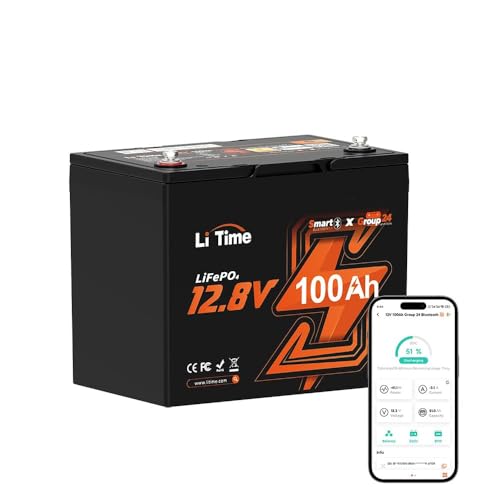
The Litime 12V 100Ah LiFePO4 (lithium iron phosphate, a chemistry known for long cycle life and thermal stability) is a different animal from the lead-acid AGM batteries elsewhere on this list. It’s a deep-cycle (designed to be discharged repeatedly rather than just deliver short starting bursts) energy storage unit aimed at trolling motors, marine use, and RV house banks rather than engine cranking. With 100Ah of usable capacity, it can run small inverters, fish-finder rigs, or camping loads for hours.
Bluetooth monitoring, low-temperature charge protection, and a Group 24/27/31-compatible footprint make it versatile for non-automotive installations. In a truck application, it shines as an auxiliary battery for overlanding setups or sleeper-cab accessories.
A Strong Showing
- 100Ah capacity runs trolling motors and RV loads far longer than typical AGM deep-cycles
- Bluetooth app delivers real-time voltage and state-of-charge visibility
- Low-temperature charging cutoff protects cells from damage below freezing
- LiFePO4 chemistry delivers thousands of cycles versus a few hundred for lead-acid
- Fits standard Group 24, 27, and 31 battery boxes for flexible mounting
Things To Weigh Up
- Not designed as a primary starting battery; lithium cranking amps work differently than lead-acid CCA ratings
- Requires a lithium-compatible charger or DC-DC converter for proper charging from a vehicle alternator
- Costs significantly more upfront than AGM options of similar capacity
Made For
Anglers, RVers, and overlanders who need reliable deep-cycle power for accessories and want modern battery management in a drop-in form factor.
Skip It When
Shoppers looking to replace a single factory starter battery in a daily-driver truck should step up to the Weize Platinum Group 94R reviewed below instead.
The Weize Platinum Group 94R packs serious cranking muscle into a battery sized for larger vehicles. At 850 CCA and 80Ah with 140 minutes of reserve capacity, it sits comfortably above the typical Group 47 or 48 battery in raw output. The H7 case dimensions (about 12.4 inches long) mean it physically replaces the battery in many full-size trucks and European SUVs that call for a Group 94R footprint.
Set against the HQST at position one, this Weize trades compactness for substantially more cold-cranking headroom and amp-hour capacity. Drivers of full-size pickups, especially diesel applications, will find the 850 CCA margin meaningful in deep winter.
Positive Points
- 850 CCA provides generous starting reserve for large-displacement gasoline and diesel engines
- 80Ah capacity supports trucks with high electrical accessory loads
- 140-minute reserve capacity handles extended idling with lights and electronics running
- 36-month warranty covers defects through typical ownership timelines
Potential Drawbacks
- Group 94R case is larger than 47 or 48, so it won’t fit compact engine bays
- Heavier than lower-capacity AGM batteries, which matters in vehicles where weight savings are tracked
Best Suited To
Full-size truck and large SUV owners who want stronger cold-starting headroom and the extra reserve capacity to support winches, plows, or extensive lighting upgrades.
A Better Fit Elsewhere
If your vehicle needs a smaller Group 48 case, the MARXON Group 48 reviewed next offers similar AGM construction in a more compact package.
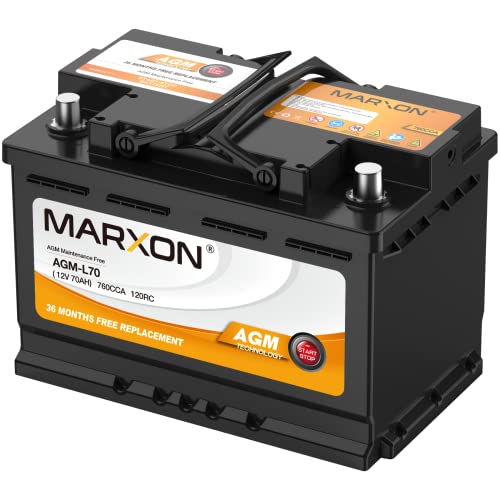
MARXON’s Group 48 H6 L3 battery is a 70Ah, 760CCA AGM designed specifically for start-stop vehicles. Faster charging acceptance means it refills between engine restarts more efficiently than standard flooded batteries, which start-stop systems depend on. The sealed maintenance-free construction weighs about 46.5 pounds and fits many domestic and import vehicles calling for the Group 48 case.
Compared to the Weize Platinum 94R above, this MARXON sits in a smaller case with proportionally less cranking output, but it fits vehicles that physically can’t accept the larger H7 footprint. For mid-size trucks and crossovers with start-stop systems, it’s a sensible match.
The Practical Payoff
- 760CCA delivers solid cold-weather cranking for mid-size engines
- Charge acceptance tuned for start-stop alternators that cycle aggressively in city traffic
- Sealed AGM design eliminates spill risk on rough roads or tilted installations
- Three-year warranty provides reasonable ownership protection
Honest Caveats
- Group 48 dimensions won’t fit vehicles expecting Group 47 or Group 94R cases
- 46.5 pounds is heavier than compact Group 47 options and may affect certain installation scenarios
Perfect Match For
Owners of mid-size trucks, crossovers, and start-stop-equipped cars who want a Group 48 battery engineered for the repeated cycling those systems demand.
Reach For A Different Pick When
Drivers needing more cranking headroom for full-size engines or heavy accessory loads should consider the Weize Platinum 94R reviewed earlier.
This MARXON Group 48 H6 L3 shares the same 70Ah, 760CCA, and maintenance-free AGM core as its sibling above, presented as a more price-conscious variant of the same battery platform. Both batteries measure roughly 10.95 x 6.89 x 7.48 inches and weigh about 46.5 pounds, and both use tapered A1 terminals in the same orientation.
Where the previous MARXON is positioned for explicit start-stop optimization, this version targets shoppers who want Group 48 fitment and AGM reliability without paying for branding around start-stop efficiency. For owners of mid-size sedans and crossovers, the practical difference between the two is small.
Why It Works Well
- Group 48 H6 L3 footprint matches the original battery in many mid-size vehicles
- 760CCA supports reliable cold starts in most North American winter conditions
- Sealed construction means no water-topping or terminal corrosion checks
- Three-year warranty aligns with industry-standard replacement intervals
Soft Spots
- Reserve capacity isn’t specified, so buyers with heavy accessory loads should verify their needs elsewhere
- Same weight class as its sibling MARXON, so handling during install requires basic care
Who Should Grab It
Budget-conscious owners of mid-size sedans and crossovers seeking a maintenance-free AGM replacement at a sensible price.
Swap It Out When
Drivers of full-size trucks who need higher cold-cranking amps will get more output from the Weize Platinum Group 94R covered earlier.
The Weize Platinum Group 48 H6 is a 70Ah, 760CCA AGM battery designed for vehicles that call for the Group 48 case. At roughly 10.94 x 6.89 x 7.48 inches with tapered terminals, it slots into the same engine bays as the MARXON variants reviewed above. The 120-minute reserve capacity gives it a slight edge for trucks that spend time idling with accessories running.
Against the HQST Group 47 at position one, this Weize trades the smaller case footprint for higher reserve capacity. Owners who need both reliable cold starts and extended accessory runtime will find that balance useful.
The Value In It
- 760CCA handles cold-weather starting across most climates
- 120-minute reserve capacity covers idling with lights and electronics running
- 36-month warranty exceeds the typical two-year industry baseline
- Sealed AGM design tolerates off-road vibration better than flooded batteries
Trade-Offs To Consider
- Group 48 dimensions won’t fit vehicles that need Group 47 or Group 94R cases
- Heavier than compact Group 47 batteries, which may affect certain lightweight installations
Built With In Mind
Daily-driver trucks, SUVs, and crossovers with Group 48 battery trays whose owners want a balance of cranking power, reserve capacity, and warranty coverage.
Another Choice May Suit
Drivers needing even higher cranking amps for full-size engines should compare against the Weize Platinum Group 94R covered earlier in the list.
The ACDelco Gold 51RAGM sits in the Professional line as a high-quality alternative to original equipment (OE) parts, manufactured to match fit, form, and function expectations for vehicles calling for a Group 51R battery. The 36-month warranty and OE-style specifications make it a familiar choice for owners who want factory-grade replacement quality, especially in General Motors applications.
Compared to the Interstate MT-51R reviewed second, this ACDelco extends the warranty by a full year. Owners willing to verify the Group 51R fitment for their specific vehicle will find the extra coverage useful.
Noteworthy Benefits
- OE-style fit, form, and function tailored to factory battery specifications
- 36-month warranty exceeds typical aftermarket coverage
- AGM sealed construction resists vibration damage common in trucks
Points To Keep In Mind
- Group 51R is a smaller case that doesn’t fit vehicles requiring Group 48 or larger trays
- Detailed cold-cranking and reserve figures aren’t listed in the source data, so shoppers must verify specs at the listing before purchase
Whose Shelf It Belongs On
Owners of Group 51R vehicles, particularly General Motors models, who value OE-grade replacement parts and longer warranty coverage.
Consider Something Else When
Drivers of trucks with start-stop systems and larger Group 48 battery trays will find better fitment from the MARXON or Weize Group 48 options reviewed above.
The Autocessking Group 65 AGM is a 70Ah, 750CCA battery with 120-minute reserve capacity, sized for vehicles calling for the Group 65 case (about 12.05 x 7.56 x 7.56 inches). AGM construction absorbs the acid in glass fiber mats, which reduces leaks, spills, and corrosion at the terminals over time. The 36-month warranty covers defects through typical ownership horizons.
Set against the Weize Platinum Group 48 reviewed above, this Autocessking is physically larger and delivers a comparable CCA figure in a Group 65 case. Many domestic full-size trucks use Group 65 trays, making this a direct-fit candidate for that segment.
Practical Advantages
- 750CCA and 70Ah deliver dependable starting across typical winter conditions
- 120-minute reserve capacity supports extended accessory runtime
- Sealed AGM design reduces leak and corrosion risk common in older flooded batteries
- Group 65 footprint matches many domestic full-size pickup truck trays
Where It Is Less Suited
- Group 65 case won’t fit compact or mid-size vehicles that use smaller battery groups
- Slightly lower CCA than the Weize Group 94R reviewed earlier for extreme cold-weather performance
Not Your Match When
Owners of domestic full-size trucks and SUVs needing a Group 65 battery replacement who want a sealed, maintenance-free AGM upgrade from an older flooded unit.
Where A Sibling Pick Shines
Drivers needing higher cold-cranking amps for extreme cold should consider the Weize Platinum Group 94R reviewed at position four.
The Weize Platinum Group 47 H5 mirrors the HQST’s footprint and core specs at 680 CCA and 60Ah, but adds a 36-month warranty where the HQST offers a shorter coverage window. At roughly 9.52 x 6.89 x 7.48 inches with tapered terminals, it physically fits the same compact engine bays as the HQST covered first.
Against the HQST, this Weize trades brand recognition for warranty length. Shoppers who value longer defect coverage and don’t need the HQST’s extended cold-weather operating window will find this a sensible alternative.
Notable Gains
- 680CCA delivers reliable cold starts across most North American winter conditions
- 36-month warranty exceeds typical two-year AGM coverage in this segment
- Sealed AGM construction tolerates underhood vibration on rough roads
- Group 47 footprint fits many mid-size and compact vehicles with limited engine bay space
Small Caveats
- 60Ah reserve is modest for trucks running winches, inverters, or extensive lighting
- Group 47 dimensions won’t fit vehicles needing Group 48 or larger battery trays
The Right Fit
Daily drivers of mid-size cars and compact SUVs who want a maintenance-free AGM replacement backed by longer warranty coverage.
Wrong Turns To Avoid
If your truck needs higher cold-cranking output or runs heavy electrical accessories, the Weize Platinum Group 94R reviewed earlier provides more muscle in a larger case.
Choosing The Right Group Size And Specs For Your Truck
Getting the battery group size right matters more than chasing the highest CCA number. BCI group numbers (standards set by the Battery Council International that define case dimensions, terminal positions, and post type) define physical case length, width, height, and terminal orientation. A Group 47 battery simply won’t drop into a tray engineered for Group 65, no matter how strong the specs look on paper.
Cold-cranking amps scale with engine displacement and compression. A 2.0-liter four-cylinder commuter needs far less CCA than a 6.7-liter diesel, and overspending on cranking amps for a small engine just adds weight. Match the spec to the application rather than buying the biggest number on the shelf.
For vehicles with start-stop systems, AGM is essentially required. Flooded batteries degrade quickly under the rapid cycling that start-stop alternators produce. AGM handles partial state-of-charge operation better and recovers charge faster between engine restarts.
Reserve capacity matters more than most shoppers realize. If you run accessories with the engine off, whether that’s a work light, a fridge, or a laptop inverter, higher RC translates directly to longer runtime before the battery drops below usable voltage.
Key Considerations Across These Picks
Where Shoppers Go Wrong
Skipping the fitment check is the most common mistake. Battery group numbers, terminal polarity (positive on left versus right), and post height all vary between vehicles that look similar under the hood. Always cross-check dimensions and terminal layout against the existing battery before ordering. A second frequent trap is buying a flooded replacement for a vehicle originally equipped with AGM, which can cause the battery management system to misread state-of-charge and shorten battery life.
Where The Extra Money Goes
Higher-tier AGM batteries typically deliver longer cycle life, better vibration resistance, and stronger warranties. For trucks that see rough roads, heavy accessory loads, or frequent short trips that don’t fully recharge the battery, that extra durability translates to fewer replacements over the vehicle’s life. For a low-mileage commuter in a mild climate, a standard AGM delivers all the practical value most owners will ever use.
Frequently Asked Questions
How long does an AGM battery typically last in a truck?
Most AGM batteries in truck applications last three to five years under normal driving conditions. Vehicles with frequent short trips, heavy accessory loads, or extreme climate exposure may see shorter service intervals.
Can I replace a flooded battery with AGM in an older truck?
In most cases, yes, but verify the charging system voltage. Some older alternators charge at slightly lower voltages that don’t fully recharge AGM batteries. A simple voltage check at the battery terminals during operation can confirm compatibility.
What does reserve capacity actually mean for daily driving?
Reserve capacity measures how long the battery can run accessories if the alternator fails. For daily drivers, higher RC provides a safety margin during stop-and-go traffic where the alternator’s output is limited.
Do lithium batteries work as truck starting batteries?
Standard LiFePO4 deep-cycle batteries like the Litime at position three are not designed for engine cranking. Starting requires very high current bursts that deep-cycle lithium isn’t optimized to deliver. Use them as auxiliary house batteries, not starter replacements.
How do I know which BCI group my truck needs?
The original battery’s group number is usually printed on the case label. Alternatively, the vehicle owner’s manual lists the specified group size, or a fitment tool on the retailer’s product page can confirm compatibility by year, make, and model.
Wrap Up
AGM batteries handle the demands of modern trucks, from start-stop cycling to heavy accessory loads, far better than older flooded designs. Match the BCI group to your vehicle’s tray, scale CCA to your engine size, and prioritize reserve capacity if you run electronics with the engine off. The right battery pays you back in reliable cold starts and fewer mid-winter replacements.