Rechargeable AA cells quietly run the household gear you touch every day: TV remotes, wireless mice, game controllers, flash units, baby monitors. Choosing the wrong chemistry or capacity means swapping batteries mid-week, watching a game pad die mid-session, or tossing swollen cells into the trash. This shortlist sorts six solid rechargeable AA options by chemistry, capacity, cycle life, and the devices they actually fit, so you can match a cell to the drawer it lives in.
The Leading Options At A Glance

Eneloop Panasonic pro AA High-Capacity Ni-MH Rechargeable Batteries, 6-Pack

Eneloop Panasonic AA 2100 Cycle Ni-MH Pre-Charged Rechargeable Batteries, 8-Pack
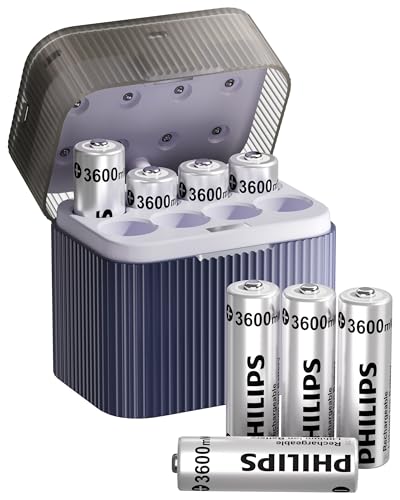
PHILIPS Rechargeable AA Lithium Batteries 8 Pack, 1.5V 3600mWh

Rechargeable AA Batteries, 2800mAh High Capacity NiMH Low Self Discharge, 16-Pack

Rechargeable AA Batteries with Charger, 2800mAh Ni-MH, 8-Pack

PHILIPS Rechargeable AAA Lithium Battery 8 Pack, 1.5V 1300mWh
More Details On Our Top Picks
The Eneloop pro AA cell is built for the gear that chews through ordinary rechargeables: wireless Xbox and PlayStation pads, camera flash units, handheld microphones. Ni-MH chemistry (nickel-metal hydride, the standard rechargeable chemistry found in most household AA cells) tops out around 2500 mAh minimum and 2600 mAh typical capacity, so each cell holds enough juice for long controller sessions or a full weekend of event photography. Where cheaper cells sag under load, this one keeps the voltage steady enough that your gear keeps working.
Compared to the standard Eneloop AA on our list, the pro version trades a few recharge cycles for higher capacity, which is the right call when your device drains batteries quickly. Low self-discharge chemistry means a cell sitting in a drawer still holds most of its charge months later, so grab-and-go spares stay useful.
Notable Upsides
- High 2500 mAh minimum capacity handles demanding controllers and flash units without early drop-off.
- Rechargeable up to 500 times, which spreads the cost over years of household use.
- Pre-charged at the factory using solar power, so you can drop them straight into a remote.
- Low self-discharge design keeps spares ready in a junk drawer for months between uses.
Trade Offs To Consider
- Six-cell pack may leave you short if you need to fill two four-bay controllers at once.
- Ni-MH voltage sits around 1.2V, so some very low-drain clocks and certain vintage gear may misread capacity.
- Recharge cycle count is lower than the standard Eneloop AA, since higher capacity and longevity are competing goals.
Key Specs
Made For Power-Hungry Households
Gamers, photographers, and anyone running a household full of wireless controllers will get the most out of these high-capacity cells.
Look Elsewhere When Cycles Matter More
Shops that mostly run remotes, wall clocks, and low-drain devices should consider the Eneloop Panasonic AA 2100 Cycle Ni-MH Pre-Charged Rechargeable Batteries, 8-Pack, which trades a little capacity for a much longer cycle life.
This is the classic Eneloop AA, the cell that quietly powers TV remotes, wireless keyboards, and wall clocks in millions of homes. Where the pro version we just looked at pushes for higher mAh, this one stretches for longevity: 2100 recharge cycles is the headline number, and that is a long time to live in a battery drawer.
The trade-off shows up in capacity, which is lower than the pro cells, so a high-drain Xbox controller will drain it noticeably faster. For low-drain household gear, though, this is the cell you forget about because it just keeps working. Owners commonly report keeping these in service for half a decade before noticing real wear.
What Stands Out
- 2100 recharge cycles extend usable life far beyond most household rechargeables.
- Factory pre-charged using solar power, so cells work straight out of the package.
- Holds around 70 percent of charge for up to ten years on the shelf, which makes them ideal emergency spares.
Honest Caveats
- Lower capacity than the pro cells means faster drain in power-hungry game controllers and camera flashes.
- Eight-cell pack size means you may have leftovers after filling a four-bay charger.
- Ni-MH 1.2V output may not register as “full” on devices that read battery level by voltage alone.
Right Fit For Everyday Low-Drain Gear
Households running mostly remotes, clocks, computer peripherals, and small flashlights will appreciate the long cycle life more than the higher mAh of the pro version.
Skip It When You Need Higher mAh
Gamers and photographers pulling heavy current from AA cells should reach for the Eneloop Panasonic pro AA High-Capacity Ni-MH Rechargeable Batteries, 6-Pack instead.
Philips steps outside the Ni-MH box with this lithium-ion AA, which holds a flat 1.5V from full to empty instead of dropping as it drains. For a wireless Xbox or PlayStation controller, that means consistent rumble, steady LED brightness, and no surprise “low battery” pop-up halfway through a ranked match. The 3600 mWh rating translates to roughly 40 percent longer runtime than typical Ni-MH cells in demanding gear.
Compared to the Ni-MH entries above, the lithium chemistry adds one practical wrinkle: you need a charger specifically designed for Li-ion AA cells, since a Ni-MH charger can damage the chemistry. Worth checking before adding these to a drawer full of older Ni-MH chargers.
Why It Works Well
- Steady 1.5V output keeps performance flat through the entire discharge cycle.
- Higher energy capacity extends runtime in high-drain game controllers and smart home devices.
- Rechargeable up to 1200 times, well beyond most household Ni-MH cells.
Things To Consider
- Requires a Li-ion compatible charger, which is a separate purchase if you do not already own one.
- Higher cost per cell than Ni-MH, so stocking a full drawer of spares adds up.
- Some older low-drain devices expecting 1.2V Ni-MH voltage curves may not behave as expected.
Key Specs
Best Suited To High-Drain Gamers
Anyone burning through AA cells in modern wireless controllers, smart locks, or other voltage-sensitive gear will see the most benefit from the steady 1.5V output.
Swap It Out When You Want Lower Cost
Households filling a drawer for general remote and clock use will find better per-cell value in the Rechargeable AA Batteries, 2800mAh High Capacity NiMH Low Self Discharge, 16-Pack.
This 16-pack from HIVEVOLT is built for the household that wants to fill every drawer in one trip. Each cell carries 2800 mAh of capacity, which edges out the Eneloop pro cells on raw mAh, and the low self-discharge chemistry holds around 80 percent charge after a full year sitting on the shelf. For emergency spares, that matters: you actually trust them when you grab one at 11pm for a dead smoke detector.
The trade-off, depending on your perspective, is cycle life. HIVEVOLT rates these at up to 1200 recharge cycles, which is solid, but still below the 2100 of the classic Eneloop AA. The mercury-free build and sealed construction also make storage in a junk drawer a low-stress affair.
Practical Pluses
- 2800 mAh capacity edges out most Ni-MH household cells for raw runtime.
- Holds 80 percent charge after one year, ideal for backup cells in rarely used devices.
- Sixteen-cell count fills a full household drawer in a single purchase.
- Mercury-free chemistry with sealed coating reduces leak risk in stored devices.
A Few Limitations
- Lower brand recognition than Eneloop or Philips, so long-term cell consistency varies more batch to batch.
- 1200 recharge cycle rating is solid but trails the 2100-cycle Eneloop AA.
- Ni-MH 1.2V output may not register as “full” on devices that read battery level by voltage.
Key Specs
Who Should Grab It
Families and busy households stocking a full drawer of AA cells for remotes, toys, and game controllers will appreciate the bulk count and high capacity.
Reach For A Different Pick When Brand Matters
Shops that want the most established long-term reliability should pick the Eneloop Panasonic AA 2100 Cycle Ni-MH Pre-Charged Rechargeable Batteries, 8-Pack instead.
The pitch here is simple: a fresh rechargeable AA setup in a single box, no separate charger hunt. Eight 2800 mAh Ni-MH cells pair with a four-slot charger, so you can rotate half the pack while using the other half. That kind of pairing matters when you are starting from zero and need to cover a wireless keyboard, mouse, and remote control on day one.
The charger has a repair mode that tries to recover cells damaged by excessive discharge, which can rescue a pack left too long in a forgotten device. Compared to the 16-pack from the same brand, you trade half the cells for the included charger, so weigh that against your backup drawer plans.
What Works In Its Favor
- Eight cells plus charger included removes the separate-purchase headache for first-timers.
- 2800 mAh capacity suits cameras, game controllers, and smart home devices.
- Repair mode can recover cells damaged by being left drained for too long.
- Four-slot charger handles rotation without needing a second charger bay.
Potential Compromises
- Eight cells may be too few if you run a household full of AA-powered devices.
- Ni-MH 1.2V output behaves differently from disposable 1.5V alkalines in some low-drain devices.
- Charger is Ni-MH only, so it cannot handle the lithium AA option earlier on the list.
Key Specs
Perfect Match For First-Time Rechargeable Shoppers
Anyone moving away from alkalines for the first time gets a clean one-purchase setup without tracking down a separate charger.
Consider Something Else When You Need More Cells
Larger households running many AA devices at once should look at the Rechargeable AA Batteries, 2800mAh High Capacity NiMH Low Self Discharge, 16-Pack for double the cell count.
Yes, this is a AAA, not an AA, but the question is the same: which rechargeable cell fits the slim devices you actually own. Slim TV remotes, certain wireless doorbell chimes, and some compact mice all run on AAA, and this Philips lithium cell delivers the same constant 1.5V flat discharge curve as its AA sibling. That means no slow fade in your clicker halfway through a movie.
The 1300 mWh rating translates to about 30 percent longer service than typical Ni-MH AAA cells. Like the lithium AA above, you will need a Li-ion-compatible charger to top these up, so factor that into your setup if you are mixing chemistries in the same drawer.
Notable Gains
- Constant 1.5V output keeps slim remotes and small electronics running at full strength until empty.
- 1300 mWh capacity extends runtime over standard Ni-MH AAA cells.
- 1200 recharge cycles support years of regular household use.
Factors To Consider
- Requires a Li-ion AAA charger, not the Ni-MH charger most households already own.
- Higher cost per cell than Ni-MH AAA options, which adds up across an eight-pack.
- Smaller cells mean smaller capacity in absolute terms, so high-drain AAA devices still drain faster than AA equivalents.
Whose Drawer It Belongs In
Households running AAA-only slim remotes, compact mice, or small smart home sensors will get the most out of constant 1.5V lithium output.
Where Another Pick Suits Better
Anyone whose devices are mostly AA, not AAA, should start with the Eneloop Panasonic AA 2100 Cycle Ni-MH Pre-Charged Rechargeable Batteries, 8-Pack and pair it with a Ni-MH charger.
What To Weigh Before Choosing Aa Rechargeable Batteries
Match Chemistry To The Device
Ni-MH cells run at 1.2V nominal and work in nearly any AA-compatible device. Lithium-ion rechargeable cells hold 1.5V constantly, which matters in voltage-sensitive gear like modern game controllers. For low-drain remotes and clocks, Ni-MH is the easier, cheaper call. For high-drain gear where a voltage dip shows up as lag or dimming, lithium earns its place.
Capacity Versus Cycle Count
Higher mAh numbers mean longer runtime per charge, but capacity and cycle count often trade off. Cells like the Eneloop pro push mAh up while accepting fewer total recharge cycles. Long-life cells like the standard Eneloop AA keep mAh modest but stretch to 2100 cycles. Match the priority to your device: high-drain gear wants mAh, low-drain gear wants longevity.
Charger Compatibility
Ni-MH chargers only handle Ni-MH cells, and lithium AA cells need a Li-ion-compatible charger. Mixing chemistries in one charger can damage cells. If you already own a Ni-MH charger, staying with Ni-MH keeps things simple. If you are starting fresh, a starter pack that bundles cells and a matching charger removes guesswork.
Pack Size And Household Coverage
A six-cell pack covers one four-bay controller plus a spare, while a sixteen-cell pack fills every drawer in a busy household. Think about how many AA devices you actually run, then pick a pack that lets you rotate without running short mid-week.
Smart Choices For Rechargeable Battery Shoppers
Common Shopping Slip Ups
Buying the highest mAh number without checking chemistry is the most common stumble. A lithium AA and a Ni-MH AA with similar mAh figures behave very differently in the same controller. Confirm the chemistry first, then look at capacity. The second slip is grabbing a bargain pack of cells with no matching charger, only to discover the cells sit unused because the old Ni-MH charger will not top up lithium chemistry.
Where The Extra Money Goes
Higher-tier rechargeable cells usually buy three things: tighter cell-to-cell consistency, longer cycle ratings, and steadier voltage under load. Premium Ni-MH cells like Eneloop tend to last more cycles and hold shelf charge longer than budget packs. Lithium cells add the constant 1.5V output and higher cycle counts, which matters in gear that punishes voltage sag. The upgrade is worth it for households running demanding controllers or professional flash gear; for low-drain remotes and clocks, the budget tier does the job.
Frequently Asked Questions
Are rechargeable AA batteries worth it over alkaline?
For any device that sees daily or weekly use, rechargeable cells pay back the cost within months. A modern low self-discharge Ni-MH AA holds its charge on the shelf, so the convenience gap with alkaline is small.
How long do rechargeable AA batteries actually last?
Cycle life varies by chemistry. Ni-MH cells like the Eneloop AA are rated for up to 2100 recharge cycles, while lithium AA cells often reach 1200 cycles. In real households, that translates to several years of regular use before noticeable capacity loss.
Can I mix rechargeable and alkaline batteries in the same device?
Mixing chemistries in the same device is a bad idea. Different voltage curves and discharge rates cause the weaker cells to drain first, which can lead to leaks or device damage. Stick to one chemistry per device.
Do rechargeable AA batteries work in cold weather?
Ni-MH cells lose capacity in cold conditions, while lithium AA cells handle low temperatures better. Photographers shooting outdoors in winter or anyone using AA gear in unheated spaces should consider lithium cells for that reason.
How should I store rechargeable batteries when not in use?
Store cells at room temperature in a dry drawer, ideally in their original packaging or a plastic case so the contacts do not short against keys or coins. Top them up every six to twelve months to keep them healthy, and avoid fully draining cells before long storage.
Closing Remarks
The right rechargeable AA setup depends less on chasing the highest spec sheet and more on matching chemistry and capacity to the gear you actually run. Lean toward Ni-MH for everyday remotes and clocks, reach for high-capacity cells when controllers and flash gear drain quickly, and consider lithium when steady voltage matters. Any of the six options here will outlast a stack of alkalines; the only question is which cell fits the drawer it is going into.