Cold mornings kill weak batteries, and a reliable 850 CCA unit keeps your engine turning over when temperatures drop well below freezing. CCA stands for Cold Cranking Amps, a measure of how much current a battery can deliver at 0°F for 30 seconds while holding useful voltage. Drivers in northern climates, owners of start-stop vehicles, and anyone replacing a tired OEM battery need to match group size, terminal layout, and reserve capacity to their specific vehicle. This roundup covers ten AGM (Absorbent Glass Mat, a sealed design that holds electrolyte in fiberglass mats for better vibration resistance and faster recharging) and dual-purpose options built around the 850 CCA benchmark, with notes on fitment and real-world trade-offs.
A Side-By-Side Look

Platinum AGM Car Battery 94R H7 850 CCA

Odyssey 34M-PC1500ST-M Trolling Thunder Marine Battery

Weize Platinum AGM Battery BCI Group 94R 850 CCA

Interstate Batteries MTP-65HD Group 65 850 CCA

Weize Platinum AGM Battery BCI Group 48 760 CCA

UPLUS AGM-L80-UP Group 94R 850 CCA
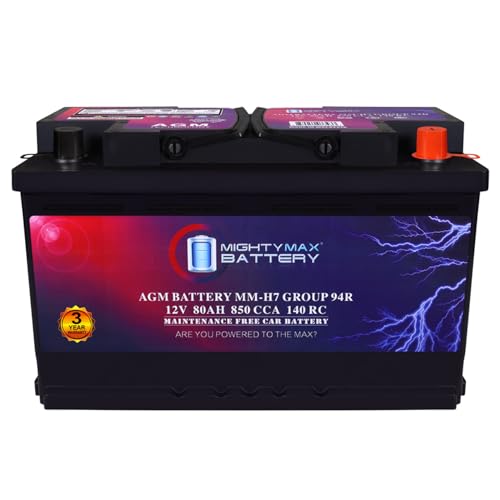
Mighty Max MM-H7 Group 94R 850 CCA AGM

Odyssey 34-PC1500T Automotive and LTV Battery
Weize Platinum AGM Battery BCI Group 47 680 CCA
MARXON Group 94R H7 L4 850 CCA AGM
More On The Choices That Made The List
The Daakmax Platinum AGM lands at the top of this list because it threads the needle that most daily drivers care about: serious cold-cranking output, a sealed AGM body, and a Group 94R / H7 form factor that fits a wide swath of newer European and domestic vehicles. The 12.4-inch length and tapered terminal layout (negative on the left, positive on the right) match the BMW, Mercedes, and VW platforms that often demand this exact footprint, so most shoppers won’t need adapter cables or terminal shims.
For owners who run stop-start systems in cold climates, the 850 CCA rating paired with 140 minutes of reserve capacity means accessories keep humming after the engine shuts off at a light. Compared to the Odyssey marine unit reviewed later, this one is purpose-built for passenger cars rather than trolling motors, which makes it the more relevant pick for the average commuter. In most garages, installation is a clean swap once you confirm the existing tray size and terminal orientation.
The Practical Payoff
- Group 94R / H7 dimensions fit many late-model import and domestic vehicles without modification.
- Sealed AGM construction resists vibration damage on rough winter roads.
- 140-minute reserve capacity keeps cabin electronics alive during long idling or accessory loads.
- Designed for start-stop systems that cycle the engine dozens of times per commute.
Worth Noting
- Confirm terminal polarity against your existing battery before ordering, since reversed terminals are a common fitment miss.
- Heavier than a conventional flooded battery at roughly 50 pounds, so handle it with both hands during the swap.
Quick Facts
Right Fit For
Drivers of newer BMW, Mercedes, VW, and Audi sedans or crossovers who need a sealed AGM replacement that meets start-stop demands.
Skip It When
Your vehicle calls for a Group 65 or Group 48 footprint, in which case the Interstate Batteries MTP-65HD or the Weize Platinum AGM BCI Group 48 will drop in cleanly.
The Odyssey 34M-PC1500ST-M sits in a category of its own on this list. Where the Daakmax unit is built for start-stop cars, this one is engineered for boats running trolling motors all day, then cranking a marine engine the next morning. The dual-terminal layout gives you SAE posts and stud terminals side by side, so you can wire accessories and the main engine without a separate distribution block.
For anglers spending long hours on the water, the deep-cycle tolerance means the battery can drop to a low state of charge repeatedly and still recover. In saltwater environments, owners commonly report that sealed AGM construction holds up better than flooded cells to constant spray and slosh. Compared to the automotive-focused Weize Platinum AGM Group 94R covered earlier, this Odyssey is overkill for a daily driver but the right tool for marine duty.
Noteworthy Benefits
- Dual SAE post and stud terminals simplify wiring on marine battery banks.
- Deep-cycle rated for sustained accessory loads like fish finders and livewell pumps.
- Sealed AGM case resists corrosion in damp bilge conditions.
- Strong cranking output for cold marine starts on early-morning launches.
Trade Offs
- Group 34 footprint doesn’t match most automotive trays, so it’s not a direct car swap.
- Premium construction carries a higher upfront cost than standard flooded marine batteries.
Whose Shelf It Belongs On
Boat owners who need one battery to crank the outboard and run trolling electronics for hours on end.
A Better Fit Elsewhere
Car commuters should skip this in favor of the Mighty Max MM-H7 Group 94R, which is built for automotive starting duty instead.
Weize brings the same BCI Group 94R dimensions and 850 CCA output as the Daakmax unit, which makes it a direct competitor for shoppers who want spec parity at a tighter price point. The 12.4 by 6.89 by 7.48-inch footprint and left-negative / right-positive terminal orientation match the factory layout on most cars calling for an H7 battery, so installation typically goes as smoothly as any other Group 94R swap.
Where this one earns its place is the cycle-life claim. Weize publishes double the cycle life of conventional flooded batteries, which matters if you sit in traffic with accessories running or make frequent short trips that never fully recharge the battery. In most daily-driving scenarios, the 140-minute reserve capacity gives you enough cushion to idle with headlights and HVAC on without stressing the cell. Compared to the Interstate MTP-65HD reviewed next, this one targets a different group size, so the choice really comes down to what your owner’s manual calls for.
A Few Highlights
- Group 94R footprint matches many European and domestic vehicles out of the box.
- Extended cycle life supports stop-start driving patterns without premature capacity loss.
- Sealed AGM case means no acid spills or vent-tube routing on modern engine bays.
- 36-month warranty window provides coverage for early-life defects.
Some Limits To Know
- Heavier than compact Group 47 or 48 batteries, which can complicate tight under-hood spaces.
- Verify terminal polarity matches your factory harness before clicking through checkout.
Best Suited To
Sedan and crossover owners who want AGM performance and 850 CCA output without paying the premium charged for European-labeled brands.
Reach For A Different Pick When
If your vehicle calls for a Group 65 tray, the Interstate Batteries MTP-65HD will fit where this one won’t.
Interstate’s MTP-65HD is the workhorse option on this list, and it fits an unusually wide range of domestic and import vehicles that use the Group 65 tray. The brand markets it as matching OEM specs across hundreds of year, make, and model combinations, so it’s a sensible pick when you want one battery that covers everything from older F-150 trucks to cargo vans and SUVs.
The 850 CCA rating paired with 150 minutes of reserve capacity gives this unit a slight edge over the Group 94R options when accessories stay on for long stretches. In real-world cold-weather use, the higher reserve minutes can mean the difference between a car that restarts after a short grocery stop and one that doesn’t. Compared to the MARXON Group 94R covered later, this one trades the AGM sealed design for a conventional flooded construction, which lowers cost but adds maintenance. For most daily drivers, that’s a fair exchange.
The Good Stuff
- Group 65 form factor fits a broad catalog of vehicles, simplifying shopping.
- 150-minute reserve capacity outpaces most AGM alternatives in this size class.
- 850 CCA output handles cold starts across a wide geographic range.
- Interstate’s nationwide distribution simplifies warranty exchanges.
Things To Consider
- Flooded-cell design requires periodic terminal cleaning and water-level checks under the caps.
- Heavier case and traditional vent routing may not suit tight, sealed battery compartments.
Feature Snapshot
Perfect Match For
Owners of older Ford, GM, and Chrysler vehicles that use a Group 65 tray and don’t require AGM start-stop compatibility.
Swap It Out When
Your car demands a sealed AGM for stop-start function, in which case the Daakmax Platinum AGM Group 94R will do the job better.
The Weize Platinum AGM BCI Group 48 (H6) is the shorter, lighter alternative for vehicles that don’t have room for a full-size Group 94R. At roughly 10.94 inches long, it tucks into the battery trays of many European midsize sedans, import crossovers, and smaller domestic cars where every cubic inch under the hood matters. The 760 CCA output is slightly lower than the 850 CCA Group 94R picks, but it’s still well above what most four-cylinder engines actually demand for a cold start.
For drivers in moderate climates, the 120-minute reserve capacity is plenty for typical commutes and short accessory loads. In hot southern summers, owners commonly report that the sealed AGM case handles under-hood temperatures better than older flooded cells in the same compartment. Compared to the larger Daakmax unit reviewed earlier, this one trades raw cranking output for a more compact envelope, which makes it the right answer when the tray dictates the size.
Useful Highlights
- Compact Group 48 / H6 dimensions fit import and European platforms with tight battery trays.
- Sealed AGM design resists vibration and heat in crowded engine bays.
- Extended cycle life supports stop-start systems without premature wear.
- Lighter weight simplifies DIY swaps in awkward under-hood locations.
Points To Note
- 760 CCA output is a step below the 850 CCA Group 94R options reviewed above.
- Verify terminal orientation, since some Group 48 vehicles use a reversed polarity layout.
Who Will Love This
Drivers of European and import midsize cars that specify an H6 battery tray and need AGM construction without the bulk of a Group 94R.
Look Elsewhere When
Your vehicle’s manual calls for an H7 / 94R footprint, in which case the Weize Platinum AGM Group 94R or the Mighty Max MM-H7 is the correct match.
UPLUS joins the Group 94R / H7 field with another 850 CCA AGM offering that targets the same audience as the Daakmax and Weize options. The 12-volt, 80-amp-hour capacity and 140-minute reserve rating put it squarely in the middle of the category, with no surprises in the spec sheet. For shoppers comparing these three side by side, the differences come down to brand familiarity, warranty terms, and real-world availability rather than raw output numbers.
Where this one earns attention is the maintenance-free promise. The sealed AGM construction means no water top-ups under the caps, no corrosion creep on nearby brackets, and no vent hose to route. In daily use, owners commonly report that AGM units like this one hold voltage more steadily through repeated short trips than flooded replacements. Compared to the MARXON Group 94R reviewed later, both units share nearly identical dimensions, so the choice often comes down to whichever brand you trust more.
Practical Advantages
- Group 94R / H7 dimensions fit the same broad range of vehicles as competing units.
- 850 CCA output supports reliable cold-weather starting in northern climates.
- Sealed AGM case requires zero routine maintenance over its service life.
- 140-minute reserve capacity covers extended accessory loads without dropouts.
Possible Compromises
- Specs are very close to the Daakmax and Weize 94R options, so brand preference carries more weight than usual.
- Verify dimensions against your tray before ordering, since slight length differences can complicate fit in tight compartments.
Who Should Grab It
Drivers who want a no-fuss, sealed AGM replacement for a Group 94R vehicle and don’t have a strong attachment to a competing brand.
Consider Something Else When
You want a brand with longer market presence, in which case the Daakmax Platinum AGM Group 94R or the Weize Platinum AGM Group 94R are equally valid alternatives.
Mighty Max rounds out the Group 94R cluster with another 850 CCA AGM option aimed at drivers who want a sealed, spill-proof replacement without paying a premium for label recognition. The deep-discharge recovery claim is worth highlighting: in stop-and-go city traffic, the battery often drops below full charge between starts, and a unit that bounces back efficiently tends to outlast one that doesn’t.
For family vehicles that rack up short-trip mileage on school runs and errands, the high-discharge output keeps the starter turning strongly even when the alternator hasn’t fully replenished the cell. In winter, the 140-minute reserve capacity gives parents enough cushion to idle for warm-up cycles without worrying about a no-start the next morning. Compared to the Daakmax and Weize 94R options, this one is essentially competing on price and warranty support rather than standout specs.
What Earns Its Place
- Group 94R dimensions cover the same broad vehicle fitment as competing AGM units.
- Deep-discharge recovery helps the battery bounce back from repeated short-trip driving.
- Sealed, spill-proof construction simplifies installation in any orientation within the tray.
- 850 CCA output and 140 RC support both cold starts and accessory loads.
Honest Caveats
- Spec sheet closely mirrors other 850 CCA Group 94R options, so differentiating factors are mostly brand-driven.
- Confirm tray dimensions and hold-down bracket fitment before ordering, since some H7 trays have tight clearance.
Spec Overview
Made For
Daily commuters and family-vehicle owners who want a maintenance-free 850 CCA replacement and aren’t loyal to a specific brand.
Where Another Pick Suits Better
Marine applications call for the Odyssey 34M-PC1500ST-M, which is purpose-built for trolling-motor duty rather than automotive starting.
The Odyssey 34-PC1500T comes from the brand’s Extreme series and is positioned for vehicles with heavy accessory loads, classic cars in storage, or trucks running winches and lighting rigs. The 850 CCA output lands it firmly on this list’s benchmark, while the Group 34 footprint suits older domestic muscle cars and many light trucks that use top-post terminals. Odyssey publishes a long service life claim of three to ten years, which matters for vehicles that sit in the garage between weekend drives.
For owners who hate replacing batteries every few years, the deep-cycle tolerance and recovery characteristics justify the higher upfront cost. In real-world use, owners commonly report that Odyssey units hold voltage longer than flooded replacements when a vehicle sits unused for weeks at a time. Compared to the marine-rated 34M-PC1500ST-M reviewed earlier, this one drops the dual-terminal layout in favor of standard top posts, which keeps the installation simpler for automotive applications.
Practical Pluses
- Extreme-series construction targets long service life, often three years or more under typical use.
- Group 34 footprint with top-post terminals fits many older domestic cars, trucks, and hot rods.
- Deep-cycle tolerance supports vehicles with winches, audio systems, or auxiliary lighting.
- Strong cranking output for cold-weather starts across a wide temperature range.
Details To Watch
- Premium construction commands a higher upfront cost than most Group 94R AGM options on this list.
- Group 34 footprint doesn’t match import platforms that call for H6 or H7 batteries.
Built With In Mind
Owners of classic cars, hot rods, and accessory-heavy trucks who want a long-lasting AGM replacement and are willing to pay for the upgrade.
Not Your Match When
Your vehicle uses a compact Group 47 or Group 48 tray, in which case the Weize Platinum AGM Group 47 is the better physical match.
The Weize Platinum AGM BCI Group 47 (H5) is the smallest battery on this roundup, and it earns its spot for shoppers who need a compact replacement that still delivers solid AGM performance. At 9.52 inches long, it fits subcompact hatchbacks, several Honda and Toyota models, and a number of Korean sedans that use the H5 tray. The 680 CCA rating is below the 850 CCA benchmark, which is why it sits near the end of the list rather than the top.
For lighter vehicles with smaller displacement engines, 680 CCA is more than enough to turn the engine over on a cold morning. In mild-to-moderate climates, owners commonly find that the 100-minute reserve capacity covers daily driving needs without complaint. Compared to the larger Group 48 Weize covered earlier, this one trades cranking output and reserve capacity for a smaller footprint, which makes it the right pick only when the tray demands it.
Key Advantages
- Compact Group 47 / H5 dimensions fit small Japanese and Korean sedans and hatchbacks.
- Sealed AGM case eliminates water-top-up maintenance over the battery’s life.
- Lighter weight than larger Group 94R units simplifies DIY swaps.
- Cycle life claim matches the rest of the Weize AGM lineup at up to twice conventional batteries.
Worth Bearing In Mind
- 680 CCA is a noticeable step down from the 850 CCA target that defines the rest of this list.
- 100-minute reserve capacity may feel tight in vehicles with high accessory loads.
Right Fit For
Owners of compact Japanese or Korean cars that specify an H5 battery and don’t need the higher cranking output of larger Group 94R units.
Another Choice May Suit
If your vehicle accepts an H7 / 94R and you want the full 850 CCA output, the Mighty Max MM-H7 or the Daakmax Platinum AGM Group 94R delivers more headroom.
MARXON closes out this list with another Group 94R / H7 / L4 option aimed squarely at start-stop vehicle owners. The 12-volt, 80-amp-hour rating and 850 CCA output match the Daakmax, Weize, and Mighty Max options reviewed above, which means the buying decision often hinges on warranty coverage, packaging, and brand familiarity rather than headline specifications. The maintenance-free promise is the key ownership benefit: install it once and forget about water levels, terminal cleaning, or vent hose routing.
For drivers who keep vehicles in a garage and rack up predictable commuter miles, the AGM construction handles start-stop cycling without the rapid degradation that plagues cheaper flooded replacements. In real-world use, the sealed design also reduces corrosion creep on nearby brackets and cable ends, which simplifies long-term upkeep. Compared to the UPLUS AGM-L80-UP reviewed earlier, this one competes on nearly identical ground, so the choice is more about which retailer stocks your preferred brand.
The Helpful Details
- Group 94R / H7 / L4 footprint fits the same import and domestic vehicles as competing AGM units.
- 850 CCA output supports reliable cold-weather starts across most North American climates.
- Maintenance-free sealed AGM design eliminates routine service steps.
- Compatible with start-stop systems on modern sedans and crossovers.
Factors To Consider
- Spec parity with other Group 94R options means the differentiator is mostly brand and warranty.
- Heavier than compact Group 47 batteries, so plan for a two-handed swap.
Feature Snapshot
Perfect Match For
Garage-kept commuters and SUV owners who want a sealed, start-stop-ready 850 CCA replacement and value the maintenance-free design.
Look Elsewhere When
Your vehicle uses a Group 65 or Group 48 tray, in which case the Interstate MTP-65HD or the Weize Platinum AGM Group 48 will fit better.
What To Weigh Before Choosing An 850 CCA Battery
Matching the right battery starts with the group size stamped on your existing unit or listed in the owner’s manual. Group 94R (also called H7 or L4) covers many European and domestic vehicles, while Group 65 fits older Ford, GM, and Chrysler platforms, and Group 48 (H6) handles several import midsize cars. Terminal polarity matters just as much as footprint, since reversed terminals will not connect to your factory harness without adapter cables.
Reserve capacity, measured in minutes, tells you how long the battery can run accessories if the alternator stops charging. A 140-minute rating covers most commutes comfortably, while 100 minutes may feel tight in vehicles with heavy accessory loads. For stop-start systems, AGM construction is generally worth the upgrade over flooded cells, since repeated engine cycling wears flooded batteries faster. Cold-climate drivers benefit from the full 850 CCA output, while those in milder regions can often accept 760 CCA without noticing the difference at the starter.
Key Considerations Across These Picks
Pitfalls Shoppers Hit
The most common mistake is buying a battery with the wrong group size or reversed terminal polarity, which leads to returns or improvised wiring. Always measure your existing battery and compare dimensions before checking out. Another trap is overlooking the charging system: a weak alternator will kill even the best AGM battery in a season, so it pays to test voltage output before assuming the battery is the problem.
Where The Extra Money Goes
Higher-tier AGM batteries like the Odyssey Extreme series command a premium for longer service life and deeper cycle tolerance. For vehicles with heavy accessory loads, stop-start systems, or long periods of storage, that premium tends to pay back through fewer replacements over a decade of ownership. For a basic commuter in a mild climate, a mid-tier Weize or MARXON AGM often delivers the same daily experience without the extra cost.