Picking the right 6S LiPo battery for a drone means balancing voltage, capacity, discharge headroom, and physical fit against your frame’s tolerances. Racers chasing tight lap times need cells that push current without sagging, while aerial photographers care more about endurance and stable voltage curves over a long flight. This list pulls together drone packs plus a few charging accessories and cross-compatible batteries that come up constantly in 6S builds.
A Snapshot Of The Selections

TATTU R-Line Version 5.0 1480mAh 6S 150C

JST-XH 6S Balance Plug Extension 5-Pack

Zeee 4S 10000mAh 120C EC5 (2 Pack)

JST-XH 2-6S Balance Board (2 Pack)
Zeee 3S 5200mAh 80C EC5 (2 Packs)

HRB 6S 4000mAh 60C EC5 (2 Pack)
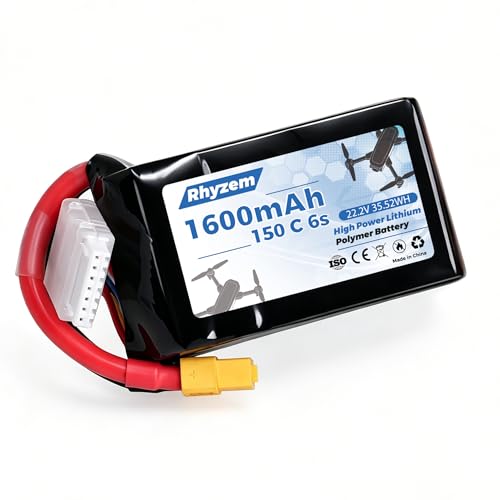
Rhyzem 6S 1600mAh 150C XT60

OVONIC 6S 6000mAh 120C EC5 (2 Pack)

Zeee 6S 5200mAh 100C EC5 (2 Pack)

Zeee 6S 6000mAh 100C EC5 (2 Packs)
A Closer Look At Each Pick
TATTU built its reputation in the FPV racing community by focusing on cells that hold voltage under punishing throttle bursts, and the R-Line Version 5.0 continues that lineage. The 1480mAh capacity lands in a sweet spot for 5-inch freestyle and racing quads, where every extra gram affects flight feel. Pilots chasing tight gate lines and aggressive freestyle combos tend to gravitate toward packs with this kind of power density.
The 22.2V nominal voltage (a 6S1P configuration, meaning six cells wired in series) gives motors the headroom they need for full-throttle pulls, and the 150C discharge rating signals that the cells can deliver current without dramatic sag mid-pack. Owners commonly report that R-Line packs maintain punch even late in a flight, which matters when every missed line costs time. The XT60 connector is a near-universal fit for most modern ESCs.
The Case For It
- 150C discharge headroom keeps voltage steady through aggressive maneuvers
- 1480mAh capacity balances flight time against weight for 5-inch builds
- XT60 connector works with the vast majority of modern FPV ESCs
- Hardcase design protects cells from minor frame impacts
- 22.2V nominal output suits high-RPM racing motors cleanly
Worth Noting
- Hardcase adds bulk; tight-fitting frames may need strap adjustment
- 1480mAh is shorter-flight than larger 6S packs used for long-range rigs
- Storage at proper voltage matters; owners commonly report cell swelling if left fully charged for weeks
Key Specs
Who It Suits Best
FPV racers and freestyle pilots running 5-inch quads who want race-grade punch and predictable voltage curves.
Where Another Pick Suits Better
Long-range and aerial photography pilots get more endurance from the Zeee 6S 6000mAh 100C EC5 (2 Packs), which trades raw punch for flight time.
Not every entry on a 6S drone battery list is a pack itself. The JST-XH 6S Balance Plug Extension sits in the builder’s toolbox, solving a stubborn problem: factory balance leads are often too short to reach a charger’s balance board when a pack sits deep inside a fuselage or frame. These 200mm extensions give you slack to work with. If you build or repair 6S packs, you tend to accumulate balance adapters fast, so a five-pack covers a workbench for a while.
The 22AWG silicone wire stays flexible in cold shops, and the JST-XH 7-pin format matches the most common 6S balance plug in the hobby. The separate pin insulation helps prevent shorts during bench charging, which is a quiet safety win when juggling multiple packs. Compared to the TATTU R-Line’s role as a power source, this one’s purpose is purely mechanical.
Advantages To Know
- 200mm length adds real reach to short factory leads
- 22AWG silicone wire stays pliable at room and cooler temperatures
- Five-pack covers a busy bench with spares on hand
- JST-XH fits the dominant 6S balance plug standard
Trade Offs
- Only useful if your charger or balance board accepts JST-XH plugs natively
- More length than some tight builds need; routing matters inside small frames
Right Fit For
DIY pack builders and hobbyists with cramped airframes where factory balance leads barely reach the charger.
Skip It When
Pilots flying pre-built packs straight out of the box rarely need this; reach instead for the TATTU R-Line Version 5.0 1480mAh 6S 150C as a plug-and-fly option.
Strictly speaking, this Zeee pack is a 4S (14.8V) unit, not a 6S drone pack, but it earns a spot because owners running larger RC platforms often keep a few of these around for ground vehicles, heavy trucks, and bashing rigs. The 10000mAh capacity translates to long run sessions on vehicles that eat current under acceleration. The 120C discharge rate handles hard launches without dropping below useful voltage.
At roughly 713g per pack, this is not a drone battery in any practical sense. It’s heavy and physically large, designed for ground vehicles like the X-Maxx, large-scale trucks, and similar platforms. Owners commonly report that the EC5 connector holds firm under the high inrush current big motors draw. The 169mm length demands a sizeable battery tray.
What Helps Most
- 10000mAh capacity extends run time on heavy ground vehicles
- 120C discharge supports hard throttle inputs without voltage collapse
- EC5 connector handles high current loads cleanly
- Two-pack configuration means less downtime between sessions
Honest Caveats
- 14.8V (4S) is too low for 6S drone builds
- Approx 713g per pack rules out multirotor use entirely
- Requires a LiPo-specific balance charger; standard NiMH chargers will damage the cells
Made For
Large-scale RC truck and bashing enthusiasts running 1/5 and 1/6 scale platforms that demand capacity over compact size.
A Better Fit Elsewhere
Pilots flying 6S drones get the right voltage class from the TATTU R-Line Version 5.0 1480mAh 6S 150C.
Another bench accessory rather than a flight pack, this Apex RC Products balance board accepts 2S through 6S batteries with JST-XH balance plugs, which covers nearly every modern LiPo in a drone hangar. The board simply routes each cell’s voltage to a charger’s balance port, letting you charge straight off the pack’s balance lead. For hobbyists juggling multiple cell counts, having two boards on hand keeps the workflow moving.
The high-quality silicone wiring holds up to repeated flexing, and the JST-XH connector matches the dominant standard on most LiPo packs, including the TATTU R-Line and Zeee 6S options on this list. Compare that to the elechawk extension leads: those add length, while this board adds an interface point between pack and charger. Owners commonly rely on boards like this for routine storage charging at safe voltages.
Everyday Wins
- Supports 2S through 6S packs on a single board
- JST-XH connector matches the most common balance plug standard
- Two-pack gives you a backup or a second charging station
- Silicone wire resists cracking through repeated bench use
Things To Consider
- Only works with chargers that expose a JST-XH balance port
- No active balancing electronics; relies on the charger’s balance circuit
Best Suited To
Home charging benches where multiple cell counts are charged side by side and a dedicated balance port saves setup time.
Consider Something Else When
If your charger already includes built-in balance ports for every cell count you run, this board is redundant; the Zeee 6S 6000mAh 100C EC5 (2 Packs) might be a better spend.
Like the 4S Zeee above, this 3S pack strays outside the strict 6S drone category, but it lands here because 3S and 4S packs from the same brand tend to share a bench with 6S cells in mixed fleets. The 5200mAh capacity and 80C discharge are tailored for 1/10 and 1/8 scale RC vehicles, where it delivers strong punch without the punishing weight of larger packs. The hard case adds impact protection for bashing sessions.
11.1V nominal output suits smaller RC platforms, but it’s not a 22.2V drone pack, so drone pilots shopping for 6S should pass on this one. EC5 connector pairs cleanly with high-current ESCs commonly found in brushless RC cars and trucks. Owners commonly appreciate the consistent quality across Zeee’s range, which makes mixing cell counts on a single charging station straightforward.
A Strong Showing
- 5200mAh capacity delivers solid run time for 1/10 scale bashing
- 80C discharge supports aggressive throttle on smaller motors
- Hard case protects cells from track and bash impacts
- Two-pack format suits rotation between heats
Some Limits To Know
- 11.1V (3S) is below 6S drone voltage requirements
- At 370g per pack, it’s too heavy for most multirotor builds
- EC5 connector adds bulk that doesn’t suit compact flight frames
Who Will Love This
1/10 and 1/8 scale RC bashers running brushless systems who want a reliable workhorse pack.
Not Your Match When
6S drone pilots should look at the Rhyzem 6S 1600mAh 150C XT60 for a properly sized flight pack.
HRB targets RC airplane pilots who need genuine 6S voltage without premium-tier pricing, and the 4000mAh capacity suits fixed-wing models that fly for longer stretches than multirotors. The 60C continuous discharge rating (a measure of how much current the battery can safely deliver relative to its capacity) is more conservative than the 120C+ packs elsewhere on this list, but for cruise-oriented flight rather than peak bursts, that’s plenty. The two-pack configuration means one pack charges while the other flies.
At roughly 590g per pack and 135mm long, this is a sizeable brick of energy suited to mid-sized RC planes and helicopters, not small multirotors. Owners commonly report that the EC5 connector holds up well to repeated mating cycles. Compared to the TATTU R-Line’s small 5-inch-racing focus, this HRB pack leans toward longer wings and slower airframes.
A Favorable Mix
- 22.2V (6S) voltage suits mid-sized fixed-wing aircraft
- 4000mAh capacity supports longer cruise-style flights
- EC5 connector is a robust fit for high-current setups
- Two-pack lets one charge while the other flies
Points To Keep In Mind
- 60C discharge is lower than racing-focused packs; aggressive 3D flying may push limits
- Approx 590g per pack rules out small drone frames
- Physical dimensions need a generous battery compartment; small trainers won’t fit
Feature Snapshot
Perfect Match For
RC airplane hobbyists flying mid-sized trainers, gliders, and sport wings where endurance matters more than peak amperage.
Look Elsewhere When
Multirotor pilots running high-throttle freestyle should reach for the TATTU R-Line Version 5.0 1480mAh 6S 150C for higher discharge headroom.
Rhyzem slots into a competitive corner of the 6S drone market with a 1600mAh pack aimed at FPV racers who want a small-but-punchy option. The 150C discharge rating suggests the cells can push current hard during aggressive maneuvers without sagging. At slightly more capacity than the TATTU R-Line 1480mAh above, this gives a small flight-time bump on similar frames, which matters when every extra second in the air counts.
The 22.2V output pairs naturally with high-RPM motors on 5-inch quads, and the XT60 connector matches the FPV standard. Owners commonly use packs in this size class for sub-250g freestyle quads where weight discipline is critical. The trade-off shows up in flight time versus heavier 6S options, which usually fly longer but reduce agility.
What It Does Well
- 150C discharge holds voltage during hard acceleration
- 1600mAh adds a small endurance bump over smaller racing packs
- XT60 connector is the FPV standard, no adapter needed
- Light enough for sub-250g freestyle builds
Worth Bearing In Mind
- Capacity is still modest; long-range pilots will want more cells
- Smaller packs are more sensitive to over-discharge if you’re not monitoring voltage
- Storage at proper voltage is essential; owners commonly report swelling after long-term full charge
Built With In Mind
FPV racers and sub-250g freestyle pilots who want a slightly larger pack than entry-level racing cells.
Another Choice May Suit
Pilots chasing longer endurance on heavier multirotors should consider the OVONIC 6S 6000mAh 120C EC5 (2 Pack) instead.
OVONIC delivers a genuine 6S workhorse aimed at pilots flying larger drones, helicopters, and heavy multirotor setups where both capacity and current matter. The 6000mAh capacity gives meaningful flight time for mapping rigs, cinematography quads, and 600-700 class helicopters. The 120C discharge rating ensures the pack can handle collective pitch changes and sudden throttle spikes without significant voltage drop.
The soft-case format (a flexible heat-shrink wrap rather than a rigid shell) keeps weight slightly lower than hard-case equivalents, which helps on weight-sensitive larger builds. At roughly 830g per pack and 155mm long, this is a serious brick of energy that demands a roomy airframe. The JST-XHR-7P balance plug is the modern 6S standard, and EC5 on the discharge side handles the current cleanly.
What Pays Off
- 6000mAh capacity delivers long run times for heavy multirotor work
- 120C discharge supports demanding collective and throttle inputs
- JST-XHR-7P balance plug matches modern 6S charging equipment
- Two-pack format keeps missions running without long gaps
Less Ideal Details
- Soft case offers less impact protection than hard-cased alternatives
- 830g per pack rules out anything but the largest drone frames
- Charging at the recommended 0.5-1C rate takes time; plan around that
Whose Shelf It Belongs On
Large multirotor and helicopter pilots running 600-700 size helicopters and heavy-lift cinematography frames.
Reach For A Different Pick When
Smaller 5-inch FPV racers won’t fit this pack; the Rhyzem 6S 1600mAh 150C XT60 is the right size class for that profile.
Zeee’s 6S 5200mAh pack sits in a versatile middle ground that suits a wide range of larger RC aircraft and drones. The 22.2V output drives 550-class helicopters, EDF jets, and large multirotors cleanly, while the 5200mAh capacity delivers solid flight times. The 100C discharge handles aggressive maneuvers without the cells sagging noticeably mid-flight.
At 753g per pack and roughly 155mm long, this is a sizeable pack for sizable airframes, not a small drone. The soft case format keeps weight slightly down compared to hard-cased alternatives. EC5 connectors are a strong fit for high-current ESCs commonly found in larger brushless setups. Owners commonly rotate two packs in this class to keep missions moving without long charge pauses.
The Value In It
- 22.2V (6S) output suits mid-to-large fixed-wing and heli setups
- 5200mAh capacity balances flight time against airframe weight
- 100C discharge supports spirited flying without dramatic sag
- EC5 connector matches high-current ESC standards
Where It May Fall Short
- Soft case offers limited impact protection compared to hard packs
- 753g per pack rules out small multirotor frames
- Requires a LiPo-specific balance charger; never charge unattended
Quick Facts
The Right Fit
Mid-scale RC pilots flying 550-class helicopters, EDF jets, and larger multirotors who want a versatile 6S pack.
Swap It Out When
Pilots needing higher capacity for long mapping missions should step up to the OVONIC 6S 6000mAh 120C EC5 (2 Pack).
Closing out the list is another Zeee 6S option, this time stepping up to 6000mAh for pilots who need every extra minute of air time. The 100C discharge rating is a touch lower than the OVONIC above, but for cruising, mapping, and EDF jet runs, that’s rarely the limiting factor. Two packs in the box means one flies while the other charges, smoothing out long session days.
At roughly 833g per pack, this is firmly in the large-airframe category. Owners commonly use this capacity class for aerial photography, agricultural drones, and long-endurance surveillance rigs where flight time is the headline spec. The EC5 connector and 22.2V output match standard ESCs in the heavier-lift segment of the hobby.
Notable Gains
- 6000mAh capacity stretches flight times meaningfully over smaller 6S packs
- 100C discharge covers most flying styles short of extreme 3D heli
- EC5 connector handles the current demands of heavy-lift setups
- Two-pack configuration fits continuous mission workflows
Practical Considerations
- 833g per pack demands a generous battery bay
- Charging at recommended 0.5-1C means planning ahead for turnaround
- Storage at proper voltage is critical; owners commonly see swelling after extended full-charge storage
Feature Card
Who Should Grab It
Long-endurance drone pilots running mapping, surveillance, and EDF jet setups where flight time outranks agility.
A Better Fit Elsewhere
FPV racers and freestyle pilots get better agility from a lighter pack like the TATTU R-Line Version 5.0 1480mAh 6S 150C.
What To Weigh Before Choosing A 6S LiPo Battery For Your Drone
Voltage And Cell Count Compatibility
A 6S LiPo delivers 22.2V nominal output, and your drone’s ESC, motors, and power distribution board must be rated for that exact class. Plugging a 6S pack into a 4S-rated system can let the magic smoke out in seconds, while under-volting a 6S-rated ESC with a smaller pack simply produces underwhelming thrust. Always cross-check your build documentation before ordering, and treat the cell count as a hard rule, not a suggestion.
Capacity Versus Weight Discipline
Capacity (measured in mAh) directly affects flight time, but every extra cell adds weight, and weight compounds across a quad’s balance and thrust budget. A 1480mAh pack suits agile 5-inch racers, while a 6000mAh pack makes sense on a heavy-lift hexacopter that needs endurance. The honest read is that more capacity is only useful when your frame can lift it without sacrificing the flight feel you actually want.
Discharge Rate And Real-World Demand
The C-rating on a LiPo tells you how much current the cells can deliver continuously relative to capacity. Higher C-ratings reduce voltage sag during hard throttle bursts, which matters for FPV racers pushing aggressive maneuvers. For cruise-oriented flight, a moderate C-rating is enough, and chasing the highest number on the market costs money without delivering meaningful in-air benefits. Match the rating to your flying style, not to spec-sheet bragging rights.
Connector Standards And Physical Fit
XT60 dominates the FPV drone world, while EC5 shows up more often on larger RC aircraft and high-current ground vehicles. Adapters exist, but each adapter is a resistance point and a failure risk. Measure your battery bay before committing, and verify the connector matches your ESC without forcing it. A pack that doesn’t physically fit your airframe is a paperweight, no matter how good the cells are.
Key Considerations Across These Picks
Where Shoppers Go Wrong
The most common mistake is treating C-rating as a pure quality score and chasing the highest number on the shelf. A 150C pack isn’t automatically better than a 100C pack; the right C-rating depends on the current your motors actually pull. Another frequent trap is ignoring connector compatibility, then buying adapters to force a fit, which adds resistance and a potential failure point. Storage discipline matters too: leaving packs fully charged for weeks is a known path to puffed cells.
When Paying More Pays Off
Higher-tier 6S drone packs earn their keep through tighter cell matching, lower internal resistance, and more consistent voltage under load. For FPV racers shaving lap times, that consistency translates directly to fewer voltage sags mid-corner and more predictable power delivery. For casual flyers, the upgrade is harder to justify, and a mid-tier pack like the Zeee 6S 5200mAh 100C is plenty for most flying styles. Spend up where your flying demands consistency, and save where it doesn’t.
Frequently Asked Questions
What Does “6S” Mean On A Drone Battery?
The “S” stands for series, and a 6S battery contains six lithium polymer cells wired in series. That configuration multiplies the per-cell voltage (3.7V nominal) into a 22.2V total output, which gives drone motors the headroom they need for high RPMs and aggressive throttle response.
Can You Use A 6S Battery On A 4S Drone?
No. A 6S pack delivers 22.2V, and a 4S-rated system is built for 14.8V. Plugging the higher-voltage pack into a 4S-rated ESC will likely destroy the speed controller and potentially damage motors. Always match the cell count to your build’s rated voltage, no exceptions.
How Should You Store 6S LiPo Batteries?
Store packs at around 3.8V per cell (called storage voltage) in a cool, dry place, ideally inside a LiPo-safe bag or metal box. Avoid leaving them fully charged for days or weeks, as that stresses the cells and accelerates puffing. Most modern chargers have a dedicated storage mode that handles this automatically.
What Does The C-Rating Actually Mean?
The C-rating multiplied by capacity gives the maximum safe continuous discharge current. A 5000mAh pack rated at 100C can theoretically deliver 500 amps continuously, though real-world demand is usually far lower. Higher C-ratings matter most under hard throttle bursts, and overspec’ing beyond your needs rarely helps.
How Long Does A 6S Drone Battery Last Before Replacement?
Cycle life depends on how deeply you discharge the pack, how often you charge it, and how carefully you store it. Owners commonly get 150-300 cycles before noticing meaningful capacity loss or puffing, though aggressive racing tends to shorten that window. Treat packs gently, store them properly, and replace any pack that shows swelling, physical damage, or sudden voltage drop in flight.
The Takeaway
The right 6S LiPo battery for your drone depends entirely on what you fly: tight 5-inch racers want small, high-C packs like the TATTU R-Line or Rhyzem, while heavy-lift and endurance rigs benefit from the OVONIC or Zeee 6000mAh options. Match voltage, capacity, and connector to your build first, then dial in discharge rate for your flying style. The bench accessories, the elechawk extensions and the Apex balance board, round out a complete charging and maintenance setup alongside the packs themselves.