Swapping out a tired set of lead-acid batteries for a modern 48V lithium pack changes how a golf cart feels from the first turn of the key. Range jumps, weight drops, and the slow creep of voltage sag on hills mostly disappears. This lineup pulls together nine solid options, from full conversion kits with chargers and monitors to a heavy-gauge cable set for owners sticking with their existing battery bank.
A Quick View Of The Lineup

HumsiENK 48V 100Ah Lithium Golf Cart Battery with 58.4V Charger

CLUBRALLY Club Car Precedent Battery Cables 48V 3 Gauge

LOSSIGY 48V Lithium Battery Golf Cart Conversion Kit

Mehrpow 48V 100Ah Lithium Golf Cart Batteries Kit

HumsiENK 48V 150Ah Golf Cart Battery 7.68kWh
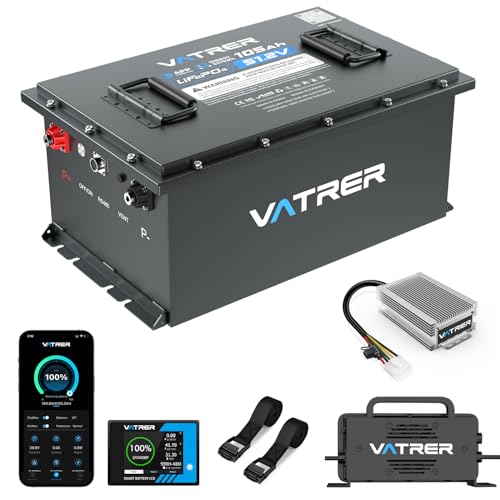
VATRER POWER 48V 105Ah Lithium Golf Cart Battery UL2271

DC HOUSE Metal Case 48V 100Ah Lithium Golf Cart Battery Kit

LOSSIGY 48V 100Ah LiFePO4 Conversion Kit 5.12kWh

HumsiENK 48V 100Ah Golf Cart Battery Metal Casing
Why These Options Stand Out
Anyone running a stock 48V club car setup knows how heavy six lead-acid batteries get under the seat. The HumsiENK 48V 100Ah lithium pack trims that mass down to roughly 90 lbs in a single case, freeing up payload room for coolers or extra gear. It is shaped to slot into the battery tray of common EZGO, Club Car, and Yamaha carts without re-routing a single cable, which matters if you are doing the swap yourself in a single afternoon.
The included 58.4V aluminum-shell charger carries an IP65 weatherproof rating (a measure of how well it resists dust and water jets), so leaving it in the back of the cart during a sudden rain is less of a gamble. For weekend course runs or short neighborhood commutes, the range comfortably covers a full day of driving. Compared with the CLUBRALLY cable set further down the list, this is a true battery upgrade rather than a maintenance part.
The Upside
- Single-case design drops hundreds of pounds of lead-acid weight from the cart.
- Compatible with EZGO, Club Car, and Yamaha 48V setups out of the box.
- Fast IP65-rated aluminum charger ships in the box, no extra purchase needed.
- LiFePO4 chemistry (lithium iron phosphate, valued for stability and long cycle life) holds voltage flat through a round rather than sagging on the back nine.
Things To Consider
- Tray dimensions are fixed, so measure your existing battery compartment before ordering if your cart has been modified.
- Lithium packs need a brief initial balance charge for longest cell life, a step owners sometimes skip.
Feature Snapshot
Built With In Mind
Golfers and homeowners driving a standard EZGO, Club Car, or Yamaha who want a true drop-in lithium upgrade.
Reach For A Different Pick When
Lifted six-seat buggies with extreme range demands will get more out of the HumsiENK 48V 150Ah 7.68kWh Extended Range pack.
Not every cart needs new batteries right away. Sometimes the factory wiring on a 2008-and-up Club Car Precedent has corroded or stretched just enough to sap range and slow charging. The CLUBRALLY cable set replaces the stock battery harness with thicker 3-gauge wire, restoring clean current flow between the six 8V cells.
Higher strand count in the copper means the cables flex without cracking during installation, which matters on tight battery trays where stiff wires fight you. Owners commonly find that range ticks back up noticeably once the old, oxidized lugs are gone. Compared with the lithium swaps earlier in the list, this is a smarter move if your batteries still hold a charge but the cart feels sluggish on hills.
What Makes Sense
- 3-gauge cable thickness reduces voltage drop across long battery runs.
- Full set covers every connection on a six-battery 48V Precedent.
- Higher strand copper bends cleanly into tight tray corners.
- Resists corrosion far better than stock OEM wire over time.
Honest Caveats
- Only fits 2008-up Club Car Precedent models, so verify your cart year first.
- Does nothing for aging batteries; pair with new cells if voltage tests come back weak.
Right Fit For
Owners of a 2008-up Club Car Precedent with healthy batteries but worn or corroded factory wiring.
A Better Fit Elsewhere
Anyone needing a complete lithium conversion should look at the LOSSIGY 48V Lithium Battery Golf Cart Conversion Kit instead.
Pulling six lead-acid batteries out, dropping them at the recycler, and wrestling a heavy bank back in is nobody’s favorite weekend. The LOSSIGY conversion kit packages the battery, charger, and monitor into a single bundle so a full swap feels more like an appliance install than a garage project. The kit ships in both 100Ah and 150Ah versions, letting you tune range and budget to your driving style.
The included monitor gives a real-time read on state of charge, so you stop guessing how much juice is left before the return trip to the clubhouse. Auto-grade LiFePO4 cells and a built-in BMS (battery management system, the onboard circuitry that prevents overcharge and overheating) aim at longevity rather than just peak performance. Where the HumsiENK 100Ah earlier is a single-case drop-in, this LOSSIGY kit is the full-system route.
The Practical Payoff
- Bundled charger and monitor remove the guesswork of matching accessories.
- Two capacity options (100Ah and 150Ah) suit both casual and heavy cart users.
- LiFePO4 chemistry with integrated BMS targets thousands of charge cycles.
- Single-battery form factor cleans up the tray compared to six-cell lead setups.
Worth Noting
- Confirm tray dimensions before ordering, since the casing is fixed-size.
- Full conversion is more involved than a single-cable replacement, budget a half-day.
Who It Suits Best
Cart owners ready to leave lead-acid behind and want charger, monitor, and battery in one bundle.
Consider Something Else When
Hilly neighborhoods with heavy passenger loads call for the HumsiENK 48V 100Ah Metal Casing battery and its stronger peak output.
The Mehrpow 48V 100Ah kit leans hard into the “less time in the garage, more time on the path” side of ownership. Built around EVE grade-A LiFePO4 cells (UL-certified 2C cells, meaning a recognized testing lab has verified safety and discharge performance), it ships as a one-time install with plug-and-play wiring rather than a pile of loose leads. That matters for anyone renting a cart or sharing it with a non-mechanical household.
Spec sheets claim deep cycle counts well past 10,000 at 80% depth of discharge (the percentage of total capacity you safely pull from a lithium pack per cycle), an order of magnitude over the few hundred cycles a stock AGM bank delivers. Compared with the LOSSIGY kit above, the selling point here is the simpler install rather than the bundled monitor. For most paved-path cart owners, that is exactly the trade they want.
What Works In Its Favor
- Plug-and-play design skips the messy re-wire step.
- Long cycle life cuts battery replacements to a once-per-decade event.
- Grade-A EVE cells with UL certification add a layer of safety assurance.
- Drop-in form factor fits most common 48V cart trays.
Points To Keep In Mind
- No bundled monitor, so adding a separate state-of-charge gauge is wise.
- Hazardous-shipping restrictions mean delivery windows can stretch.
Made For
DIY installers who want the fewest wiring steps and the longest service interval between swaps.
Skip It When
Tech-minded owners who prefer live Bluetooth readouts should look at the DC HOUSE Metal Case 48V 100Ah kit with monitor.
Lifted carts with chunky tires and 6-passenger family haulers drink electricity like a thirsty truck. The HumsiENK 150Ah pack, rated at 7.68kWh of usable energy, is built specifically for those punishment-duty setups. Capacity claims stretch into the 60-to-80 mile range on a single charge, which turns a quick errand into an all-afternoon outing without range anxiety.
Same aluminum-cased, IP65-rated charger family as the 100Ah sibling earlier, so the weatherproofing story is consistent. Where the 100Ah pick covers most casual carts, this 150Ah version trades some under-seat clearance for serious capacity. Compared with the VATRER POWER 105Ah further down, the headline number here is raw energy, not safety certification.
Practical Pluses
- 7.68kWh capacity delivers the longest single-charge range in this lineup.
- Built to feed power-hungry lifted and 6-passenger carts.
- IP65-rated charger withstands outdoor charging in covered storage.
- Single lithium case simplifies the swap from a six-battery lead bank.
Some Limits To Know
- Physical size may not fit carts with shallow or non-standard trays.
- Higher capacity drives a heavier pack than the 100Ah sibling.
Best Suited To
Lifted carts, 6-seaters, and owners who want multi-day range without nightly charging.
Look Elsewhere When
Standard 4-seater carts used for short course rounds will do fine on the lighter HumsiENK 48V 100Ah from earlier in this list.
For households nervous about leaving a high-capacity lithium pack charging in the garage, third-party safety certification is the feature that sells the cart. The VATRER POWER 48V 105Ah battery carries UL2271 certification from Intertek, the recognized standard for light-electric-vehicle lithium packs. That testing covers overcharge, short-circuit, thermal runaway (a chain reaction where heat inside a failing cell triggers heat in neighboring cells), vibration, and impact resistance.
The 105Ah capacity slots between the HumsiENK 100Ah and 150Ah options, giving a useful bump without the tray-size headaches of the largest pack. It is marketed toward both carts and side-by-side UTVs, which hints at rugged internal construction. Compared with the LOSSIGY kits reviewed earlier, this one leads with certification paperwork rather than bundled accessories.
What Earns Its Place
- UL2271 certification by Intertek covers a wide range of failure modes.
- 105Ah capacity hits a sweet spot between range and physical size.
- Built to handle vibration, useful for carts on rough paths.
- Compatible with a wide range of 48V cart and light-utility setups.
Things To Weigh
- No monitor included in the box, adding cost if you want live readouts.
- Hazardous-materials shipping rules apply, so lead times stretch.
Feature Snapshot
Perfect Match For
Safety-first households that want independent verification of the battery’s protection systems.
Swap It Out When
Owners wanting live state-of-charge readouts from the dashboard will prefer the DC HOUSE Metal Case kit with monitor.
For data-driven owners who want to know exactly how much range is left before pulling out of the driveway, the DC HOUSE kit adds the trappings of a modern lithium pack. The bundle includes a Bluetooth mobile app and an LCD monitor that report voltage, current, and state of charge in real time. The metal case adds a layer of crash and abrasion protection over soft-pack alternatives.
Spec sheets point to a 200A BMS (battery management system) and peak currents high enough for moderate hill climbs on a full 4-seater. The 18A charger is faster than the typical 10A brick, trimming downtime between rounds. Against the HumsiENK 100Ah drop-in, this kit is the smarter, app-connected option at a similar capacity tier.
Real-World Strengths
- Bluetooth app and LCD monitor remove range guesswork.
- Faster 18A charger cuts downtime between outings.
- Metal case adds durability over shrink-wrapped soft packs.
- Peak current headroom handles moderate hill climbs with passengers.
Points To Note
- App functionality varies by phone, so check current OS compatibility before relying on it.
- Metal case adds a touch of weight compared with plastic-clad competitors.
Feature Snapshot
Whose Shelf It Belongs On
Tech-oriented cart owners who enjoy monitoring their setup through a phone app and want faster recharges.
Not Your Match When
Off-grid solar or RV owners looking for a multi-purpose pack will find the LOSSIGY 100Ah 5.12kWh conversion kit a better fit.
Some battery purchases do double duty: cart by the weekend, off-grid cabinet by the week. The LOSSIGY 48V 100Ah 5.12kWh kit is marketed for exactly that crossover use, pulling duty in golf carts, solar sheds, and RV house banks alike. Auto-grade LiFePO4 cells and a 200A Bluetooth BMS keep tabs on the pack without requiring a separate shunt or display.
Peak currents in the 1000A range for short bursts (3 to 5 seconds) handle the inrush that motors and inverters draw at startup. A bundled charger and monitor round out the install so the pack drops into whatever 48V project you have on the bench. Against the more cart-specific DC HOUSE kit reviewed above, this one leans multi-purpose.
A Strong Showing
- Multi-purpose design fits carts, solar, and RV banks.
- Bluetooth BMS streams data to a phone without extra hardware.
- Short-burst 1000A peak handles motor and inverter inrush.
- LiFePO4 cycle life targets a decade of regular use.
Trade-Offs To Consider
- Listed as non-returnable under hazardous-shipping rules, so inspect on arrival.
- 5.12kWh lands between the smaller and larger cart picks, with no clear capacity edge.
Who Should Grab It
Shoppers splitting one lithium pack between a cart and an off-grid solar or RV system.
Another Choice May Suit
Pure cart owners chasing maximum range should look at the HumsiENK 48V 150Ah 7.68kWh Extended Range pack instead.
Carts that pull four passengers up a sloped driveway reveal which batteries have real current and which ones fold under load. The HumsiENK 48V 100Ah metal-casing pack is engineered for that exact stress test, with a 200A smart BMS and a stated 700A peak burst for one-second climbs. The metal shell adds a sturdier feel than soft-pack equivalents.
Continuous output figures near 10kW leave plenty of headroom for stock controllers and modest aftermarket upgrades. Compared with the standard HumsiENK 100Ah drop-in reviewed first, this metal-casing sibling focuses more on rugged output than on the included charger package. For hilly neighborhoods, that trade usually feels worth it.
Practical Advantages
- 700A peak burst handles short, steep climbs with full passenger load.
- 200A BMS keeps cells protected under sustained heavy draw.
- Metal casing shrugs off knocks better than soft-pack designs.
- 100Ah capacity still delivers solid daily range.
A Few Limitations
- Metal case weighs more than plastic-clad competitors, lifting the cart slightly.
- No bundled monitor, so adding a gauge is a separate purchase.
Feature Snapshot
The Right Fit
Hill-heavy neighborhoods, four-seater family carts, and anyone who has watched a stock pack sag on a steep grade.
Where A Sibling Pick Shines
Flat-terrain owners chasing the longest single-charge range will prefer the HumsiENK 48V 150Ah 7.68kWh pack from earlier in the list.
What To Weigh Before Picking A 48V Pack
Capacity Vs. Tray Space
The single biggest mismatch in cart upgrades is buying a pack the tray cannot hold. Measure the inside length, width, and height of your battery compartment before chasing the highest Ah number on the page. A 100Ah case that slides in cleanly will outperform a 150Ah brick that pins against the seat frame every drive.
Chemistry And Cycle Life
LiFePO4 (lithium iron phosphate) cells have become the standard for serious golf cart conversions because they tolerate deep discharge without the quick aging seen in AGM lead-acid banks. Cycle counts in the 4,000-to-10,000 range translate to a decade of regular use for most owners. Pay attention to grade-A cell sourcing and integrated BMS protection, both of which are worth more than a modest capacity bump.
Charging And Monitoring
Charger amperage matters more than most buyers expect. A faster 18A brick gets the cart back on the path in a few hours rather than overnight, which matters for rental fleets or households sharing one cart. Bluetooth monitors add cost but remove the guessing game when planning a long loop, especially helpful on carts without a fuel-style gauge.
Safety And Certification
Third-party safety testing, such as UL2271 certification, gives an outside lab’s read on thermal runaway, overcharge, and vibration resistance. For carts charged indoors or in attached garages, that paperwork translates to fewer sleepless nights. Look for BMS specifications that match your cart’s controller amperage so the protection circuitry actually engages when needed.
Things Worth Knowing Before You Click Buy
Where Shoppers Go Wrong
The most common slip is assuming any 48V lithium pack bolts into any 48V cart. Tray dimensions, terminal orientation, and controller amperage all need a quick check before ordering. Owners who skip that step often return batteries that physically fit but cable up backward or trip the BMS on the first hill.
Another mistake is ignoring the charger that ships in the box. Some kits include a proper IP65 weatherproof unit, while others leave you hunting for a matching aftermarket brick. Factor that into the real cost before committing.
What Separates Premium From Basic
Higher-tier packs earn their markup through cell grade, BMS sophistication, and certification paperwork. Auto-grade cells last longer under deep cycling, smarter BMS units balance individual cell voltages more precisely, and third-party safety certifications catch design flaws that internal QA can miss. For a daily-driver cart, those extras usually pay back through fewer headaches and longer service life.
Frequently Asked Questions
How long does a 48V lithium golf cart battery typically last?
Most quality LiFePO4 packs in this category are rated for several thousand deep cycles, which works out to roughly a decade of regular use. Actual life depends on how deeply you discharge the pack each round and whether it is stored in extreme temperatures.
Can I install a 48V lithium battery myself?
Most drop-in kits are designed for DIY installation with basic hand tools and a half-day of patience. The work involves disconnecting the old battery bank, dropping the lithium case into the tray, and reconnecting the main cables.
Do lithium golf cart batteries work in cold weather?
LiFePO4 cells do not love sub-freezing charging, though they generally still discharge well in the cold. Some BMS units throttle charging at low temperatures to protect the cells, so wintertime range can shorten slightly compared with summer use.
What is the difference between 100Ah and 150Ah packs?
The Ah (amp-hour) rating measures how much energy the battery stores, so a 150Ah pack roughly delivers one and a half times the range of a 100Ah unit of the same voltage. The trade-off is physical size and weight, which can affect tray fit.
Do I need a special charger for a lithium golf cart battery?
Yes, lithium chemistries require a charger matched to their voltage profile and BMS. Most kits include a compatible unit, but using a leftover lead-acid charger risks undercharging or tripping the BMS protection circuitry.
Closing Thoughts
The right 48V pack depends less on spec-sheet superlatives and more on your cart, your terrain, and your tolerance for wiring work. Match capacity to your daily drive, double-check the tray, and treat certification as a feature worth paying for when the cart lives in an attached garage. Any of the nine picks above will modernize your cart, the question is just which trade-off matters least to you.