A multi-battery boat isn’t a luxury anymore, it’s the norm. Trolling motors, fish finders, house banks, and starter batteries all want reliable charging, and a mismatched charger shortens battery life faster than almost anything else you can do wrong. The right multi-bank charger lets you plug in once and walk away, knowing each bank gets the right voltage profile without babysitting.
A Side-By-Side Look

Battery Tender Plus 4 Bank Multibank Charger 5 AMP

Tecmate Optimate 2 Duo x 4 Bank TM-575 Charger
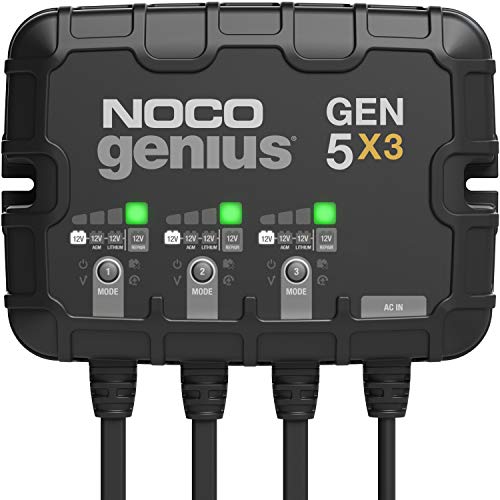
NOCO GEN5X3 12V 15A 3-Bank Marine Charger

Schumacher SL1674 1500A Lithium Jump Starter
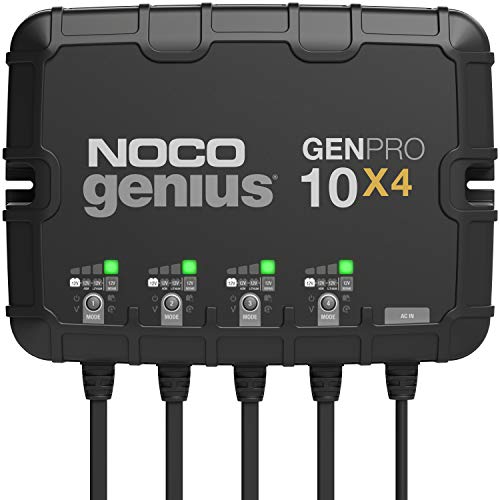
NOCO GENPRO10X4 12V 40A 4-Bank Marine Charger

Minn Kota Precision MK-440PCL 4-Bank Charger
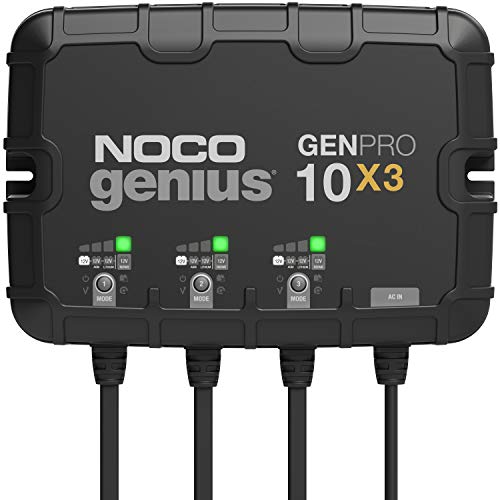
NOCO GENPRO10X3 12V 30A 3-Bank Marine Charger

Schumacher SC1355 1.5A 6V/12V Maintainer

Schumacher SC1280 3A 12V/6V Trickle Charger

Schumacher SC1445 Wheeled 6/12V Starter Charger
Why These Options Stand Out
The Battery Tender Plus 4 Bank is built for the kind of boater who plugs in and walks away for weeks at a time. Four independent outputs deliver a calm 1.25 amps each, which is gentle enough to nurse a stored ski boat or a classic carbureted runabout back to full health without cooking it. It auto-switches from bulk charging to a float stage, so leaving it connected through winter layup is the intended use case rather than a side effect.
Chemistry coverage is broad for the price, accepting standard flooded, AGM, and LiFePO4 packs side by side. Owners commonly use it in a garage bay or shrink-wrapped storage unit where four separate vehicles or seasonal toys each need a top-up circuit. It’s not a fast charger; in our view, anyone chasing rapid recovery should look elsewhere, but for long-term float service it does exactly what it claims.
What Helps Most
- Four truly independent channels let you mix chemistry without worrying about cross-feed
- Automatic float mode protects batteries through months of unattended storage
- Compact, low-mass housing is easy to wall-mount in a tight garage corner
- Compatible with standard, AGM, and lithium LiFePO4 banks on the same unit
Things To Consider
- 1.25 amps per bank is slow for any battery that has been deeply discharged
- Lacks the rugged waterproof housing of purpose-built onboard marine units
At A Glance
Made For
Recreational skippers and weekend hobbyists who store a boat or ATV fleet over winter and want a simple set-and-forget charger on the workbench.
Consider Something Else When
Runabouts that see heavy use should consider the NOCO GENPRO10X4, which delivers far more amperage per bank for faster turnaround between trips.
The Tecmate Optimate 2 Duo x 4 is a workshop-oriented four-bank charger with a 5-step program and 2 amps per channel. What sets it apart from the Battery Tender above is genuine dual-chemistry intelligence: it speaks 12V lead-acid and 12.8V lithium fluently on the same bank, testing each battery before committing to a charge profile. Owners commonly rely on this diagnostic behavior to catch a sulfated or weak cell before it strands them.
It’s a sealed unit with a longer, more elaborate recovery sequence than typical maintainers, including desulfation and a low-voltage save mode for deeply discharged packs. Depending on your fleet, that extra intelligence is either essential or overkill. For someone running a mix of AGM starters and LiFePO4 house banks, the chemistry auto-detect alone justifies the pick.
Everyday Advantages
- Dual chemistry support covers both 12V lead-acid and 12.8V lithium batteries
- 5-step program including diagnostic save mode for neglected batteries
- Sealed housing holds up in humid bilge or shop environments
- Each bank operates independently with its own status feedback
Points To Keep In Mind
- 2 amps per bank is moderate; deep-cycled house banks may need overnight recovery
- Not waterproof-rated for permanent external mounting on a transom
- The diagnostic beeps and indicator sequence have a learning curve
Best Suited To
Workshop owners and dual-chemistry fleets where each bank may carry a different battery type and you need the charger to figure it out on its own.
Not Your Match When
High-output offshore boaters should reach for the NOCO GENPRO10X4 instead, since 2 amps per bank is too gentle for serious house banks.
The NOCO GEN5X3 is the three-bank sibling of the brand’s onboard lineup, and it’s a real mount-it-and-forget-it piece of hardware. The fully sealed, waterproof housing handles bilge splash and engine-room heat without complaint, while each bank independently delivers 5 amps to flooded, AGM, gel, or LiFePO4 banks. Compared to the Tecmate above, it’s physically smaller, fully potted for marine abuse, and stripped of diagnostic theatrics in favor of clean plug-and-play.
Where it falls naturally is on smaller boats with only three battery banks, like a bay boat or center console running a single house bank plus two starters. You may find that the 5 amps per bank is generous enough for routine overnight recovery but light for a heavily cycled trolling setup. For a sealed, low-profile install where engine room space is at a premium, this is a smart upgrade.
Points In Its Favor
- Fully sealed waterproof housing survives harsh bilge conditions
- Compact footprint frees up bulkhead space on smaller vessels
- Charges flooded, AGM, gel, and lithium chemistries across the same unit
- Independent per-bank operation prevents one weak battery from dragging others down
Honest Caveats
- Three banks only, so four-battery setups need the larger GENPRO10X4
- 5 amps per bank is on the modest side for heavy deep-cycle recovery
Feature Snapshot
Right Fit For
Compact bay boats, pontoons, and skiffs running three batteries total where engine-room real estate is tight.
A Better Fit Elsewhere
Four-battery offshore rigs should swap to the Minn Kota Precision MK-440PCL, which adds a fourth dedicated bank and per-bank chemistry control.
The Schumacher SL1674 isn’t a charger at all in the multi-bank sense, and that’s exactly why it earns a spot here. It’s a 1500-amp lithium jump starter that also doubles as a power pack with 10W wireless charging, USBA and USBC fast charging, plus an LED flashlight. Picture it tucked behind the helm seat for the day a starting battery fails away from the dock.
For boaters, the value lies in redundancy. Your four-bank charger keeps things topped up at the slip, but this unit bridges the gap between a flat starter and getting the engine turning on a sandbar weekend. It’s small enough to live in a dry bag, and the multi-mode flashlight earns its keep during an evening launch ramp recovery.
The Practical Payoff
- 1500-amp jump capacity revives most dead V8 marine starters in one shot
- Wireless 10W charging pad powers phones without extra cables
- USBA and USBC fast-charge ports handle modern electronics on board
- Multi-mode LED flashlight covers breakdown, ramp, or signal duty
Trade Offs
- Single-use emergency tool rather than ongoing battery maintenance
- Lithium pack itself needs periodic recharging to stay useful
Whose Shelf It Belongs On
Travel-ready boaters and tow-vehicle drivers who want a safety net for a dead starter without hauling heavy jumper cables.
Skip It When
Daily multi-bank maintenance is your actual need; in that case the NOCO GEN5X3 or GENPRO10X4 does the real work of keeping banks charged over time.
The NOCO GENPRO10X4 is the unit serious anglers and offshore boaters reach for when they want every bank to come back hard overnight. With 10 amps per bank across four channels and a fully sealed waterproof housing, it balances fast recovery with permanent-mount durability. Compared to the smaller GEN5X3, you’re doubling the amperage per bank while keeping the same compact form factor.
It’s a workhorse designed for boats with big house banks, dual trolling setups, or a starter plus accessory layout. Owners commonly run flooded, AGM, gel, and LiFePO4 batteries on the same unit without second-guessing. The trade-off shows up in cost, and at this output level you’re paying for charging speed as much as for the sealed construction.
Benefits That Matter
- 10 amps per bank handles deeply discharged house banks in reasonable time
- Fully sealed housing tolerates engine-room mounting on offshore boats
- Independent per-bank operation isolates a weak battery from the rest
- Supports flooded, AGM, gel, and LiFePO4 chemistries in one chassis
Possible Compromises
- Higher price point than the three-bank GEN5X3 sibling
- Bulkier than single-bank garage maintainers, requires a real mounting footprint
- 10A per bank may be excessive for lightly used seasonal boats
Key Specs
Built With In Mind
Offshore center consoles, sportfishing rigs, and anyone running four batteries that all see real draw between trips.
Where Another Pick Suits Better
Low-amp seasonal float duty on a small runabout is overkill; swap to the Battery Tender Plus 4 Bank for cheaper, gentler storage charging.
The Minn Kota Precision MK-440PCL is a bass-boat favorite for a reason, and the headline is per-bank chemistry selection. Where most multi-bank chargers treat all banks the same, this one lets you tune each channel individually for the specific battery it’s feeding. With 10 amps per bank and an optimized LiFePO4 curve added to the legacy lead-acid profiles, it covers both modern and traditional rigs.
It’s also a true onboard unit, designed to live in the bilge and recover from tournament-style daily discharge. Compared to the NOCO GENPRO10X4, you trade a slightly bulkier housing for the ability to mix a flooded starter, AGM house bank, and lithium trolling battery on the same charger. The honest read is that this is the choice for anglers who refuse to standardize their battery chemistry.
Where It Excels
- Per-bank chemistry selection handles mixed flooded, AGM, gel, and LiFePO4 banks
- 10 amps per bank supports aggressive recovery after tournament days
- Onboard construction rated for permanent bilge mounting
- Optimized LiFePO4 charge curves protect newer lithium house banks
Small Caveats
- Per-bank controls add complexity for users who just want plug-and-play
- Larger physical footprint than the NOCO GEN5X3 family
Quick Facts
Who Should Grab It
Competitive anglers and multi-battery bass boats where each bank may run a different chemistry and needs its own profile.
Look Elsewhere When
You only run one battery type across all banks; the NOCO GENPRO10X4 will deliver the same 10 amps per bank at potentially lower cost without the per-bank selector overhead.
The NOCO GENPRO10X3 occupies the middle of NOCO’s onboard lineup, splitting the difference between the GEN5X3 and the four-bank flagship. With 10 amps per bank across three channels, it brings flagship-class recovery speed to vessels that don’t need a fourth bank. Compared to the GEN5X3, you’re doubling per-bank output while keeping the same sealed, waterproof construction.
It’s a logical choice for a center console with a single house bank plus two engine batteries, where overnight recovery matters more than the absolute number of channels. For most family fishing trips, that’s enough headroom to top off a heavily used day and still leave room for the next morning’s start. Nothing flashy, just reliable sealed charging where it’s needed.
Strong Points
- 10 amps per bank means faster recovery than the 5A GEN5X3 sibling
- Fully sealed housing handles engine-room and bilge environments
- Supports flooded, AGM, gel, and LiFePO4 across all three banks
- Independent bank operation isolates weak cells automatically
Less-Strong Areas
- Three banks only, so a four-battery setup must step up to the GENPRO10X4
- Higher per-bank output comes with a higher price tag than the smaller GEN5X3
Perfect Match For
Center-console family boats with three batteries that all see real use between outings.
Reach For A Different Pick When
Your boat only sees occasional weekend duty; in that case the Battery Tender Plus 4 Bank handles storage and light maintenance at a friendlier price point.
The Schumacher SC1355 is a single-bank charger that doesn’t pretend to be anything else, which is part of its charm. At 1.5 amps across 6V and 12V chemistries, it charges, maintains, and reconditions batteries for cars, motorcycles, ATVs, and the occasional outboard tender. It’s the kind of unit you mount in a garage bay and forget about for six months at a stretch.
Boaters with a single auxiliary battery or a small tender boat may find it useful as a bench-side companion, though it’s not an onboard marine unit. Where it stands out is reconditioning: that mode helps recover sulfated batteries that have sat neglected over a long winter. It’s basic, but for one battery at a time, it’s hard to beat on cost.
Positive Takeaways
- Charges, maintains, and reconditions in one compact unit
- Dual 6V and 12V compatibility covers vintage and modern batteries
- Lightweight and portable for shop or garage use
- Budget-friendly entry point for basic battery care
Worth Noting
- Single bank only, not a multi-bank marine solution
- Not waterproof, intended for dry-location mounting
Who It Suits Best
Garage hobbyists with a single motorcycle, ATV, or small-boat battery that needs slow, steady conditioning between outings.
Another Choice May Suit
Anyone running multiple boat batteries simultaneously should reach for the Battery Tender Plus 4 Bank instead, which covers four banks in parallel.
The Schumacher SC1280 is the workshop-friendly cousin of the SC1355, adding a 3-amp trickle rate and a broader chemistry umbrella. Where the smaller unit stays at 1.5 amps, this one doubles that and adds a restore mode for neglected AGM, gel, and deep-cycle packs. Boaters commonly use it to nurse a tired trolling battery back to health over a weekend.
It handles 6V and 12V systems with microprocessor-controlled charging, testing, and maintenance in a single brick. It’s still single-bank, but for the DIY owner who wants diagnostic feedback on one battery at a time, it’s a step up in capability. The honest read is that this is a bench tool, not a permanent marine install.
The Value In It
- 3-amp output restores batteries faster than 1.5A entry-level units
- AGM, gel, and deep-cycle support covers most marine and auto needs
- Microprocessor-controlled multi-stage charging protects against overcharging
- Restore mode helps recover sulfated batteries before they fail outright
Practical Considerations
- Single bank only, requires sequential charging for multiple batteries
- Not waterproof, so it stays in the garage or workshop rather than on board
Right Fit For
DIY boaters with a single deep-cycle or AGM battery that needs periodic restoration and maintenance in a dry workspace.
Swap It Out When
Real onboard multi-battery duty is the goal; the NOCO GENPRO10X4 is a better fit, with sealed construction and four independent banks.
The Schumacher SC1445 is a shop-grade wheeled unit that combines a manual 10-amp charger with a 250-amp engine starter. It’s a different category than the multi-bank onboard chargers above, designed for the home mechanic or marine shop that needs cranking power on demand. Picture it rolled out to a dead V8 inboard or a stubborn diesel starter that won’t give.
It’s heavy, manual, and not particularly elegant, but it gets the job done on engines that smaller chargers can’t touch. For a serious workshop with occasional marine service work, this fills a real gap that no onboard multi-bank unit can. Boat-side, however, you’d never install something this large permanently.
Reasons It Performs
- 250-amp engine-start assist revives stubborn inboards and diesels
- Wheeled chassis simplifies positioning around the shop or dock
- 6V and 12V compatibility covers classic boats and modern setups alike
- Manual 10-amp charging mode for controlled top-ups in the workshop
Room For Improvement
- Heavy and bulky compared to onboard multi-bank marine chargers
- Manual operation requires more attention than automatic multi-bank units
- Not designed for permanent marine install, intended for shop use
Made For
Marine workshops, classic-boat restorers, and serious home mechanics who need a wheeled charger-starter combo for occasional heavy use.
Consider Something Else When
Daily multi-bank maintenance is the actual task; the Minn Kota Precision MK-440PCL or NOCO GENPRO10X4 is a better onboard fit by a wide margin.
What To Weigh Before Picking Your Charger
Start with chemistry. Modern lithium LiFePO4 house banks need a charger that speaks 12.8V and recognizes lithium charge profiles, while flooded and AGM batteries want traditional multi-stage lead-acid curves. Mixing chemistries on a charger that can’t distinguish between them shortens battery life faster than undercharging ever will, so honest chemistry matching matters more than headline amperage.
Output per bank sets the recovery pace. A 1.25A unit like the Battery Tender Plus 4 Bank is fine for float storage, while a heavily used trolling bank wants at least 5A per channel to recover overnight. For offshore setups with big house banks, 10A per bank is the practical minimum.
Housing matters more than spec sheets suggest. Onboard marine units should be fully sealed and waterproof to survive bilge splash and engine-room heat. Bench-only units like the Schumacher SC1280 belong in a garage, not on a transom. Pick the housing class first, then the amperage, then the chemistry support.
Key Considerations Across These Picks
Pitfalls Shoppers Hit
Buying a charger based on total amperage without checking per-bank output is the most common mistake. A 20A unit split across four banks delivers only 5A each, which may be half what your house bank actually needs for overnight recovery. Always divide total output by the number of banks before comparing.
Another trap is assuming all “12V” chargers handle lithium. Many legacy units only speak lead-acid profiles, and a LiFePO4 bank charged on a lead-acid curve will slowly undercharge over time. Confirm explicit LiFePO4 support before connecting a lithium house bank.
When Paying More Pays Off
Premium onboard units like the NOCO GENPRO10X4 and Minn Kota MK-440PCL earn their price through sealed waterproof construction, independent per-bank control, and broader chemistry coverage. For boats that see real saltwater exposure or aggressive discharge cycles, the upgrade pays back through longer battery life and fewer strandings.
Lower-cost bench units are fine for garage storage duty, but onboard marine environments punish unsealed housings with corrosion. Spending up for a sealed, multi-bank onboard unit is the move when your boat lives at a slip and your batteries live or die by shore-power charging.
Frequently Asked Questions
How many amps per bank do I really need?
For seasonal float duty, 1.25 to 2 amps per bank is plenty. For active boats with deep-cycle house banks, aim for at least 5 amps per bank, and 10 amps per bank if you run heavy trolling loads or big lithium banks that need fast recovery between days.
Can one charger handle different battery chemistries on separate banks?
Yes, but only if the charger advertises per-bank chemistry control or independent channels. Units like the Minn Kota Precision MK-440PCL handle mixed banks well, while simpler units may force one chemistry profile across all banks.
Is an onboard waterproof charger really necessary?
Onboard installation in an engine room, bilge, or exterior locker demands sealed construction to survive splash and humidity. A bench-only unit will corrode quickly in that environment, even if the charging electronics work fine indoors.
What is LiFePO4 compatibility?
LiFePO4 stands for lithium iron phosphate, a lithium battery chemistry that needs a specific 12.8V charge profile rather than the 14V+ range used for lead-acid. Chargers without explicit LiFePO4 support will undercharge lithium banks over time.
Should I leave the charger plugged in all winter?
Quality multi-stage chargers with automatic float mode are designed for long-term connection. Units like the Battery Tender Plus 4 Bank switch to a maintenance float once the battery is full, making winter storage hookup the intended use case.
The Takeaway
A four-bank marine charger is the kind of upgrade you forget about once it’s installed, and that’s the goal. Match the unit to your battery chemistries first, then your typical discharge depth, then your mounting environment. The right charger quietly extends battery life for years without demanding attention, which is the best kind of marine accessory you can own.