A dead battery on a Monday morning is the kind of surprise you can plan around, and that’s the whole case for owning a dedicated 12V tester. These compact diagnostic tools read state of health (SOH, basically how much life the battery has left), state of charge (SOC, how full it is right now), and cranking health, so you know whether to charge, replace, or simply drive. The picks below cover hobbyists, weekend tinkerers, pros running a busy bay, and anyone caring for a boat, RV, or lawn tractor that sits for weeks at a time.
A Closer Look At The Lineup

TOPDON BT300P 12V/24V Battery Tester

TOPDON BT600 Plus 6V/12V/24V Battery Tester
Clore Automotive SOLAR Digital 12V Tester

TOPDON BT100 12V Battery Load Tester
Veepeak 12V Battery Load Tester

ANCEL BA101 Plus 6V/12V Load Tester

ANCEL BA101PRO 12V/24V Battery Tester

ANCEL BA101 12V Battery Tester

TOPDON BC100 12V Battery Load Tester

TOPDON BT600 12V/24V Battery Tester with Printer
Why These Options Stand Out
The TOPDON BT300P targets the user who wants paperwork, not just numbers. It runs 12V and 24V battery health tests along with cranking and charging diagnostics, and pairs each reading with a small printed receipt straight from the unit. For someone who services a fleet, runs a small shop, or simply likes to log a battery’s decline over time, that little strip of paper is genuinely useful.
Compared with the Veepeak reviewed later, this one trades a bit of portability for a more professional workflow. It’s a touch heavier, and you’ll feed it thermal paper rather than just glancing at a screen, but the diagnostic depth makes up for it. For most home mechanics, the feature set may feel like overkill, but for pros, it’s the right kind of overkill.
What Works In Its Favor
- Built-in printer produces a tangible record you can hand to a customer or tape to a work order.
- Covers both 12V and 24V systems, which is handy for trucks and diesel applications.
- Runs battery, cranking, and charging tests in one unit, reducing the need to swap tools.
- Compatible with common flooded, AGM, gel, and EFB (Enhanced Flooded Battery, used in start-stop vehicles) chemistries found in modern cars.
Things To Consider
- Thermal paper rolls are a consumable you’ll need to reorder, depending on how often you print.
- The unit is bulkier than screen-only models, so storage in a small toolbox may be tight.
Who It Suits Best
This fits service shop technicians and serious hobbyists who want documented battery results without hauling a laptop to the bay.
A Better Fit Elsewhere
For a casual home user who only needs quick screen-based readouts, the ANCEL BA101 is a lighter, simpler alternative.
The BT600 Plus broadens the same idea as the BT300P with one important addition: a 6V mode. Vintage motorcycles, golf carts, and many classic batteries still run on 6V, and most consumer testers skip them entirely. If you service a mixed garage, that single feature saves you from keeping a separate tool around.
It also adds resistance and sequence tests for deeper diagnostics, which is meaningful for shops performing warranty work or tracking battery decline over time. For someone who only owns a modern daily driver, those extras may feel like noise, but in a working bay, they’re the difference between guessing and knowing.
Reasons It Performs
- Triple-voltage reach covers 6V, 12V, and 24V batteries in one unit.
- Integrated printer is helpful for customer-facing shops that document every test.
- Resistance and sequence tests surface internal wear before a battery fails outright.
Worth Noting
- The expanded feature set raises the learning curve for first-time users.
- It’s more expensive than screen-only units, so casual owners may not use half the functions.
Feature Card
Made For
Working technicians who service everything from golf carts to heavy trucks and want one unit that handles all of it.
Consider Something Else When
If your shop sticks to late-model cars and trucks, the Clore Automotive SOLAR BA9 is a more focused alternative.
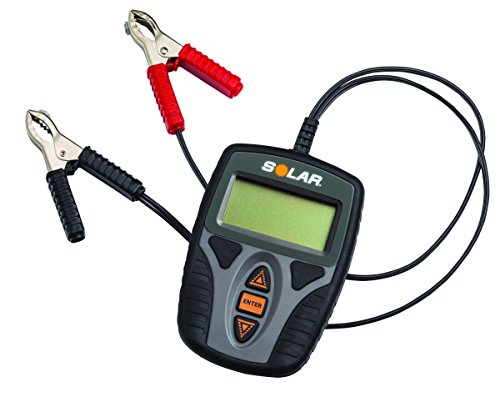
The Clore SOLAR BA9 is one of those tools that’s been on shop benches so long that some techs won’t switch. It covers 40-1200 CCA (Cold Cranking Amps, the rating that tells you how much current a battery can deliver in cold weather), runs from 7-15V, and reads flooded, AGM flat plate, spiral, and gel batteries, which covers most of what a typical garage sees. The screen was designed to read clearly under shop fluorescents, which sounds trivial until you’ve squinted at a tester in a dim garage.
Stacked against the newer TOPDON models, this feels old-school, and that’s its charm. It skips the printer and 6V mode but does the core job without fuss. For someone who wants a tester they can leave plugged in and trust for years, the BA9 still earns its spot.
Where It Helps
- 40-1200 CCA range covers most passenger vehicles and light trucks.
- LCD designed for visibility across bright shop lighting.
- Compatibility with flooded, AGM, spiral, and gel cells broadens its usefulness.
Honest Caveats
- No 24V mode, so heavy-duty trucks are out of reach.
- Lacks the on-board printer seen on newer TOPDON units.
Best Suited To
Longtime pros and garage loyalists who prefer a proven, no-frills tool over feature-packed newcomers.
Not Your Match When
If your household includes a diesel truck that demands 24V testing, the TOPDON BT600 Plus handles that workload better.
The BT100 is a friendly starting point for someone who has never owned a dedicated tester. It walks you through state of health, state of charge, voltage, and cranking status without burying you in menus. Most home users care about exactly those numbers, and this one delivers them without ceremony.
Its 100-2000 CCA range covers a motorcycle battery on the low end and a heavy pickup on the high end, which is broader than its modest price suggests. Compared with the pricier BT300P, you give up the printer and the 24V mode, but for a 12V daily driver, that’s a fair trade.
Practical Pluses
- Wide chemistry support including AGM flat plate, AGM spiral, EFB, and gel.
- 100-2000 CCA range handles everything from a small ATV to a full-size truck.
- Clean interface that’s approachable for first-timers.
- Compact enough to stash in a glove box or small drawer.
Trade Offs
- 12V only, so no heavy-duty truck testing.
- No printed record capability.
Who Will Love This
First-time owners and home garage hobbyists who want a simple, dependable read on a 12V battery.
Skip It When
You’ll find the Veepeak a stronger value if you also want alternator ripple readings.
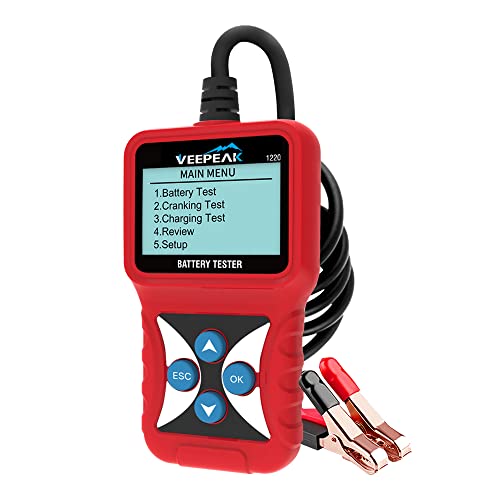
The Veepeak tester punches above what its price tag suggests. It reads state of charge, state of health, voltage, internal resistance, and CCA, but the standout trick is its alternator diagnostics: ripple, loaded voltage, and unloaded voltage. That last one catches a dying alternator before it strands you, which is a real-world ownership benefit most budget tools skip.
Versus the BT100, the Veepeak leans more toward alternator health than chemistry variety. For a single-car household, the depth in charging diagnostics often matters more than the broader chemistry list. It’s a slightly different tool for a slightly different mindset.
The Practical Payoff
- Ripple testing helps catch alternator diode problems early.
- 100-2000 CCA range suits cars, trucks, motorcycles, boats, ATVs, and RVs.
- Internal resistance reading flags weak cells before they fail outright.
- Approachable for someone testing a battery for the first time.
Minor Gripes
- 12V only, no support for 24V systems.
- Screen visibility in direct sunlight is less forgiving than pricier units, depending on where you work.
Perfect Match For
Casual DIYers who want alternator diagnostics on a budget.
Where Another Pick Suits Better
If you run mixed vehicles including a motorcycle and an RV, the ANCEL BA101PRO covers heavier-duty systems with a sharper display.
The BA101 Plus stretches from 20-2000 CCA, which is unusually broad for the category. On the low end, it reaches small motorcycle batteries; on the high end, it covers large truck batteries. Add 6V support and you’ve got a tool that handles the whole driveway.
Compared with the original BA101 covered later, this Plus model picks up 6V testing and wider chemistry support, including AGM spiral. For multi-vehicle households, it’s often the only tester you actually need. For a single commuter, you may not use half its range.
What Makes Sense
- 20-2000 CCA range covers small powersports batteries and full-size trucks alike.
- 6V and 12V modes broaden its usefulness.
- Reads CCA, voltage, internal resistance, SOH, and SOC in one pass.
Points To Keep In Mind
- No 24V support, so heavy-duty commercial trucks are out of range.
Feature Card
Right Fit For
Multi-vehicle households with a mix of powersports, daily drivers, and older classics.
Reach For A Different Pick When
Owners running a 24V commercial truck should look at the TOPDON BT600 Plus instead.
The BA101PRO is built for vehicles that earn their keep. Trucks, RVs, boats, and heavy-duty machines live and die by their electrical systems, and this tester targets them specifically. The 2.8-inch color display is a meaningful upgrade over older monochrome units, especially in dim engine bays where small digits vanish.
It reads 100-2000 CCA, supports flooded, AGM flat plate, AGM spiral, gel, and EFB, and handles both 12V and 24V systems. Compared with the BA101 Plus reviewed earlier, you trade 6V support for 24V support and a sharper screen. For most cars that’s irrelevant. For an RV owner, it’s the entire point.
What Helps Most
- 12V and 24V coverage handles heavy trucks and RVs alongside cars.
- Color display remains readable in low light engine bays.
- Cranking and charging tests isolate whether the battery or the alternator is failing.
Small Caveats
- Heavier than pocket-sized testers, so portability between vehicles takes a small effort.
- 6V batteries aren’t supported, so vintage vehicles still need another option.
Whose Shelf It Belongs On
Truck, RV, marine, and heavy-equipment owners who service large batteries on a regular basis.
A Better Fit Elsewhere
If you only run a small 12V car and want a tidier result with a paper trail, the TOPDON BT600 brings a built-in printer instead.
The original ANCEL BA101 has earned a long track record, and there’s something reassuring about a tool that’s been in service for years. It covers 100-2000 CCA, runs SOH and SOC checks alongside voltage and current, and adds cranking and charging diagnostics. For someone who values proven reliability over the newest features, it’s a sensible anchor.
Compared with the BT100 covered earlier, this one trades TOPDON’s interface polish for ANCEL’s broader real-world footprint. Long-term owners tend to keep these around long after they’ve upgraded other tools, which says a fair bit about the build.
What It Does Well
- Tracks SOH, SOC, voltage, current, and CCA in a single pass.
- Cranking and charging tests help diagnose hard-start complaints.
- Works across cars, trucks, boats, RVs, and marine vehicles.
Areas To Watch
- 12V only, with no 24V support.
- Lacks the sharper color display seen on the BA101PRO.
Built With In Mind
Long-term home mechanics who prefer a familiar design that’s been field-tested for years.
Look Elsewhere When
You run a fleet with mixed voltages; the ANCEL BA101PRO adds 24V capability with a brighter screen.
The BC100 is the practical middle child of the TOPDON lineup. It tests 12V batteries across every common lead-acid chemistry, including regular flooded, AGM flat plate, AGM spiral, gel, and EFB, with a 100-2000 CCA range. It runs battery, cranking, and charging tests in a single pass, which is essentially the holy trinity of what most owners ever need.
Against the BT100, the BC100 leans toward newer vehicle coverage, especially start-stop cars with EFB batteries. For most home mechanics, the differences are subtle, but the BC100 is the better long-term buy if your household runs a recent model.
The Helpful Details
- Chemistry support spans regular flooded, AGM flat plate, AGM spiral, gel, and EFB.
- Cranking and charging tests isolate the failing component.
- Sized for daily-driver diagnostics rather than shop use.
Practical Considerations
- No 24V mode limits heavy-duty use.
- No on-board printer for paper records.
Who Should Grab It
General-purpose home diagnostics for a household that drives modern vehicles with start-stop systems.
Another Choice May Suit
If you also want alternator ripple readings, the Veepeak covers that ground more directly.
The BT600 is what happens when TOPDON stretches the BT300P’s idea further. It bumps the screen to 3.5 inches, adds conductivity-based testing for more accurate readings, and keeps the printer that customers and shop owners tend to appreciate. It’s the more grown-up sibling of the BT100, with both 12V and 24V coverage for trucks and equipment.
Against the BT600 Plus covered earlier, this version skips the 6V mode and resistance sequence tests, but in exchange, you often pay less. For someone running a mixed garage without vintage 6V vehicles, the BT600 hits the sweet spot of features, screen size, and price.
Points In Its Favor
- 3.5-inch screen is easier to read at arm’s length than smaller displays.
- Built-in printer creates a tangible record for customers or service logs.
- 12V and 24V support reaches cars and light trucks.
Things To Weigh
- No 6V mode, so classic batteries need a separate tool.
- Consumable thermal paper adds a small ongoing cost.
Best Suited To
Technicians who hand printed test results to customers and want a larger, easier-to-read screen.
Swap It Out When
Classic vehicle owners are better served by the BT600 Plus, which adds 6V testing alongside the same printing.
Choosing a 12V Tester That Actually Matches Your Garage
The first decision is voltage coverage. Most passenger vehicles run 12V, but if you also own a diesel truck, an RV, or any commercial equipment, 24V support matters. Conversely, if you restore a vintage motorcycle or classic car, 6V is the mode you’ll actually use most.
Chemistry coverage comes down to what you drive. Most cars sold in the last decade use either standard flooded, AGM (Absorbent Glass Mat, a sealed battery with fiberglass matting that holds the acid), or EFB batteries for start-stop systems. A tester that lists those chemistries will give you the most accurate reading, since each type has slightly different internal resistance baselines.
CCA range sets the practical floor and ceiling. A motorcycle battery might be 150 CCA, while a heavy truck battery can push past 1500. A range of 100-2000 CCA covers nearly every vehicle a household will own. If you have a deep-cycle (a battery designed for steady, long-duration power rather than short bursts) boat or RV battery, double-check the chemistry support before assuming compatibility.
Finally, think about cranking and charging tests. A battery can show full SOC and still fail under load. A good tester simulates that load through a small resistance measurement, which is what makes the difference between guessing and knowing. For most home users, this is the single feature that turns a $20 voltage meter into a genuinely useful diagnostic tool.
Pitfalls and Premium Tradeoffs
Common Buying Slip Ups
The easiest mistake is buying a tester rated only for a narrow CCA window. A unit that tops out at 500 CCA works fine on a sedan, then surprises you when you finally test the truck. Equally common is ignoring chemistry support: a tester that doesn’t list your battery’s chemistry will return readings that look plausible but don’t reflect the battery’s true state. Before clicking, confirm the unit lists your exact battery type on its spec sheet.
What The Higher Tier Buys
Spending up typically gets you a built-in printer, a sharper color display, and wider voltage coverage. For a single-car household, those extras feel like overkill. For a shop, a busy hobbyist, or anyone managing multiple vehicles, they pay for themselves in saved trips to the parts store and cleaner customer-facing records. The honest read is that mid-tier testers serve most home users well, while the higher tier makes more sense once you’re testing batteries weekly rather than occasionally.
Frequently Asked Questions
Do 12V battery testers actually work on completely dead batteries?
Most need a minimum residual voltage, often around 7-8V, just to power up and communicate with the battery. A truly dead battery at zero volts may need a slow charge before any tester can read it.
How often should I test my car’s battery?
Twice a year is a reasonable cadence, ideally before summer heat and winter cold, since both extremes stress lead-acid chemistry. Owners of vehicles that sit for weeks at a time benefit from monthly checks.
Will a 12V tester hurt my car’s electronics?
Quality testers draw only a tiny load during testing, far below what the headlights or stereo draw. As long as you follow the included instructions and don’t attempt to crank the engine while connected, the risk is minimal.
Can one tester handle multiple battery types?
Most modern testers cover flooded, AGM, gel, and EFB chemistries in one device. The trick is selecting the right chemistry in the menu before running the test, since each type uses different internal baselines.
Do I need a printer built into my tester?
Not really, but it’s useful. A printed receipt saves a step when documenting work for customers or your own records. For casual home use, a screen-only tester captures the same information.
Bottom Line
A good 12V tester pays for itself the first time it catches a weak cell before it strands you somewhere inconvenient. Match voltage coverage to your vehicles, confirm chemistry support on the spec sheet, and lean toward wider CCA range if your household owns anything larger than a compact car. The picks above cover most realistic ownership situations, so the choice comes down to whether you want a simple screen, a paper trail, or heavy-duty support.