Your router, modem, and home security cameras are useless the moment the lights blink. One short brownout can cost you a work-from-home meeting, a missed smart-home automation, or a gap in your security footage. A small uninterruptible power supply (UPS), basically a battery that sits between your wall outlet and your gear, keeps the Wi-Fi alive long enough to ride out flickers or shut things down cleanly. The eight picks below cover everything from compact single-router boxes to whole-workstation backups, with honest notes on where each one earns its keep.
The Shortlist At A Glance

CyberPower SL950U Standby UPS

APC 850VA/450W UPS (BE850G2)


APC BE650G1 650VA/390W
APC BR700G 700VA/420W
Shanqiu Mini UPS for Router
The Details Behind The Selections
The CyberPower SL950U is a slim standby UPS (a battery that only kicks in when wall power drops) that fits behind a media cabinet or under a desk without hogging floor space. Rated at 950VA (volt-amps, a measure of how much load it can handle) and 510W, it gives your router, modem, and a few low-draw devices enough runtime to ride out short blackouts cleanly.
Compared to the larger mini-tower APC BR700G later in this list, the SL950U trades some capacity for a low-profile shape and modern charging ports. You get a USB-C PD (Power Delivery) port alongside a USB-A port, which is handy if your phone or tablet shares the same power strip. Owners commonly appreciate the LED status indicators, which confirm wiring faults at a glance.
Positive Points
- Eight NEMA 5-15R outlets (the standard North American three-prong socket) split between battery-backed and surge-only banks
- Two widely spaced outlets accommodate bulky wall warts without blocking neighbors
- Five-foot cord reaches farther corners of the room without an extension
- USB-A 2.4A and USB-C 18W PD ports replace two chargers on your desk
- Simulated sine wave output (a stepped waveform that mimics pure utility power) protects sensitive electronics
Things To Consider
- Standby topology means brief transfer time to battery, so picky workstation gear may prefer line-interactive models
- Internal battery is user-replaceable only with compatible cartridges
Who It Suits Best
Anyone running a router-plus-streaming-device setup in a tight living room or den will appreciate the slim footprint.
Where Another Pick Suits Better
Power users running a full workstation should look at the CyberPower BRG1500AVRLCD2, which adds voltage regulation and more outlets.
APC’s BE850G2 is a compact brick-shaped UPS aimed squarely at the home office crowd. At 850VA/450W it sits comfortably above the CyberPower SL950U’s 950VA/510W output in capacity per outlet, but in a chunkier housing that prioritizes outlet count over slimness. Seven NEMA 5-15R outlets give you room for a router, modem, NAS (network-attached storage), and a desktop computer.
Two of those outlets are surge-only, meaning they pass through utility power but don’t tap the battery, so you save runtime for the gear that truly matters. For most mixed home setups, this split-bank layout avoids the awkward trade-off of choosing which plug runs on battery.
What Stands Out
- Five battery-backed plus two surge-only outlets let you prioritize critical gear
- Right-sized for router-plus-NAS combinations
- Compact brick form factor tucks behind a printer or filing cabinet
- Replacement battery cartridge widely available and easy to swap
Honest Caveats
- No USB charging ports, so phones and tablets need a separate charger
- Slightly heavier than slim-profile alternatives at this wattage
Made For
Remote workers running a router, modem, and NAS together will find this one of the most balanced single-unit choices.
Consider Something Else When
If you want fewer batteries and more outlets overall, the APC 850VA + 600VA Bundle spreads the same protection across two units.
This bundle pairs APC’s BE600M1 with the smaller BE425M to give you two separate UPS units running side by side. The idea is simple: spread your gear across two batteries so a single fault or aging cell doesn’t knock out everything at once. It’s a practical redundancy play that bigger single-unit boxes can’t match.
You place one unit near the router and modem in the living room, and the other near a desk or entertainment center. The source specifies clearly that the two units are designed to operate independently and should not be chained together. For shoppers prioritizing protection per dollar over a single sleek box, this split approach has real appeal.
What Pays Off
- Two separate batteries reduce single-point-of-failure risk
- Modest capacity per unit suits low-draw router and modem loads
- Physical separation lets you protect gear in two rooms
- Lower cost than premium single units with comparable VA totals
Points To Note
- Each unit covers fewer devices, so heavier workstation loads need a bigger box
- Two separate batteries means two eventual replacements down the road
- No consolidated status display, so you monitor two units independently
Best Suited To
Apartment dwellers or renters running a router and modem in one room and a small PC setup in another.
Not Your Match When
Anyone wanting one tidy box on a single desk should choose the APC BE650G1 instead.
Stepping up from the budget bundle, this pairing combines an 850VA/450W BE850G1 with a 600VA/330W BE600M1 for a combined 16 outlets across two chassis. The bigger 850VA unit alone offers nine NEMA 5-15R outlets (six on battery, three surge-only), while the 600VA companion adds seven more, with two USB charging ports on the larger box and one on the smaller.
Compared to the single APC BE650G1 later in this roundup, you trade a tidy one-box layout for genuine redundancy and far more plug space. In a home studio or workshop where monitors, docks, and a router all share one outlet cluster, that headroom prevents the awkward “which device do I unplug?” moment.
The Value In It
- Sixteen total outlets cover multi-device workstations and racks
- USB charging ports consolidate phone and tablet power
- Two independent units isolate failures across rooms
- Battery cartridges (RBC17 and similar) are widely supported
Room For Improvement
- Two units take up more shelf or floor space than a single tower
- Higher up-front cost than single-unit alternatives
- You manage replacement batteries for both chassis over time
Right Fit For
Home office power users, podcasters, and creators running multiple screens, audio interfaces, and a router off one wall circuit.
Skip It When
Anyone working with a single router and modem should grab the APC BE650G1 for a simpler one-box setup.
The CyberPower BRG1500AVRLCD2 is a mini-tower line-interactive UPS (a battery that actively boosts or trims voltage using a transformer, without switching to battery) with Automatic Voltage Regulation (AVR), which corrects minor brownouts and overvoltages without draining the battery. That matters in regions where the lights dim but don’t quite cut out, since standby UPS units would otherwise cycle the battery unnecessarily.
At 1500VA capacity it dwarfs the SL950U and supports a full desktop, monitor pair, and router at once. The LCD panel shows real-time load, estimated runtime, and input voltage so you can see exactly what’s happening during a brownout.
Everyday Wins
- AVR extends battery life by correcting small dips without engaging backup
- LCD display surfaces load, voltage, and runtime at a glance
- Simulated sine wave output handles sensitive PC and networking gear
- Higher VA headroom covers a router plus a full workstation
Worth Noting
- Larger footprint than the slim SL950U; needs shelf or floor space
- Premium pricing relative to standby-only units
- Heavier weight makes wall-mounting impractical
Who Will Love This
Anyone whose home sees frequent brownouts or voltage swings and wants a single box that handles the whole desk.
Look Elsewhere When
If you only need to back up a router and modem, the Shanqiu Mini UPS at the end of this list is a fraction of the size.
The BE650G1 is one of APC’s longest-running home UPS designs, and for good reason. At 650VA/390W it sits between the smaller BE425M and the larger BE850G2, with eight NEMA 5-15R outlets split evenly: four on battery, four surge-only. For most living rooms or small offices that balance feels just right.
Where the chunkier BR700G next on this list prioritizes extended runtime, the BE650G1 keeps a low, flat profile that slides behind a TV stand. The shape matters more than people expect, since a UPS that lives behind furniture only protects gear if it’s actually plugged in.
Standout Benefits
- Eight outlets handle router, modem, TV, and console in one place
- Replaceable battery cartridge (RBC17) extends unit life
- Low-profile chassis fits behind most media stands
- Established model with widespread parts and support
Trade Offs
- No native USB charging ports for phones or tablets
- Shorter runtime under heavy loads than the BR700G
- No LCD readout, so status info is limited to LED indicators
Feature Snapshot
Perfect Match For
Anyone building a one-box solution for router, modem, and entertainment gear in a single media cabinet.
A Better Fit Elsewhere
Home offices in regions with chronic long outages should look at the APC BR700G for longer runtime.
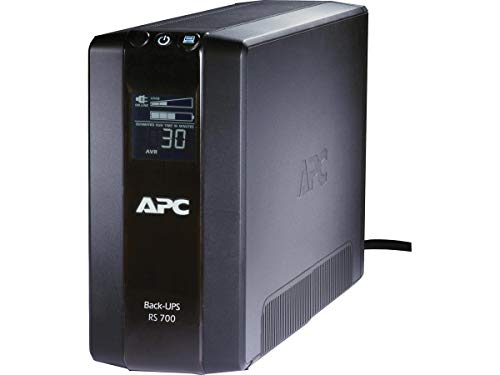
The APC BR700G comes from APC’s Back-UPS RS line, which targets poor-power regions where outages stretch into hours rather than minutes. At 700VA/420W with a focus on extended runtime, it shares capacity with the BE650G1 but pushes that energy out over a longer window under modest loads.
Compared to the BE650G1’s flat media-cabinet shape, the BR700G stands taller as a classic tower. The trade-off is footprint versus battery longevity, which matters most in rural or storm-prone areas where the lights flicker for an hour, not ten seconds.
Practical Advantages
- Higher-capacity cells deliver longer runtime for low-draw gear
- Built for repeated deep discharge cycles
- Surge protection covers data line and phone connections
- User-replaceable battery design extends total product life
Softer Spots
- Taller tower footprint takes more shelf space than flat-profile units
- Heavier chassis complicates wall mounting or repositioning
- Modest outlet count compared to bundle alternatives
Quick Facts
Built With In Mind
Suburban and rural households where the power company takes an hour to restore service after every storm.
Swap It Out When
City apartment dwellers with reliable utility power should choose the slim CyberPower SL950U to save space.
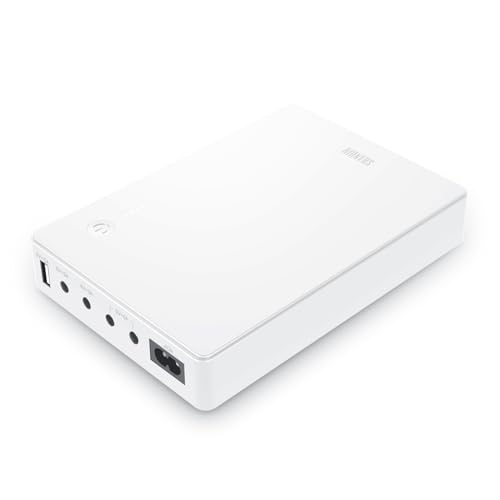
The Shanqiu Mini UPS is built for one job: keeping low-voltage DC devices alive when the wall power drops. With output ports at 5V USB, 5V DC, 9V DC, and 12V DC, it can feed a router, modem, security camera, or telephone without the bulk of a full AC UPS. The aluminum-alloy housing is small enough to mount behind a wall-mounted router.
Unlike every other pick on this list, this unit outputs DC (direct current) rather than AC (alternating current), so it only powers devices with matching barrel-jack or USB inputs. That limit is also the point, since skipping the AC inverter lets the unit stay tiny and silent.
Everyday Perks
- Tiny footprint fits behind mounted routers and cameras
- Multiple DC voltages cover most consumer networking gear
- Silent operation with no cooling fans
- Aluminum-alloy shell dissipates heat efficiently
Possible Compromises
- Cannot power standard AC plugs or PC equipment
- Maximum 60W output caps the number of devices it can feed
- Runtime depends heavily on device draw, and specific capacity isn’t listed in the source
The Right Fit
Anyone protecting a single router, modem, or security camera in a tight spot where a full UPS would be overkill.
Another Choice May Suit
Run a desktop alongside your networking gear and you’ll want the APC 850VA + 600VA Bundle for AC outlets.
Choosing The Right UPS Capacity For Your Network
Capacity ratings trip up most first-time shoppers. A UPS rated in VA handles roughly 0.6 to 0.7 times that number in real watts, so a 600VA unit covers about 360 to 420W of actual gear. Measure the watt draw of your router, modem, and any device you want to keep alive (the number is usually on the back of the power brick), then leave at least 25% headroom for surge events and battery aging.
Outlet layout matters as much as raw wattage. Look for split banks where some outlets are battery-backed and others are surge-only, so you can plug a desk lamp or printer into surge-only sockets without wasting battery runtime. Widely spaced outlets help if your cables use chunky wall transformers.
Match topology to your power quality. Standby UPS units are fine in cities with stable utility power. If your neighborhood sees frequent brownouts or voltage swings, a line-interactive model with Automatic Voltage Regulation like the CyberPower BRG1500AVRLCD2 corrects small dips without ever touching the battery.
Runtime is the honest trade-off. More VA means more minutes, but also a bigger, heavier, more expensive box. Routers and modems draw so little power that a small 600VA unit can keep them online for hours, while a desktop PC drains the same battery in minutes. Decide whether you need to keep working through the outage or just want your smart home and security cameras alive until the lights return.
Key Takeaways Across These Picks
Pitfalls Shoppers Hit
The most common mistake is buying a UPS based only on VA ratings without checking actual outlet count and configuration. A box with eight outlets but no split banks forces you to choose which devices run on battery, which often means the printer accidentally drains the runtime meant for your router. Look for at least two or three surge-only outlets to absorb non-critical loads.
Another trap is underestimating runtime for PC gear. A 650VA UPS that keeps a router alive for four hours may give a gaming PC only six minutes. Spec sheets typically list runtime at half load, so read the fine print before assuming a small box will power a desktop through a long outage.
When Paying More Pays Off
The jump from a basic standby UPS to a line-interactive model with AVR buys you battery longevity in poor-power regions. Every minor brownout that a cheaper unit would handle by switching to battery, a line-interactive model corrects silently with its transformer. Over years, that adds up to fewer charge cycles and a battery that still holds capacity when you finally need it.
Higher-capacity units also buy headroom. If you regularly add devices to your setup, monitors, external drives, a new printer, a bigger capacity box absorbs those additions without forcing a replacement. The CyberPower BRG1500AVRLCD2 represents that upgrade path for households that want one box to last a decade.
Frequently Asked Questions
How long will a UPS keep my router and modem running?
Most 600 to 850VA units keep a typical router and modem alive for two to five hours, since those devices draw only 10 to 20 watts total. Larger loads like desktop PCs drain the same battery in minutes.
Can I plug a power strip into a UPS to add more outlets?
Yes, but only into a battery-backed outlet, and only if the total draw stays below the UPS watt rating. Plugging a power strip into a surge-only outlet defeats the purpose of battery backup.
Do I need pure sine wave or is simulated sine wave fine?
Simulated sine wave works for most consumer networking gear, modems, routers, and basic PCs. Pure sine wave (a smooth, grid-matching waveform) matters only for sensitive equipment like some medical devices, high-end audio gear, or active PFC (Power Factor Correction) power supplies in workstations.
How often should I replace the battery inside a UPS?
Most sealed lead-acid UPS batteries last three to five years before capacity drops noticeably. Many models accept a replacement cartridge so you can swap the cell without replacing the entire unit.
Will a UPS protect against lightning strikes?
A UPS guards against most surges and grid events, but a direct lightning strike overwhelms any consumer-grade protector. For areas with frequent lightning, layer a whole-house surge protector at the breaker panel alongside the UPS.
Wrap Up
The right UPS depends more on your power environment than on specs alone. Stable city power calls for a small, slim box like the CyberPower SL950U or Shanqiu Mini UPS. Frequent brownouts or rural outages push you toward longer-runtime or line-interactive units like the BR700G or BRG1500AVRLCD2. Match capacity to what you actually plug in, leave room to grow, and your Wi-Fi will keep running long after the next storm rolls through.