A single power blip can fry a motherboard, wipe out hours of editing, or shut down a NAS mid-write. The picks below cover two real needs: clean surge protection for tool-heavy workbenches and shops, and genuine battery backup for computers, network gear, and home storage. Whether you’re protecting a workshop full of high-draw equipment or just trying to keep your internet and NAS alive through a storm, there’s a fit here.
The Lineup, Simplified

CCCEI 12 Gauge Extension Cord with Multiple Outlets, 50FT

CCCEI 12 Gauge Extension Cord with Multiple Outlets, 100FT
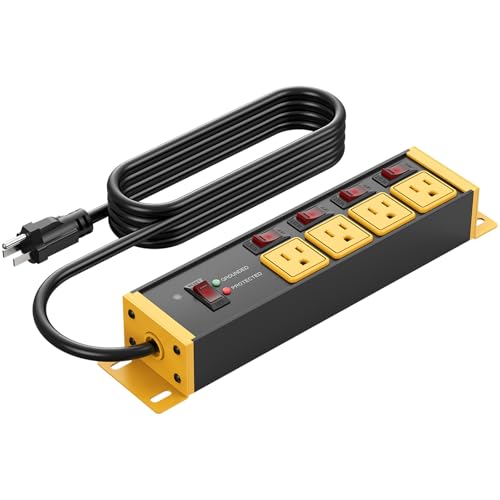
CCCEI 12 Gauge Heavy Duty Surge Protector, 6FT

CCCEI Magnetic Heavy Duty Surge Protector, 12 Gauge, 6FT

CCCEI 12 Gauge Heavy Duty Power Strip, GFCI, 8 Ports

CCCEI Heavy Duty Surge Protector with 20 Amp Switches

CyberPower CP1500PFCLCD PFC Sinewave UPS

UPS Mount 548 Heavy Duty Wall Bracket

APC BE600M1 and BE425M Battery Backup Bundle

UGREEN NAS UPS US3000 Battery Backup
The Picks, Examined More Closely
Workshop outlets rarely sit where your tools want to live, and that’s exactly where this CCCEI strip earns its keep. The 12-gauge, 50-foot cord reaches across a mid-size garage or shop floor without forcing you to daisy-chain thinner cables, and eight outlets mean a table saw, dust collector, and battery charger can share one safe hub.
For shop owners running high-draw tools on a standard 15-amp circuit, the dedicated circuit breaker is the quiet hero. Grounding protection adds a second layer against stray voltage. The flat plug sits flush against a wall, so the strip tucks neatly behind a workbench.
Positive Takeaways
- Eight outlets let you power a tool cluster from a single wall tap
- 12-gauge cord holds voltage steady across 50 feet
- Dedicated breaker lets you cut power fast without unplugging gear
- Flat plug hugs the wall for tight behind-bench placement
Trade Offs To Consider
- Bright yellow jacket shows scuffs and shop grime quickly
- No individual switches, so everything cycles together
- 50 feet may run short on larger jobsites or driveways
Whose Shelf It Belongs On
Workshop owners and home renovators running multiple power tools from one outlet.
Reach For A Different Pick When
The CCCEI 100FT strip suits you better if your tool cluster sits farther from any wall outlet.
When the only available outlet is on the far side of a driveway or jobsite trailer, a 100-foot run stops being a luxury and starts being a necessity. The CCCEI 100-foot version keeps the same 12-gauge build and eight-outlet hub as its 50-foot sibling, just stretched across a longer jacket for sprawling layouts.
The grounded three-prong plug and independent breaker carry over unchanged, so you’re not trading safety for reach. For contractors powering miter saws and air compressors from a distant garage tap, the extra 50 feet of headroom can be the difference between a smooth workday and constant replugging.
A Few Strong Suits
- 100 feet reaches across large yards, barns, and jobsites
- Same eight-outlet hub as the 50-foot model
- 12-gauge cable resists voltage drop across long runs
- Grounded plug and breaker protect distant equipment
Small Caveats
- Heavier to coil and store than shorter options
- Single master switch, no per-outlet control
- Yellow jacket stands out in tidy landscaped yards
Feature Snapshot
Best Suited To
Contractors, event crews, and homeowners running gear far from any wall outlet.
Skip It When
You mostly work at a stationary bench, where the CCCEI 12 Gauge 6FT strip is the tighter fit.
Not every wall needs a 50-foot cord. The CCCEI 6-foot strip targets benchside duty, where you want a compact hub for high-amp gear that lives in one spot. Four outlets paired with 20-amp capacity and per-outlet switches turn this into a control panel for a small tool cluster.
Wall-mount tabs let you fix the strip off the floor and out of the way, which helps in workshops where dust and foot traffic chew through anything left at ground level. The 5-20R and 6-20R outlet mix is a quiet win for owners running twist-lock or specialty plugs alongside standard three-prong gear.
What Stands Out
- Per-outlet 20-amp switches cut power to individual tools
- Wall-mount design lifts the strip off dusty floors
- Mix of 5-20R and 6-20R receptacles fits specialty plugs
- 6-foot 12-gauge cord keeps voltage steady on bench circuits
Things To Consider
- Only four outlets, so expansion needs a second strip
- 6-foot cord may need an extension on larger benches
- Yellow finish can clash with finished interior spaces
Key Product Details
Right Fit For
Woodworkers and metalworkers running a tight cluster of high-amp bench tools.
A Better Fit Elsewhere
The CCCEI Magnetic Heavy Duty Surge Protector suits you better if your bench is steel and you want tool-free mounting.
Steel workbenches, tool cabinets, and the side of a metal shelving unit all become instant mounting spots thanks to the rare-earth magnet on the back. The CCCEI magnetic strip solves a small but persistent annoyance: where do you put a power strip in a metal-heavy shop without drilling more holes?
You still get the four-outlet, 20-amp build from the non-magnetic sibling, plus a master switch that kills everything at once when you sweep up for the day. The 6-foot, 12-gauge cord stays put under load, so the magnetic mount does not have to fight a swinging cable.
The Upside
- Magnetic mount clings to any iron surface, no drilling
- Master switch kills all four outlets in one motion
- 20-amp capacity supports heavier shop tools
- Orange jacket is easy to spot in a cluttered shop
Honest Caveats
- Magnet is useless on wood, plastic, or stone benches
- Four outlets is tight for larger tool setups
- Master switch means no per-outlet control
Made For
Metal-shop and garage owners who want tool-free, repositionable outlet placement.
Look Elsewhere When
The CCCEI 6FT Heavy Duty Surge Protector fits better if your bench is non-magnetic and you need per-outlet switches.
GFCI, or Ground Fault Circuit Interrupter, protection cuts power the instant it senses current leaking to ground, which is exactly what you want near water. The CCCEI 8-port GFCI strip brings that safety into a workshop, basement, or outdoor kitchen where standard outlets leave you exposed to ground faults.
Eight outlets give you room for a sump pump, work lights, and a couple of tools without stacking power cubes. Overload and grounding protection sit behind a 20-amp switch, and the heavy 12-gauge cord stays cool under sustained load. Owners commonly find the gray finish easier to blend into finished spaces than the bright yellow siblings.
The Practical Payoff
- GFCI protection cuts power fast on ground faults
- Eight outlets support multi-device zones
- 12-gauge cord stays cool under full draw
- Neutral gray finish fits finished basements and kitchens
Small Limitations
- Single master switch cycles everything together
- GFCI resets sit on the strip, not at the outlet
- 6-foot cord may need an extension in large rooms
Quick Facts
Who Should Grab It
Homeowners protecting sump pumps, basement gear, and outdoor kitchens from ground faults.
Not Your Match When
The CCCEI Heavy Duty Surge Protector with 20 Amp Individual Switches suits you better when per-outlet control matters more than GFCI.
Few things are more annoying than shutting off a bench light just to kill a dust collector. The CCCEI 20-amp strip puts a switch on each of its four outlets, so you can idle one tool without unplugging the rest. For mixed-use shops and busy kitchens, that kind of granular control changes daily routines.
GFCI protection, overload shutdown, and grounding round out the safety story, and the 6-foot 12-gauge cord keeps temperatures down even when all four outlets are loaded. Owners commonly mount it on the side of a kitchen island or garage pegboard to keep counters clear.
Everyday Perks
- Four independent switches let you idle tools individually
- GFCI protection for wet-area or garage use
- 12-gauge cord stays cool under sustained load
- Standard 5-15P plug fits any standard home outlet
Points To Note
- Four outlets is tighter than the 8-port sibling
- Bright yellow housing can clash with neutral kitchens
- Switches add slight bulk to the strip body
Perfect Match For
Shop owners and home cooks who want to switch each appliance on its own schedule.
Where A Sibling Pick Shines
The CCCEI 8-Port GFCI Power Strip gives you more outlets and a quieter finish when individual switches aren’t critical.
Most cheap UPS units spit out a stepped, square-ish wave that some modern power supplies refuse to play nicely with. The CyberPower CP1500PFCLCD uses sinewave output (a smooth, rounded wave that mirrors what comes out of your wall), which matters for any desktop running active PFC power supplies. If you’ve ever had a PC refuse to boot off a backup battery, this is why.
Line-interactive topology means the unit actively corrects small voltage dips without draining the battery, which extends runtime when you actually need it. The color LCD panel surfaces load, battery level, and estimated runtime at a glance, so you are not guessing whether to save and shut down.
Key Advantages
- Sinewave output works with active PFC power supplies
- Line-interactive topology corrects minor dips on the fly
- Color LCD surfaces runtime, load, and battery status
- Mini-tower footprint fits under a desk or beside a workstation
Some Limits To Know
- Heavier and bulkier than a basic surge strip
- Battery is user-replaceable but not user-trivial
- Fan noise may be noticeable in a quiet bedroom office
Feature Rundown
Who It Suits Best
Desktop PC owners, content creators, and small servers needing true sinewave backup and clean shutdown time.
Consider Something Else When
The UGREEN NAS UPS US3000 is the tighter fit when your only load is a UGREEN NAS and you want compact DC backup.
A UPS on the floor collects dust, gets kicked, and blocks airflow. The Glitwing UPS Mount 548 lifts your backup unit off the ground and bolts it to a wall, desk side, or cabinet. That alone reclaims floor space in tight home offices and server closets.
The 16-gauge cold-rolled steel frame and powder-coated black finish suggest a bracket that will not flex under a loaded unit. For households with pets or kids, getting heavy battery gear off the floor also removes a tempting chew toy and a trip hazard. Owners commonly mount it next to a network rack to keep cables tidy and visible.
Useful Touches
- 16-gauge cold-rolled steel resists flex under load
- Powder-coated finish hides scuffs in a busy closet
- Vertical mounting saves floor space in tight offices
- Compatible with common APC Back-UPS footprints
Practical Considerations
- Requires wall anchors or studs for a secure install
- Best fit is for specific APC-style UPS shapes and sizes
- Mounting hardware selection is on the installer
Built With In Mind
Home office and small server room owners running a wall-friendly APC-style UPS.
Swap It Out When
The CyberPower CP1500PFCLCD is the better fit when you need the actual battery backup, not just a place to mount one.
Most people only need backup power in two places: the modem and router, and maybe a desktop or a smart hub. The APC BE600M1 and BE425M bundle ships two units designed to be used separately, so you can put one by your network gear and one by your workstation without buying anything else.
Setup is genuinely plug-and-play, with no software install required for basic surge protection and battery backup. Both units also include surge-only outlets for printers or accessories you want protected but not kept alive during an outage. For first-time UPS owners, that split design removes a lot of guesswork.
Good Reasons To Consider
- Two units cover two zones without buying twice
- Plug-and-play setup, no software required for basic use
- Mix of battery and surge-only outlets on each unit
- Compact wall-tap form factor fits behind furniture
A Few Limitations
- Limited runtime for full desktops, not just networking gear
- Units must be used separately, not daisy-chained
- No advanced LCD for runtime estimates
The Right Fit
First-time UPS owners protecting a modem, router, and one or two other small devices.
Another Choice May Suit
The CyberPower CP1500PFCLCD is the upgrade path for anyone running a full desktop with an active PFC power supply.
Standard UPS units output AC, which a NAS then converts back to DC, wasting energy and adding bulk. The UGREEN NAS UPS US3000 skips that round trip by delivering 120W of DC power straight to compatible UGREEN NAS units, keeping your storage alive through short outages without the heat and noise of a full-size UPS.
The 12,000mAh Li-ion battery gives your NAS enough runtime to finish writes and shut down cleanly, which is the real point of a NAS battery. Built-in surge, overcharge, overcurrent, and short-circuit protection mean a single compact brick covers most failure modes.
Where It Excels
- DC output skips the wasteful AC-to-DC round trip
- Compact, quiet design fits beside a NAS
- Multi-layer protection against surges and shorts
- Li-ion battery rated for long cycle life
Where It Is Less Suited
- Only works with select UGREEN NAS models
- Not compatible with DXP6800 and DXP8800 series
- No outlets for anything beyond a single NAS
Technical Highlights
Who Will Love This
UGREEN NAS owners with a supported model who want clean, quiet, compact DC backup.
Wrong Turns To Avoid
The APC BE600M1 and BE425M Bundle fits better when your network gear is mixed-brand and needs standard AC outlets.
What To Weigh Before Picking A Surge Protector Or Battery Backup
Start with what actually needs protecting. A shop full of high-draw tools wants GFCI (Ground Fault Circuit Interrupter) safety, 12-gauge cords, and 20-amp capacity, while a home office with a single desktop cares more about sinewave output and clean shutdown time than raw amps.
Cord length matters more than people expect. A 6-foot strip is plenty under a bench, but a basement or detached garage often demands 25 feet or more, and going longer than needed means more coil to store. Match the cord to the room, not the other way around.
Outlet count and per-outlet switches change daily habits. Four individually switched outlets let you idle one tool without unplugging the rest, while a single master switch on an 8-port strip is fine for always-on clusters like a server shelf.
For genuine battery backup, look at topology and waveform. Line-interactive units correct small voltage dips without burning battery, and sinewave output keeps modern active PFC power supplies (the kind inside most desktops built in the last several years) happy. Modified sinewave units cost less but can refuse to boot sensitive systems.
Safety certifications and GFCI matter in wet or outdoor zones. A basement sump pump, outdoor kitchen, or workshop with a wet saw all benefit from GFCI protection that cuts power the instant current leaks to ground.
Key Considerations Across These Picks
Common Shopping Slip Ups
The most common mistake is buying a basic surge strip for a desktop that needs true battery backup. Surge protection alone does nothing during an outage, and a five-dollar power strip with no battery cannot save work in progress. Match the gear to the risk: surge-only for tools that can be restarted, full UPS for anything holding unsaved work.
Another slip is ignoring outlet type. Specialty plugs like 6-20R do not fit standard 5-15R outlets, and adapters add resistance and failure points. Check what your tools and gear actually use before ordering.
Forgetting runtime is the third trip-up. A UPS rated for 1500VA might give a router 90 minutes but only five minutes to a gaming desktop. Always size for the device that draws the most power, and assume half the rated runtime in real-world use.
Where The Extra Money Goes
Higher-tier units earn their price in three places: cleaner output, longer runtime, and better diagnostics. Sinewave output costs more because it requires more complex inverter circuitry, but it is the difference between a UPS that boots a modern PC and one that doesn’t.
Larger batteries and better LCD readouts are the other upgrades. A unit that tells you exactly how many minutes you have left removes the panic of guessing during a long outage. For most households, those upgrades pay for themselves the first time a storm drags on for hours.
Frequently Asked Questions
What’s the difference between a surge protector and a battery backup? A surge protector only blocks voltage spikes; a battery backup (UPS) keeps devices running during a full power loss and protects against surges too.
Do I need sinewave output for my computer? Most desktops built in the last several years use active PFC power supplies and prefer sinewave output. Laptops and basic networking gear usually run fine on modified sinewave.
How long will a UPS keep my equipment running? Runtime depends on the load. A modem and router can ride out hours on a small UPS, while a gaming desktop might only get five to fifteen minutes on the same unit.
Can I plug one power strip into another? Daisy-chaining strips is generally discouraged because it stacks resistance and overload risk, and the inner strip’s breaker often never trips before the outer one.
Is GFCI protection the same as surge protection? No. GFCI cuts power on ground faults to prevent shock, while surge protection clamps voltage spikes to protect electronics. Wet zones benefit from both.