A pump-action sprayer is fine for one hedge. By the third refill, your wrist starts questioning every life choice that led you to the garden. Battery backpack sprayers fix that, letting you carry 2 to 6 gallons on your back and spray at the pull of a trigger. The trick is matching tank size, pressure range, and battery compatibility to the work you actually do, whether that’s a small flower bed or several acres of fence line. Below are nine picks that cover the most common scenarios, from compact weekend tools to commercial-grade rigs.
The Essentials At A Glance

FlowZone Typhoon 3 Battery Backpack Sprayer

Makita DUS158Z 18V LXT Backpack Garden Sprayer

EARTHCRAFT 2.6 Gal Battery Powered Backpack Sprayer

EARTHCRAFT 4.2 Gal Backpack Sprayer for DeWalt

EARTHCRAFT 5.3Gal Backpack Sprayer with Mixing System
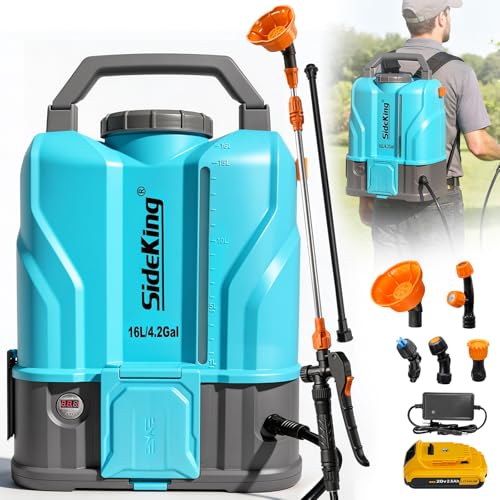
SideKing 4.2 Gallon 120 PSI Backpack Sprayer
Poxsmuly 5.3 Gallon 100 PSI Backpack Sprayer

PetraTools HD4000 Battery Powered Backpack Sprayer

SideKing 3.2 Gallon Electric Backpack Sprayer
Inside Each Recommended Option
The FlowZone Typhoon 3 arrives ready to work, with the 18V lithium-ion battery and charger tucked in the box. That alone removes the most common barrier to cordless spraying, which is buying a sprayer and then discovering you still need a battery. Once running, the unit pushes fluid up to 30 feet at its top setting and covers over 110 gallons per charge, enough for most homeowners to spray their entire property without stopping.
Five pressure settings ranging from 8 PSI (pounds per square inch, a measure of spray force) up to 115 PSI give you meaningful control. Low pressure works for delicate seedlings, high pressure for tree canopy or fence-line weed control. The padded ComfortStraps harness keeps weight distributed across your shoulders during longer sessions, and the threaded brass hose connector lets you disconnect without pulling off the front cover plate. Compared to the Makita DUS158Z covered next, this one ships as a complete kit rather than a bare tool.
Real-World Strengths
- Battery and charger included, so there’s no extra purchase before you spray.
- Five pressure settings from 8 to 115 PSI cover everything from seedlings to tall trees.
- Up to 30-foot spray distance at top pressure extends your reach without a ladder.
- Sealed internal electronics protect the pump from accidental splashes.
- Padded ComfortStraps reduce shoulder fatigue during longer treatments.
Things To Consider
- Rinsing the tank thoroughly after each use is the most common reported maintenance step to keep seals healthy.
- The 3-hour continuous runtime assumes light, intermittent spraying rather than constant full-pressure output.
Quick Facts
Who It Suits Best
Homeowners with medium to large yards who want a complete, ready-to-spray kit without buying a separate battery platform.
Consider Something Else When
You already own DeWalt 20V batteries and would prefer to skip the charger and battery altogether, in which case the EARTHCRAFT 2.6 Gal Battery Powered Backpack Sprayer makes more sense.
The Makita DUS158Z is built for landscapers and serious homeowners already invested in the LXT platform, which is Makita’s 18V battery system used across their cordless tool lineup. Slide in any LXT battery you already own, and the brushless motor delivers up to 0.5 MPa (megapascals, roughly equivalent to about 72 PSI) of spray pressure. That’s enough force for most weed-control and fertilizing applications, though less than the 115 PSI the FlowZone Typhoon 3 reaches.
The compact, lightweight design trades raw pressure for maneuverability. You can work a densely planted garden bed without the sprayer feeling like a tank on your back. The lock-on function reduces trigger fatigue during extended passes. Note that the battery and charger ship separately, so the true cost only makes sense for someone who already has LXT batteries on the shelf.
The Value In It
- Uses existing Makita LXT 18V batteries, removing the cost of a new battery platform.
- Compact and lightweight build suits maneuvering around flower beds.
- Lock-on trigger function reduces hand strain on long spray passes.
- Pro-grade Makita construction designed for daily commercial use.
Worth Noting
- Battery and charger not included, so first-time Makita buyers face a meaningful add-on cost.
- Lower max pressure than some competitors makes it less suited for tall-tree spraying.
- Capacity is smaller than the 4 to 6 gallon tanks offered by later picks on this list.
Right Fit For
Professionals and dedicated DIYers who already own Makita 18V LXT batteries and want a familiar, well-supported platform.
Look Elsewhere When
You need a battery included out of the box and want maximum pressure, in which case the FlowZone Typhoon 3 Battery Backpack Sprayer is the stronger all-around fit.
The EARTHCRAFT 2.6-gallon sprayer is built for users who already own DeWalt 20V batteries and want a small, manageable tank for quick yard work. At 2.6 gallons, it weighs considerably less than the 5+ gallon picks further down this list, which matters when you’re climbing ladders or working raised beds. The included low-voltage protection helps preserve battery health by shutting the pump off before the cells drop into damaging discharge territory.
Where this sprayer stands out is its built-in agitation system. An agitator is an internal mixer that keeps powdered or liquid concentrates suspended in the tank so they don’t settle and create uneven concentrations during spraying. That makes it a strong fit for soluble fertilizer and wettable powder applications. Compared to the larger EARTHCRAFT 4.2 Gal and 5.3 Gal models, this one trades capacity for portability.
Good Reasons To Consider
- Compatible with DeWalt 20V 2.0Ah batteries already on many shop shelves.
- Built-in agitation system keeps concentrate evenly mixed during use.
- Low-voltage cutoff protects battery cells from deep discharge damage.
- Compact 2.6-gallon tank reduces fatigue on short jobs.
Minor Gripes
- Smaller tank means more frequent refills on larger properties.
- Battery not included, so you need a DeWalt 20V pack to run it.
Made For
DeWalt 20V owners with small to mid-sized yards who value a lightweight, easy-to-carry rig.
Reach For A Different Pick When
You want a larger tank for extended spraying, in which case the EARTHCRAFT 4.2 Gal Backpack Sprayer offers similar compatibility with more capacity.
Step up to the 4.2-gallon EARTHCRAFT and you gain a meaningful amount of capacity without crossing into heavy-weight territory. The tank holds enough mixed solution to cover a typical suburban lot on one fill, while the DeWalt 20V compatibility keeps the battery side simple for anyone already running that platform. Low-voltage protection works the same way as the smaller EARTHCRAFT, preventing the battery from draining into a damaging range.
Like the 2.6-gallon sibling, this unit includes a built-in mixing system to keep wettable powders and liquid concentrates properly suspended. For homeowners who treat lawns, fence lines, and garden beds in a single afternoon, the 4.2-gallon tank hits a useful middle ground between the small EARTHCRAFT and the full-size 5.3-gallon version covered next.
Useful Touches
- 4.2-gallon capacity handles a typical yard in one fill.
- Built-in mixing system prevents concentrate from settling.
- DeWalt 20V compatibility for tool-shed integration.
- Low-voltage cutoff preserves battery longevity.
Points To Note
- Battery sold separately, which adds to the real cost for non-DeWalt households.
- Heavier than the 2.6-gallon EARTHCRAFT when fully loaded, so harness comfort matters more on long days.
Key Product Details
Best Suited To
Suburban homeowners with DeWalt batteries who want one fill to handle most weed-and-feed treatments.
A Better Fit Elsewhere
You want maximum capacity for multi-acre spraying, in which case the EARTHCRAFT 5.3Gal Backpack Sprayer with Mixing System gives you an extra gallon.
This is the largest of the EARTHCRAFT lineup at 5.3 gallons, and the inclusion of six spray nozzles turns it into a genuinely versatile rig. Different nozzles produce different droplet sizes and spray patterns, which matters for everything from a fine mist on seedlings to a coarse stream on stubborn weeds. Built-in agitation continues the EARTHCRAFT pattern of keeping wettable powders and concentrates in suspension.
At full capacity, you’re carrying about 44 pounds of liquid plus the unit itself, so a well-padded harness becomes essential. The DeWalt 20V battery requirement still applies, and low-voltage protection is built in. For homeowners with bigger properties, the trade-off of a heavier tank for fewer refills is usually worth it.
Bright Spots
- 5.3-gallon tank minimizes refill stops on larger properties.
- Six interchangeable nozzles cover a wide spray-pattern range.
- Built-in agitation for wettable powders and concentrates.
- Low-voltage protection preserves DeWalt battery health.
Honest Caveats
- Full tank weight adds up, so the harness quality matters more than on smaller picks.
- Battery sold separately, adding real cost for those without DeWalt tools.
Who Will Love This
Property owners with multiple acres or large gardens who want fewer interruptions for refills.
Swap It Out When
Your yard is smaller and a lighter tank would be easier to manage, in which case the EARTHCRAFT 4.2 Gal Backpack Sprayer is the more practical fit.
The SideKing 4.2-gallon unit stands out for one simple reason, which is battery flexibility. It works with both DeWalt 20V and Milwaukee 18V packs, a rare feature that makes it ideal for households with mixed tool platforms. At 120 PSI maximum pressure and a flow rate of up to 1.0 GPM (gallons per minute), it produces strong, consistent output suitable for taller trees and longer-distance spraying.
A built-in digital voltage display shows real-time battery level, which removes the guesswork of whether you’ll finish a tank on the current charge. The package includes five nozzles and two spray wands, so you can switch between mist and stream patterns without buying extras. Compared to the EARTHCRAFT 5.3Gal, this SideKing trades a smaller tank for higher pressure and broader battery compatibility.
Where It Helps
- Compatible with both DeWalt 20V and Milwaukee 18V batteries.
- 120 PSI max pressure handles taller foliage and longer reach.
- Digital voltage display prevents surprise battery drain mid-job.
- Five nozzles and two wands included for varied applications.
A Few Limitations
- Battery not included, so you need an existing pack to operate.
- Higher pressure uses more battery, so runtime per charge may be shorter than lower-PSI alternatives.
Feature Snapshot
Perfect Match For
Shops that run both DeWalt and Milwaukee batteries and want one sprayer that handles either.
Skip It When
You want maximum tank capacity and don’t need cross-platform compatibility, in which case the EARTHCRAFT 5.3Gal Backpack Sprayer offers more volume.
The Poxsmuly 5.3-gallon sprayer packs more accessories into the box than most rivals. Seven nozzles, a telescopic wand for reaching high branches or under low decks, and 100 PSI of working pressure make this a versatile pick for homeowners who tackle varied tasks across a single season. Battery swapping means you can extend runtime indefinitely by rotating charged DeWalt 20V Max packs.
The telescopic wand adds genuine reach for spraying fruit trees or the eaves of outbuildings without a ladder. Compatibility is DeWalt 20V Max only, which limits flexibility if your shop runs Milwaukee or Makita. For most DeWalt households, the seven-nozzle selection is more variety than you’ll ever use, but the extras don’t add meaningful weight and they’re there when needed.
Reasons It Performs
- Seven included nozzles cover virtually every spray pattern you might need.
- Telescopic wand extends reach for trees and elevated areas.
- 5.3-gallon capacity handles big yards in one fill.
- Battery swap workflow extends runtime indefinitely with charged spares.
Practical Considerations
- Limited to DeWalt 20V Max batteries, no Milwaukee or Makita cross-compatibility.
- Battery not included, so factor in a DeWalt pack if you don’t already own one.
Built With In Mind
DeWalt homeowners who want maximum nozzle variety and telescopic reach in one package.
Not Your Match When
You need cross-platform battery support, in which case the SideKing 4.2 Gallon 120 PSI Backpack Sprayer handles both DeWalt and Milwaukee packs.
The PetraTools HD4000 is built for users who measure output in acres, not square feet. The upgraded 9AH battery (amp-hours, a measure of battery capacity) delivers 8 to 10 hours of runtime and covers 250+ gallons per charge, enough for a full day of commercial spraying without a recharge. That’s a meaningful jump from the 2 to 3-hour runtime common to many competitors, and the steel-reinforced spray pistol feels substantial in the hand.
The package includes a stainless steel wand for chemical resistance, a 20-foot extended reach hose plus a standard 4-foot hose, two stainless steel fan nozzles, and sprayer gloves. Nine total nozzles round out the kit. For homeowners with very large properties, the runtime alone justifies the cost. Compared to the FlowZone Typhoon 3, this unit prioritizes endurance and premium components over portability.
Everyday Wins
- 8–10 hour runtime covers a full day of spraying per charge.
- 250+ gallon capacity per charge suits large properties.
- Stainless steel wand resists corrosion from harsh chemicals.
- 20-foot extended hose reaches far without moving the tank.
- Nine nozzles plus heavy-duty steel spray pistol included.
Trade-Offs
- Larger battery and premium components raise the price above most picks.
- Heavier rig when fully loaded, so fit and harness padding matter.
Whose Shelf It Belongs On
Landowners, ranchers, and commercial users who need all-day runtime and corrosion-resistant components.
Where Another Pick Suits Better
You have a smaller yard and don’t need 250+ gallons of runtime, in which case the FlowZone Typhoon 3 Battery Backpack Sprayer is a more accessible option.
The SideKing 3.2-gallon sprayer is the simplest entry point on this list. The rechargeable handle has the battery built in, so there’s no separate battery platform to manage, and the 7.4V motor with self-priming pump starts spraying with the press of a button. Three adjustable spray speeds give you some control without overwhelming a first-time user with too many settings.
A real-time battery level display on the unit takes the guesswork out of remaining runtime. The 40-inch telescopic wand helps reach hanging baskets and the underside of foliage. At 3.2 gallons, this lands between the EARTHCRAFT 2.6-gallon and 4.2-gallon models, making it well-suited to a small yard without the commitment of a larger rig.
Positive Takeaways
- Built-in rechargeable battery means no separate platform to buy.
- Three spray speeds offer simple, approachable control.
- Real-time battery indicator prevents mid-job surprises.
- 40-inch telescopic wand extends reach to hanging baskets.
- Five mist nozzles included for varied spray patterns.
Points To Keep In Mind
- Lower 7.4V motor delivers less pressure than 18V or 20V picks.
- Smaller tank means more frequent refills on larger properties.
Who Should Grab It
First-time sprayer owners with small yards who want a simple, self-contained unit without platform decisions.
Another Choice May Suit
You want higher pressure and longer reach for taller trees, in which case the SideKing 4.2 Gallon 120 PSI Backpack Sprayer delivers stronger output.
What To Weigh Before Choosing a Battery Backpack Sprayer
Pressure and Flow Rate
The pressure range, measured in PSI, determines what you can realistically spray. Lower pressures around 40 to 60 PSI handle lawns and ground-level weeds, while 80 to 120 PSI covers tall trees and distance spraying. Flow rate, measured in GPM, tells you how fast liquid leaves the nozzle. Higher GPM covers more ground per minute but drains the battery faster. For most residential use, 60 to 100 PSI with a moderate GPM strikes the right balance.
Tank Capacity and Runtime
Tank size directly affects how often you refill. A 2 to 3-gallon tank suits small yards under a quarter acre, while 4 to 6 gallons covers larger properties with fewer interruptions. Heavier tanks demand a well-padded harness, since you’ll feel every extra pound after twenty minutes. Battery runtime is the other half of the equation, and amp-hour ratings (Ah) roughly predict how long you’ll spray before needing a recharge or swap.
Battery Compatibility
If you already own a DeWalt 20V, Makita 18V, or Milwaukee 18V platform, choosing a sprayer that accepts those batteries saves real money. Tool-only sprayers typically cost less up front but require you to bring your own battery. For first-time cordless tool owners, complete kits like the FlowZone Typhoon 3 ship ready to spray with no extra purchases.
Nozzle Variety and Wand Reach
Different nozzles produce different droplet sizes and patterns, and the right one matters. Fine mist nozzles work for foliar feeding and delicate plants. Fan nozzles handle broad coverage of lawns. Stream nozzles reach tall trees and fence lines. A telescopic wand extends reach without a ladder, and a longer hose lets you leave the tank on the ground while spraying high or far. Pick the combination that matches the tallest and most distant things you plan to spray.
Key Considerations Across These Picks
Common Shopping Slip Ups
The most common mistake is choosing a sprayer based on tank size alone. A 5.3-gallon tank is useless without enough battery runtime to empty it, and a high-PSI sprayer with a small battery will die mid-fill. Match tank size, pressure, and battery capacity as a set, not separately. Another frequent oversight is overlooking battery platform compatibility. A cheaper tool-only sprayer ends up more expensive once you buy a battery and charger to run it.
Where The Extra Money Goes
Premium models like the PetraTools HD4000 spend the extra money on three things that matter under heavy use. Stainless steel wands resist corrosion from harsh chemicals. Larger amp-hour batteries deliver 8 to 10 hours of runtime instead of 2 to 3. Reinforced hose connections and brass fittings outlast the plastic-only components on entry-level units. For anyone spraying more than a few tanks per season, those upgrades pay back in fewer replacements and less downtime.
Frequently Asked Questions
How long does a battery backpack sprayer last on a single charge?
Runtime varies by model and pressure setting, but most cordless backpack sprayers run 2 to 3 hours of continuous spraying at moderate pressure. Higher-capacity rigs like the PetraTools HD4000 reach 8 to 10 hours thanks to a 9AH battery.
Can I use any brand of battery with these sprayers?
No, battery compatibility is model-specific. Some sprayers like the SideKing 4.2-gallon accept both DeWalt 20V and Milwaukee 18V packs. Others, like the EARTHCRAFT lineup, work only with DeWalt 20V. Always check compatibility before assuming an existing battery will fit.
What’s the difference between PSI and GPM?
PSI (pounds per square inch) measures spray pressure, or how hard the liquid leaves the nozzle. GPM (gallons per minute) measures flow rate, or how much liquid moves through the system per minute. Higher PSI reaches further and penetrates dense foliage, while higher GPM covers more ground quickly but uses more battery.
Do backpack sprayers need any maintenance?
Rinsing the tank thoroughly after each use is the most widely recommended step, especially after applying chemicals that could clog seals or nozzles. Periodically checking hose connections for tightness and inspecting the wand tip for buildup extends the life of the pump and spray pattern.
What tank size do I need for my yard?
For a small yard under a quarter acre, a 2 to 3-gallon tank is plenty. Mid-sized yards up to one acre benefit from 4 to 4.2 gallons, while larger properties benefit from 5+ gallons to cut down on refill stops. Bigger tanks also weigh more, so factor in harness comfort.
Bottom Line
The right battery backpack sprayer depends on your yard size, what you already own, and how often you spray. Compact 2 to 3-gallon models like the SideKing 3.2-gallon handle quick residential jobs, mid-size 4.2-gallon rigs balance capacity and weight, and high-end 5+ gallon units like the PetraTools HD4000 cover commercial-scale work. Match the tank and battery to your property, and you’ll spend your time spraying instead of pumping.